
Birdchick Blog
Nemesis Birds
UPDATE: The Duluth News Tribune joined us for part of the day and you can see our birding posse and learn more about Minnesota's boreal owl irruption here.

Nothing says winter in Minnesota like snow drifting into a port-a-potty.
I can't really do my Big Half Year fundraiser for the Friends of Sax Zim Bog without at least one trip to the bog. I knew I would get up there at some point this winter and I had made some plans with friends and then last week, things went a little nuts. A tiny owl called a boreal owl showed up in spades. One report from Chris Wood counted seven! Granted that this not on the scale with the great gray owl irruption of 2004/2005 but it's significant none the less...especially since this is somewhat of a nemesis bird for me (a bird I always seem to miss). I finally got to the point of not even chasing one since every effort to do so ended up with the classic phrase, "Oh it was just hear yesterday (or 15 minutes ago)..."
I figured one day I'd get one. Well, as plans solidified for my friends and I to head to Duluth and pay for the daily guiding services of Erik Bruhnke (a GREAT guide and worth every penny of his guiding fee, this is the second time we've used him). The reports of boreal owls were just too much and everyone in our group needed one for their list. The owls are mostly being seen between Duluth and Two Harbors, MN (and some right in Two Harbors). We asked Erik what our chances would be to go boreal. He said doable, but it would cut into our time for the bog. I thought to myself, "Do I want to get as many birds as possible for my Big Half Year or do I want to risk that number and get a lifer (and hopefully a photo of it) and have fewer birds for the day. We went for the boreal.

Erik told us that we would have to drive along Scenic Highway 61 which is usually a pretty, scenic highway right along Lake Superior...thanks to some snow and lack of plows, it was a bit slow going, which is great if you have eyes desperate for spotting an owl that's about 10 inches long tucked in the thick brush the same color it is. Also, note Erik in the above photo. It was 18 degrees and there he is, sweet as you please standing outside with out a coat and his sleeves rolled up. Northern Minnesota show off.

We creeped along slowly on the highway. As the minutes passed, our vehicle became more quiet--would we miss the owl? Were we wasting valuable bog time by going for a bird we wouldn't see? Was I jinxing everyone in the group by making an attempt for my nemesis bird? You know, the typical things that go through your mind when you decided to chase a bird.

Then blammo! We got one! The bird was actively hunting along the highway, not paying any attention to us at all while it flitted from perch to perch. And those of us with cameras were able to get photos.

I don't often get a chance to celebrate a life bird--especially in Minnesota, but when I do, I do it with 16 year old scotch!

What a treat to see this bird, we got to watch it fly, bob it's head trying to listen for something small an furry tunneling beneath the fluffy snow, posing in fabulous light, I felt 15 years of searching ease right off my shoulders. Whatever would happen the rest of the day was just gravy.
We did pursue a few more birds in and around the Duluth area before heading over to the bog. Of note was a snowy owl which was the weirdest snowy owl I've ever seen.

Is it me or does this snowy owl bear a resemblance to Hitler? This bird has been banded as well as marked with spray paint. As I understand it, banders have used spray paint to make sure they don't keep retrapping the same owl, because of the feathers on the toes and the bird's tendency to keep its feet hidden, it's hard to tell if a bird is banded. The spray paint can act as a sort of marker. But here is what I do not understand--note the number "8" on the wing? That's a patagial tag, a marker that allows you to know that the bird is already banded but you can actually id individual birds easily with a pair of binoculars. They are used on California condors, pelicans, old world vultures and turkey vultures. It seems to me that the patagial tag and the spray paint is a bit of overkill as far as trying to make sure you're not pestering the same owl.
The other thing that bothers me about this is that snowy owls use camouflage to hide form predators as well as prey. Does this muck it up? I normally side with banders on things, but fiddling around with a bird's camouflage makes me uneasy. Perhaps I would feel better if I could find some published information on this, but I can't seem to. I found one article from the 1960s about captive snowy owls that were spray painted to id some molt and then whole bunch of links about Martha Stewart spray painted owl stencils.
I'm currently at 56 birds for my Big Half Year, though that will change a bit in a few days. Thanks again to everyone who has pledged money to the effort to build a visitor center in the bog!
Win My Spotting Scope!!
This is the story of a girl and her spotting scope...
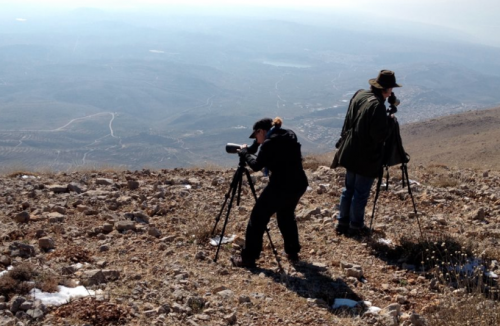
Oh, the adventures I have had with my Swarovski ATM spotting scope. It has literally traveled the world with me. We ascended Volcán Atitlánin Guatemala to see horned guans. We survived rigorous airport security in Kazakhstan to view breeding sociable lapwings on the Kazak Steppes. We got our lifer Syrian woodpecker outside a mine field on the Syria/Israel border. We even delighted in digiscoping tufted titmice at Neil Gaiman’s bird feeders. We’ve showered together when covered in sand and dust. In short: we have had a blast.
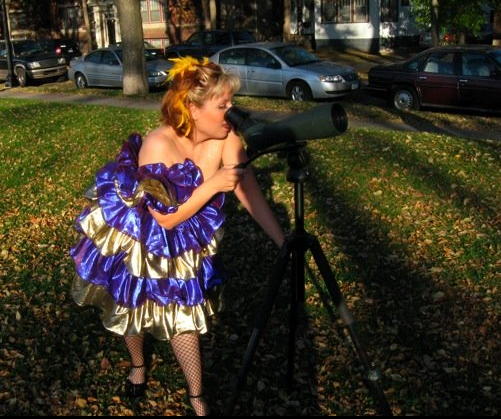
But, some partnerships must end and some things are so awesome, they should be shared. Swarovski hires me from time to time to teach workshops, test equipment and help out at booths. That means I need to have the latest equipment to take to events. When equipment changes, I have the option of purchasing the older equipment or I can send it back to Swarovski. With the debut of the new Swarovski ATX scope, it was time to change out my equipment.
This time I asked, “Hey, could I have a contest so one of my blog readers could get my scope and all the great birding mojo that has built up with it over the years?”
And Swarovski said, “Yes!”
So, anyone who reads my blog has a chance to win a FANTASTIC spotting scope. You will receive my ATM scope with 20 – 60 zoom eyepiece and my carbon fiber tripod (and I’ll even throw in my DCA digiscoping adapter). This is a scope and tripod that has been loved hard and used on a daily basis. I will send it in to Swarovski headquarters to get cleaned up before you get it (maybe Gail can finally get that heron poop stain off) and whoever wins it will also get the Swarovski Optik limited lifetime warranty with the scope. I love this thing, it has been such a wonderful birding companion and helped me id so many birds and I hope whoever wins it, gets the birds of a lifetime that I have gotten with it.

I really wanted to come up with a contest that would level the playing field. The logical thing would be a photo contest, but if you can get really great photos, you don’t need my scope. I want any birder of any age to have a shot at winning this magnificent, light-weight beast. I thought about a guest blogging contest but I know not everyone is comfortable writing, so Non Birding Bill and I kicked around ideas to figure out what would be something universal that anyone could do…and we landed on a contest that would truly level the playing field:
Birdchick’s WORST bird photo contest!
That’s right, kids, send me your worst bird photo: blurry, over exposed, under exposed, funny, weird, get creative. That’s right, I want to see the worst bird photo you can possibly take. There are any number of ways to do it, so you can go bonkers with this.
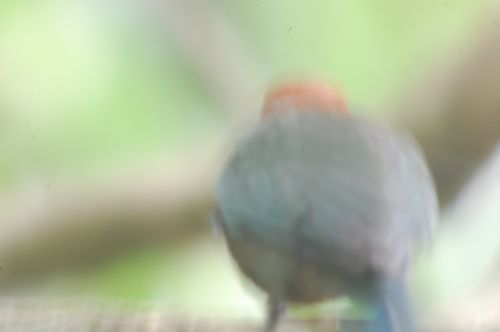
We will post our favorite images and then those that are selected as our favorites will be entered into a drawing and we will pick the winning name from that bank of entries!
Rules:
- Photo must be one that you have taken. You can’t just harvest a bad photo off of Wikipedia or Google Image Search. I have strong Google Fu and will find it if you do.
- Photo must be accompanied by a brief description or what you think the bird was that you were trying to photograph.
- Photos must be emailed to sharon at birdchick dot com.
- Photo submissions must include your first and last name in the email and your shipping address (so if you win, I know where to send my scope off to).
- Photos must be submitted no later than February 8, 2013. The winner will be drawn and announced on February 11, 2013.
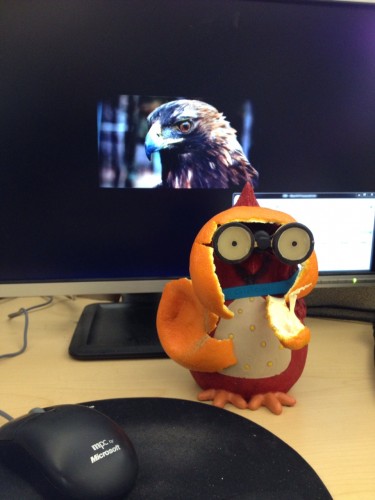
Don't be afraid to get creative! Good luck!!
Picking My Battles With Bird Photos
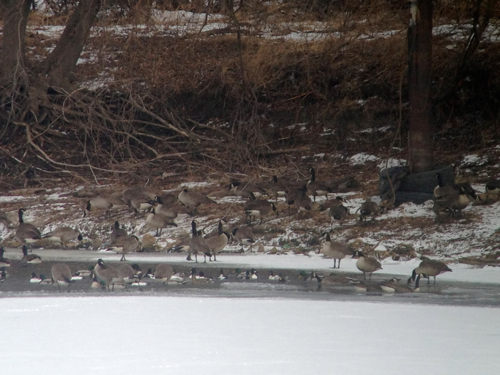
As I do my competition for the Big Half Year, I know this issue is going to come up again and again. Which photos to count? Above is a very mediocre or what I would call a documentation photo that I got at Pig's Eye Outflow in St Paul this week. There's identifiable common goldeneye in that shot...but would I get a better photo later. Who can say with my crazy schedule and migration. You really never know with birds and this may be as good as it gets goldeneye wise with me. I know my buddy Craig Nash is insisting that all my photos be in focus to be countable (unlike The World Series of Birding rules). But would the above photo count.
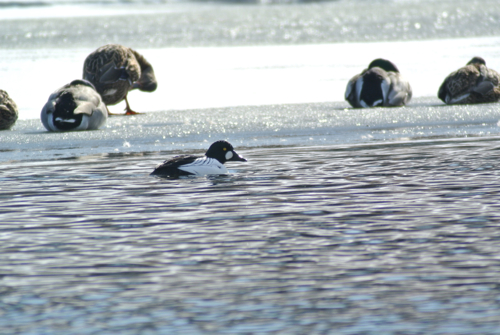 And then I went to Lake Rebecca in Hastings, MN and found a lovely albeit backlit goldeneye. I bided my time and worked my way around the lake to see if I could position myself to have the sun behind me instead of the goldeneye. When I do something like this, I try to walk in a way that the bird doesn't notice. I'll look in the opposite direction of the bird and even make sure that my scope's objective lens isn't facing the bird as I carry it. If I stared at the bird the whole time, the bird might become suspicious as to why I'm staring at it, I'd look like a predator.
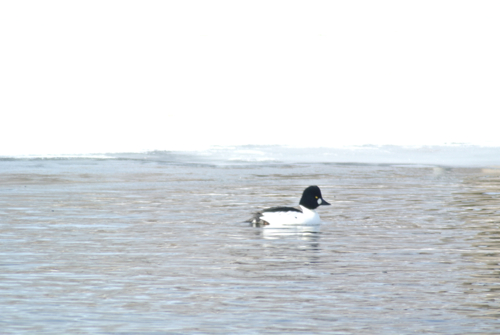
I eventually found a better position on the lake...but then the camera flaked out and under exposed the crap out of it. But a few adjustments in the settings and viola:
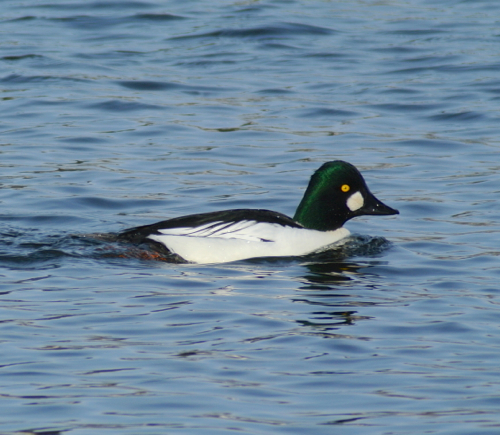
A reasonable common goldeneye photo and bird number 15 for my Big Half Year fundraiser for a Sax Zim Bog visitor center!
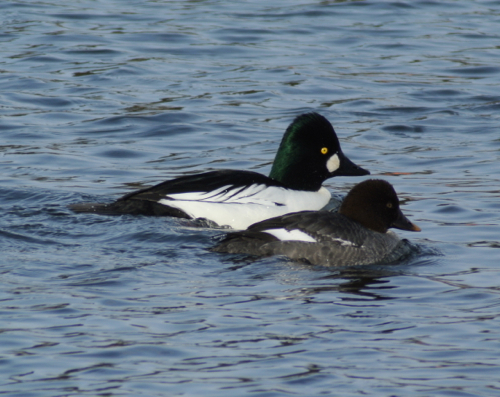
He even found a female goldeneye to hang out with on the lake.
This lake has a large population of mallards and Canada geese (and even a young trumpeter swan) hanging out. It's a popular town activity to bring your kids and a bag of corn or bread and feed everybody. I wonder if the goldeneye notice the mass exodus of waterfowl when a car pulls in and wonder what the fuss is about. These ducks are fish eaters so the corn and bread is wasted on them. But the goldeneye's presence is a good sign for ice fishermen who tempt fate on the frozen-ish side of the lake.
Here's a link to the Flickr and I cannot say this enough: thank you to everyone who has donated so far. I had absolutely no clue what I'd raise with this thing and seeing it past the $250 mark is an honor. With all the participants, the fund is already at 15%! That's fantastic--we have until June 30, 2013 to make the goal so to be at this point before the end of January--is fantastic!
Birds and Electrocution
Well I had two very interesting things hit my inbox that are somewhat related. One is kind of a gruesome photo but fascinating:
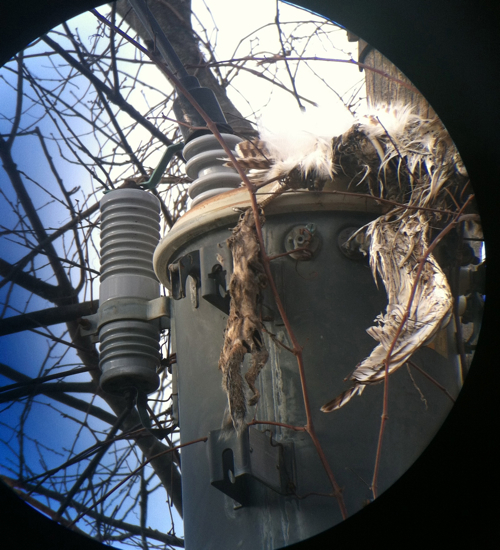
The above photo was taken by Lili Taylor (woman after my own heart, she takes pictures of dead stuff). In the photo, we have a dead squirrel and a dead raptor on top of a transformer. Based on the tail feathers, it looks to be a hatch year red-tailed hawk. It's a shame, the bird graduated from the nest, figured out how to hunt down tough quarry like a gray squirrel and then landed to eat it only to be electrocuted on a transformer.
I also got a notification that he U.S. Fish and Wildlife Service and the Avian Power Line Interaction Committee have released their updated guidance document Reducing Avian Collisions with Power Lines: State of the Art in 2012. This manual is supposed to identify "best practices and provides specific guidance to help electric utilities and cooperatives, federal power administrations, wildlife agencies, and other stakeholders reduce bird collisions." So it seems there are things that can be done to prevent this and it's up to the power company to take that initiative to make adjustments. I think in this case of the hawk on the transformer that you could try and call the power company to alert them so they could at least remove it and encourage them to maybe put a cover over it to prevent further electrocutions.
It's fascinating to follow some of those links. The APLIC offers workshops on this subject and you can even download a copy of an Avian Protection Plan (a working document that states with the risks are to birds and how to mitigate that). On page 30 it gets into construction guidelines.
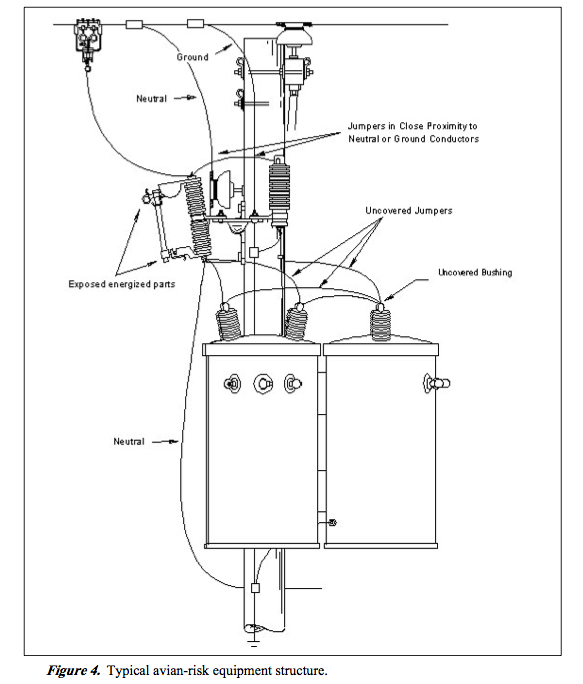
The document points out what the risk is to a bird landing on the transformer but also points out way that could fix it easily:
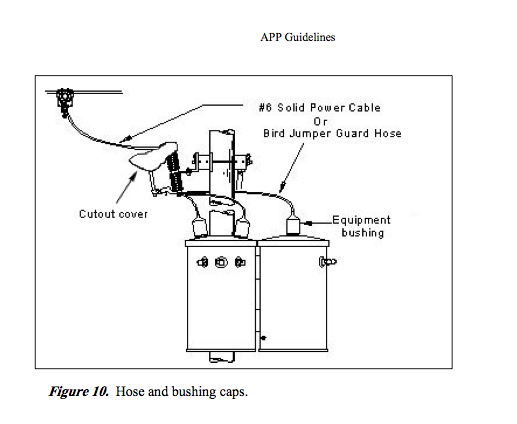
The hard part is tracking down the power company responsible for the transformer and getting them to come out and fix it. It's in their best interest to do so, they could be fined or something like this could lead to a costly power outage.
Another Day On The Job, Another Animal Part In The Tree
I honestly thought yesterday was going to be the strangest day on the particular job assignment I have here in the southern Midwest. It apparently wasn't quite over. Another day on the job, another day of animal parts in trees!
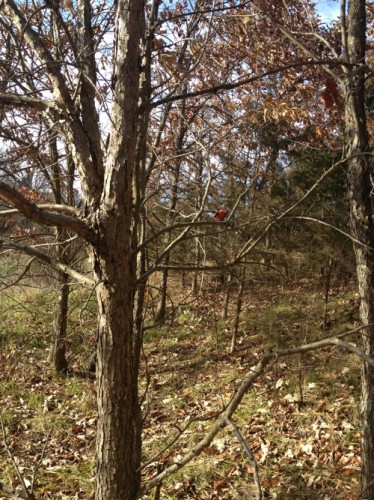
As I was walking my point, something in the trees caught my attention. Do you see anything? If you have colorblindness, you may not. Basically, I noticed a red bird not moving.
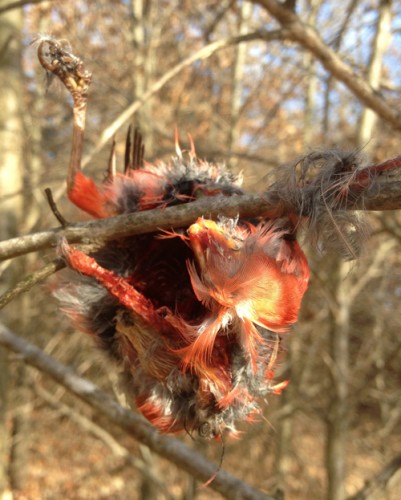
Closer inspection revealed an eviscerated male cardinal wedged and pinned to branch. I don't think this is a case of a sharpie or Cooper's hawk dropping some prey after eating from up high in a tree. The body of the cardinal was really wedged into the fork and hooked well on the branch. I suspect the body was cached here by a shrike, but dang on, shrikes are only 9 - 10" long and a cardinal is about 8.5" long. That's some fancy beak work to kill a bird that size. Since shrikes don't have the talons for gripping and killing that hawks and owls do, after they kill their prey with their beak, they try to wedge it into a branch or in the case of small prey, impale it on thorns or barbed wire as a larder for later or as a way to hold it still while they hack off strips of meat.


I imagine it was a nice meal for that shrike!
Kind of excited to see what sort of dead stuff I'll find in trees today!
Yes, I've Seen The Golden Eagle Attacks Kid Video. Yes, It's Fake
If you were not on social media last night, you may have missed this discussion. But if you are remotely into birds, especially birds of prey, someone will send you this video: WARNING IF WATCHING THIS AT WORK. THERE IS A SWEAR WORD.
http://www.youtube.com/watch?v=CE0Q904gtMI&feature=youtu.be
Yes. Fake.
And in case you still don't believe that this video is as authentic as Kenny Rogers's face, here's an article on the golden eagle attacks kid hoax video that identifies the makers of the video.

So, please everyone who keeps sending me an email or text saying, "I told you an eagle could grab a kid,"...stop.
Dead Stuff In My Office
FYI: No podcast this week. I got called away to work in Missouri for the week and well, we just don't like Skyping in for the Podcast. We'll be back next week. Also, kinda gross photos ahead.
I have a weird lifestyle. I don't often know where I'm going to be from day to day. Most recently that came to an extreme level when a quick phone call Wednesday afternoon turned in to me on the Illinois/Missouri border on Friday afternoon to help with a habitat survey.
As I travel, I frequently post to social media what I call Today's Office, which is basically a shot of what my outdoor office looks like that day. Often, it's beautiful.
Then there are these sort days like I had yesterday:

Look close...that's not a bird in that tree...I think it's some sort of way to let nature clean off of a deer skull. Apart from the weirdness of suddenly noticing a giant deer head with an amazing rack suddenly appear out of the branches like a magic eye puzzle is unsettling. But then you just tell yourself, "Oh, those hunters." And press on.
Then you find another one:

And you note the rotting and shuttered farmhouse surrounded by goats and how it looks like something Jason would live in on the property and think, "Maybe I'll step a little livelier on this survey."
But deer decapitation wasn't the only fun body parts I found in today's office!

My field partner called me over to see "something cool" and he's not as into birds shouted, "You have to see this, it's so cool!" And he was right. It looked like some sort of cache, possibly a fox had left a large, dark wing wedged into some trees. Hmmm, what could this be? I had noticed some large black feathers as we were walking and took mental note. I was trying to resist the temptation to explore the wing further because I have a completely different assignment to this survey and it doesn't involve CSI Special Bird Unit. But I couldn't help but take a photo and notice a familiar smell...mmmm...vulture. And I wondered given my location if it was black or turkey.

We soon found the rest of the carcass...yep, turkey vulture based on the light gray edging on the underside of the wing.

As if that weren't proof enough, we found the head!! And that totally sealed the deal for turkey vulture based on the nose opening--look how huge it is! Black vultures do not have the sensitive aroma sniffing abilities that turkey vultures have. Definitely a cool find and one of the things I love about my super wacky unpredictable schedule lifestyle.
I can neither confirm nor deny that this head is in a make shift field envelope tucked away in a back pack in my hotel room (yes, I do in fact have a permit if I did choose to pick up the decomposing vulture head). I'm more worried about recriminations that could be suffered when a particular cohabitant finds out.
TV Show Is Casting Birders!!
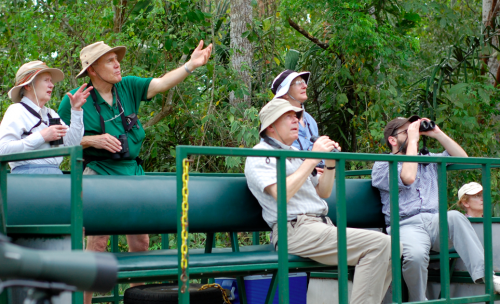
OK, kids, it's time to polish those bins and put on your Sunday best convertible pants! A national cable network is looking for birders to appear on a new television series about birding. If you are an avid birder – bordering on obsessive – we want you. You do not need to have a degree in ornithology or a book coming out (although if you do, we want to hear from you). Please send your contact information, a short description of your birding experience (where you bird for instance) and a photo (if you have one) to natgeocasting@gmail.com. (Please put “Bird” in the subject line.)
Send it now. Because, after all, the early bird... well, you know the rest. I personally hope that this morphs into an Amazing Race style show with Kenn Kaufman, David Allen Sibley, Richard Crossley and Lillian Stokes all sharing the same vehicle. But this is probably what we'll get:
The Lonely & Quiet Of Winter
I have been surveying the same patch for on and off for the last three years in southern Minnesota. I really enjoy watching how the patch changes during the seasons: seeing when certain birds arrive, listening to all the birds on territory, noticing when certain birds leave and when winter birds arrive.
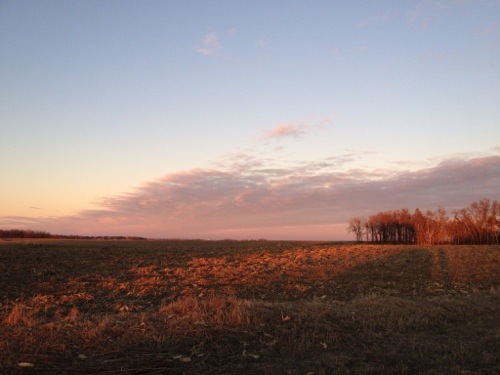
But every December I'm always surprised at how lonely I find myself during my many hours in the field. Oh sure there's still some crows and bluejays around and there are the bald eagles which I'm watching for but it's still so quiet compared to what it had been the several months previous.
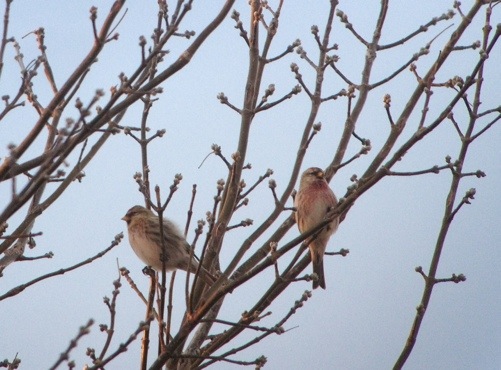
This year I'm getting a bonus. I've had such delights as the above common redpolls and a few white-winged crossbills too. And they're large flocks of Lapland longspurs all around and they're now being joined by large flocks of snow buntings. But these birds are predator wary and not like feeder birds. However, these birds are different. They are wary and distrustful of someone watching them. It's not like the birds that were singing on territory that were so focused on proving that they were the best male for breeding. These birds are constantly on the alert for predators. I don't blame them, I've seen plenty of merlins, northern harriers and Cooper's hawks around here even make me worry for their safety.
But combined with the wind, these fields are now a lonely place.
Because I Love Bird Camouflage
I was recently at the Rio Grande Valley Bird Festival in Harlingen, TX. If you can't tell by how often I talk about South Texas, it's one of my favorite places to visit not only for the birds, but also for the great friends I've made at the festival. Next year is the 20th Anniversary of the festival, it should be a wild time and if you have never been, you should have it on your bucket list.
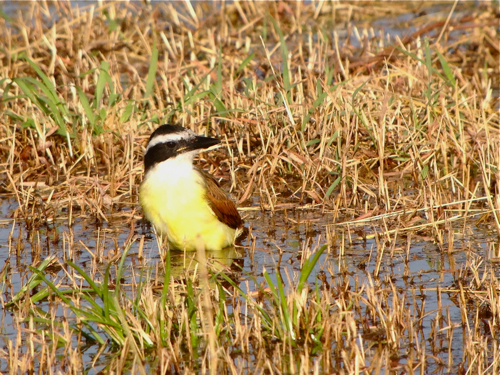
I have an odd checklist when I visit, I've seen almost everything I can possible see there but getting the key valley species as soon as I arrive is always fun (like the above great kiskadee). This time I went with a new friend that I made at the Biggest Week In Birding Festival in Ohio last May. She had never been to the valley so showing someone all those great Texas specialties for the first time is as fun for me as seeing them the first time.
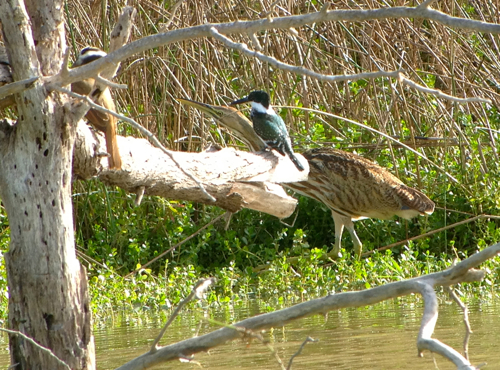
I could spend several days at Estero Llano Grande (and have) and this photo though not the best on the planet is a great cross section of the amazeballs birding that can happen. In one scope view I have green kingfisher, American bittern and great kiskadee. I ask you, where else would you get such a great birding trifecta in the same field of view? South Texas, it's hard to beat.
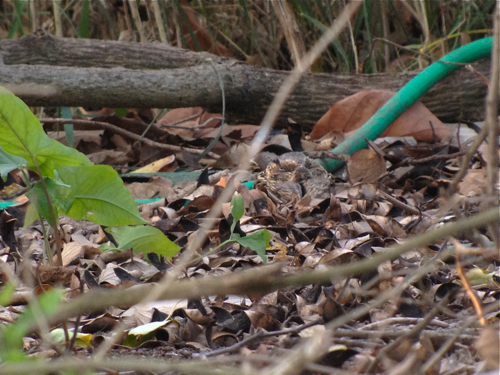
I swear there is a bird in the above photo.
Estero is where the nightjar known as the common pauraque is relatively easy to find. I've posted about their camouflage before. And though we were able to find them easily in that same spot, we were pointed out more parauques by field trip leaders that were hunkered down in yards of people who live next to Estero. There's one in the above photo...can you find it (even Non Birding Bill was able to find to find it in the photo).
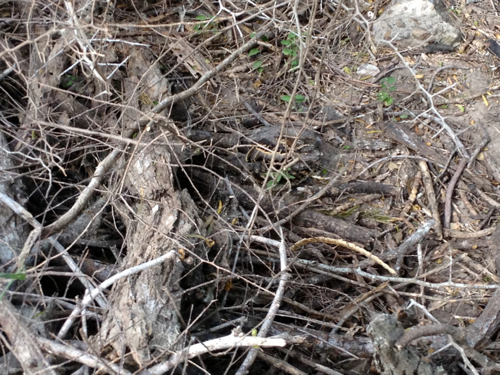
Yep. I swear there's a bird in the above photo too. That's the pauraque in the "usual spot" at Estero. There are actually about two or three in this spot (but only one in the above photo). I know brown birds aren't for everybody. I know that I can seem unreasonable in my love of things like native sparrows and pipits but you have to give it to pauraques as a brown bird. They at least stay in one spot for several hours to give you a chance to find them.
Digiscoped Images
Fresh Tweets
Would you like to hire me as a speaker for your event?
Email sharon@birdchick.com