
Lawrence's Warbler
I took a quick trip down to Indianapolis to visit my family. On the way, I made a stop at Mr. Neil's and got a big surprise. I went to the spot where blue-winged warblers have nested in the past and sure enough heard the familiar 2 note, buzzy call of a blue-wing. I was excited to see one, but when I got it in my binoculars I was surprised to see something golden-winged warbler-ish...it was a hybrid!
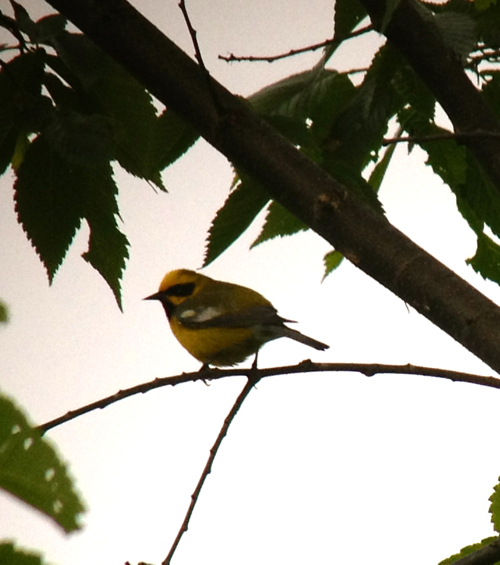
This is a Lawrence's warbler which is some sort of mix of blue-winged warbler and golden-winged warbler. These two species are known to hybridize, the more familiar hybrid is the Brewster's warbler. This bird really threw me for a loop because it sounded so much like a blue-winged warbler. Here's a video so you can hear what it sounded like (there's also a common yellowthroat singing in the background):
http://www.youtube.com/watch?v=4XffAG983LY&feature=youtu.be
I was kicking myself that I didn't wander the trail for bird watching until so late in the evening, I wished I had better light. I took both the photo and video with my iPhone through my scope...incidentally, I used the Meopix iScoping Adaptor to secure my iPhone to my spotting scope...more on that later.
I found an interesting article by by David Bonter and Irby Lovette on these two hybrids. It reads, "The most common hybrid form is known as a "Brewster's" warbler; the rarer form is known as a "Lawrence's" warbler. We currently believe that a "Lawrence's" warbler results when two "Brewster's" warblers mate, or when a "Brewster's" warbler backcrosses with one of its parent species, but research into the genetics of hybridization between these species is underway and many questions remain unanswered."
I haven't paid attention to this spot in the last few years because of my work and travel schedule. Did a golden-winged warbler mix it up with a blue-winged warbler? I can't imagine this bird coming to the exact territory where a blue-winged has nested in the past unless it hatched here. One thing is for sure, I'll be checking it more closely this year.
Here's a an article from the American Birding Association's Birding about the hybrids with lots of great photos.