
Birdchick Blog
Hummingbird Reminder
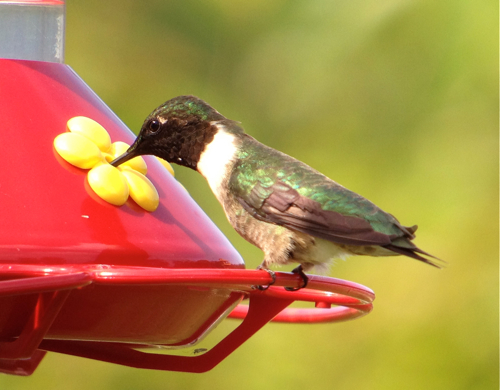 It's the time of year when I get hummingbird questions so I thought I would do a quick reminder about hummingbird nectar. Here is the recipe:
4 parts water 1 part table sugar (not honey, not corn syrup, not Splenda, not Stevia, no artificial sweetner)
Don't bother with red dye, it's not needed, could be harmful (we don't know for certain but it's best to err on the side of caution). Your feeder should be red enough to get the hummingbirds' attention.
Mix until the sugar is dissolved. One thing that I do is add in a little hot water from our tea kettle to the sugar, just enough to dissolve it. Once it's dissolved I add in cool water so the nectar won't be too hot and can go right in the feeder. You can make a big batch and store the excess in your refrigerator for up to two weeks.
Remember to keep the nectar in the feeder fresh. If you feeder is in direct sun, change the nectar every two days. If it's in the shade, change it every five days. If the nectar looks cloudy or if you see black on the inside of the feeder or around the feeder points--clean the feeder and change the nectar. A clean feeder is essential.
If the idea of keeping a feeder clean is daunting, use flowers to attract hummingbirds instead.
http://youtu.be/JhTSjgwKzUo
Warblers Eating Honey
I'm in a quandary with my beehives and my love of birds.

On my way out to the Horicon Marsh Bird Festival, I stopped at Mr. Neil's for a quick check of our new beehives and some birding. The warblers have arrived and the cool weather has forced those who arrive early in migration to search for alternate sources of food. Yellow-rumped warblers like these would prefer insects. Far too cool and far too few available, so the enterprising early migrants explored the bird feeders.

Despite the fact that Baltimore orioles are in the area and singing, none came to the feeders. Yellow-rumps gladly took advantage of the grape jelly.

The warblers even jockeyed for position at the suet feeder among the four species of woodpecker that normally feed here.

Pine warblers are also hitting the feeders. Whereas the yellow-rumps go for the suet and jelly, the pine goes for sunflower hearts. It will also go for the suet, but seems content to eat the seeds.

While I was working around the garage, I noticed Neil's groundskeeper Hans had put out some old bee frames. We do this so the bees from active hives will fly in and clean out the old honey. These frames were from the hives that died over the winter. The bees found it. While I was working around the garage, I noticed warbles hanging out in the area. At first, I thought the warblers were after the live bees and even said allowed, "I know you're desperate for insects, but you're far too small for eating bees."

Then, right about dusk when the honeybees were all tucked in their hives for the day, I noticed the warblers on the frames, pecking at them. The light was dim but thanks to the auto timer on my Nikon D40 I was able to digiscope a Nashville warbler and a yellow-rumped warbler on the frames.

Based on the holes in the frame it looked like the warblers were going for dead bees. Some of the frames had capped larvae that never hatched, so I figured the warblers were after the protein of old squishy non-hatched larvae. We had more frames of dead larvae and honey in the garage so I set more out. I figured the warblers could clean out the larvae and the bees could clean out the honey and help get a head start on their hives for the season.

The next morning when I went out for some birding, I checked the frames, they were covered in warblers. Above are two yellow-rumped warblers and one Nashville warbler. These were a small cross-section of about two dozen warblers waiting in line to feed off of my old beehive frames. There were at least four species in the flock, the above two and pine warblers and orange-crowned. I didn't get photos of the other two species, but got plenty of shots of the feeding frenzy.

Here are four warblers on one frame. As I took pictures and watched them feed, it became clear that old bee larvae was not the only sustenance they were after. They were very certainly eating honey. I had a moment of panic...should birds be eating honey? Honeybees are a fairly new species to North America, they came over with the early settlers. Warblers did not evolve with honeybees. Could they safely process honey and still migrate?

As I watched them I noticed that they tugged and chipped at wax foundation too. Is that safe? I've seen honeybees that have built comb out in the open on a bare branch, I remember seeing some abandon ones in Arizona and Texas...perhaps warblers have had exposure to this.

The air was so cold and their food scarce, I didn't want to take this source of food away if they were still trying to load up for their journey north. I couldn't find anything about it on the Internet other than not using honey as a means to make nectar. I wanted to plant myself in front of the frames all day long see how many species of warbler would come in but I had to go.

I also noted that as the sun got higher in the sky and our honeybees became more active, the bees didn't tolerate the warblers in close proximity and chased them off. A few warblers still came in for the bounty but not four on a frame like at dawn.

I'm not sure if this is a good thing but if the warblers figured honey out, no doubt other birds will and I don't know if they should. We already had one casualty of a tufted titmouse getting covered in honey while it explored some of our dead beehives. I'm going to have to seek out an avian nutritionist to find out if this is a safe thing to offer birds. If it is, this may be a new way to enjoy birds and bees and a new product to offer at bird stores.
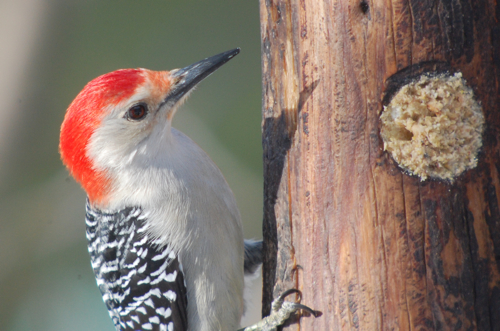 Male red-bellied woodpecker coming in for some suet dough.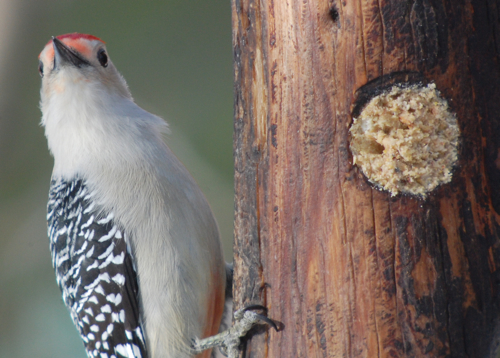
Siskins Are Moving
I went out to Mr. Neil's yesterday to deal with some of our beehives that died over the winter (it was a hard winter, lots of beekeepers lost hives, it's part of the hobby). While walking around outside, I could hear titmice singing territory song and then I heard a golden-crowned kinglet.
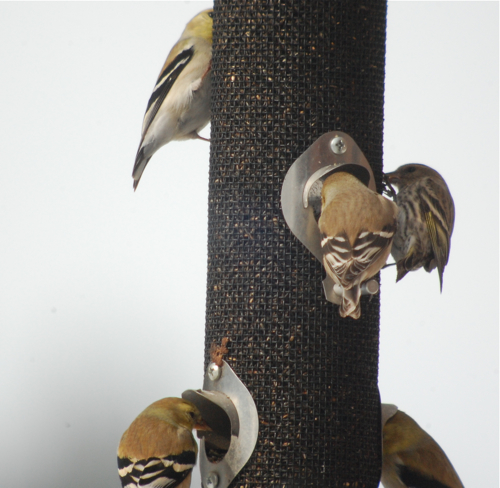
I looked out the window and among the goldfinches noticed someone a little streaky.
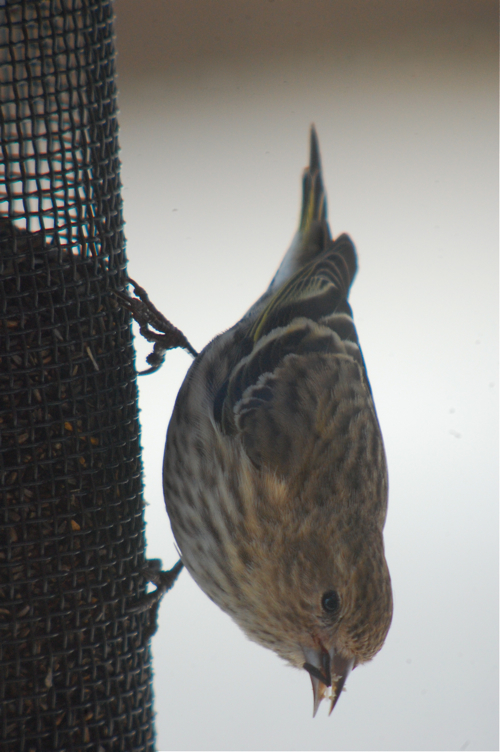
It was a pine siskin! Some winters, we get tons and tons of siskins that show up, but this winter we didn't see very many pine siskins at all. I was glad to see this one siskin and thought it strange that it was alone--you generally get a buttload of siskins, not just one or two.
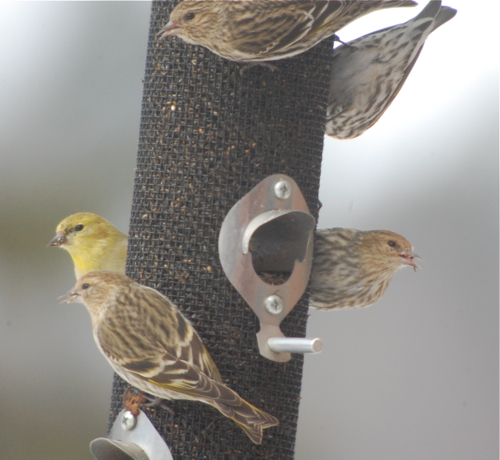
I looked out the window five minutes later and the number of siskins outnumbered the goldfinches. I went outside and the trees were full of them, their chipping and trilling took over the chorus of other birds. Here's a link to what they sound like--does that sound familiar? Have you heard that in your yard?
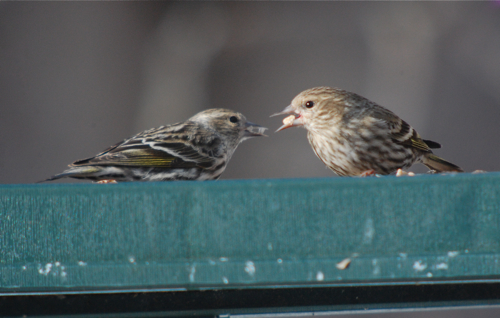
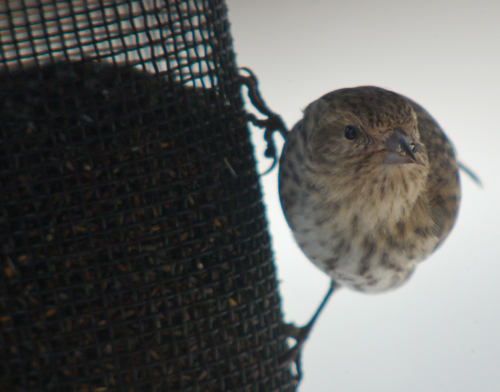
I think this is definitely a sign that spring is on its way--even up there in the northern states (finally). Between the kinglet and the large siskin flock, these are birds moving north. Can red-winged blackbirds be far behind for me? Watch for these finches at your feeder, you'll notice them from goldfinches by their extreme streaky plumage. They love Nyjer (aka thistle) and above the birds are eating sunflower seeds.
My Great Backyard Bird Count 2011
The Great Backyard Bird Count was over the weekend and normally for bird county things I like to do it at Mr. Neil's because he gets better birds at his home than I do. But I never cease to be amazed at what I can attract with some sensible bird feeding choices out of my very urban apartment.

My first day on the count wasn't all that. Oh sure, I had these lovely house finches, but I didn't see any of the hoped for winter birds for my hood like robins, Cooper's hawks or chickadees--not that I don't appreciate that pretty pink of male house finches (I love you boys, really I do).

I was starting to think that all I was going to get on my Wingscapes Camera and on the count were non native species like the above starlings until that blue jay photobombed them. Even the house finches are somewhat non native (western species introduced to New York in the 1940s and they gradually worked their way east). But then, Saturday morning I noticed that my news alerts were saying my town was under a Winter Storm Warning.

And snow hit like crazy on Sunday. I had to laugh when I was filling out the form on the Great Backyard Bird Count site. You had to fill in out much snow you had. I was trying to calculate what we had because we had 61 inches on the ground, but last week we hit 45 degrees and some melted. Fortunately, the highest total was 24 inches or above. Even with the melt, we had at least 30 inches. Then 12 more fell on Sunday.

This is from one of the beaches off of Lake Calhoun...where's the horizon??? The frozen lake and the sky were the same color! It was a bleak horizon on Sunday. Fortunately, that changed the game for how many birds that came to my apartment window.

The chickadees and downy woodpeckers came back in spades. They had to fight their way through some pigeons and starlings, but these hard urban residents were able to hold their own.

Everybody was digging the peanut suet. I have some in a suet log that's outside of the view of the camera, but I slathered some on the wall and sprinkled a few chunks on my window ledge. In the above photo, the female cardinal has a huge chunk of suet in her beak and the white-breasted nuthatch was working on the patch of suet I stuck to the wall.

I had to chuckle at some of the photos the Wingscapes camera picked up. This house finch was trying to beat the starlings to the last remnants of the suet on the wall. I didn't even know they would go for suet.
All in all, we had 14 species show up which isn't bad for how urban an area our apartment is located in.

And now that the count is over, I have to figure out how to deal with another 15 inches of snow dealt to us (no doubt by some vengeance seeking groundhog). I keep reminding myself that this time next month, I may find myself sitting in a cool field of freshly melted snow listening for the "peent" of displaying woodcocks.
Great Backyard Bird Count #gbbc #birding
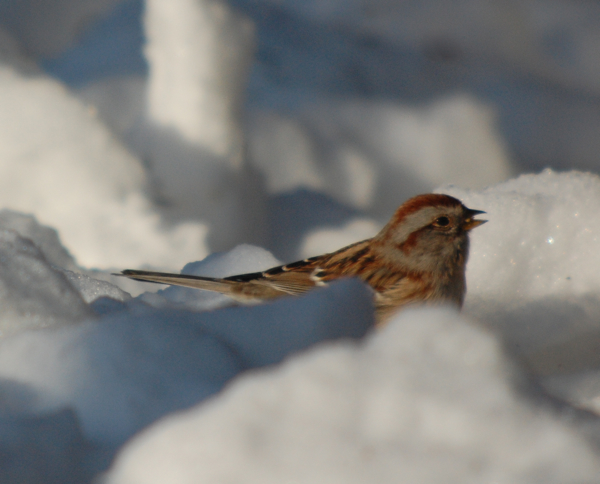 Here is a friendly neighborhood tree sparrow reminding you that today is the start of the Great Backyard Bird Count. This is YOUR chance to take 15 minutes day over the next four days to note what birds and how many of each you see. This is a joint project with Audubon and Cornell Lab. Please consider taking a moment to help get a cross section of winter birds in your yard.
Even if you do not have a bird feed, this is something you can do. Maybe you have robins foraging in mud in your yard--that counts. Maybe you notice a flock of 6 crows fly over your yard--that counts. Maybe you have pigeons roosting on a neighbor's roof--that counts.
Even the most common birds count. It helps in the long run to get an idea of prey base for raptors or population trends for common birds. We especially need a good base on the off chance bird populations may drop in the future. Fifteen minutes day. That's drinking a cup of coffee to note what's in your yard. Give it go, won't you?
If you want to follow it on Twitter, I believe the hashtag is #GBBC.
Cowbird Suet?
I found this suet at a Walmart last night.

Periodically, people email or ask me, "Hey, I've had a suet feeder out, but no bird comes to it. Why won't they come?"
Most of the time, I picture a yard void of trees, but after finding this suet in a popular shopping destination, I wonder if this might be one of the reasons? The above suet cake is LOADED with milo. This is a cheap filler seed that does not attract many birds. If you live out west and get quail--milo is great. In the eastern US only a few birds love it: pheasants, turkey, rock pigeons and brown-headed cowbirds.
This was not the only crap block of suet I found, but this was the worst offender I found on the shelf. It's bad enough that suet cakes are being loaded with cracked corn but milo? Really?
If you are looking for suet, look at it from the back. If the label reads that it is a peanut suet and you see lots of corn...that may be a sign that it's not a good brand. If you see lots of peanut chunks, then that is a good suet. If you see lots of small, yellow round seeds, this is millet and woodpeckers don't care for that either.
I don't know if I can fault the company that makes the above suet. I mean, they wouldn't unless they were making some sort of profit. Is there enough of a profit to be made in a suet cake that is not attractive woodpeckers and ends up sitting in a feeder for along time? Or maybe more people like to feed cowbirds than I realized? I am frustrated because this company does make some pretty good, affordable bird seed mixes. They make regional blends that are good for someone new to bird feeding and they don't know what seed to get. But that suet...that's lame.
Rainbow Mealworms Is In Dire Need Of A Bird Consultant
Oh, Rainbow Mealworms, why couldn't you have had a birder to take a quick look at this ad before you submitted it for print? I feel for you, I bet you'll get a few phone calls over this one.
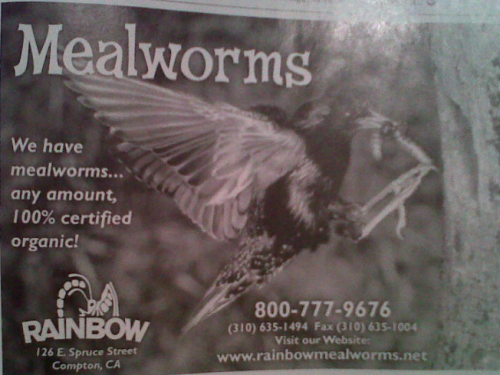
I was thumbing through one of the many bird magazines that find their way into my mailbox when this half page ad caught my attention. Rainbow Mealworms used a starling as the target bird to attract with their product for a US bird publication. This is a bit of an advertising blunder when you consider the type of birders who purchases mealworms: bluebird and purple martin enthusiasts.
Mealworms gained a place on wild bird specialty store shelves because bluebirds do not eat seeds and bluebird trail monitors wanted a way to offer them food. Starlings are one of the birds bluebird and purple martin enthusiasts work to great lengths to avoid since this introduced species will displace so many birds from nesting cavities like bluebirds, purple martins and flickers. Using a starling in the advertising is somewhat of a smack in the face akin to giving the peace sign backwards in the United Kingdom. Mealworms are a great addition to any feeding station, regulars like cardinals, chickadees and nuthatches eat them but so do catbirds, orioles and robins. I've yet to see any US bird feeding enthusiast anxious to attract starlings.
I don't blame the magazine's editorial staff for this one. Editors have remarkably little control over the ads, especially in this media era when few advertisers are investing in print. Often, the advertisers are submitting their pre designed ads last minute and the ads are put in with very little thought. A company should do a bit of research before they do their marketing. I'm sure both the magazine and the company will get some emails over this. Perhaps some enterprising bluebird or purple martin enthusiast will offer use of their photos of birds eating mealworms in exchange for a few bags of a 1000 Mealworms?

Rainbow Mealworms has had a tough few years. They are the biggest supplier of mealworms to North America and were one of the reasons for the mealworm shortage in 2008.
Better luck next time, Rainbow Mealworms.
Snowpacalypse 2010
We got a wee bit of snow. We're still trying to dig out of it. After watching the feeding frenzy at Neil's on Friday, I felt certain that the weather folks were "for serious" when they reported one to two feet of snow was eminent the next day.

Saturday morning I woke up to seven inches of snow, with more falling. I would fill out my window feeders, only to have snow block the food ports ten minutes later. It reminded me of the time in 2006 when Cinnamon and I were stranded in a blizzard after the Sandhill Crane festival in Nebraska. At least this time we were home and not trying to entertain ourselves in a hotel room with nothing but an Irish/Mexican restaurant to feed us.

Non Birding Bill and I spent half the day moving cars before the Snow Emergency kicked in (for those who don't live in the Twin Cities, local communities declare a snow emergency and you have to pay attention to the parking rules or one of three things happen to you: you get ticketed, towed or plowed in). Above is a car entombed in a snow bank, the plows hadn't even gotten to this street yet, if they didn't get it out soon, they'd be plowed in and stuck for some time.

Our little car was blocked by a snow bank too, but between the two of us and a shovel, we got the Stiteler Mobile out. We even helped shovel the ally when one of our neighbors was stuck and she needed to get to a wedding.

Ah, this is the spirit of our neighborhood--take to the streets with your cross country ski gear when a blizzard hits! The side walks were totally impassable on Saturday. The only way to get anywhere was in the street, either walking or on skis.

Since we were spending show much energy moving cars, we spent the other half of the day eating. While I was bottling up honey on Friday, NBB was gathering supplies for survival during Snowmaggedon which included alcohol infused whipped cream. As tasty as this is on hot chocolate and an Irish Coffee, I find the warnings about not refridgerating it--even after opening, a little disturbing. What kind of cream are they using in there anyway?
And so we kept tabs on the news and learned of various highways closing, theater performances canceling, bus service was halted and even snow plow drivers were taken off the road because they were getting stuck. Some local bars sent out messages on Twitter that if you could walk to them, they would buy you your first drink. We met up with one of our neighbors at Moto-i for drinks and some appetizers marveling at how crazy it was to walk around a city almost completely shut down. Minneapolis usually is on the ball when it comes to snow removal, but getting 17 0 21 inches (depending on where you lived) was too much. And there are only so many places the city can put the snow.
We went to bed and when we awoke the next day, we got the news that the snow was so heavy, the Metrodome (home to the Vikings) collapsed. For my family who has not seen the video footage--here it is:
[youtube]http://www.youtube.com/watch?v=kh5iE5FA84g&feature=player_embedded[/youtube]
Holy crap!
I was supposed to work at the park service on Sunday morning, but learned that we would be opening three hours late. That game me plenty of time to dig out our car and help others in my neighborhood. When I eventually could drive to work, it was no picnic. It was about as much fun as getting a TSA pat down from Barney the Dinosaur. During the storm, the temps were in the 20s. After it finished, it plummeted to below zero, rendering most of the snow melting techniques used by the salt/sand trucks ineffective. It looked as though none of the streets had been visited by a plow in the last 24 hours.

This poor car owner that did not heed the Snow Emergency rules was so boned. Blocked by a snow drift one one side and plowed in completely on the other side. There is probably a parking ticket attached to the car windshield beneath the snow. The only reason this car did not get towed was that the tow drivers saw that it was too packed in with snow to be worth the bother.

The roads were so narrow from all the snow, that often only one car could fit. Everyone was trying to move their cars at once before a new set of Snow Emergency parking rules were about to take effect. If you were walking the streets with a shovel, hungover hipsters would accost you, "Dude, can you help me dig out?"
They stood before you in their pajamas in the -3 degree F temperature with their sad ice scrapers trying to dig out their no-wheel drive cars--how could you say no? Actually, that's one of the things I love about where I live. If you are out about after a hard snow and you see someone struggling with their car, you help--no questions asked. That's just what you do. One poor dope was stuck in the middle of the street. Four of us tried pushing his car but could not get it to budge more than six inches at a time. His wheels spun hopelessly in the snow while he was blocking traffic both ways. Finally, I decided to use my little Kia to push him to a street with less snow (that's what bumpers are for, right?). That did the trick and he was on his way to safer parking ground.

Not even bicycles were immune to the fury of the snow plows. Believe it or not, quite a few people ride continue to ride their bikes in winter up here. NBB and I saw a couple during the blizzard and a few on Sunday. I hope the person who owns this bike gets it out soon. The below zero temps will soon turn the snow banks into rock solid slabs of ice.

I marveled at all the robins in my neighborhood. We saw quite a few watching the birds at my feeding station during the storm, but none of them came to the window. We have quite a few hackberry trees loaded with fruit and that appears to be a big source of food for them this year. Still, even though the robins we see in winter are from Canada, I wonder if they wished they could go further south?

Here it is the third day after the storm and life is not completely back to normal. I realized with a grin that it's still technically Autumn and we haven't had the Winter Solstice yet. I do enjoy the snow and that's one of the reasons I chose to live here, but it will be interesting to see how this winter plays out.
Banded Birds At My Bird Feeder Camera
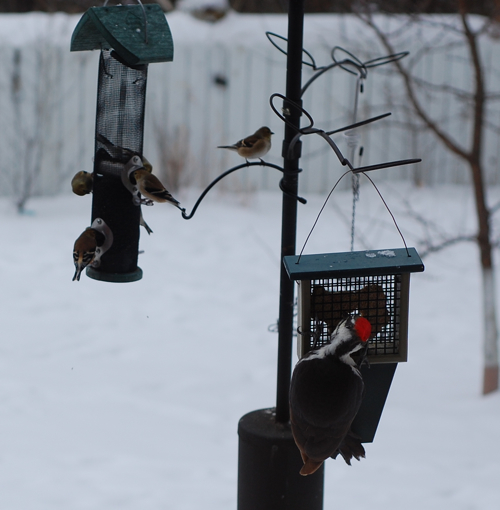 In case you have not heard, we're buried under an old school blizzard dumping up here. The local weather folk were predicting with barely restrained glee the potential for a massive storm. And though many of us have heard in the Twin Cities that we could get 1 - 2 feet of snow, many of us eyed this impending Snowmaggedon with skepticism. It often amounts to only a few inches. But to to be safe, I head out to Neil's for some last minute honey bottling finished--I need to get some together to mail to family for the holidays. I generally use birds at the feeder as an indication if the weather predictions are true. On Friday all feathers pointed to us getting seriously slammed on Saturday. The goldfinches were draining the thistle feeder and even the pileated woodpecker chowed down on the suet feeder closest to the window.
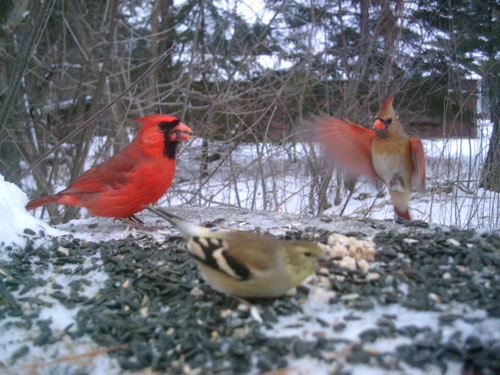
While I was dealing with the honey (more on that later), I set up my WingScapes Camera out on a stump and covered it with some bird food. Above is a male and female cardinal along with a winter plumage goldfinch.
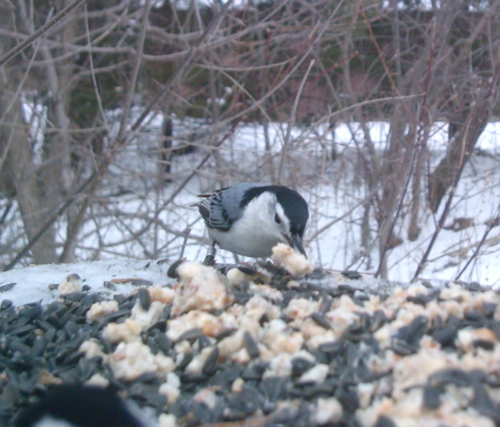
Check out this ambitious white-breasted nuthatch! Besides black oil sunflower seed, I crumpled up some peanut suet and the nuthatch was grabbing one of the larger chunks. I also noted the nuthatch was banded. Most likely the handy work of my buddies Mark and Roger who come out to band birds twice a year. There were quite a few banded birds coming in to the cam:
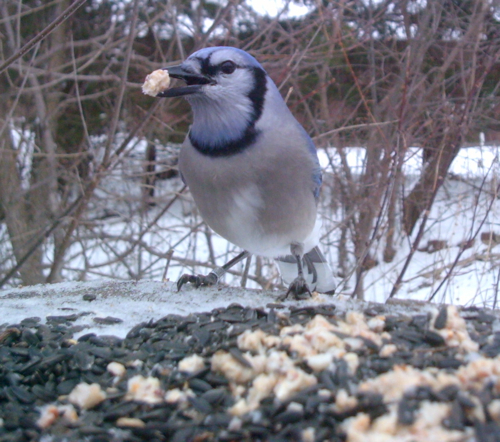
Here's a banded blue jay--I think it's been a few years since Mark and Roger got one of these in the nets, so this bird could be a few years old. Can't say for sure, since I can't read the band number, I can't say for sure. It could even be someone else's banded bird.
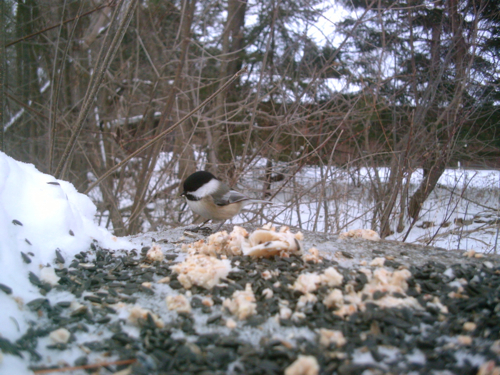
Here's one of several banded black-capped chickadees. Are they all photos of the same banded bird or several banded chickadees coming in to the seed, each taking a turn?
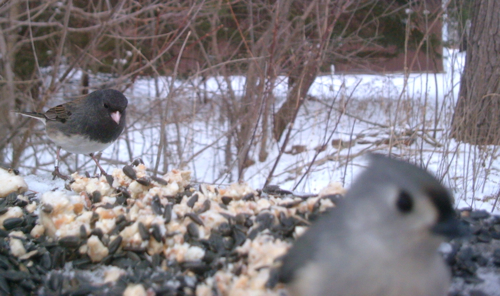
Here's a banded dark-eyed junco. With the dark gray head and the brown on the back feathers, its looks like a first year junco, probably banded this fall.
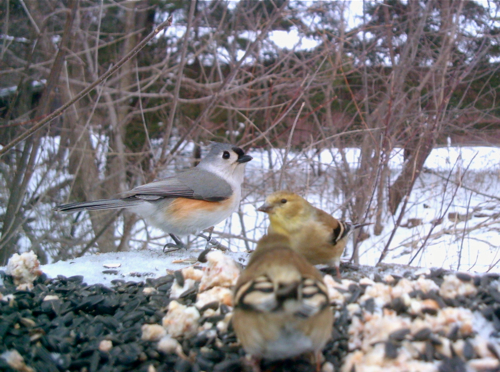
And here is a banded titmouse. It's nice to see all of the banded birds surviving and still coming to the feeding station, despite the nets going up twice a year.
There were a few other interesting photos that the cam picked up:
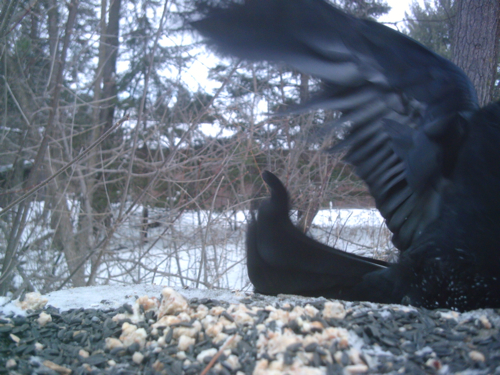
I find that crows are the hardest birds to capture on a motion sensitive camera. This crow was watching the other birds go after the suet and it really, really wanted it. It watched the stump for about ten minutes, trying to work out what the camera was all about. After watching dozens of smaller birds go down for the suet, it tried. But as soon as it landed, it bounced off the stump. I wonder if it can hear the digital camera go off? Can it see some change in the shutter? It never grabbed any suet and it never returned to the stump--which suited the smaller birds just fine.
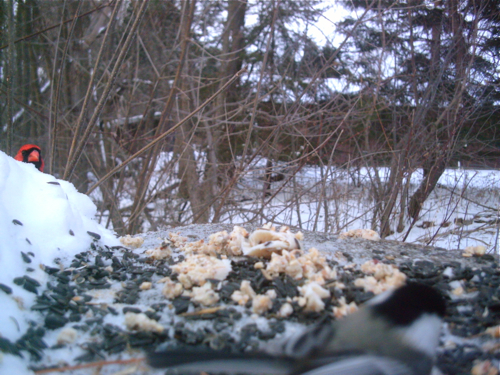
This photo cracks me up. It looks like the cardinal is totally planning to ambush the chickadee.
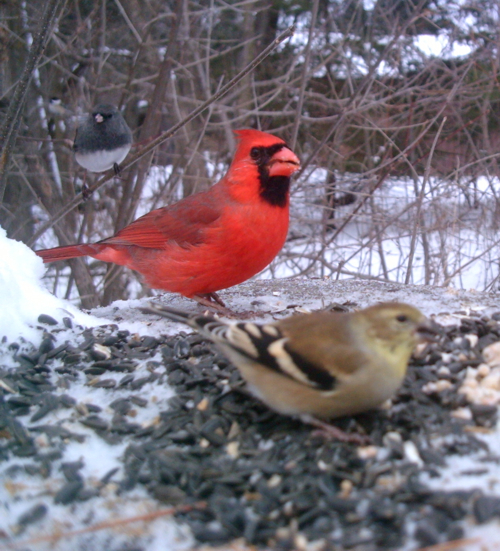
These are just a small fraction of the hundreds of photos my Wingscapes Cam grabbed that afternoon. The birds didn't lie, we got slammed with snow. Even though the storm was Saturday, I can hear a semi truck in my neighborhood squealing it's tires as I type this. It's been stuck in a bank of snow for the last 45 minutes. Minneapolis is pretty savvy when it comes to snow removal, but this one came so fast and there's only so any places that a city can put it, we're still a few days away from normality.
Mom, I'll post photos of our neighborhood later
Digiscoped Images
Fresh Tweets
Would you like to hire me as a speaker for your event?
Email sharon@birdchick.com