
Birdchick Blog
Best Bird Festival Idea Ever
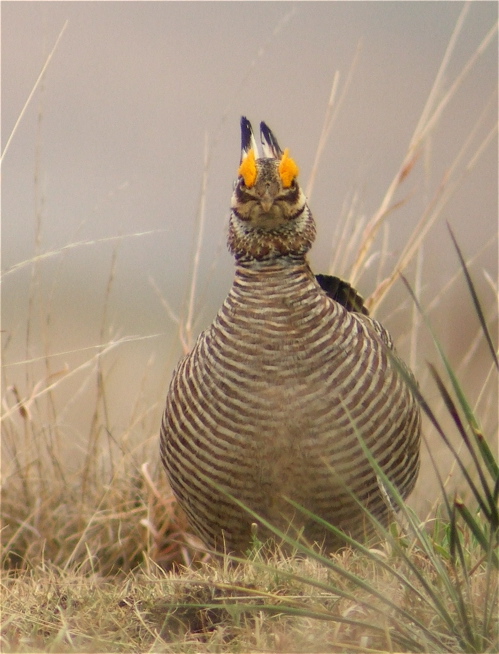
I have to say, that I enjoy attending bird festivals and events in general (I must, I go to more in a year, than most birders will in a lifetime). But, I was really struck by the Lesser Prairie Chicken Festival in Woodward, OK. Because the festival wasn't just about seeing the festival bird, but we actively helped the bird:
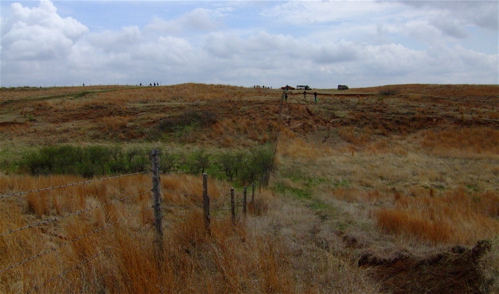
Oklahoma is a beautiful state with vast, sweeping landscapes, but it's also divided by several cattle fences. They are everywhere, dividing property lines. The fences have become a part of the many problems facing the lesser prairie-chicken's precarious future. The bird's natural defensive behavior when fleeing a predator, is to fly low, right above the grasses. If they are fleeing a fast predator like a peregrine falcon, the prairie-chickens may not pay attention in their panic and cannot dart the fences that are taller than the grasses. The chickens fly into the fences and die. Look at the above photo, you can see how the fence blends in to the grassy landscape.
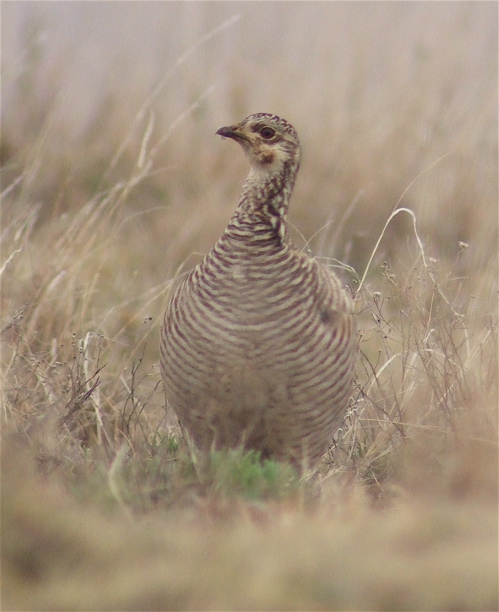
Research about lesser prairie-chicken mortality conducted by The Sutton Center has found that 40% of the mortality in Oklahoma is due to collisions with these fences! If you follow the link to the lesser-prairie chicken ecology, you can read more about the results. It was interesting to note that female prairie-chickens are especially susceptible to fence collisions and that is a huge concern--they lay the eggs. Sure, they need the males for fertilization of the eggs, but beyond that, the , build the nest and raise the young--you need all the females you can get out there to replenish the population. The Sutton Center, however, has come up with a unique plan!
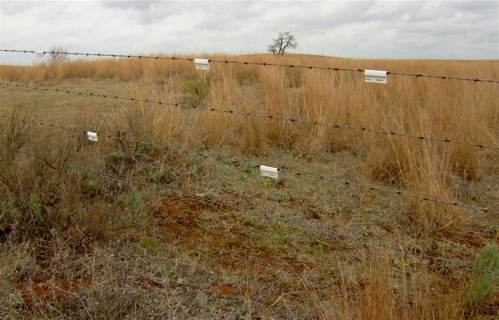
They have come up with a unique fence marking plan to save the lesser prairie-chicken. By using "undersill" strips (trim strips) of vinyl siding available at many big box home stores, fences can be made more visible to the chickens. Eric Beck, the Oklahoma Audubon Council's Important Bird Area Coordinator was a field trip leader for the festival. However, when not leading trips, he was cutting up strips of trim to be placed on fences.
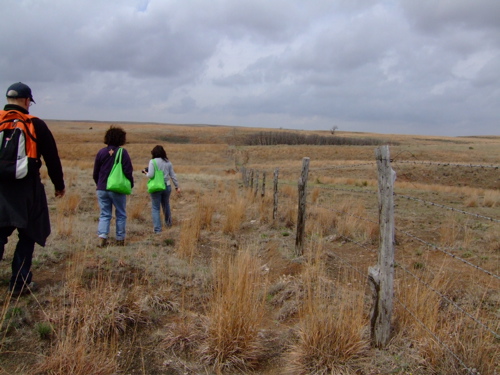
After we watched the lesser prairie-chickens on the lek, we were given a filling ranch breakfast at Selman Ranch, shown how do the fence marking, and set loose with bags of tag to mark fences at a WMA that has prairie-chickens. This was the most proactive bird field trip I have ever been on at a bird festival. What a GREAT idea--show us this cool bird and let's not just lament that it's fate in the wild is uncertain, let's actually have festival participants do something that could actually help the birds. Best idea I've seen at a bird festival in years. I love this as much as I love the Delaware Bird-a-thon that raises money to buy up migratory habitat for the red knot. We need more of this kind of active conservation and birding.

And that's not to say that fences are the only challenge facing the lesser prairie-chicken. Wind farms are popping up all over Oklahoma. Lesser prairie-chickens nest out in the open on the ground, they don't nest next to all trees--red-tailed hawks and Swainson's hawks perch there, watching for some fat tasty prey. Tall windmills look a little too much like tall trees and lesser prairie-chickens will not nest next to the farms, so that fragments their nesting habitat even more.
Still challenges ahead, but still hope too.
Oklahoma Porcupines
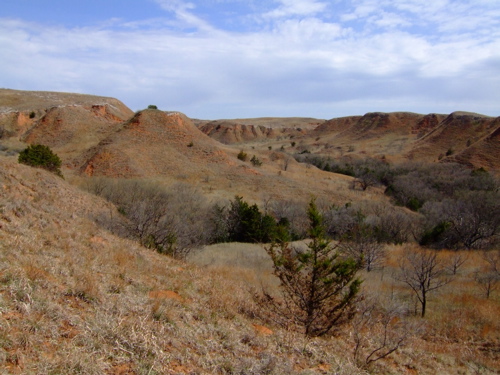
One of the fun things about the Lesser Prairie Chicken Festival that I attended in Oklahoma was the opportunity to see an area owned by The Nature Conservancy normally closed to the public called Four Canyon Preserve. It wasn't very bird--the top of the canyons were so windy, you could barely hear any song, but the views were stunning and a reminder that Oklahoma is not all flat land.
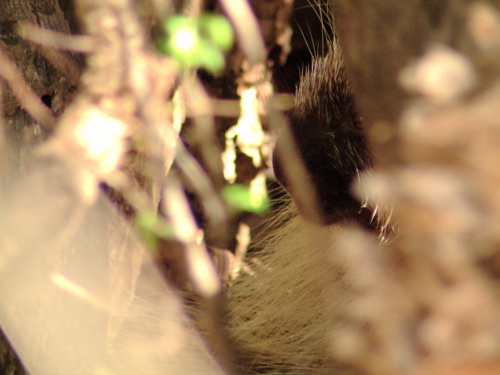
Though we did not see much in the way of birds, we did see some porcupines. I grew up in Indiana and didn't have much experience with porcupines until I moved to Minnesota. I don't have mammals on my radar quite like birds, so I just assumed in my head that porcupines were a northern species. I did not expect to encounter in them in Oklahoma. However, I did notice a couple of dead ones on the road as soon as I arrived.
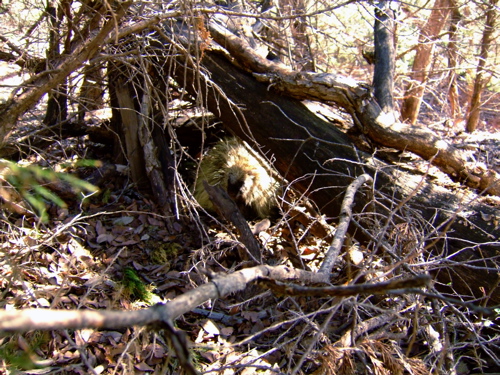
When I came home from the trip, I looked through one of my mammal books and was surprised to find that their range extends all over the western US. One of our birding group noticed this porcupine lurking under some cedars. At first, the porcupine only showed its backside, but I stayed behind while the group continued on the trail. When it was quiet, the porcupine turned around.
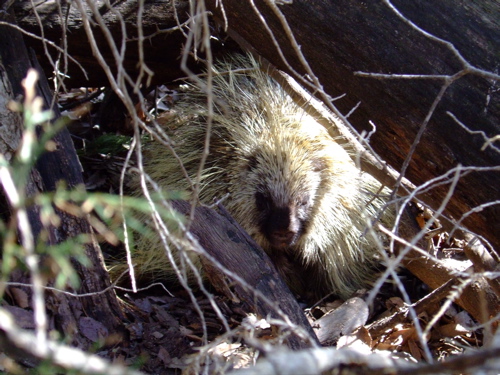
I slowly snuck in for a closer look. Apart from the now famous porcupet that my friend Gail took care of, I've never spent too much time up close with a porcupine. I moved slowly and quietly, the porcupine was sort of cornered in this nook. I'm sure it realized it had the upper hand in the situation. Porcupines cannot shoot their quills out, but if it decided to charge and run past, even brushing my leg would leave me with a few quills. But it seemed chill and I didn't dilly dally with my photos, just a few quick snaps and then I went on my way to catch up with our birding group.
Oh, and for those curious about how female porcupines are able to give birth without getting "quilled," it because the young are born with soft quills that harden within about two hours after coming out.
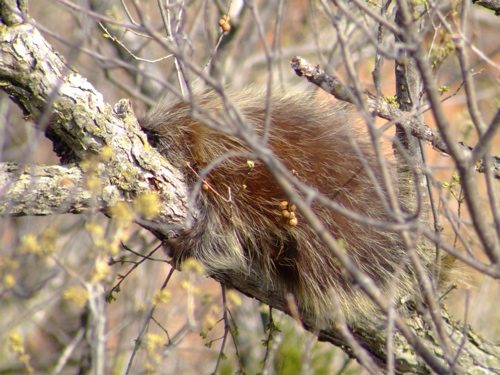
From the top of one of the canyons, we looked down and I spotted another porcupine sleeping in a tree. I read in one of my mammal books, that many porcupine specimins in museums were found to have healed fractures. The speculation was that while porcupines are known as good climbers, they might also be good fallers too. Perhaps they fall out the trees and just learn to deal with the injury?
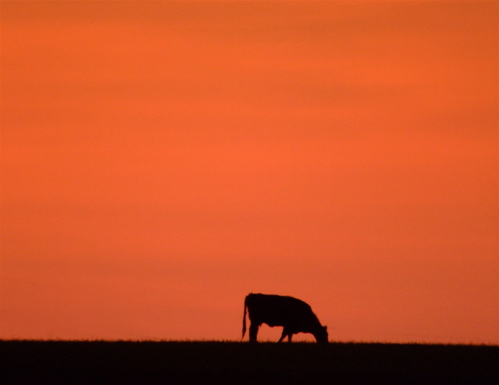
While we watched this critter, our guide told us that there were many porcupines in Oklahoma and many ranchers shoot them because porcupines chew the bark on trees, making them look bad. It's funny that some ranchers don't like the aesthetics left behind by a porcupine since I have had the same feeling about the aesthetics of some of the overgrazed prairie we passed.
Other Oklahoma Birds Besides Prairie Chickens
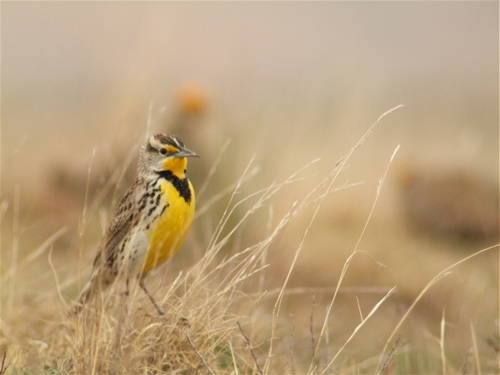
For the record, I did see other birds besides lesser prairie chickens in Oklahoma. As a matter of fact, while I was focused on a pair of male chickens in the middle of a stare down, a yellow blur moved in front of them. I adjusted the focus of my scope to reveal a meadowlark. I'm not sure which one this is. We heard both eastern and western meadowlark singing around the prairie chicken lek and I'm not bold enough to call it based on plumage. The bird did not sing while I got its photo. I love this shot of the meadowlark with the chickens blurred in the background.
If you are new to birds and have never heard a meadowlark call...or not sure if you have, check them out at Xeno Canto. Here is the western and here is the eastern. I grew up with eastern meadowlarks in Indiana (a beautiful evening song) but the westerns are quite striking.
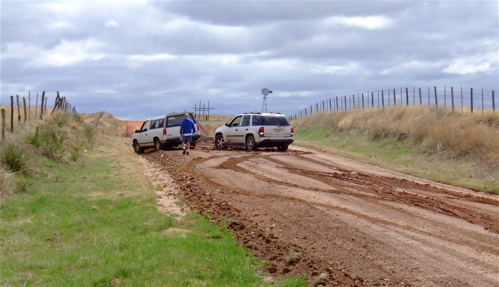
I have to say that there was quite a bit of adventure to our birding--one day about 4 different vehicles toting participants to birding spots got stuck in mud along the minimum maintenance roads. There had been quite a bit of rain beforehand. I heard through the grapevine that many vehicles got stuck on the way to the lesser prairie chicken leks. A tractor was required to get the vehicle out. Since that road was blocked, the field trip leaders cut a barb wire fence (with the fence owner's permission and the understanding it would be repaired) to get the vehicles to the blind--that's dedication to get birders to the birds! And what a great adventure to see the bird.
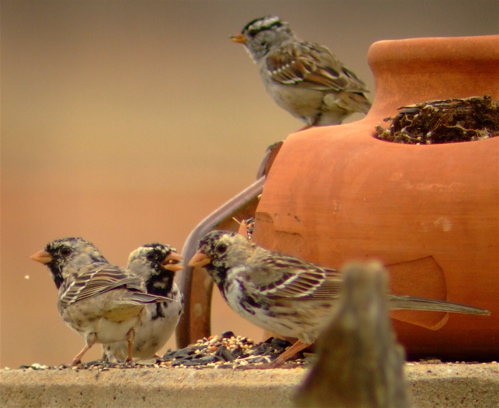
I really dug the sparrow action at the festival--check out this feeding station. Harris sparrows (dudes with the black beards) and a white-crowned sparrow. Harris sparrows are just amazing little birds. First, they look cool with the beard, but second, I was just reading on Cornell's newly revamped All About Birds site that they are the only sparrow that breeds in Canada and nowhere else. Here I was in Oklahoma watching these little brown birds, they still had thousands of miles to go to the breeding grounds.
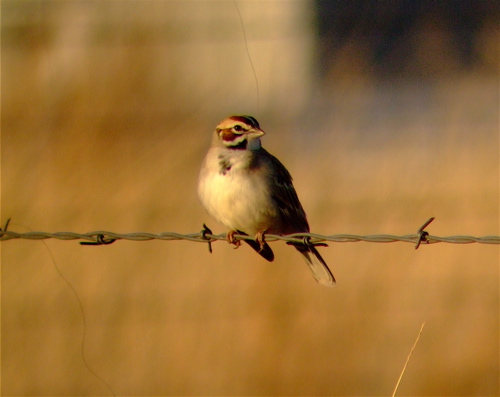
Another incredibly common bird in Oklahoma was the equally striking lark sparrow. Just about anywhere there was a barb wire fence, you could find one of these guys perched nearby. Lark sparrows have an interesting nesting history. They are capable of building nests, usually in a shrub or tree, but they have been documented nesting in old woodpecker cavities. This species has also been known to reuse old nests of mockingbirds and some notes suggest that there is a bit of nest sharing going on--perhaps unintentional. Field studies have found eggs and young of both mockingbird and lark sparrow in the same nest. Oh, lark sparrow, please do not go the way of the cowbird.
Lesser Prairie Chicken aka Jets vs Sharks
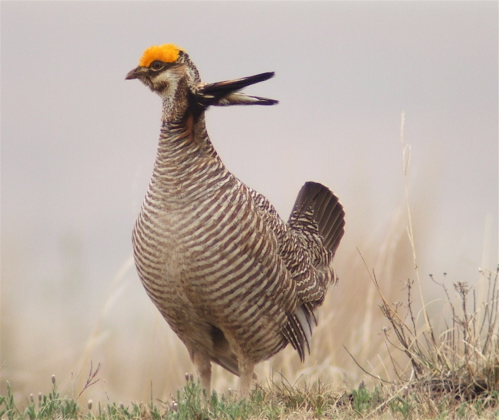
I'm wrapping up my time in Oklahoma. The Leks, Treks, and More lesser prairie chicken festival is still going on with a cool post tour to Black Mesa, but I have to return to the Twin Cities to do some park rangerin' tomorrow. The festival had birding trips surrounded the Woodward area, but the main thrust of the festival was the lesser prairie chicken.
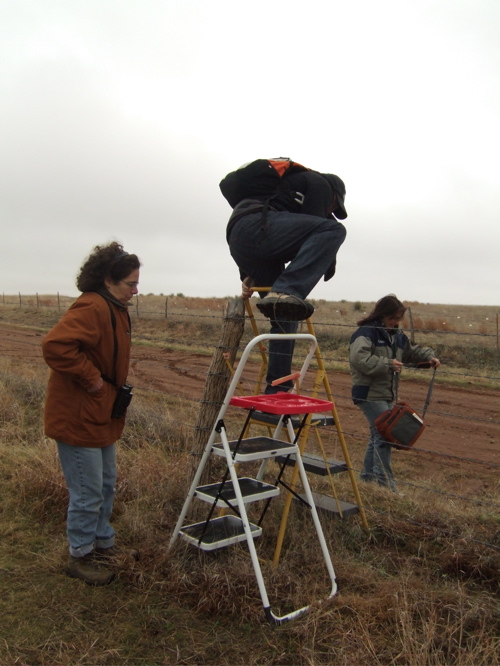
My first morning at the festival, I met the group at 5am to ride out to the Selman Ranch to get to the blinds. There had been some concerns about the rain that had recently fallen, making many of the unpaved roads we were taking a bit treacherous, but our experienced drivers got to us the area with the blinds. We had to scale two step ladders over a barbed wire fence...only this is a photo of when we were leaving, when we were on our way to the leks, we had to do this in darkness, the sun was not up yet. The leks we visited were on private property, cattle ranches.
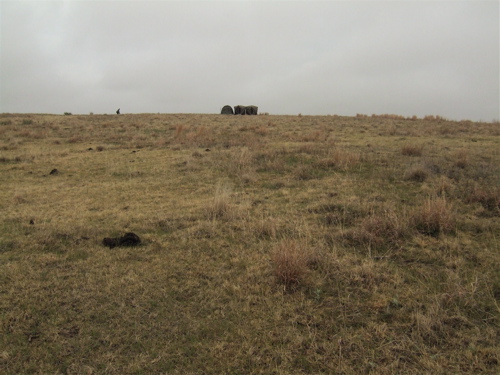
These were the portable blinds we sat in on the prairie. Winds in Oklahoma are fierce and the blinds were staked deep into the ground. We sat three to a blind and I actually ended up in a blind with two fellow bloggers: Drawing the Motmot and From The Faraway, Nearby. I was a tad nervous, I discovered that morning that I forgot my deodorant and my toothbrush, I was going into the blind and hoped it would stay cool enough so I wouldn't stink up the joint.
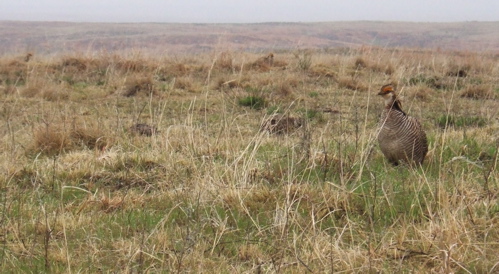
It did stay cool, it felt like it was in the 40s, which was a treat for me, some greater prairie chicken viewing has been in 10 degree weather, so above freezing was a pleasure. The birds were so close, that we really did not need binoculars. I took this photo from the window without my scope. We arrived in the blinds in total darkness and sat waiting for the birds to start their display. I huddled beneath my layers, listening to all the sounds around us. Cattle waking and beginning their deep mooing. Turkeys gobbled in the distance, then we heard the gobbling of the chickens.
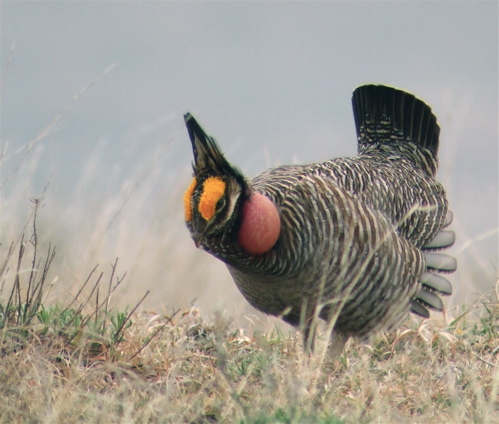
As the light in the morning grew brighter, I could get some photos of the male. Cornell Lab of Ornithology describes this interaction as, "Males display by exposing and enlarging the superciliary eye-combs, elevating tail to highest extent, erecting pinnae and positioning them forward and parallel to the ground, drooping wings and spreading primaries, extending neck and head in forward position, stamping feet on ground and moving forward, and expanding esophageal air sacs and producing Booming vocalization"
If that was hard to read or understand, Non Birding Bill made this animated giff of a "Before and After" of a male lesser prairie chicken displaying:
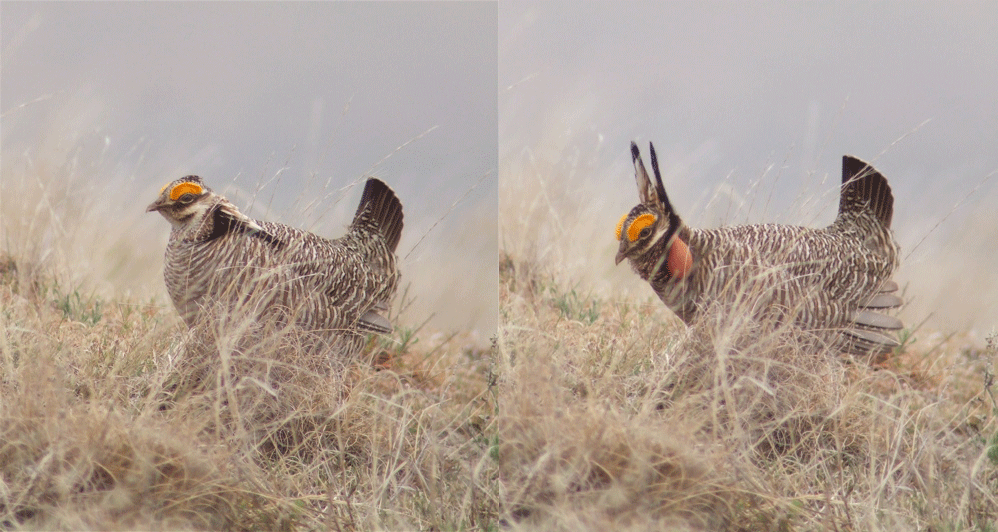
You can also watch a video I took of the behavior too (and more importantly, hear the sounds of these crazy dancing chickens).
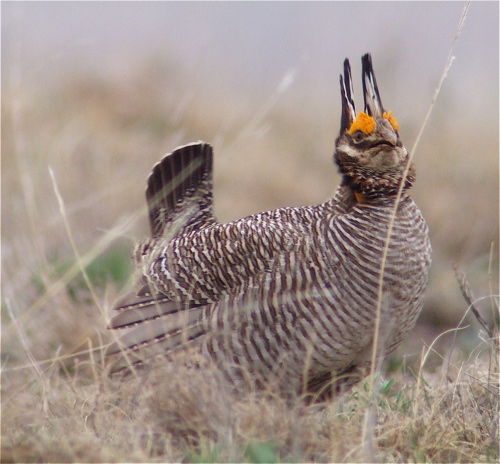
The males went at it for a good hour. The danced, fluttered, squabbled, and stamped their feet in their individual territories. Periodically, a male would run over and challenge another male. They would bow and display to each other, almost like the start of some odd square dance. Some times there would be a display and the birds would walk away or sometimes, things would escalate into full on fighting with a few feathers left hanging and falling in the aftermath.
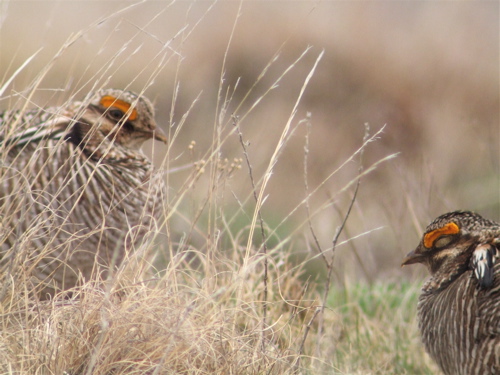
The males displayed themselves into utter exhaustion. I know how winded I can get on a dance floor and I'm just doing it for fun. These birds are doing it...sort of like the guys in the musical West Side Story. They are dance-fighting out their issues, nonstop without eating for several hours. These two males were bowing to each other and the male on the left, appeared unable to keep his eyes open, as if we were saying, "Dude, I'm too tired, let it go."
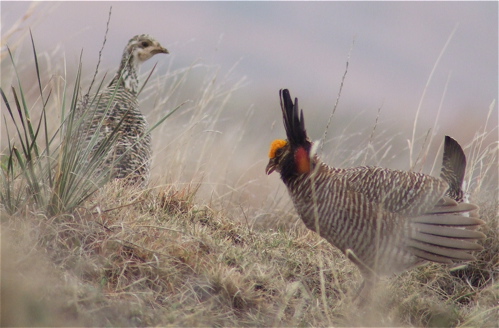
However, as soon as a female appeared on the scene, every male immediately woke up, it was as if all them were instantly injected with Red Bull. Their displays became more frantic and they ran back and forth around the female displaying their virility. We saw about three or four females approach the lek throughout the morning, it was interesting to watch their behavior. When a male approached, the female would hide in grasses and preen. If a male gave up, she would stop preening and watch the displays, I wondered what in the displays she was hoping to see--the size of the yellow pouches? The droop of the wings? The sound of the gobble?
I only saw one female select a male and attempt mating. That was the video I posted earlier...where we had some "male chicken blocking" going on. Considering how quick bird mating goes, that second attempt was probably successful in fertilizing on egg.
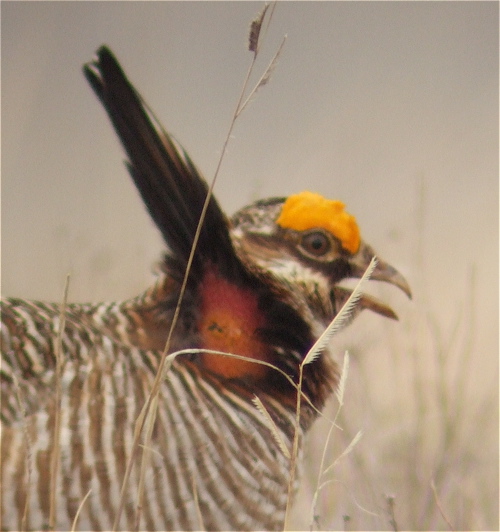
I did notice one male who apparently had some pouch issues. Do you see it? He has a hole. This most likely occured during one of the many fights we witnessed. Lesser prairie chickens have a sharp beak, so a good solid peck would damage the pouch, affected the gobble sounds and reduce this male's chances of mating with a female.
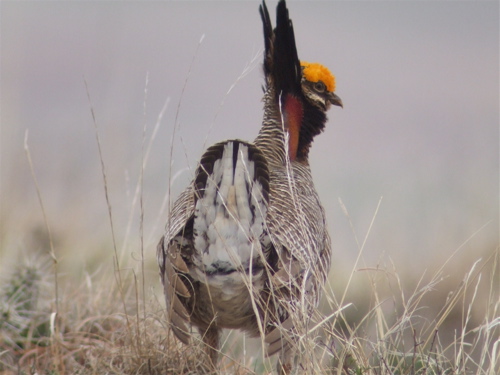
All in all it was a pretty cool experience and I loved hanging out in the blind and just watching one bird and absorbing its behavior. It was a treat sitting next to an artist and watching her sketch the lesser prairie chickens. I admire the ability to do what looks like a few simple strokes and capture the essence of a creature. Her sketchs also capture the movement and mood of the chicken. Here is a link to Drawing the Motmot's lesser prairie chicken sketches that she made in the blind--so cool.
Crap, I just looked at the time, I need to pack for my flight back to the Twin Cities, more Oklahoma adventures coming later!
Lesser Prairie Chicken Attempts At Mating
This has been a very popular video at the Leks, Treks, and More Festival in Woodward, OK. It's a video from the lesser prairie chicken lek. I female has found a male she likes and attempts to mate with him. The other males in the lek are not happy about this.
Random Monday Sparrow
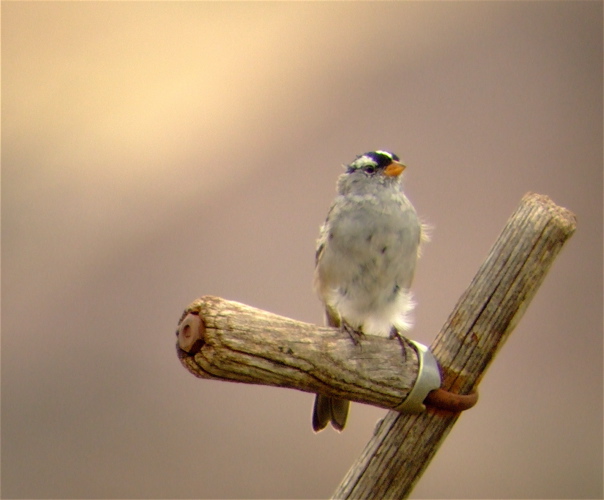
I have to say that I'm having a heck of a time here in Oklahoma. Yesterday, at least three vehicles got stuck in muddy roads during field trips (no worries, vehicles were saved and participants still got to see some great birds). But you know it's a great adventerous festival with gorgeous wild places with a tag line like that.
Besides the prairie chickens, we're gettins some great sparrows, like this white-crowned sparrow above. I'll have more photos to post, but I've got one more field trip to do.
Digiscoped Images
Fresh Tweets
Would you like to hire me as a speaker for your event?
Email sharon@birdchick.com