
Birdchick Blog
Birds of Snowpocalypse
For those like my mother who lives in Indianapolis (who are getting Rainmageddon) and cannot experience the white Christmas we are enjoying in the Twin Cities, I thought I'd put out my Wingscapes cam to get some photos of birds and the falling snow. I forgot that I had it set to take video, so here is a cardinal in the snow:
I love the crow who seems to be on cue giving periodic two caws for ambient noise. Love the little dome over the tray to keep the seeds dry and uncovered.
Happy Holidays to everyone--however you celebrate it.
Thank you so much for taking the time to visit my blog throughout the year and a special thank you to everyone who sends to that read, "I've never really noticed birds before reading your blog, but..." and then you send me your bird story. That's what makes sharing my bird stuff so fun.
Growing Nyjer Thistle In North America
Last Saturday was the Minnesota Ornithologists' Union Paper Session (a boring term for annual gathering). One of the presentations was from John and Lisa Loegering about attempts to produce Nyjer in North America.
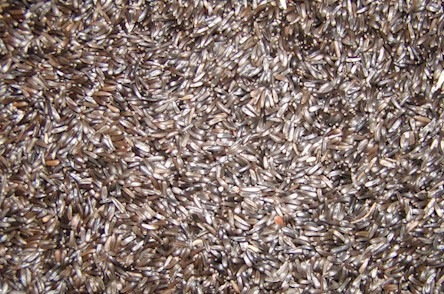
Let's get some basics down about this seed first, on the off chance that someone reading this doesn't know about the tiny seed for finches. Above is a picture of Nyjer also known as Niger and Thistle. Most of what you purchase for goldfinches at your local feed store comes from Singapore, Burma (I remember seeing that location frequently when I got in 50# bags at the bird store I managed), Ethiopia, and Myanmar. This is not a seed grown in North America. It is in no way related to the noxious weed thistle. It was originally called Niger but frequently got mispronounced as a racial slur. So many retailers referred to it as thistle. Since some got confused that it might be seeds of the noxious weed thistle, some cities tried to ban its sale. The Wild Bird Feeding Industry has pushed for the name to be changed to a phonetic spelling: Nyjer.
Confused yet? Basically at bird stores: Nyjer = Niger = Thistle, it is all the same seed. It's that tiny seed you put out for finches, siskins and redpolls and it's not grown in North America--one of the reasons it's one of the more expensive seeds.
According to the Loegerings, attempts have been made to grow a type of Nyjer in North America. A Niger Growers Group was even formed. By 2002, a plant had been developed and seeds were produced...and no bird would touch it. The group contacted the Loegerings and asked them to figure out why birds wouldn't eat the seeds. They set up 15 different feeding stations with the North American Nyjer in one feeder and Ethiopian Nyjer in the second. They measured the amount of seed put in the feeder, the amount the birds ate, the type of birds and the flock composition. The most common birds coming to the feeding stations were goldfinches and redpolls. Sure enough, if the birds had their choice, they ate the Ethiopian Nyjer more than the North American Nyjer.
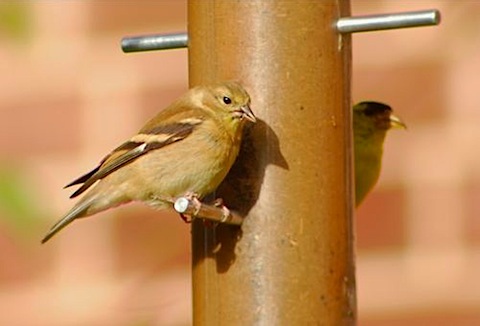
Loegering wondered what was different. One of the first things that came to mind was that Ethiopian Nyjer is supposed to be heat treated to prevent it from germinating in North American soil (we all know how successful that is...not). So he got the directions for the exact process and heat treated the North American Nyjer and restarted the experiment. This time, the finches ate both types of Nyjer at the same rate. Now why would they prefer the heat treated seed? Does the heat remove the moisture to make the shell easier to crack? Does it make for a better tasting seed? Does it look different in the UV color spectrum? We don't know.
Now, this does not mean you will be finding locally grown Nyjer anytime soon. The Nyjer Growers Group has since disbanded. Part of the reason is that there is no farm equipment available to separate the tiny seeds from the chaff. Nyjer is all hand harvested overseas, think about that when you are pouring it into your feeder--that is a hand harvested seed. Kind of makes you wonder about the age of the harvesters and if they are paid a fair wage for harvesting that bird seed. Between that and tariffs, you can understand why it's an expensive feed to put out. The other reason was that when corn prices went crazy on all the ethanol speculation, many farmers gave up trying to grow bird food like Nyjer or sunflower (it's costly since you have to protect from the very creatures it is being grown for) in favor of growing corn. They also gave up some of their CRP land, so birds got a raw deal from ethanol...no bird can live in a corn field.
And now a few words from one of my site's sponsors:
Hey! While we're talking Nyjer and finches, you might need one and some are available at the Birdchick's OpenSky Store. One that is pictured quite a bit in my blog and used by thousands of finches is the Finch Flocker (a 36" feeder). There's also the Droll Yankee Clever Clean Series for finches too.
Remember that 20% of the profits of my store are donated to the ABA's kids programs.
Pine Siskins Hit This Weekend
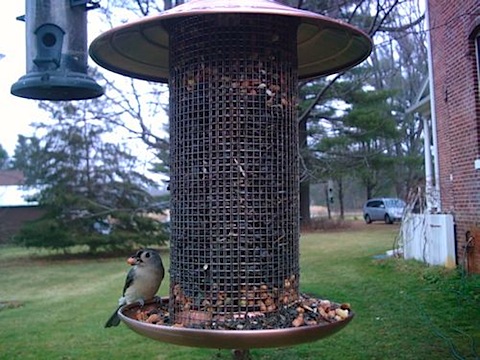 We had the Wingscapes Cam up at Mr. Neil's this weekend and I'm fairly certain I witnessed the arrival of pine siskins. I was out and about on Wednesday and I didn't see any. Just the usual suspects like the above tufted titmouse were using the feeders on Wednesday.
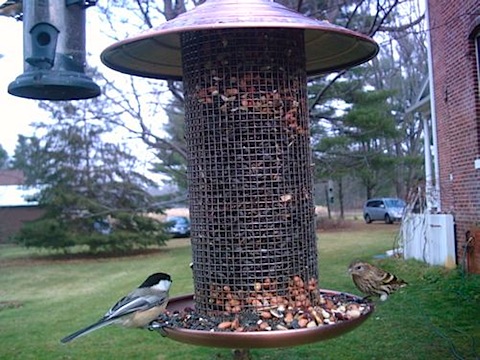
Then on Saturday, I noticed one or two pine siskins. The pair either jockedy for position at the thistle feeder with the goldfinches or took their chances with the more easy going black-chickadees at the sunflower feeder. Non Birding Bill and I ended up spending the night and the next morning...
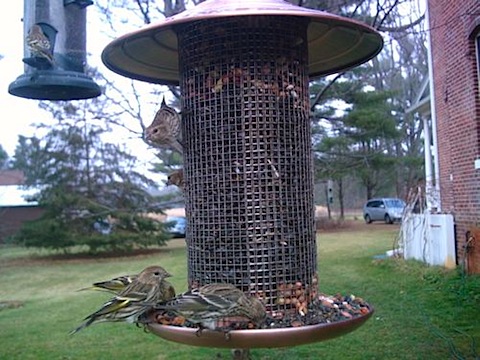
...it was pine siskin palooza! I stepped outside and you could hear that distinctive upward trill of the siskins sounding from the tops of trees, they easily out numbered the goldfinches at this point. I wasn't expecting to get big numbers of siskins this year, last winter we had tons and some even stayed around the Twin Cities metro area to breed. I wonder if we'll get a few redpolls again this year?
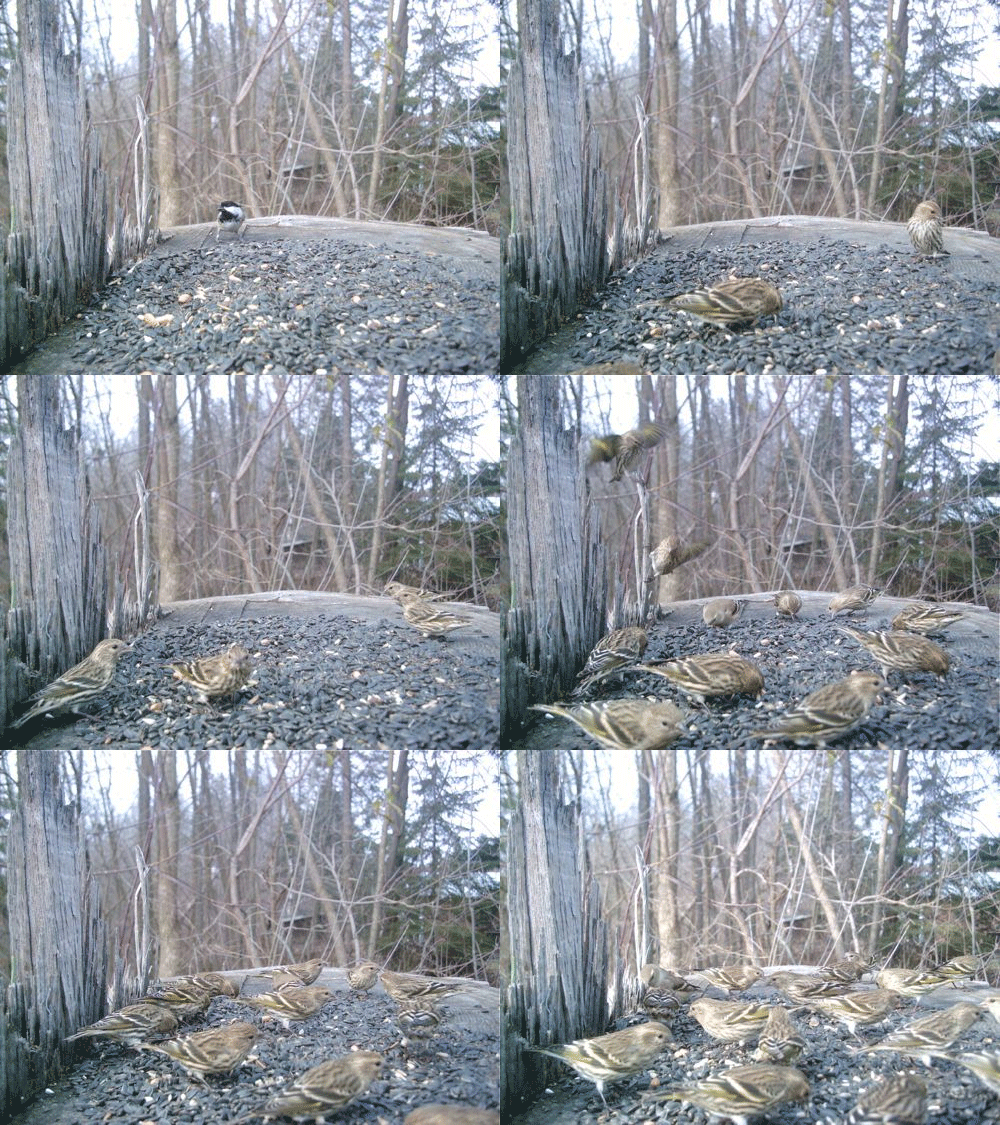
Here's an animated gif of the birds flocking down to the stump covered with sunflower and thistle. I love watching the build up with the photos. It starts with a chickadee and then ends with a ton of siskins.
Trying My Hand At Hand Feeding
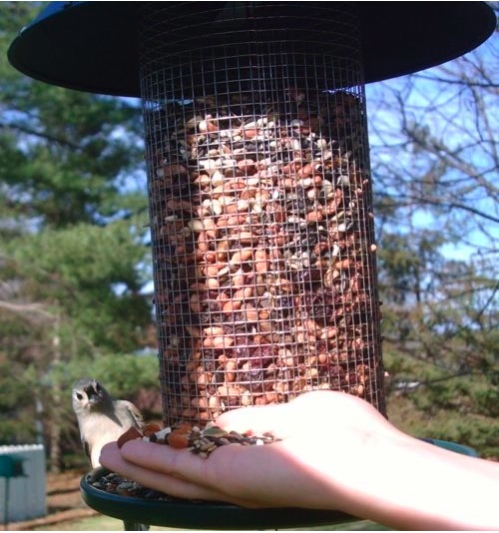
Most of the time when I'm filling the feeders at Mr. Neil's, the birds zip around my head and many land directly on the feeder as I'm hanging it on the pole. I've read how to get birds to feed from your hand but have never really put it into practice before, but think I might this winter. I did some preliminary experiments this morning and considering that most books say to do it when it's cold and all the feeders are empty...I got off to a pretty good start. It was sixty degrees today and all the feeders were full and yet, I got some brave birds landing on the feeder while my hand was on it. I figured they were used to flying in and so would be used to my hand. That tufted titmouse in the above photo, however is suspicious.

I did get a black-capped chickadee to take one nut from my hand. I got the photos by setting up the WingScapes motion sensitive cam in front of the feeder so that way I wouldn't be freaking the birds out while holding a point and shoot. I'm encouraged to see what will happen.
And, I'd like to thank my husband Non Birding Bill for filling in for me for a few days. I'm lucky to be married to such a talented writer who sees when I get stressed over the blog and offers to step in. I love doing the blog, but the way I blog has changed and who knows how it will continue to change with the trends on the Internet.
Everybody needs a vacation from what they do and I'm so grateful to have a husband who can step (or the many readers who have guest blogged during our contests when I have been out of the country).
Early on, there were few bird related sites and blogs. Blogs were a means for birders to share bird news stories, talk about research, share personal birding stories, encourage others to share. Now, there are a TON of great birding blogs out there to choose from. There's no need to feel the pressure of sharing a bird related news story because one--several other bloggers are already on it and two--more blog readers are internet savvy and can set their news readers to find the bird stories for themselves.
And then there is the challenge of fresh material. I'm fortunate in that I get to travel and can share new birds, but when I'm not traveling and I'm reveling in watching basic bird feeding...how many times can I show a photo of a chickadee and have it be interesting? What else can I say about the 180th dark-eyed junco that we've banded (unless it has an interesting injury).
Now, there is Facebook and Twitter to contend with as well. I wasn't sure how I would use Twitter, but I find I use it as often as I blog. I started by using Twitter as a preview area for photos that I might post later in the blog, but I also use it for real time bird banding photos and to answer birding questions, or even share links that I formerly would just post in the blog.
I'm not sure where this blog is going...I don't think any of us do, that's a challenge the media is facing with the internet: how do we make it all work and still earn a living too. As long as I find blogging interesting, I'll keep doing it. And thank you to everyone who stops by (whether you leave a comment or not).
If there's something you'd like to see blogged about--please let me know. I try to take requests when I can.
The Crow: A Reappraisal
NBB's Guide to the Bird You Saw: Crows
Okay, so hopefully you've gotten the identification of Sparrow down pat. If not, there's no hope for you, and you're destined to lead a lonely, sheltered life, fearing the companionship of your fellow man. Which, ironically, makes you a perfect candidate to be a bird watcher. But I kid the birders.
Let us now move briskly on to the other type of bird you just saw, the Crow. In contrast to the Sparrow, which is vile, corrupt mockery of all that is righteous in the world but which is extremely popular—the Internet Explorer 6 of birds, if you will—the Crow is, in fact, a fairly awesome bird which people hate. People hate Crows so much you'd think they horked in the back of their car, or had a reality show.
This is not an unreasonable reaction. Crows have several things working against them, the first being is that while Crows are cool, they know it. Crows don't walk, they strut, making sure that you notice them without acting like they're making sure you notice them. I don't think that anyone would disagree that Crows have what Vice-Principals the world over would describe as "an attitude problem," before adding "Mister" with a very significant period at the end, because Crows are basically the teenagers of the bird world. You'll often find them hanging around behind feeders, sneaking a smoke. Chase them off and they'll simply fly off—slooooowly—to the nearest tree, glaring at you without looking like they're glaring at you. You can almost hear them mutter "bogus," and "whut-evah, grand-dad."

Yeah, I'll get right on that. Watch me go. Zoom.
I can hear my wife cringing from across town as I write this, because she can't stand anthropomorphization of animals. But it doesn't really apply to Crows, because I feel they are so very human, which is, again, part of the reason why people don't like them. They're cooperative, family-based, and part of the reason they've been so successful is that they've adapted to humanity, eating the roadkill (created by us) and garbage (likewise).
So, it can be easy to hate on Crows, but nonetheless I urge you take another look at them: I honestly really like them. Crows can be a lot of fun to watch, provided they don't know you're watching them: they play pass-the-stick and have this weird cartwheeling game they play in the park in the winter. And winter is the best time to watch crows, because that's when they lose some of their smugness and are, like the rest of us, just trying to get from A to B. Their strut becomes a trudge as they try to make their way through the snow, and they'll hang in the trees, wrapped in their feathers like trench coats. They hang out at my bus stop, probaby waiting for the cross-town to take them to the U. campus, where they are no-doubt studying Russian Formalism and smoking hand-rolled cigarettes. And as we stand there, both freezing our butts off, they'll shake off the snow with a shudder as if to say "this weather is b.s."
Yes, yes it is.
Sharon tells me that the Crows we have around our house are notoriously hard to take pictures of (again, like teenagers), so your best bet is try try and snap a picture with a motion-sensitive camera like the Wingscapes Birdcam. Both items are available at the Birdchick’s OpenSky Store, and 20% of the profits are donated to the ABA’s kids programs.
As an added bonus, if you enter the coupon code Sharon1009, you’ll get an additional 10% off your OpenSky order.