
Birdchick Blog
Random Lineated Woodpecker
Going through photos of last year and I found a Panama woodpecker that I didn't post:
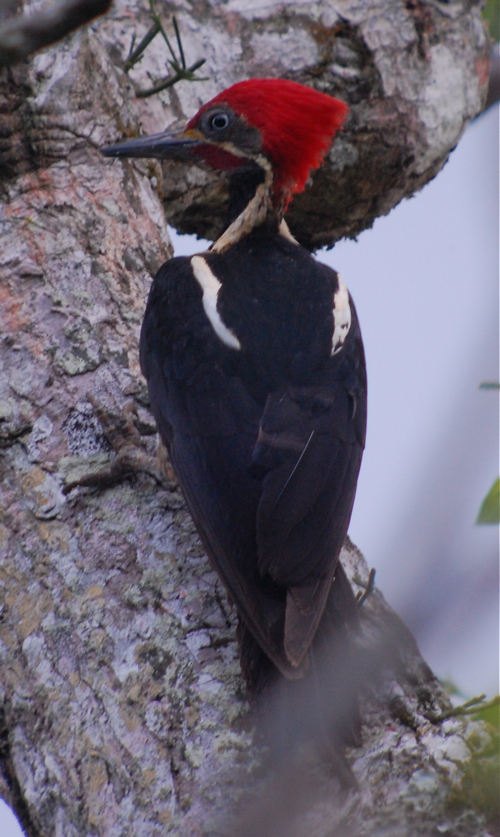
This is a Central American cousin of the pileated woodpecker and about the same size.
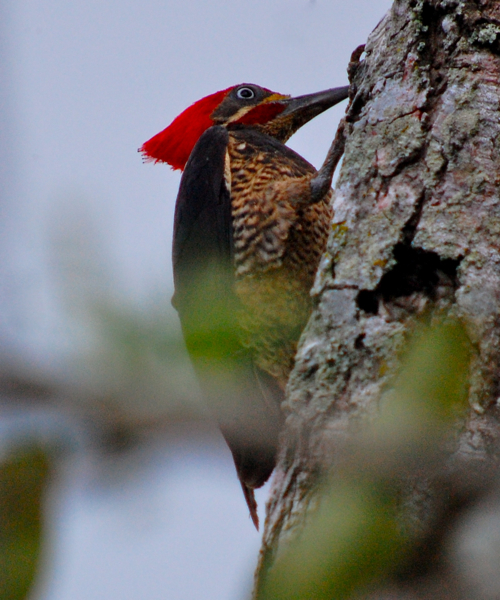
I ended up seeing them on field trips based both from Canopy Tower and Canopy Lodge. They weren't super common but, like a pileated, if you hang out a bit in the places they are most likely to be found, you'll see one.
2 Caracaras In 1 Year
Winter and lots of snow brings with it cabin fever. We have lots of modern conveniences that help ease that tension, like Netflix Watch Instantly and Amazon Streaming and alcohol! You don't have to go to a rental facility, you don't even have to wait for Netflix to arrive in the mail--you can have most any movie...even things you shouldn't watch like Dagmar's Hot Pants delivered right to your tv with the press of a button. But that leads to things like watching Inception several times in a row, which for me leads me to vexing states: either I need a more exciting job or I have no idea what reality I'm living in. Bwaaaaaa. But being cooped up is a great time to go through photos and put them in storage since I'm running out of space on my laptop. I have so many birds that I have not blogged! Holy crap, I completely forgot the caracaras!

One species was observed during the Rio Grande Valley Bird Festival at Laguna Atascosa. I remember looking at their images in field guides as a kid and thinking, "How cool would it be to see one of those?" They are one of the birds that attract me to Texas.

Man, stick a cigar out the side of this bird's beak and you could confuse it with Groucho Marx. I'm not sure if you can make it out in the above 2 photos, but there's a yellow bulge on the caracara--that's a full crop. These birds eat quite a bit of roadkill and will forage for insects too. Man, what must it be like to get a nice big fat food baby in the middle of your chest and then have to fly around.

I have to admit, it kind of grossed me out to watch the bird preening around the bulge.

The second species of caracara I saw in 2010 is a yellow-headed caracara on one of the field trips with Canopy Tower in Panama. I didn't get the weird crop/saggy yellow boob view on this one, but it was cool to see nonetheless.
So random bird blogging coming soon.
Summit Nature Park Panama

I was beginning to think the annual cold that hits me in February might miss me this year, but it arrived unannounced yesterday morning. Gr. As I have been drinking gallons of various instant Thai soups and toddies to rid my nasal cavaties of this beast before Saturday's Birds and Beers, I wondered what might make me feel better. Reading some Isak Denisen? Watching old Douglas Sirk movies? But I decided to go back to Panama.
This trip really stuck with me. I love travel and I'm generally happy where ever I am from a lone prairie in North Dakota to the porch step of my neighbor Zoe to an abandon research station in Kazaskhstan, but when I have quiet moments to myself, I find my brain returns to the platform on top of the Canopy Tower, gazing beyond the Panama Canal and into the unknown of the rain forest listening to unknown creatures in air thick with humidity carrying the smell of lush green leaves.

One place that I really enjoyed was our trip to Municipal Summit Nature Park. Check out those big hanging oropendola nests hanging from the fronds of a palm tree. This was a zoo and park and our primary reason for visiting was to see a harpy eagle exhibit. But what I really enjoyed about this park was that it gave me a chance to spend time with some common Central American birds--they weren't in cages but in the surrounding trees and gardens. Since so many people pass through the park, the wild birds are habituated to people and you could get some great views and photos.

This is a female masked tityra, a cavity nesting bird. She was taking her time selecting the berries ready to eaten. I think this is one of those birds that scientists aren't sure where they fit in the grand scheme of taxonomy. That face with the red skin kind of reminds me of a crane or muscovy.

I think I mentioned earlier that vultures were the most common bird in Panama--like house sparrows. At the park, the vultures (like the above black vulture) flew in to see what pickin's could be had around trash bins and picnic tables. I believe you could throw scraps to some of these birds and they'd waddle right up. They were a bit cagey when I would aim my scope at them, pictures made them shy. It's okay to come to humans with food, not one that is giving you the stare down with a large scope.

We did see the harpy eagle exhibit. I believe this bird is from the Peregrine Fund and has been part of the education and captive breeding program. Some harpy eagles have been released in Panama, not too far from Canopy Tower. I was a tad jealous to discover that one was seen on a field trip after I left the Panama, but sometimes in birding, that's the way it crumbles, cookie-wise. Look at the feet on this bird. This bird has what I would call man hands for feet--that's because they eat big prey...like sloth. There's a famous video of a harpy eagle grabbing and killing a slot. The first time I showed it to Non Birding Bill, he was underwhelmed. He said, "Yeah, it's big but come on, it's a sloth. It doesn't move that fast." But then he saw one being treated at The Raptor Center one day and was shocked by the size of it's toes--they were as big as his hands.
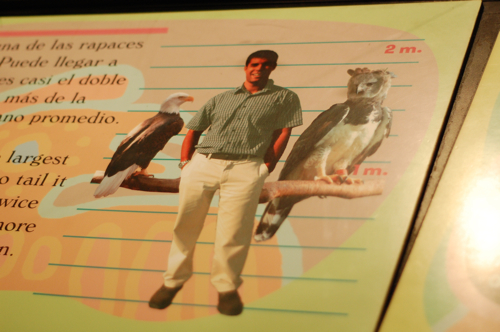
Here's a sign that gives you an idea of the size of the harpy eagle compared to your average guy and a bald eagle. According to The Peregrine Fund a harpy eagle can be between 35 - 41 inches long (huh, I'm 60 inches long) and weigh anywhere from 10 pounds (a male) to upwards of 20 pounds (female). Bald eagles in MN average about 10 pounds. It's a big, cool bird and I was honored to see one in a large paddock if I could not see it in the wild.

Another cool bird we got great looks at was a squirrel cuckoo. I'd seen one in Guatemala and we saw quite a few in Panama. They remind me of a cross between a sharp-shinned hawk and a brown thrasher (they've got the bright red eye like sharpie and the beautiful cinnamon brown of the thrasher). They're huge but like to hide in the canopy. Like many birds, they will fly ahead of an army ant swarm catching bugs trying to flee the coming swarm. Birds weren't the only fun we saw at the zoo, we also got to see some cool little bats:
http://www.youtube.com/watch?v=pN11f_lM3tI
That is a tent-making bat. Here's a photo:

Isn't just the cutest little thing! These little dudes make bite marks along the palm leaf causing it to bend down and create a tent to roost under during the day (hence the name). This species of bat is very tiny and they eat a variety of foods including insects, fruit and nectar. I love that little stripey face.

As we were leaving the park, we got one more bird--a black hawk perched on one of the paddocks. At first I thought maybe it was part of the zoo, but I banged on the cab of the truck to stop. It was a wild hawk that stay perched then flew across the road in front of us. I wasn't able to get a better photo, but it was a great view for my first ever sighting of a black hawk.

I'll leave you with one last turkey vulture shot. This poor guy was trying so hard to preen and kept missing getting his actual feather in this beak. Check it out below:
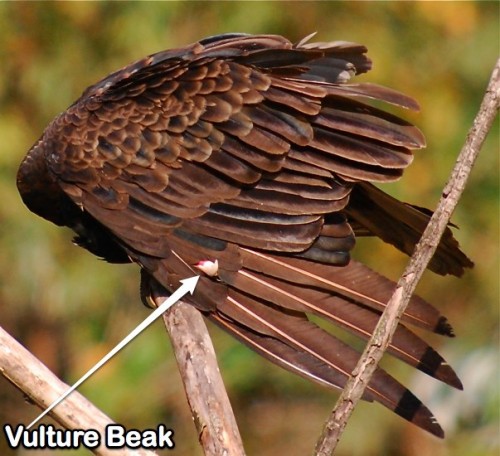
That's gotta be like an itch you can't scratch. Alright, cold medicine is kicking in. Time to stop blogging.
What Kind Of Pede Is This?
Okay, Tai-haku requested more photos of the centipede/millipede to try and figure out the strange id of the Panama bug we saw on one of our bird walks:

Here it is with the toe of my Keens as a size comparison.
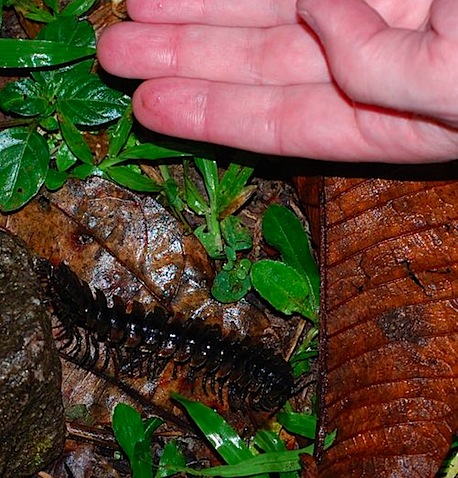
Here it is with my reluctant hand model.

It didn't move nearly as fast as North American centipedes do but maybe the move slower in Central America. Whatever it was, it was huge.
Digiscoped Images
Fresh Tweets
Would you like to hire me as a speaker for your event?
Email sharon@birdchick.com