
Birdchick Blog
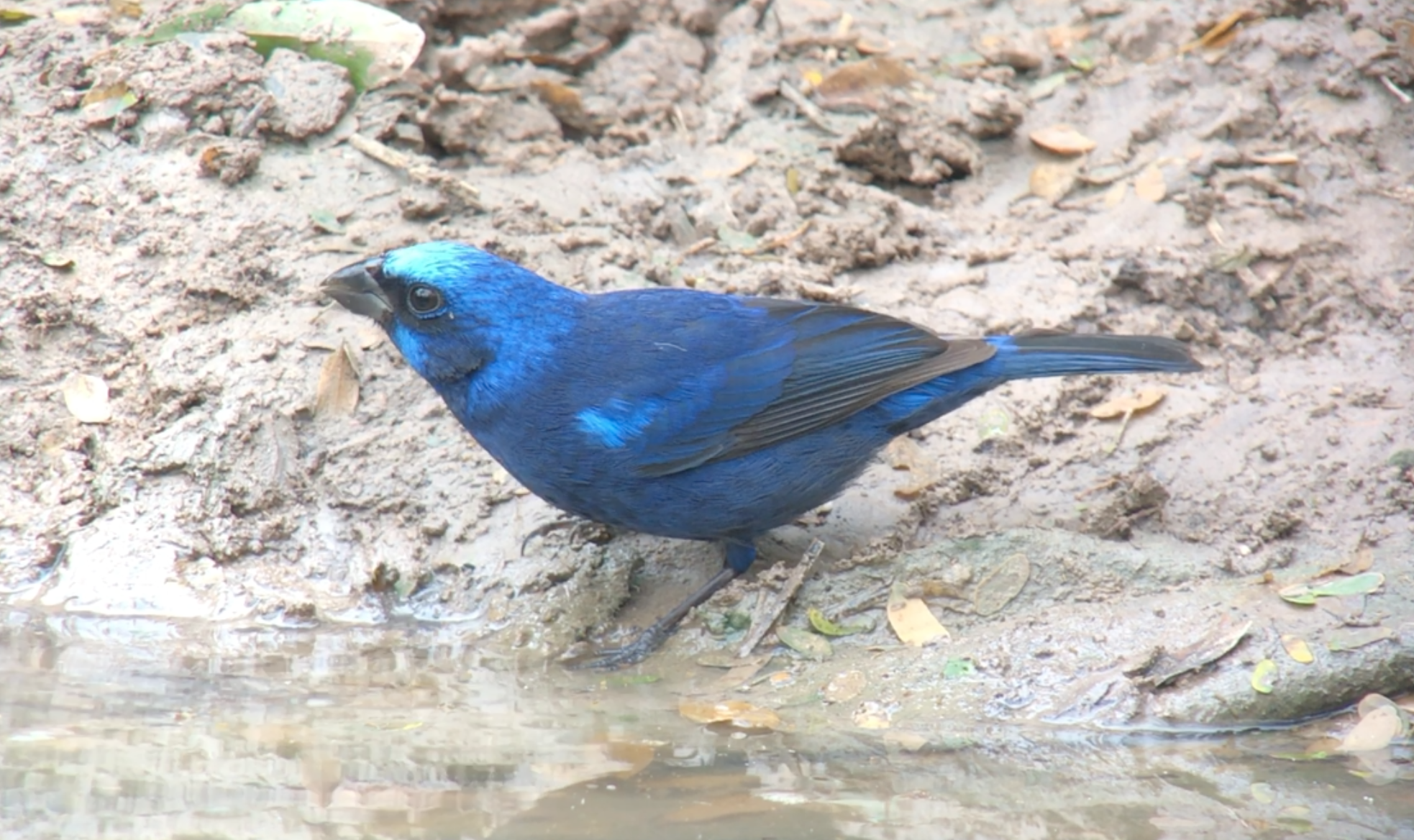
My Lifer Texas Blue Bunting

There are life birds and then there are LIFE BIRDS.
Taking a trip to a new state or country can yield you dozens of new birds in a day. But then there are those birds that catch your eye in a field guide or bird magazine article and you think, “My gods, I want that so much, I need to see it so badly, shut up and take all my money. Show me that damn bird.”
Generally, I prefer to get birds where they are supposed to be. And I’m content seeing birds over and over. The day I’m bored with green jays is the day I hang up my Swarovskis. I’m not one to chase a new state record on the other side of my state, especially if I have seen that bird where it normally lives. I’ll make an exception if it is within ten miles and I know I’ll see friends, but I’m not into chasing that much.

The blue bunting in the National Geographic Field Guide.
When I was working from the Rio Grande Valley, Texas this past winter there were many rarities being reported and of particular interest to me was a blue bunting. I have been intrigued by blue buntings ever since I was a kid and given a National Geographic Field Guide. Whenever I got a new bird book as a kid, I would immediately go to the pages of my favorite birds: scarlet tanager, indigo bunting, pileated woodpecker to see the photo or illustration. When I got to the page for buntings in the National Geographic, I was struck by a bird I hadn’t heard of before called a blue bunting that was even darker blue than an indigo bunting, it looked like it had patches of lighter blue, did the bird shimmer? As a kid I thought that must be something to see.
As I started traveling, I figured it was a matter of time until I would cross paths with one, but alas, my life list was blue bunting free. Sure, there are birds that pop up across the Texas/Mexico border, but they were usually females. I know, I know, female birds are cool too and we shouldn’t just look at the pretty boys, but I really wanted to see how that blue works on that bird. I couldn’t understand from photos what that blue was all about. Was this bunting super shiny?
This winter, one was reported at Resaca de la Palma, about 45 minutes from where I was working. People were posting pictures on social media, eBird was giving me alerts, it was too tempting not to chase. And Resaca is a good park, lots to see there so it’s not like I was going just for the bunting. I headed out and brought my bike along. Masks were still required if you were grouped around the blinds to watch the feeder birds. We waited, and even ran into a few friends who were happy to tell me that they had already seen the bunting. But no bunting ever showed up. Many other great birds did like the usual green jays and Altimira orioles. I decided to hit the trails with my bike and maybe try again the next day—the bike ride was good birding, and yielded a ruddy ground dove on one of the trails.
The dulcet tones of plain chachalaca song serenaded me as I waited hours for a blue bunting to show up to Resaca de la Palma.
I’d arrived a bit late in the day for the blue bunting and word on the birding street was that the bird shows up in the morning. The next day I arrived mid-morning and was told the bunting had just been seen. But it wasn’t seen again while I was there. I had only a couple of hours because I had an online training to do and the reception wasn’t good enough at the park for me to participate from the bird feeders. At this point I was thinking, “I’ve tried twice, let’s not waste any more time and gas…” But I kept seeing pictures of this glorious male posted by people who made the drive down from Dallas or Austin. I was only 45 minutes away. This male was practically a guarantee if I was there at the right time and when would I see one again? Also, we were in a freaking pandemic…what else do I have to do but go birding or ride my bike? The last time I’d gotten a lifer was 2019? Maybe even 2018?
I decided I would give the bird a third try, this time taking some annual leave work. I had a meeting at 12pm so I gave myself from dawn until 11am to get it. When I arrived before the visitor center was open the ranger saw me and said, “It was just here but usually will come back in 45 minutes.”

I actually got this crimson-collared grosbeak at Estero Llano Grande but it’s better than the picture I got at Resaca de la Palma. This species was all over the Valley this winter.
I had a good four hours to play with so I waited and 45 minutes came and went. I saw so many great birds that other people were trying for like the crimson-collared grosbeak, tropical parula, and golden-crowned warbler. Heck, I even saw the orange crown of the orange-crowned warblers as they bathed in the water feature in front of me. It was a weekday and pretty quiet, I mostly had the place to myself, apart from the occasional person looking for a different bird.
“You here for the crimson-collared?”
“No, but it was just here ten minutes ago, I’m here for the blue bunting.”
“Ohhhh man, I had the bunting last week, it’s amazing! Darn, I wonder if the crimson-collared will come back. I need that bird.”
Anther couple arrived and like me, they were going for the bunting. They staked themselves out at a blind to my left and we waited. 10am arrived and I began to wonder if I was going to dip on this bird again. I wanted to see it so badly. I’d already invested about 11 hours of watching and driving trying to get the bird that everyone else seemed to get. And I was seeing GREAT birds too so it wasn’t a total loss but I really wanted this bird. Time was growing short, it was already past 10:30am. I had to be in my car and driving back at 11am to make my next meeting.
Then miraculously…it flew in for some water at 10:45am. I managed to get some video because I wanted to see how all that dark and light blue worked together. Of course the danger of when I get life birds and take video is that it comes with a lot of swearing. But here is the video.
Who doesn’t swear when they get a lifer?
And the blue was insane. The bird looked like it shimmered, even though the feathers weren’t really shiny, so much as the bird has lighter patches of sky blue on its head, cheeks, and wings. It was a combination of blue that no photo can do justice and to watch it move and fly was like watching a piece of electricity flit around trees and dirt.
I drove home, triumphant. I felt giddy. I felt like a huge weight was off my shoulders. I felt like…I’d say I felt like I got a massage, but no, I felt like I’d just had really great sex. It’s not a feeling I get with just any lifer, this was a bird I dreamed about seeing as a kid—it’s colorful bird, it’s not like getting a flycatcher or Old World warbler. This was a highly desired bird. Also, I had gone for it multiple times. And while I waited for this magical creature to show up, I got to enjoy all my Texas favorites. I enjoy winter, but the silence gets to me. Working in south Texas this past winter really hit home how much I need bird song in my life as much as possible.
I lived on the high of finally seeing that damn bunting the rest of the day and well into the next. I could feel the endorphin rush with every breath. I made it back to my computer in time for my meeting. Oddly enough, the meeting I had to attend after getting that bird led me to more lifers, including a nemesis bird.
All in all, it was a great day and writing about the blue bunting still gives me a bit of an endorphin rush.
Overly Dramatic Painted Bunting
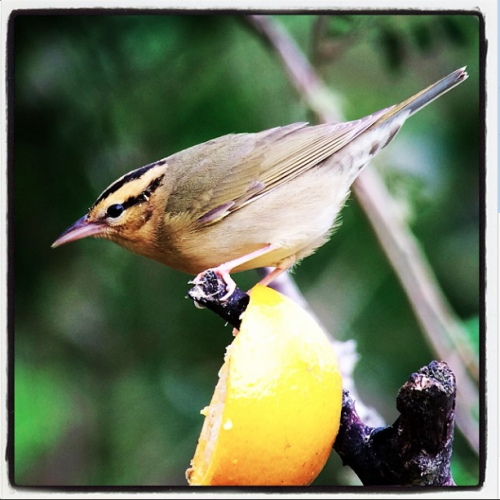 As cool as it is to do work in south Texas during spring migration, things like worm-eating warblers are really distracting when one has serious deadlines looming.
Things have been quiet on the blog and a little bit on the podcast front because I have been knee deep in a fun project with several partners including Swarovski Optik, Princeton University Press, South Texas Nature, Alamo Inn Bed and Breakfast and Birds Eye Birding and well, even poor Non Birding Bill. Here's snippet of some footage I'm putting together for a program Clay and I going to do about it at this week's ABA Convention (it looks better if you watch it in HD):
https://www.youtube.com/watch?v=bS6hbwtaBwU
So what's been occupying my brain? A web series which will premiere May 8, 2014 on my YouTube Channel. It will air once a week for 8 weeks. All the bird footage in each episode was digiscoped by Clay Taylor and me. And on top of that, all the birds in each episode are a clue to the series theme. If you correctly guess what the theme is, you will be entered into a drawing for a Swarovski Spotting Scope (and a few other prizes).
Each episode is only 5-10 minutes long and features a digiscoping and birding tip and a little bit of info about some of our favorite places for birding and designed to be something you could watch on a break at work--so safe for work viewing for sure.
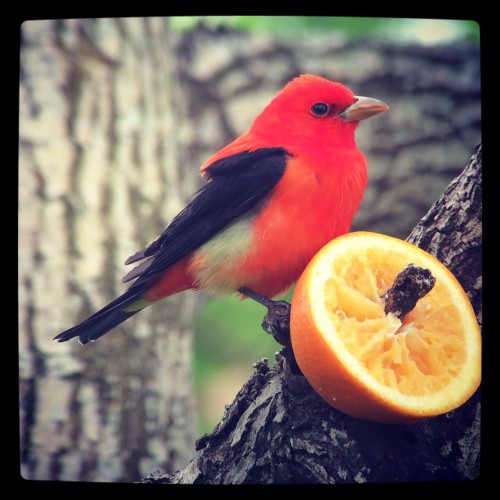
One of the challenges that Clay and I have filming this is that most if it is outdoors and "pretending" to be digiscoping in great places like South Padre Island during migration. That's when we had the above scarlet tanager fly in front of us. Of course you're going to digiscope that...but do I have an episode that it will fit in based on time of year and the series theme? And aren't we supposed to film some dialog? Ah well.
Despite all of the challenges, this project has incorporated all of my favorite things: birds, travel, working with good friends and colleagues and stretching all of my creative muscles. Here's a preview if you haven't seen it yet:
https://www.youtube.com/watch?list=PLj80lDyA_RDBE5og8dgz_UGqugm_8yxvj&v=Mm0OE0aSoV8
If you could share the trailer on your various social medias, I'd appreciate it. I'm hoping this opens the door for other bird series (whether by me or others) to show up on YouTube or other venues. If you want to make sure to not miss one of the 8 episodes, subscribe to the YouTube Channel.
The drawing for the scope winner happens in the 8th episode.
I have to give some major props to poor Non Birding Bill, he's had to travel along with me for help. He even travelled with me to the Rio Grande Valley...during spring migration.
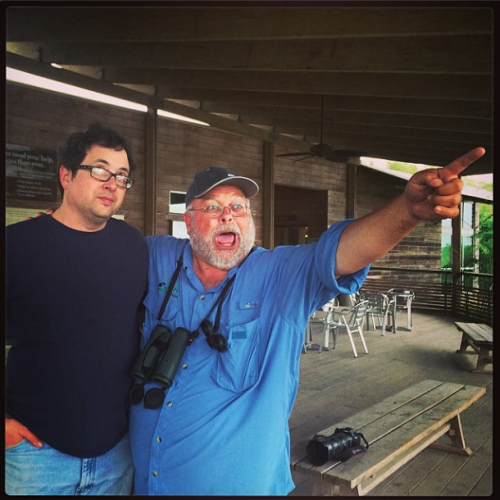
It's weird that so much of my life is on the road and I have a passel of good friends he's never met in person and with this project, he's had a chance. It was also fun to run into the likes of Greg Miller (aka Jack Black's character in the The Big Year movie). Here's Greg trying to wow NBB with birds as Estero Llano Grande State Park. Bill did concede that the pauraques were cool.
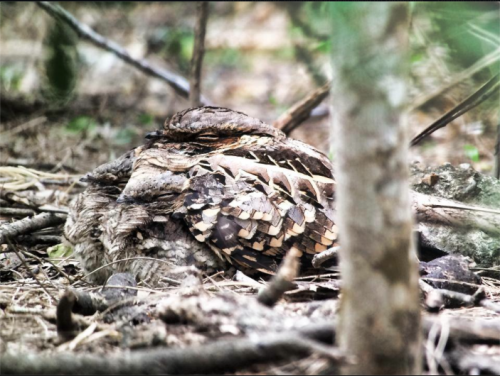
Oh and speaking of pauraques, you know how they're always a possibility at Estero near Alligator Lake? They're currently tucked further back and there are babies! How many birds can you make out in the above photo?
Clay and I had been warned that the birds were tucked a bit. We were trying to find them when one just kind of ambled out and was stretching wings. The bird suddenly noticed Clay and I staring at it in awe and then it scurried behind a yucca--I had no idea those things could scurry. We grabbed our scopes to try and digiscope it, making sure to stay on the trail. We had to practically hand to be on all fours to see her from the trail, but Clay found her lurking way back. With the naked eye, she looked really puffed out. I wondered aloud, "Is she incubating eggs since she's puffed out like that?"
Clay got the scope on her and said, "She's not puffed out, those are chicks!"
Sure enough, she had two chicks snuggling out from her breast--how cool to see that!
Alas, pauraques do not fit into the series theme for the show...maybe this show will be good enough that I can get another series commissioned?
Web Series Teaser
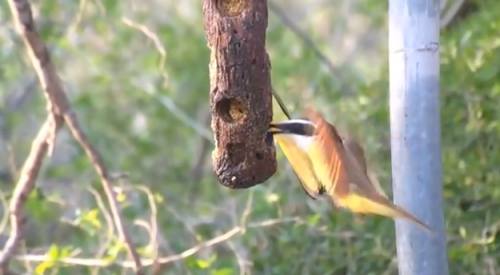 I'm just back from some epic US travel. I've been in California, Oregon and south Texas. Some was bird festival work and the rest was filming for the web series Clay Taylor and I working on for this spring. Here's a little clip of some of the fantastic footage we got while at Bentsen Rio Grande State Park:
http://www.youtube.com/watch?v=42Wfr_gr0jg&feature=youtu.be
This clip is crazy on several levels: the fact I can get slow motion video with my iPhone and you can see how fast the kiskadee zips in and out of the shot and then watch it hover in slow motion to get the peanut butter out of the suet log is just nuts.
If you haven't seen the trailer for our series, check it out. It's not just a nature show, the birds in each episode will be a clue to the series theme. Guess correctly and you will be entered into a drawing for a free Swarovksi spotting scope!
http://www.youtube.com/watch?v=Mm0OE0aSoV8
Final Rio Grande Valley Bird Festival Post
Really, it is. I swear. At least for this year.
 Banding was slow today at Carpenter Nature Center and I spent the morning talking to the Development Director while she repaired nets. Fortunately, I had a chance to observe some banding while at the Rio Grande Valley Bird Festival. Once again, a Sunday morning trip was scheduled to watch bander Mark Conway (that's Mark in the above photo banding a kiskadee) and his assistants band birds at Los Ebanos Preserve.
 Here's a closer shot of the kiskadee Mark was banding. Something interesting that I learned was that all kiskadees have a yellow gape.
 I took a photo of one earlier in the festival and I had never noticed that before and thought it was a young bird, but all kiskadees of all ages have that yellow outline at the corners of their mouths.
 The first bird of the morning wast a gray phase eastern screech owl. The banders weren't targeting owls, but they had the nets up at not long after dawn and this bird was just flying through and flew into the net.
 Here is a long-billed thrasher which I hear way more than see in when birding in South Texas. That bill is not deformed, that's the way they are.
 The best part of the day was getting to see a green jay up close. Last year they banded quite a few and I figured that green jays were par for the course.
 But Mark said that they don't get green jays in the nets very often as they are members of the corvid family and very intelligent. They had not banded at Los Ebanos recently so the birds were just not used to it.
 Mark said that this set a record for the most green jays that they have ever caught in a day: 9 green jays banded--and I never got tired of them.
 Another exciting bird of the day was an olive sparrow--one of the hardest birds to see, you hear them quite a bit. I was glad to have a chance to get this photo because, frankly, my earlier efforts were just plain sad:
 Behind all those tiny branches lurks an olive sparrow at Llano Grande. This was not bad, just finding an olive sparrow sitting on a branch long enough to aim your scope and camera is feat within itself.
 Here, Mark is holding an orange-crowned warbler. These guys are all over in the trees in south Texas this time of year. They're not an easy warbler to see, so when a guide finds one, I think people hear warbler and hope for an exciting/colorful bird. As they search and search, they'll say, "I see a small brownish bird..." Yep, that's the orange-crowned. It's not even as orange as a blackburnian warbler. You may be wondering to yourself, why this bird is called an orange-crowned warbler...

 Here, Mark demonstrates the name. When you hold and orange-crowned warbler about six inches from your face and blow on its crown, you can see a kind of orangish color on the underside of the crest feathers--see how obvious that is? Another one of those birds that was named when bird watching was done with a gun, not with binoculars.
 Here are one of the many great-tailed grackles in the area. When you get them in the sun, they really are a striking bird. You can hear great-taileds singing all over Harlingen, any time of day--even all night long when they are roosting in the trees--how do those guys get any rest?
 They do sound incredibly mechanical as opposed to musical. I wonder how that adaptation sounded, and what must have early explorers to North America have thought hearing those things chatter all night in the trees above them?
 There was also a very exciting bird into the nets--a common yellowthroat, which to Mark are not common but something to study in depth. He thinks that there is an isolated population of yellowthroats that could be a subspecies that he calls the Brownsville yellowthroat. Will there a split some day separating this species of yellowthroat from the rest of the common yellowthroats seen around the United States? If so, Mark will have been instrumental in that research.
 Okay, this doesn't have too much to do with banding, but there were quite a few anoles running around during the banding program and this guy with the wavy tail caught my eye. I wondered what happened to make it look like that? Did appear to slow it down in its daily travels.
 And so, I leave you wit one final green jay photo, because they are just so darn cool looking. I'm very excited, it looks like we will be able to go out with Mark one day on the South Texas trip next year, which would be awesome for the group and great for me to learn different banding techniques from different people.
Digiscoped Images
Fresh Tweets
Would you like to hire me as a speaker for your event?
Email sharon@birdchick.com