
Birdchick Blog
Oklahoma Porcupines
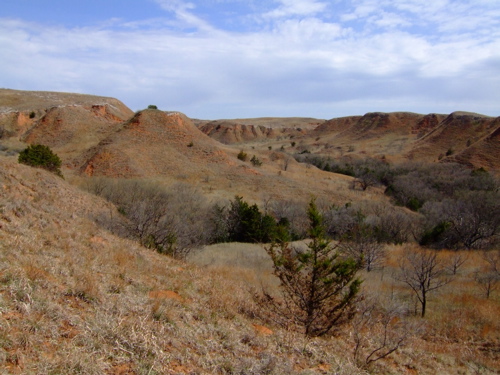
One of the fun things about the Lesser Prairie Chicken Festival that I attended in Oklahoma was the opportunity to see an area owned by The Nature Conservancy normally closed to the public called Four Canyon Preserve. It wasn't very bird--the top of the canyons were so windy, you could barely hear any song, but the views were stunning and a reminder that Oklahoma is not all flat land.
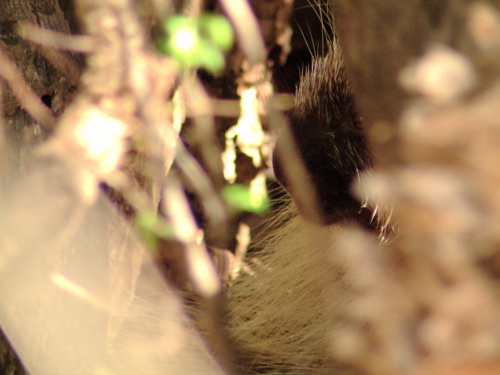
Though we did not see much in the way of birds, we did see some porcupines. I grew up in Indiana and didn't have much experience with porcupines until I moved to Minnesota. I don't have mammals on my radar quite like birds, so I just assumed in my head that porcupines were a northern species. I did not expect to encounter in them in Oklahoma. However, I did notice a couple of dead ones on the road as soon as I arrived.
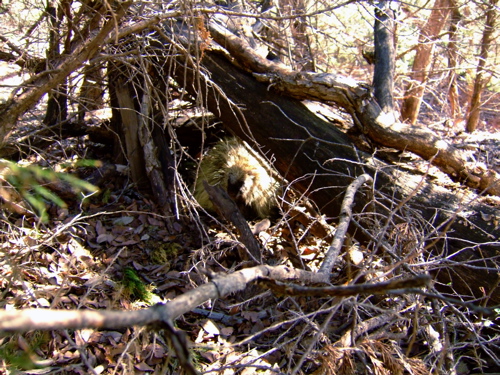
When I came home from the trip, I looked through one of my mammal books and was surprised to find that their range extends all over the western US. One of our birding group noticed this porcupine lurking under some cedars. At first, the porcupine only showed its backside, but I stayed behind while the group continued on the trail. When it was quiet, the porcupine turned around.
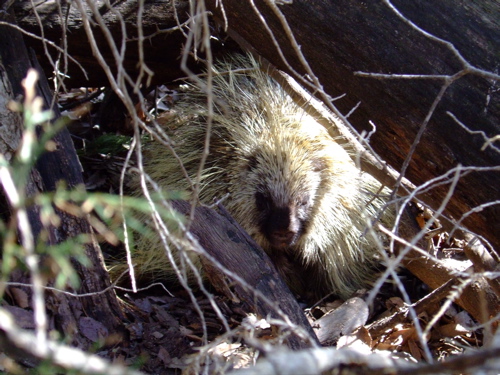
I slowly snuck in for a closer look. Apart from the now famous porcupet that my friend Gail took care of, I've never spent too much time up close with a porcupine. I moved slowly and quietly, the porcupine was sort of cornered in this nook. I'm sure it realized it had the upper hand in the situation. Porcupines cannot shoot their quills out, but if it decided to charge and run past, even brushing my leg would leave me with a few quills. But it seemed chill and I didn't dilly dally with my photos, just a few quick snaps and then I went on my way to catch up with our birding group.
Oh, and for those curious about how female porcupines are able to give birth without getting "quilled," it because the young are born with soft quills that harden within about two hours after coming out.
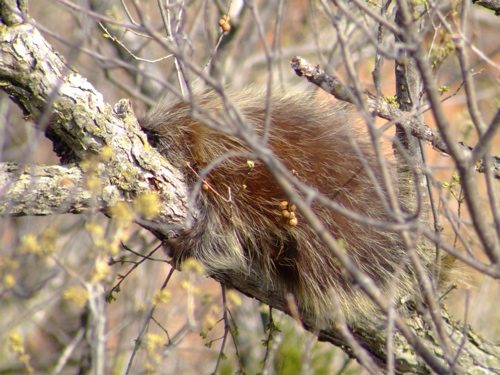
From the top of one of the canyons, we looked down and I spotted another porcupine sleeping in a tree. I read in one of my mammal books, that many porcupine specimins in museums were found to have healed fractures. The speculation was that while porcupines are known as good climbers, they might also be good fallers too. Perhaps they fall out the trees and just learn to deal with the injury?
While we watched this critter, our guide told us that there were many porcupines in Oklahoma and many ranchers shoot them because porcupines chew the bark on trees, making them look bad. It's funny that some ranchers don't like the aesthetics left behind by a porcupine since I have had the same feeling about the aesthetics of some of the overgrazed prairie we passed.
Lesser Prairie Chicken aka Jets vs Sharks
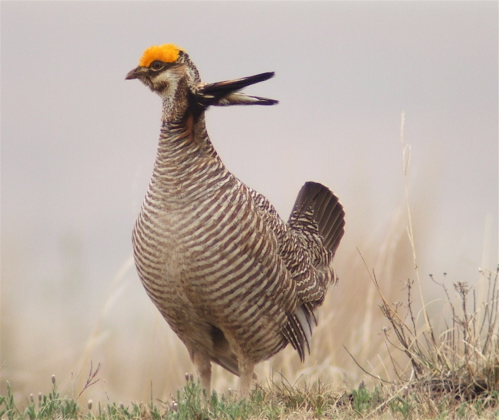
I'm wrapping up my time in Oklahoma. The Leks, Treks, and More lesser prairie chicken festival is still going on with a cool post tour to Black Mesa, but I have to return to the Twin Cities to do some park rangerin' tomorrow. The festival had birding trips surrounded the Woodward area, but the main thrust of the festival was the lesser prairie chicken.
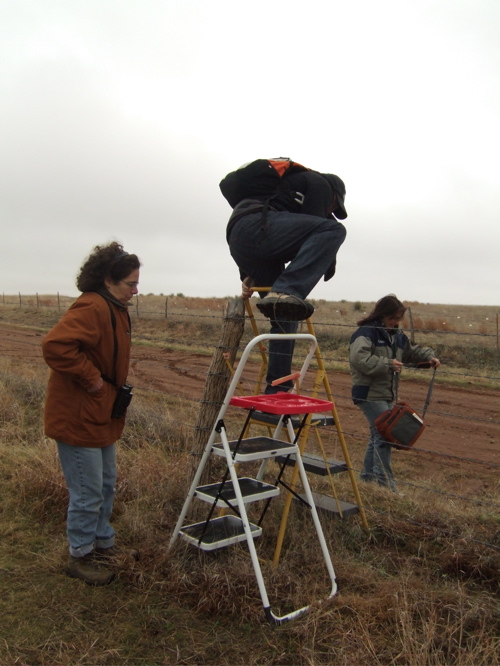
My first morning at the festival, I met the group at 5am to ride out to the Selman Ranch to get to the blinds. There had been some concerns about the rain that had recently fallen, making many of the unpaved roads we were taking a bit treacherous, but our experienced drivers got to us the area with the blinds. We had to scale two step ladders over a barbed wire fence...only this is a photo of when we were leaving, when we were on our way to the leks, we had to do this in darkness, the sun was not up yet. The leks we visited were on private property, cattle ranches.
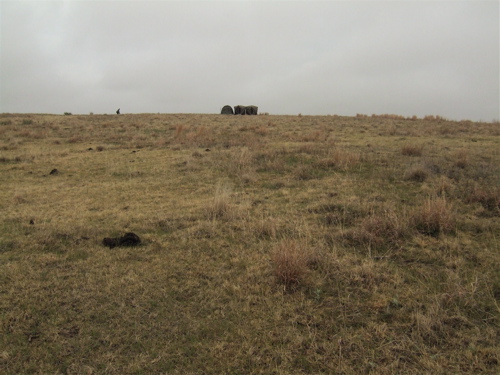
These were the portable blinds we sat in on the prairie. Winds in Oklahoma are fierce and the blinds were staked deep into the ground. We sat three to a blind and I actually ended up in a blind with two fellow bloggers: Drawing the Motmot and From The Faraway, Nearby. I was a tad nervous, I discovered that morning that I forgot my deodorant and my toothbrush, I was going into the blind and hoped it would stay cool enough so I wouldn't stink up the joint.
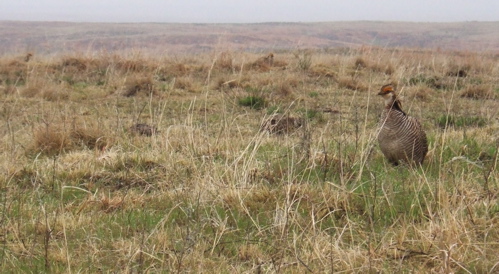
It did stay cool, it felt like it was in the 40s, which was a treat for me, some greater prairie chicken viewing has been in 10 degree weather, so above freezing was a pleasure. The birds were so close, that we really did not need binoculars. I took this photo from the window without my scope. We arrived in the blinds in total darkness and sat waiting for the birds to start their display. I huddled beneath my layers, listening to all the sounds around us. Cattle waking and beginning their deep mooing. Turkeys gobbled in the distance, then we heard the gobbling of the chickens.
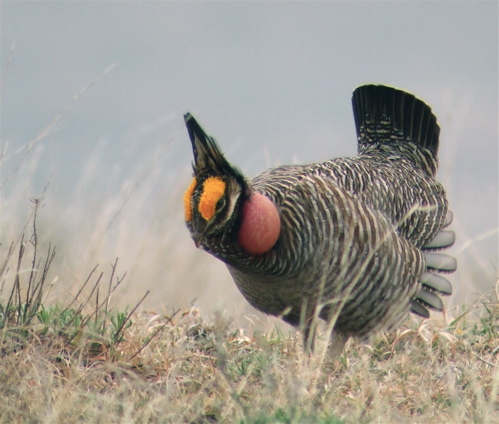
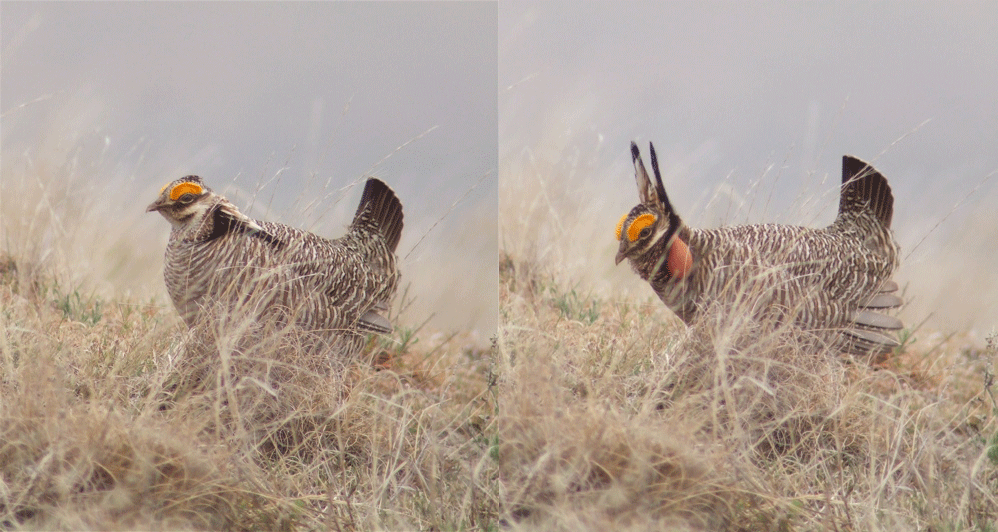
As the light in the morning grew brighter, I could get some photos of the male. Cornell Lab of Ornithology describes this interaction as, "Males display by exposing and enlarging the superciliary eye-combs, elevating tail to highest extent, erecting pinnae and positioning them forward and parallel to the ground, drooping wings and spreading primaries, extending neck and head in forward position, stamping feet on ground and moving forward, and expanding esophageal air sacs and producing Booming vocalization"
If that was hard to read or understand, Non Birding Bill made this animated giff of a "Before and After" of a male lesser prairie chicken displaying:
You can also watch a video I took of the behavior too (and more importantly, hear the sounds of these crazy dancing chickens).
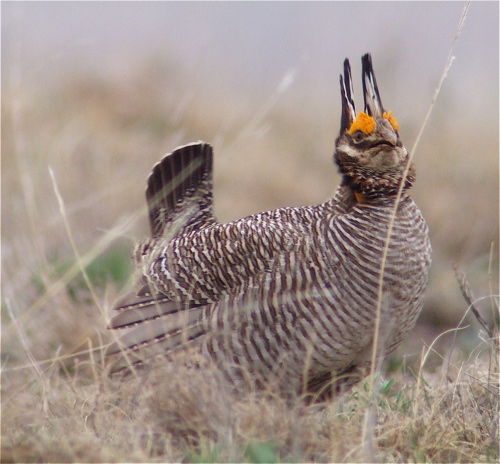
The males went at it for a good hour. The danced, fluttered, squabbled, and stamped their feet in their individual territories. Periodically, a male would run over and challenge another male. They would bow and display to each other, almost like the start of some odd square dance. Some times there would be a display and the birds would walk away or sometimes, things would escalate into full on fighting with a few feathers left hanging and falling in the aftermath.
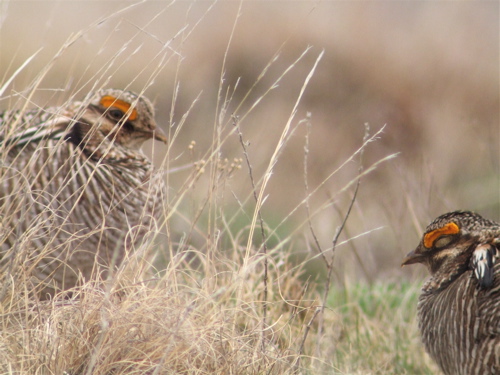
The males displayed themselves into utter exhaustion. I know how winded I can get on a dance floor and I'm just doing it for fun. These birds are doing it...sort of like the guys in the musical West Side Story. They are dance-fighting out their issues, nonstop without eating for several hours. These two males were bowing to each other and the male on the left, appeared unable to keep his eyes open, as if we were saying, "Dude, I'm too tired, let it go."
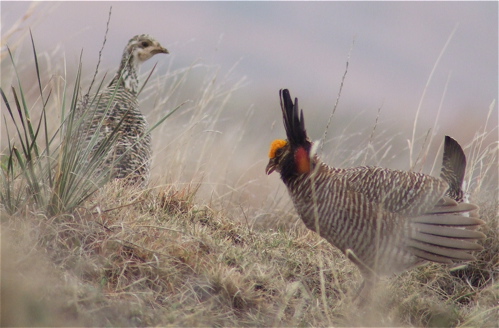
However, as soon as a female appeared on the scene, every male immediately woke up, it was as if all them were instantly injected with Red Bull. Their displays became more frantic and they ran back and forth around the female displaying their virility. We saw about three or four females approach the lek throughout the morning, it was interesting to watch their behavior. When a male approached, the female would hide in grasses and preen. If a male gave up, she would stop preening and watch the displays, I wondered what in the displays she was hoping to see--the size of the yellow pouches? The droop of the wings? The sound of the gobble?
I only saw one female select a male and attempt mating. That was the video I posted earlier...where we had some "male chicken blocking" going on. Considering how quick bird mating goes, that second attempt was probably successful in fertilizing on egg.
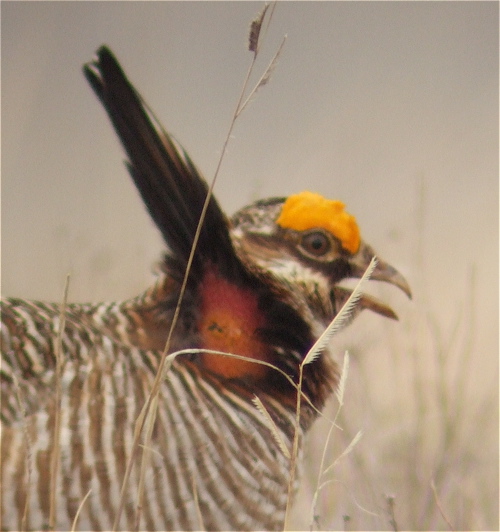
I did notice one male who apparently had some pouch issues. Do you see it? He has a hole. This most likely occured during one of the many fights we witnessed. Lesser prairie chickens have a sharp beak, so a good solid peck would damage the pouch, affected the gobble sounds and reduce this male's chances of mating with a female.
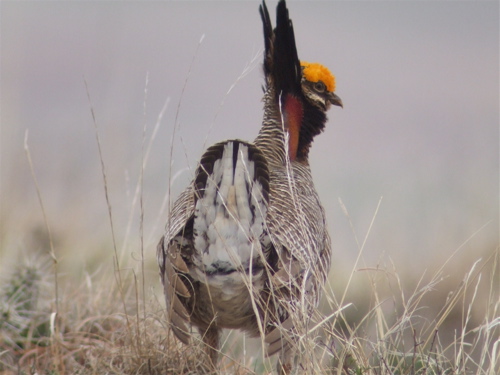
All in all it was a pretty cool experience and I loved hanging out in the blind and just watching one bird and absorbing its behavior. It was a treat sitting next to an artist and watching her sketch the lesser prairie chickens. I admire the ability to do what looks like a few simple strokes and capture the essence of a creature. Her sketchs also capture the movement and mood of the chicken. Here is a link to Drawing the Motmot's lesser prairie chicken sketches that she made in the blind--so cool.
Crap, I just looked at the time, I need to pack for my flight back to the Twin Cities, more Oklahoma adventures coming later!
Lesser Prairie Chicken Attempts At Mating
This has been a very popular video at the Leks, Treks, and More Festival in Woodward, OK. It's a video from the lesser prairie chicken lek. I female has found a male she likes and attempts to mate with him. The other males in the lek are not happy about this.
Digiscoped Images
Fresh Tweets
Would you like to hire me as a speaker for your event?
Email sharon@birdchick.com