
Birdchick Blog
Picking My Battles With Bird Photos
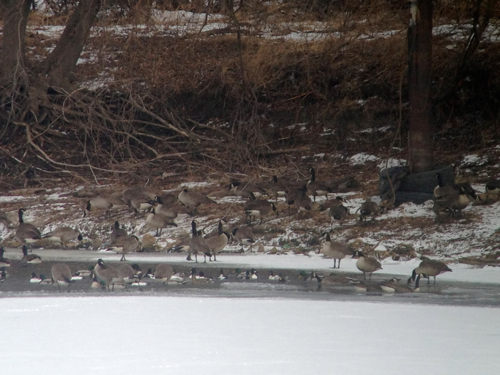
As I do my competition for the Big Half Year, I know this issue is going to come up again and again. Which photos to count? Above is a very mediocre or what I would call a documentation photo that I got at Pig's Eye Outflow in St Paul this week. There's identifiable common goldeneye in that shot...but would I get a better photo later. Who can say with my crazy schedule and migration. You really never know with birds and this may be as good as it gets goldeneye wise with me. I know my buddy Craig Nash is insisting that all my photos be in focus to be countable (unlike The World Series of Birding rules). But would the above photo count.
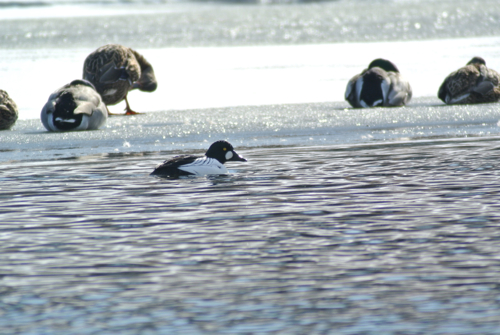 And then I went to Lake Rebecca in Hastings, MN and found a lovely albeit backlit goldeneye. I bided my time and worked my way around the lake to see if I could position myself to have the sun behind me instead of the goldeneye. When I do something like this, I try to walk in a way that the bird doesn't notice. I'll look in the opposite direction of the bird and even make sure that my scope's objective lens isn't facing the bird as I carry it. If I stared at the bird the whole time, the bird might become suspicious as to why I'm staring at it, I'd look like a predator.
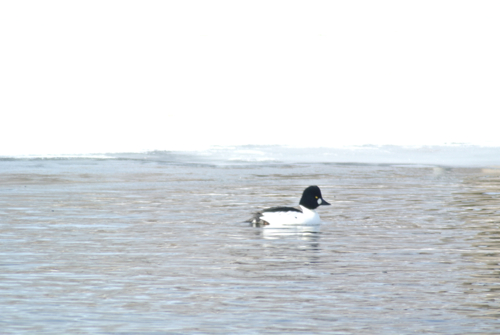
I eventually found a better position on the lake...but then the camera flaked out and under exposed the crap out of it. But a few adjustments in the settings and viola:
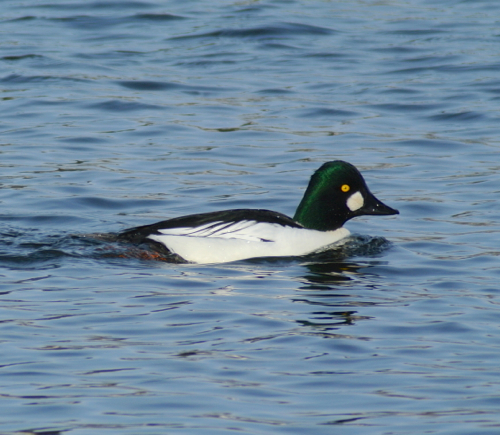
A reasonable common goldeneye photo and bird number 15 for my Big Half Year fundraiser for a Sax Zim Bog visitor center!
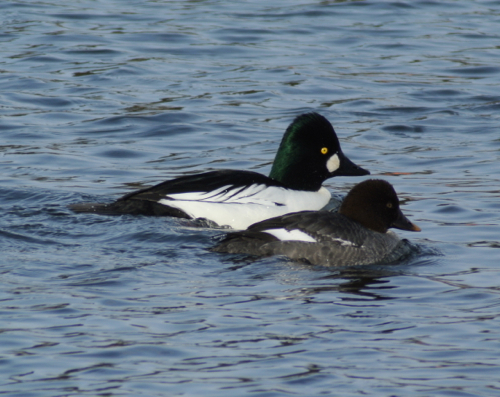
He even found a female goldeneye to hang out with on the lake.
This lake has a large population of mallards and Canada geese (and even a young trumpeter swan) hanging out. It's a popular town activity to bring your kids and a bag of corn or bread and feed everybody. I wonder if the goldeneye notice the mass exodus of waterfowl when a car pulls in and wonder what the fuss is about. These ducks are fish eaters so the corn and bread is wasted on them. But the goldeneye's presence is a good sign for ice fishermen who tempt fate on the frozen-ish side of the lake.
Here's a link to the Flickr and I cannot say this enough: thank you to everyone who has donated so far. I had absolutely no clue what I'd raise with this thing and seeing it past the $250 mark is an honor. With all the participants, the fund is already at 15%! That's fantastic--we have until June 30, 2013 to make the goal so to be at this point before the end of January--is fantastic!
Digiscoping with an iPhone vs SLR
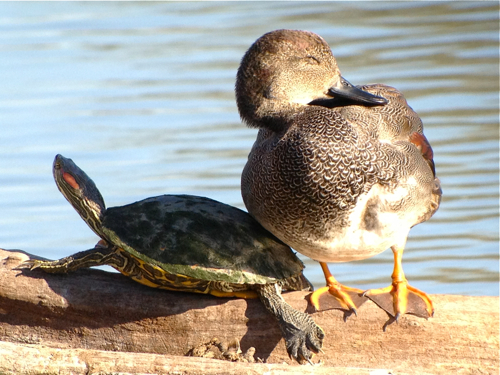
I digiscoped the following photos using both my Nikon D40 and my iPhone 4s with my Swarovski Scope. Can you tell which ones are the iPhone 4s and which ones are the Nikon D40 photos? 1. Green-winged Teal
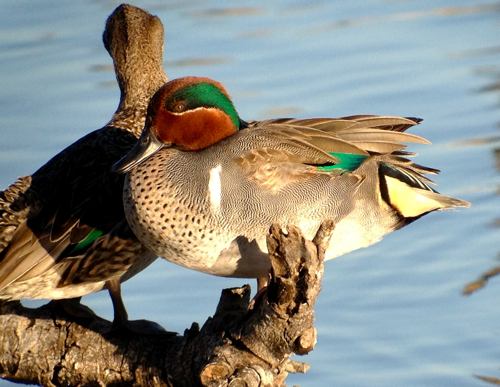
2. Northern Pintail
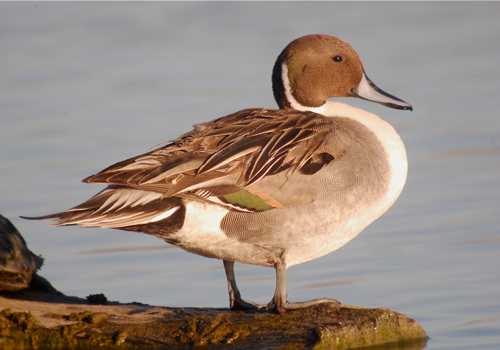
3. Red-eared Slider and Gadwall
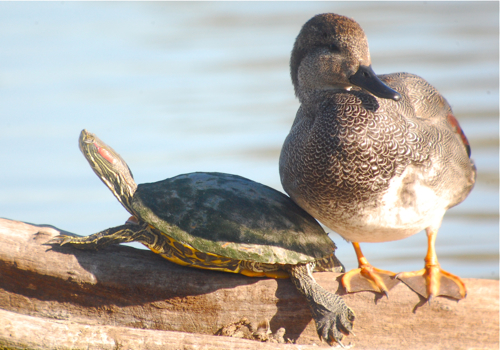
4. Red-eared Slider and Gadwall
Redhead Shenanigans
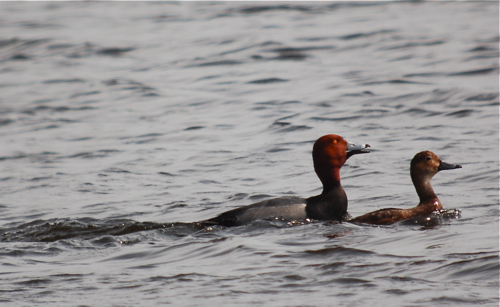 This is a pair of redheads (a type of duck) seen during last weekend's Horicon Marsh Bird Festival. Horicon Marsh is over 33,000 acres in size and at first glance it may appear to be managed for Canada geese and muskrats, but redheads are one of the main targets for optimizing habitat.
If you are not familiar with any other duck but mallards, you should really get to know the redhead. Rather than the usual green head of male mallards, they have a gorgeous rusty red head. And they don't quack...they kind of sound like crows that have swallowed helium--what's not to love?
Check out the above photo, that is some serious redhead flirting going on--that kind of "my head is higher than your head" posture. Don't worry if you are reading this at work, that's not the hardcore flirting. For that they completely throw their heads back.
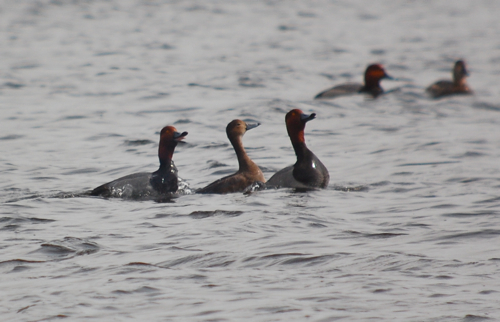
Here's an example of a couple of male redheads competing for the attention of a female. I love this look of who can raise their head the highest in the above photo. For some reason, it reminds me of Kanye West.
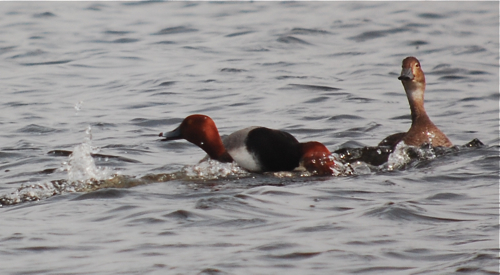
But then things can get heated between 2 males. Note how the female is observing the fight.
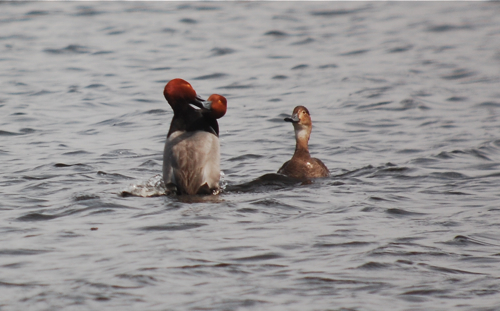
The redhead with 2 backs! (How many times am I going to make that joke this week?). Two males duking it out.
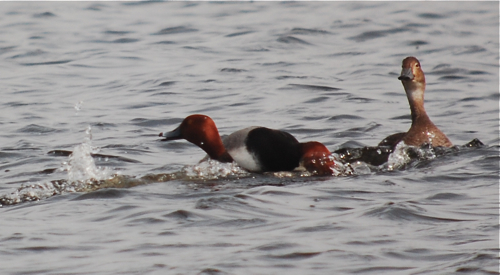
Oh no, redhead body slam! Again, note how the female is watching with a discernible eye.
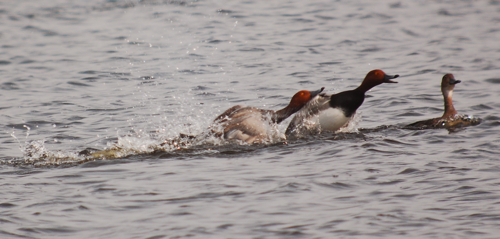
Oh no, redhead chase!
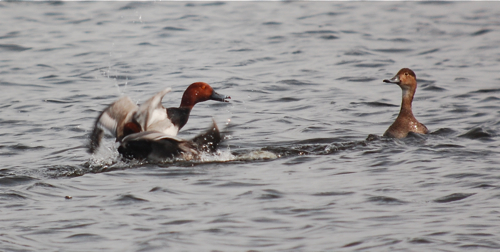
Uh oh, is that a redhead goose? Is that allowed?
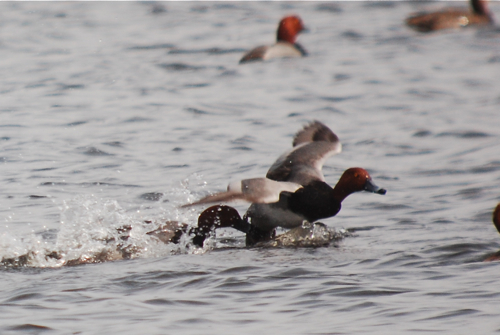
Oh man, that is a total redhead goosing.
All part of the mating shenanigans you can see at Horicon Marsh!
Birding By Bike
Birding got the better of me yesterday--you will note there is no podcast today. I had my day all planned out, serious writing to do, if I got to certain point I would ride my bike for exercise, then tidy up the kitchen, mop the floor, make dinner, record the podcast and then bed. The siren song of 70 degree weather and spring migration poved to be too much. I got to a good point on my writing and changed into my bike gear. I realized that all of the lakes near me iced out the day before so waterfowl would be a good possibility. I figured out a safe way to strap my spotting scope to my bike...tucked my camera for digiscoping into my backpack and hit the trails. What only should have been an hour long ride turned into three.

Cool waterfowl were all over Lake Calhoun and Lake Harriet. This is part of a mixed flock of red-breasted mergansers and horned grebes. I about wiped out on my bike when I saw this flock close to shore. The trails were so packed with Minnesotans walking and riding that I had a tough time getting a photo without someone jogging in front of my camera. As I was watching this flock, I heard a guy tell his friend, "Hey the dog wants to run, I'm gonna jump him in the water here."
"Pardon me," I shouted to get his attention. "I'm actually trying to watch those birds right in front of us, would you mind using a different stretch of the 3 mile trail around the lake?"
He hadn't noticed me or the birds, was very apologetic and gladly jumped his dog further down the trail. I could understand, I'm oblivious to people around me when I watch birds and the lake trails were so packed, I could see how someone might think a bird watcher would be no where near this place.

Here's a photo of a pair of male red-breasted mergansers. I have to say, that when my single female friends lament about having trouble meeting someone, I always try to suggest birding. If you want to attract attention, go to a crowded lake with a bike and a spotting scope--guys come of out of the woodwork to talk to you...although I have to wonder, is my butt in the biking pants or my Swarovski that really gets their attention? Most of the people who came up to me wanted to know if I was watching the loons. I'd seen the loons, but they were further out and the mergansers were closer. One guy kept trying to get me to move my scope to watch the loons (which is a refreshing change, normally people want me to look at that bald eagle on the other side of the lake). I kept insisting that I was really into seeing the red-breasted mergansers which have a more Dr. Seuss look than the loons.

I did find a pair of loons very close to shore on Lake Calhoun. I planted myself on the ground to snapped away. Nothing like watching the elegant and deadly fish killing machine in bright sun.

As I took photos, one of the birds yodeled loudly and everyone on the trails stopped moving and stopped talking momentarily. Everyone had to pay attention to that haunting sound. It was cool to hear it and even cooler to see everyone around me to pause and take notice. How strange and wonderful it was to hear it with the Minneapolis skyline in the background, this bird so associated with the remote northern woods and lakes. I overheard a nearby jogger say to her companion, "That really did sound like a loon, that must be what those birds are out there. Wow!"
I'm so grateful when I find loons in the metro area, especially biking distance from my home. When I first moved up here, I expected the state bird of Minnesota to be as easy to find as the state bird of Indiana was. It was actually a year or so before I got to experience a wild loon. There seems to be a pair that hangs out all summer bouncing between the Chain of Lakes in Minneapolis. Maybe one summer they will successfully nest and fledge a young loon?

I don't know that I got much in the way of exercise since I stopped to watch birds so many times, but it was totally worth going out. I don't regret my dirty kitchen one bit (I made Non Birding Bill fire up the grill for dinner instead).
Next podcast will be Friday for sure...it's supposed to get nastier weather later this week so no migratory distractions.
Snow Storms During Migration & Goose Collars
True to form, our great state of Minnesota received a dumping of snow yesterday. The nice thing about March snow storms is that they melt relatively quickly. Even the city gets slack about it, "Eight inches? No Snow Emergency or parking restrictions, it will melt, deal with it." But many people wonder about those early spring migrants and how it will affect them? Over the weekend, my buddy Clay Taylor and I were at the National Eagle Center and we tallied all sorts of early spring migrants--even tree swallows. What do insect eating birds do when they get back early and have to contend with several inches of snow? Yesterday, Michael Bates sent me a photo of a woodcock he found in his yard during our Minnesota snow storm.
So, what do early insect eating migrants do when they come back early? They adapt. Woodcocks eat mainly earthworms, but according to Birds of North America Online the will eat some vegetation. Same with tree swallows, they will eat berries if there are no flying insects to feed on. That's all part of the gamble of coming back early to get the prime territory, if you can find something to keep you going for a few days, you'll get the best territory. Not all bird make this, it's part of what makes migration so fascinating.

Here are some Canada geese who found a puddle of open water amid the snow at Lilydale Park in St. Paul, Mn. These were part of a flock that included about five neck banded geese. All of the numbers were sequential, so I wonder if this is a family group banded last summer that's migrating together. I turned in the band numbers to the Bird Banding Lab and I'm curious to find out where these birds were banded.

Remember this goose? This is a banded Canada goose that I saw at the confluence of the St. Croix River and the Mississippi River in December of 2009. I submitted the record with a note expressing concern about the tightness of the collar on the goose. It's been over a year and I haven't heard a thing. I found a page about goose color bands with some interesting info just based on the color of the neck bands and the characters on it:
"Orange and Blue collars are widely used in the Mississippi Flyway. These collars were part of an extensive effort to track the populations and movements of Canada Geese. Orange collars were used in the Canadian portion of the Mississippi Flyway, and Blue collars were used in the US portion of the Mississippi Flyway."
So, sounds as if this goose is also a Mississippi Flyway bird. Then, I got an interesting email last week from Erik Collins:
"I was birding at Pt. Douglas Park today and saw a Canada Goose with a blue neck collar that had "617A" on it. I got home and searched online for information about blue collars on geese. This link from your site came up.
The goose you photographed with the super-tight collar in December of 2009 was the same one I saw today! Thankfully, it looked a lot more comfortable.
Thought you would find this interesting."
I found it very interesting that someone else saw the goose over a year later alive and well and the collar looking comfortable. Must have been extremely cold that day and the goose's neck feathers were super fluffed.
I resubmitted the sighting a second time with a note saying that as someone who has volunteered with bird banding projects, I understand that it can take awhile to turn in banding entries, but over a year is a bit much. When I received my acknowledgment of the color band submissions from the BBL, I noticed this in the email:
"We cannot predict or control the nature of the response you will get from the bander, although we do make them aware that color marking authorizations carry with them an obligation to respond to the public. Many color marking projects are designed to study only local movements, and the bander may not be interested in reports from afar."
That's such BS. If you put a collar on a bird (so bright that even non birders notice) you should have a system in place so if the goose goes where you don't expect you can at least send out some basic info in an email. I'm not expecting a long response, but I would like to know what state this bird was banded in and what year. It would be nice to know that bare bones info of how old this bird is and where it has been.
By not responding to neck band reports, a researcher could discourage people from ever turning in any band that they find--what's the point if no one responds? That certainly is not helpful to fellow bird banders. Also, a lot of people who don't understand banding do not like it and think it's cruel. Not responding to banding reports only reinforces that idea.
I don't see what's so hard about turning in the date and place of where you banded a bird so the BBL can at least let the person submitting the band number know the basic info. Heck, just create a document with your study's theory and copy and paste when you get a neck report.
At any rate, I'm glad the blue neck band hasn't interfered with the bird's survival and we at least know it's still a year older.
Gratuitous Grebes!
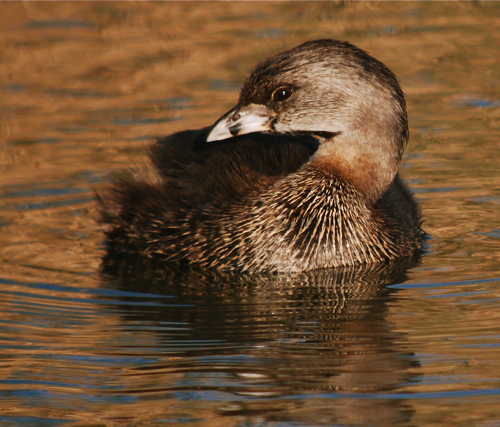 One thing I love about visiting southern states is that some of the birds I see in Minnesota are so much more camera friendly. Pied-billed grebes are shifty in Minnesota, they don't trust anyone staring at them for too long or they submerge and resurface further away. While in Corpus Christi, my buddy Clay took me to a place with a ton of great waterfowl and some rather obliging grebes. The above bird is an adult pied-billed grebe.
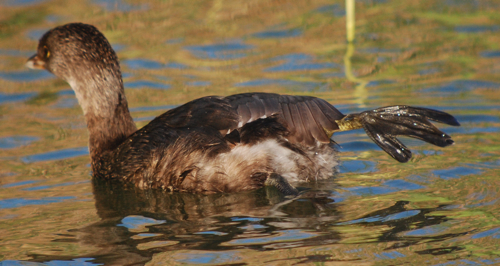
They even showed me their grebe toes. How do you like them apples, not webbed like a duck at all. Let's get a closer look:
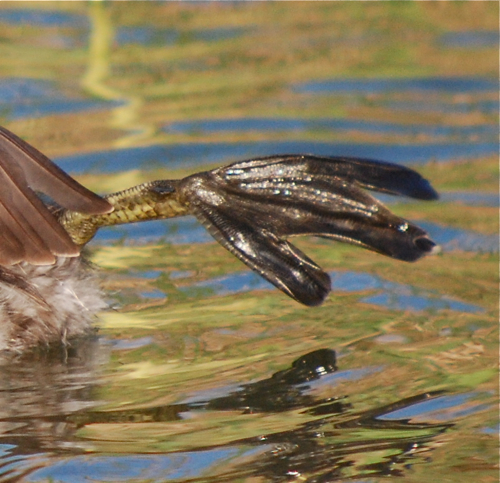
Look at that crazy foot...wonder if this will lead to a slew of foot fetish comments getting clogged in the blog spam filter? The feet of the grebe are far back on the body and the lobed toes do aid it as it swims underwater. They really can't walk on land very well. Ask yourself if you have ever seen one on land?
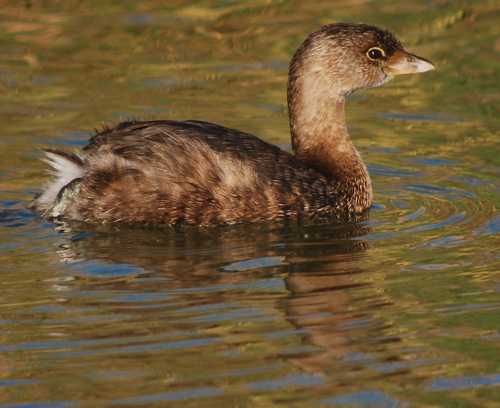
Here's a first year pied-billed grebe--it barely has any pie on its bill.
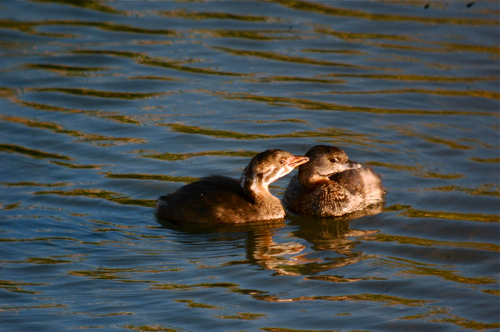
This grebe was so young that it still had the stripes on its face and was begging for food aggressively from its parent.
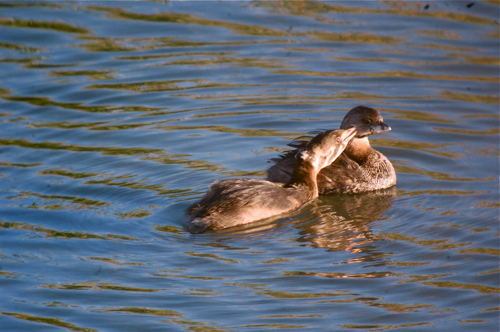
The adult bird was trying to preen its feathers, but the younger bird pecked and pecked while peeping in a high pitched tone incessantly. Periodically the adult would nonchalantly reach down, grab a minnow and hand it to the begging young and then go back to preening. I wonder how the adults teach the young to get their own food when the young are this aggressive when they are about the same size as the adult. Perhaps the adults just flee in terror of the incessant begging?
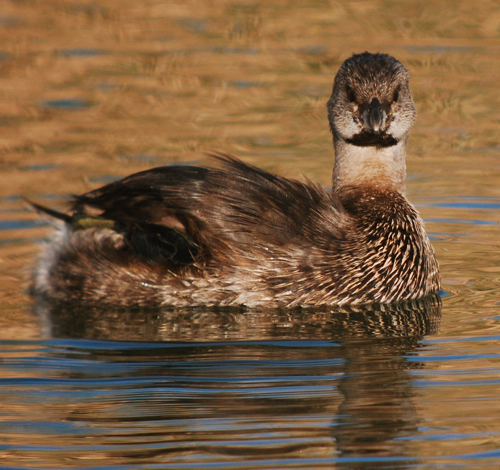
Anyway, it was fun to spend time with brown birds with freaky toes.
Digiscoped Images
Fresh Tweets
Would you like to hire me as a speaker for your event?
Email sharon@birdchick.com