Birdchick Blog
For Teageeare
Who tells me that I don't put enough Kabuki in the blog: Here is my cranky little cockatiel, eyeing my inbox, hoping I will not notice if he pulls out and chews some paper. He and Cinnamon are about to go an a small adventure. We're going to dog sit for the next few days and we're bringing the pets with us.
 I can't believe blogging escaped from me for a couple of days--it turned much busier here than I had anticipated. Next weekend should be about the same. I took Cinnamon with me to Carpenter Nature Center on Friday. I got an email a few weeks ago from some blog readers who said they might join us for banding. They asked if Cinnamon would be there and originally I had said no, but Thursday night and Friday morning, she was doing all those things that say, "Hey, mom, I need some stimulation." ie - digging in her litter box and sneaking into the kitchen. So, on went her leash and she went with me to Carpenter and found a whole slew of new things to disapprove of.
 Even though we can still get her to put on the leash and harness without too much of a fuss doesn't mean she tries to chew and whip it off when she thinks I'm not looking.
 We're getting in quite a few of the summer residence. Above is a male robin we have had in the nets twice this summer. You can tell he is male by the dark head and the darker rusty breast. Boy, he really looks unhappy in this photo.
 We also got in this hairy woodpecker. Notice anything strange about him? Check out his red patch--it's on the front of his head and not the back--a way you can tell if the bird just hatched this year when it is at your feeder.
 Cinnamon was not as impressed with all the banding going on and was way more interested in exploring all the prairie grasses. Just by hopping in a few feet, she would completely disappear.
 Apart from the leash, the only other way you could tell she was in there was by watching a tall piece of grass waver for a moment and then fall over as she had chewed its stalk. She was almost on sensory overload with the abundance of chewables at her feet.
 To a blade of grass, she's kind of a scary looking monster. Afterwards, she kept me company as i scouted for a field trip that I was leading on Saturday. Which I will blog about later tonight. Right now, I have to go out and check on the bee situation...have I prevented a swarm...will the Olga hive be ready for a queen excluder...what wonderful bee adventures will I encounter this week?
A Wee Monarch Caterpillar Post--and a bird.
The banding has been on the slow side this spring at Carpenter. I'm not attributing that to an overall problem, after all we only meet on Fridays--maybe I would be posting something different if we were banding five days a week. Maybe it's time to change net location--who can say at this point with just anecdotal evidence from banding once a week.
But the awesome thing about Carpenter is that if the banding is slow we can easily find other nature to occupy out time. This week it was the monarch butterflies that caught our attention:
 Since I've been noticing so many monarch butterfly eggs everywhere else I've wandered, I thought I would see what the milkweed around Carpenter would yield--LOADS. The leaf in the above photo shows two eggs--believe it or not, there was a third egg on the top side of the leaf too! That's unusual, monarchs tend to lays eggs on the underside of the leaf. These eggs are about to hatch, you can see (assuming you can see the eggs) that they are dark, when they are first laid, monarch eggs are a cream color (like the ones I found last weekend). In case you're having trouble viewing the eggs, here is a close up:

 See the dark spot towards the top of the egg? That's the little caterpillar head. This little cat is chewing its way out of the egg. This is also what gives the about to hatch egg a dark color.
 Eventually, one of the eggs did hatch! So Tiny! It's hard to believe that in about two weeks this will be a ginormous caterpillar. And yes, in case you are having trouble seeing it...

 Here is an up close shot of the freshly hatched cat. It will eat a small bit more of the egg casing and then begin to chew on the monarch leaf itself. They are so small at this point that it will just chew the top few layers of the leaf and may not make a complete hole to the other side.
 It is a dangerous world this tiny creature must face. So many things can eat it at this point. If it doesn't get eaten by some other insect or bird, there is still the danger that a wasp or fly will lay eggs inside the cat which will eat its insides, killing the monarch caterpillar when the larvae emerge through the skin. It truly is a miracle that any monarch caterpillar makes to a butterfly.
 I was surprised to find a caterpillar that was about five days old nearby. It was all alone, perhaps all of the others its age were eaten? This cat was on a leaf with no chew marks which meant that it was probably shedding--chew marks draw attention to potential predators and lets them know you are nearby. If you want to shed your skin--a time when you are immobile and incredibly vulnerable, you want to be incognito.
 If you look close in this photo, you can see the old head sliding down revealing the new larger head behind it. The new head is not only larger, but very yellow. The skin splits right about where the old head connects to the skin on the back. Once the head is off, the rest of the skin will be pushed towards the butt end of the caterpillar where it will collect in a small heap.
 After looking through the milkweed, I noticed a downy woodpecker fly to a tree and disappear--then I saw the hole! When the bird would poke his head out of the hole, the black and white feathers totally blended into the tree. He must still be busy excavating the hole, you could see wood chips on the tip of his bill and the top of his head. Cute.
Friday Birds
A quiet day of banding at Carpenter Friday morning--I keep hoping for a big warbler wave in the nets but the timing has been off when we are banding. Some birders are mentioning that they aren't seeing warblers like they normally do this spring, but I think they are there. We had one heck of a leaf out in early May and most the warblers have been hidden. Much my warbler enjoyment this spring has been by ear.
 We did get a ruby-throated hummingbird stuck in the nets. We don't have any equipment for banding hummers so when they are in the nets, someone takes them out and we let them go. This girl needed a few minutes for recovery and we got to get a good look at her feathers.
 As Jim was getting her out of the net, we noticed that her throat was tinged a light golden yellow. I wondered if this was a plumage variation--the older the female she gets some coloration on her throat? We looked it up in the Pyle book and on BNA Online but could find not mention of gold throats on males or females. The only explanation we could think of was pollen dusted onto her throat from foraging on flowers. Has anyone else seen anything like this before?
 The peony garden at Carpenter was loaded with pollen. The gardens are gorgeous right now in various reds, whites and pinks. If you are a fan of the Hoosier state flower and live near Carpenter Nature Center, I'd stop by this weekend.
 I did get a chuckle when I found one of Carpenter's honeybees gathering pollen in the peonies. Who knew I'd be paying attention to bees in flowers? Am I losing my birding edge?
 Since the banding was slow, I thought I would take some time to try and digiscope some kingbirds with Larry around the property. While walking, I noticed some monarch eggs. Above is a monarch egg on the bottom side of the milkweed--that's my big ole honkin' thumb next to the egg for size comparison. Ah, it's getting to be monarch ranching time. If you would like to learn more about raising native monarchs indoors for release, I'll be teaching a Monarch Ranchin' workshop at Staring Lake Outdoor Center July 7, 2007. Contact Staring Lake for details.
 We did find some kingbirds on our walk. Not the best photo ever, but you get the idea. It was so cute, while I was away at Detroit Lakes last week, I could tell Non Birding Bill missed me--he was noticing birds. He sent me a text message on my phone that he had seen a kingbird in Loring Park on his way to work--I didn't even know he knew what a kingbird was.
 On my way back to my car, I found myself being spied on by a thirteen-lined ground squirrel. Sometimes they snarf up the spilled seed under the bird feeders.
 Larry had posted on the listservs this week that he'd seen dickcissels in Dakota County already. I usually don't see those guys until June. So I drove over to my favorite spots for dickcissel in Dakota County at the Empire Substation on 210th St. There's a small tree farm, power station and Buddhist temple surrounded by farm fields which is great for sparrows and meadowlarks. I didn't find the dickcissels but I did find chipping sparrows singing on territory (above) and lots of singing clay-colored sparrows.
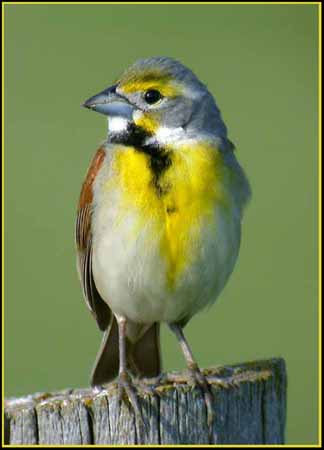
 As I was driving home, a sparrow popped up on a tree on the side of the road--a grasshopper sparrow. I pulled over and set my scope on my window mount tripod--which isn't easy to use for short people, but fortunately for me, the Swarovski eye piece rotates around so I can kind of use it with the window mount--it still takes some contorting on my part.
 The grasshopper sparrow was incredibly accommodating. It stayed perched in the open even though it took me a few minutes to get the scope up and on it. Maybe this sparrow is ignored so much, it was happy that someone wanted to digiscope it?
 Boy, you can tell this has been a good birding month, not many entries on the antics of Cinnamon. She disapproves of her lack of exposure in the blog. Okay, now Non Birding Bill and I are off to celebrate the Holiday Weekend, enjoy the outdoors, irritate a disapproving bunny, grill up some meat, bake some rhubarb pies, and I have to finish up a couple of deadlines. The rain is supposed to ease up tomorrow and I'll try to get out to the beehives and take some photos--our first batch of new workers should be hatched--whoot.
Hope you guys have a good time and enjoy birds where ever you are.
Northern Rough-winged Swallow
 Kudos to everyone who made a guess at the photo id contest--it was pure evil on my part. The northern rough-winged swallow is not a bird I normally talk about, it's brown and nondescript and just not a bird people pay a lot of attention to--even though they are there and easy to see if you look. A big pat on the back to Leanne for the correct answer.
 Here's the original photo of the bird that was zoomed in for the contest. We had two swallows fly into the nets at the same time at Carpenter--near the bird feeders of all places! Since these aren't birds that will come to bird feeders, our best guess is that they were chasing each other over a territory battle and both landed in the nets at the same time.
 At first, there was some talk that it might be a swift, but a check of the tail--and running fingers along the wing confirmed that this was a northern rough-winged swallow. The barbs on in the primary wing feathers on a male rough-wing are distinctly hooked and running your finger over them kind of feels like running your finger over a nail file. Females do not have as distinct barbs. I don't think scientists have figured out the reason for the barbs yet--if anyone knows or has an idea, please let me know in the comments. I would have gotten a photo of the barbs, but the birds were flappy and stressed and we wanted them back out on the wing ASAP.
Again, thanks to everyone who guessed. It's not easy to put your name to an id when you aren't sure.
Common Yellowthroat & Another Contest
Okay, I know I wrote in the comments of the previous entry that I would update after breakfast, but truth be told the gorgeous spring day took hold of me. Once outside, there was not going back indoors. I do have enough material for a whole week's worth of entries and I'm not sure when I'll have time to get them up.
 First up, the correct answer for the photo id in the eyeball contest was common yellowthroat, a bird we banded at Carpenter Nature Center on Friday. These are those tiny birds in marshy areas that sing "whichity whichity whichity" from the reeds and are very pishable.
 Here is the eyeball...
 And here is the whole original photo. Aren't they just gorgeous little guys?
 I love the macro feature on my Nikon Coolpix 4500, it really can capture the magic of seeing these birds in hand. The photos though make the common yellowthroat look much bigger than it really is.
The winner of the eyeball contest already has a copy of the book, so the prize is still available. So, here's another eyeball contest--however, this one is much more diabolical than the last! Mwa ha ha ha ha ha ha ha:
 What bird species belongs to the eyeball? First correct answer in the comments section with a name wins the prize--a paperback Singing Life of Birds with CD (you can use anonymous as a blogger id, but put your name in at the end of the comment if you want the book). The first correct answer with no name wins self satisfaction. Something for everybody!
Fox Snake At Carpenter
 Today at Carpenter Nature Center, we found a fox snake right outside on the stairs. Apparently, there are quite a few slithering around.
 At first we saw just one snake, but Larry said he saw two slither into a crack under the pavement on one of the building. Fox snakes are nonvenomous and constrict their prey (mostly mice, some small birds and eggs). They will coil up, vibrate their tail making a rattling sound and strike out when threatened. This defense probably developed to keep predators away since they could be mistaken for a rattlesnake. However, humans who don't know and mistake them for rattlers will kill them. Interesting that a behavior that evolved to protect them, now is more likely to get them killed.
Below is an 8 second video of the fox snake giving its fake rattle:
Getting Some Work Done At Carpenter
Stopped in to watch the Friday morning banding at Carpenter Nature Center this morning. I haven't been able to go for a few weeks and I was glad to hang with the guys again. I was able to get two birds with one stone (so to speak) since I took the Wingscapes Camera with me to test out. For the moment, those photos go on their blog.
It started out as a slow morning. It was about ten degrees but we didn't have any snow. With it being that cold, we didn't put up any nets, but set out potters traps.
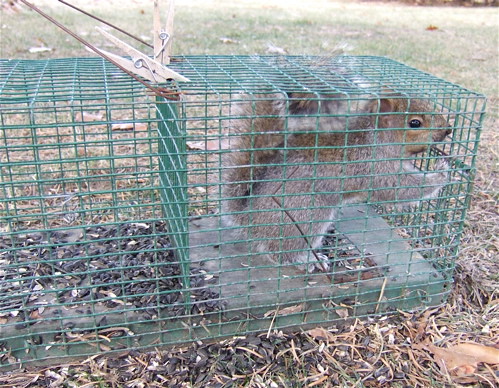
A squirrel managed to find its way into one of the traps. Ooops! It was very perplexed and alarmed--as were the banders. Some birds can be a little nippy when they are in the hand, imagine what a squirrel can do. Larry got a stick and opened the trap and the squirrel scampered to freedom unbanded.

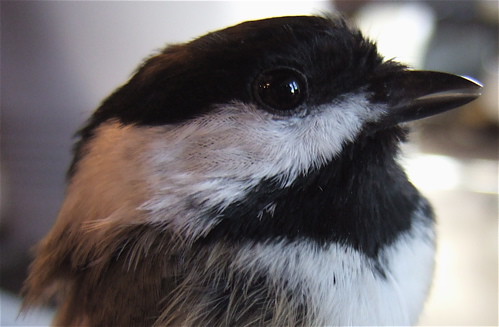
We did get in quite a few black-capped chickadees. One very exciting bird already had a band and turned out to have been banded in 2002! This tiny guy lasting close to five years in the wild--amazing. By the way, is it me or does this bird's bill look a little big for a chickadee? I can't tell if I'm getting overly paranoid about birds with overgrown bills or if it's normal.

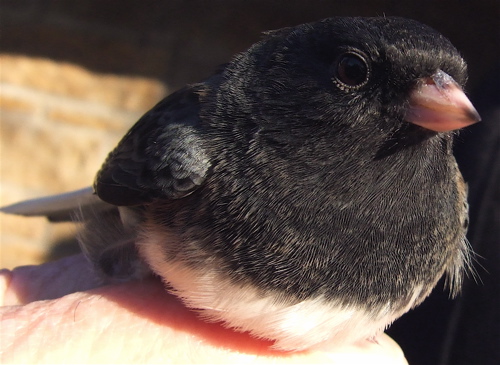
Juncoes were busting out all over. I love dark-eyed juncos, they kind of remind me of little penguins. Something interesting at Carpenter is that they bait all of their traps with black oil sunflower seeds and the juncos still go in. Working at a bird store and with personal experience, I have always found these guys love white millet, sunflower hearts and Nyjer and not black oilers. I wonder if they are actually cracking open the sunflower or if they see seed and just check it out?
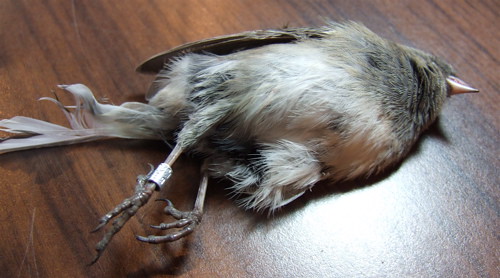
There was a minor junco tragedy. When the guys went out to check all the traps, a sharp-shinned hawk was flushed and left behind a freshly killed junco. The bird was banded, so this was one of the few times when a dead bird could be fully documented we have an idea of where its life ended and how old it was. I think this bird was in its second year. Don't worry raptor enthusiasts, the dead junco was put back outside and the sharpie did return for it.
Pete vs Pyle
And now, more fun from banding at Carpenter Nature Center on Friday. This time of year with odd molting patterns and juvenile/immature birds, some identification can be tricky. Some ids, with a little deduction, you can figure out pretty quick:
 Check out this cardinal. It's mostly brown with lots of red patches--on the surface it shows characteristics of being both male and female. Is this bird a metrosexual? No! This is a male, hatched this summer and is now molting into his adult red plumage. When cardinals leave the nest, both males and females are brown. Half way through the summer, the males grow in all new feathers, ditching the brown and getting the red.
 Check out how funky the face is. The feathers are brown like a female with hints of red. You can see the beginnings of the black that will surround his bill. And the bill itself is a whole hodge podge of colors. Young cardinals have black bills--that's one way you can tell a young cardinal from a female--adult cardinals have orange bills. This bill is definitely in transition from black to orange.
 Here it is head on. Very psychedelic.
 Here was another weird one. A female house finch with one pink feather on her breast. What was that about? I wondered if it was like female orioles. The older they get, the more they start to look like male orioles. However, clues on the bird said that it was a hatch year bird (hatched this spring) so I'm not sure why the one pink feather. Male house finches get their pink color from their diet--maybe this female has been eating like a male? Another mystery for another day.
 And here we have a dreaded empidonax! Not the guy, but what is in his hand. That's Jim Fitzpatrick trying to figure out a small brown bird's identification. For people who don't know birds, there's a whole group of flycatchers called the empidonax flycatchers (willow flycatcher, alder flycatcher, etc) and they all pretty much look the same. In the spring when the birds are singing you have a chance to tell them apart by song. But in the fall when they are silent, it's not easy and empidonax flycatchers can bring the best birders to their knees in tears and frustration.
When you are banding birds, you use a very intense guide called the Identification Guide to North American Bird by Peter Pyle. It can tell you how to age and sex many species of birds by looking at subtle colors and feather shape and size. As we were trying to narrow the identification of the flycatcher in the above photo, we of course turned to Pyle. We were thinking it was between an alder flycatcher and a willow flycatcher.
Here is one equation offered by Pyle to determine the two--yes, that's what I wrote, an equation. Leave it to an ornithologist to use math to take all the fun out of birding:
"Formula I is (longest primary feather minus primary feather 6) minus (primary feather 5 minus primary feather 10), the latter value (p5 minus p10) being positive if p5 > p10 or negative if p10 > p5. The thin lines represent a buffer zone of 30% around the optimal equation (thick line on chart). Birds with measurements falling within the two thin lines should not be identified."
Yawn. Basically, this is saying to measure some of the flight feathers and an attached chart to determine if the bird is identifiable. It very well may not be identifiable at this time.
I brought the new Pete Dunne book Essential Field Guide Companion to see if there was any new insight to offer. There were a few hints but the end of the paragraph was tied up with this:
"But in the East, where Willow is more like Alder in all respects, the most helpful characteristic is often humility (on the part of the observer)."
Basically, you're just not going to know for sure. An excellent point, Pete, which garnered a knowing laugh from all the banders at the table.
Going back to Pyle we found this:
"Thus, successful identification of Alder and Willow flycatchers in the hand involves a synthesis of plumage characters, measurements, and wing morphology by age, sex, and geographic variation, and the use of a buffer zone in which birds should be left unidentified."
So, basically, Pyle is saying the same thing that Pete is saying. There are some things you can try, but some birds, you just aren't going to be able to identify.
The flycatcher in question was released without being banded. During the whole time, the flycatcher never struggled and sat patiently for the short time it was with us. If I were going to anthropomorphize (give human emotion to a bird's behavior) I would have said that it look resigned to not knowing quite what it was itself and could we please help it. We didn't want to keep the bird for an hour to try and guess the id and it's important to get the correct id to make sure the correct sized band is on the bird.
So take heart when you're having trouble figuring out a bird in the field. Some species are so complex, that they can't even be identified in the hand, six inches from your face.
Retrapping Banded Birds
 So, why is this bird so exciting? What is this bird's id? If you don't know the id, they eyes of this bird should be a hint--note the red eyes. Now is it clicking in? It's a red-eyed vireo. And this particular vireo was in the blog not too long ago!
 This bird was banded at Carpenter Nature Center on May 26 and had its photo in the blog May 29th. I was told that the same vireo was netted again at Carpenter in June while I was away, and now here it showed up for a third time in the nets on July 7th. Every now and then I meet people are against banding birds, that it is too cruel and that banders are traumatizing and scarring these birds for life if not out right killing them. If that's the case, why is this vireo showing up in the nets once a month? This bird has made an informed decision about where to set up it's territory. The nets are set up in the same spots when birds are banded, if the bird was so traumatized the first time it was banded, it would have gotten the heck out of dodge and set up a nesting territory elsewhere. At the very least it would have avoided the area where the nets are. And this vireo isn't the only retrap, many species end up being retrapped at Carpenter, it's a helpful tool in determining how long certain birds live in the wild. I'm not saying that a bird's favorite activity in life is to be handled by humans and to be banded, but birds are not as traumatized by it as some would believe. Think about what a bird goes through on a day to day basis: constantly on the lookout for Cooper's hawks, foxes, cats, snakes, never knowing where that next meal is coming from for sure, defending it's territory--violently if necessary from rivals or other species, sitting out storms, getting up and doing it's job every single day--regardless of how it feels--now that's a work ethic. Birds are hardy, tough, resilient creatures. Five minutes of banding is not going to wreck them for the rest of their life. It certainly does far less damage than someone who finds a young bird of prey and feeds it only hamburger and chicken breasts or a young robin and feeds it only bread and milk.
 Since the vireo had posed so nicely with a song sparrow in May, I tried photographing it with a nuthatch for comparison this time. Nuh-uh, that nuthatch was not going to have any of that. The nuthatch trashed and snapped and made such strange catcalls that we decided to let it go. When both birds came in the nets, they were fairly low to the ground--the vireo surprised me, that's a bird I tend to associate with the tops of trees and here it had flown into the net only three feet from the ground and about the same time as the nuthatch--hm, I wonder if they were chasing each other?
 I was the one who got the white-breasted nuthatch out of the net. I had to stifle my chuckles while I removed her. First she did her caterwauling, but then she started doing that usual nasally nuthatch "her her". I could feel her body vibrate in my hand while she made her yanking calls. Very cool.
 Other birds we got in the nets today included a very tiny house wren--we had heard a winter wren that morning and were hoping for one, but got the boisterous house wren instead. It's so hard to believe this tiny guys make such a loud call.
 We also got in SEVERAL recently fledged red-winged black birds. The young blackbird pictured above was so fresh from the nest you could still see the edges of the gape that baby birds have.
On a side note, Non Birding Bill just informed me that the Disapproving Rabbits pages are getting more traffic than the blog...Cinnamon is demanding an increase in her parsley allowance and is threatening to hire an agent if we don't comply.
Raptor Release Report
 You couldn't have asked for better weather for the Spring Raptor Release yesterday. It was gorgeous, although the one downside was that I was down wind from an apple orchard and all the binocular demos kept getting dusted with pollen. It was encouraging to see parents getting monoculars and kid sized binoculars for their children.
TRC released four birds yesterday, 1 Cooper's hawk, 2 red-tails and one hefty eagle. I worked my way through the crowd to try and get different shots of the birds taking off.
 Above is a little boy who was sitting on his father's shoulders watching one of the red-tails take off after recovering from a wing injury. It was fun to watch the difference in the birds. The Cooper's hawk took off like a shot in one direction. It didn't try to catch a thermal, it just shot out of there above the tree line. The two red-tails looked for thermals and tried to use those to circle up high in the sky.
After watching which was the birds took off, I decided to find a spot where I thought the eagle might fly low. It was down off to the side of the stage, facing the crowd. There were a few other TRC volunteers there too. As they were making all the speeches about the bird's recovery, Lori, one of TRC's vets came by and told everyone to sit down. This was a big bird and would more than likely need a few seconds to get serious lift.
 The eagle was thrown into the air. For second it looked like it might land on one of the speakers. Although, the hoard of people around it, made the eagle change her mind. Then she turned and flew towards the area I was sitting in.
 And then I got this shot! I can't believe it, I look like a professional photographer and all I used my little Nikon Coopix 7900. Really, the bird was quite low and I was quite lucky. Boy, I was grateful that Lori had warned all of us to sit on the ground--or that bird would have run into one of us for sure. From there the bird flew right over our heads and into the wild blue yonder. I rolled over backwards as she flew over us and revelled in seeing her talons zoom past a few feet above my head.
And on a weird note, I have a mention in the New York Times. Non Birding Bill noticed in the website stats that we were getting some traffic from there. The link wasn't open to non subscribers until today. The writer was at the Ivory-bill Celebration. I remember Bobby Harrison telling me that he was going out with someone from the New York Times, and the writer apparently came to my beginning birding workshop. It's a nice mention and will make my mother proud. I have to say, it's interesting to read Bobby's comments, which reminds me that I haven't heard from him in weeks. Hmm, has he seen and photographed something and has been taken into the woodpecker mafia custody?
I'm also kind of curious about my status with Cornell...the no talking ban was supposed to be lifted in either April or when Cornell gave me the official go ahead...I haven't heard. Can I start talking about scaling and cavities and if I did or did not see the bird? I don't know. Although, I suppose if given enough scotch, one could get me to sing like a...an ivory-bill?
Digiscoped Images
Fresh Tweets
Would you like to hire me as a speaker for your event?
Email sharon@birdchick.com