MEOW! Saucer of Milk to Table 2

Some catching up: DK and the Fluffies won the owl caption contest with "Yes, damn it, we are having rodent for dinner again tonight and until you can flap your a** out of this damn nest and get your own damn food, I'm not having any more whining from you! *snap*"

Sorry I fell behind on that one, I blame the bee class. Email your snail mail to me.

Okay, a BIG FAT thank you to Veronica B in SoCal for bringing this to my attention:

Okay, to the untrained non birder eye, this might look like bird "marital relations" but it is quite the opposite. This is an all out peregrine falcon territory battle happening at the Riverside Falcon Cam. You can view all of the photos at the website, but you will need to scroll down to March 11, 2007.

You'll note in all the fight photos that the raptors are keeping their heads back and their feet forward. On raptors, the feet are the business end of the bird, they are strong and sharp. The goal is to kill or severely disable your opponent--aim for the eyes with the toes. The eyes are the last thing raptors want destroyed on their body--they can't see to hunt or defend the territory. That's why people who work with birds of prey and have them sitting on the fist aren't worried about being bit. Raptors don't want to use their bills as a primary weapon, they want to keep their eyes away from any potential danger. By bringing their face close to your face to bite you, they risk bringing their eyes closer to a dangerous situation. It's much safer for them to use their talons.

Speaking of fights, I go out today for awhile and when I come back home all heck is breaking loose on the birding blogosphere. Laura Erickson has left binoculars.com and started her new (temporary) blog here. I had a link earlier to her notice of resignation that was up at the old blog, but it has been taken down. Mike has a copy of the original notice up on his blog. I'm sure Laura will come out on top when the dust finally settles. If you're worried and want to help her, you can always purchase a copy of one of her books--even if you already have one, purchase another and gift it to a school, your senator, or library.

If you're looking for a place to purchase binoculars, I still recommend my former employer Eagle Optics. Their record for giving back to the birding community and funding for conservation programs speaks for itself. There's even quite a bit that they do that no one ever hears about. Early on in the current war in Iraq, Dan Hamilton (the owner) read about an army unit that had really poor binoculars among the many hardships they were enduring. He sent the whole unit new optics. It didn't make the papers. Just one of the many interesting facets of Dan Hamilton.

More on Golden Eagle vs. Fox

Remember that photo we were debating about before Christmas of the golden eagle attacking a fox? I know goldens will go for foxes--no debate from me on that one. But this has the signs of an internet hoax since no one is claiming (with a first and last name) to have taken the photo. I found someone on BirdForum with a "raptor" username, but no photograper saying, "Yes, that is me. My name is ...."

Also, the photos are said to come from a variety of places like a hunter in Montana, a hunter in Colorado, a photographer in Canada--again, no name. I'm also bothered by the lack of back story. Was this actually filmed on a deer carcass? Was this staged with a falconry bird on a game farm? What is the story?

Well, now there is a series of photos on Tarisger.com and it's said that the photos were taken in Finland by Pekka Komi. Still no back story but at least we have a name to go along with the photos.

Golden Eagle vs Fox--is this real?

Every now and then I'm sent an incredible photo and a warning bell will go off. The last one was the photo of the black bear going after some bird feeders. The person who had sent me the photos had gotten if after a long line of forwarding. No one knew who originally sent the photo, but was sure the photos were taken near Detroit Lakes, MN. After some digging on "the Google" I found that some websites had it, but no one was taking credit for the photos. Hmmm, were they photo shopped? I found one message board where people were arguing about the trees in the background. This site said the photos were from Canada, but a tree expert said the trees weren't native to North American and someone else anonymously said the photos were taken at a zoo in Russia.

I still have no idea where the photos came from or what the story is.

Here is the latest:

It's a golden eagle in the middle of an altercation with a fox. The photo comes with a note "Taken by a hunter in Montana." My assessment of the situation is that the fox and magpie (small bird flying away on the right) were checking out the carcass and the golden decided that it wanted the food and made an attack on the fox to scare it away.

What makes me suspicious is that no one seems to be taking credit for the photo and there is no back story to go with it. Is it photo shopped? Was the eagle landing on the carcass and then someone added in the fox later? Was the scene staged on a game farm? With the position of the bird and fox, jesses on the eagle's feet could easily be edited out.

I've been sent the photo from a few sources and no one seems to know who took the photo. I did some checking on Google and found that there is no entry on Snopes, but the Snopes message boards are talking about the photo. At this time there doesn't appear to be a clear consensus on the photo. I have no doubt that this is possible. Golden eagles will go after large prey--especially younger eagle learning what they can and cannot hunt. I have seen young goldens take pot shots at deer and turkey. A few years ago there was golden that several people witnessed attacking white tailed deer. Usually, the young birds learn that it takes a lot of energy and rarely a food reward so they give up and end up going after easy to kill prey.

I hear stories from all types of people of goldens taking all sorts of animals. If someone tells them they witnessed an eagle carrying away sheep, deer, antelope, etc I don't believe them. Eagles are only able to carry half their weight in flight and considering goldens average between 10 - 12 pounds, it's not possible for them to carry away anything too heavy. Can they kill something bigger than they are that is on the ground and eat it gradually--you betcha! However, the risk of going after healthy prey is a danger to them, they tend to go for weak, injured, or young who do not have parents smart enough to protect them.

I kept searching for more on the photo and found a discussion on a hunting blog about golden eagles going after mule deer and other odd prey (someone in the comments section also references the young golden we had in MN that went after the deer and turkeys).

Here's an example from You Tube. This looks to be a Spanish video on falconry techniques with a golden eagle. From my limited understanding, they were taking the golden out to hunt and weren't aware of the fox and the golden decides to go for it. The falconer freaks out and goes to intervene. The eagle has a firm grip on the fox but the fox is putting up one heck of a fight. If the golden's feet get injured by bites from the fox, the bird will be at a huge risk for infection and probably die. The video is about a minute and a half long, watch it at your own risk.


THERE IS NOW AN UPDATE TO THIS POST HERE. THE PHOTO IS REAL.

Duck!

coopsflight.jpg

So, I almost got clotheslined by a Cooper's hawk today! Above we have Jane Goggin, one of the many fabulous vets at The Raptor Center. We didn't have any programs scheduled for my shift today so our crew asked if we could watch Jane and Lori (one of the other fabulous vets) test fly one of the 13 Cooper's hawks still in clinic (that's down from 24--it's been a record year).

testflight.jpg

We followed Jane and Lori and stood behind them as they released the immature female Cooper's. The bird had recovered from its injury and has been test flown by the volunteer flight crew (after birds have recovered from their injury they go through this to build up their muscles). Lori and Jane go out and test fly the birds to determine if the flight therapy is working and to see if the bird's flight is strong enough for release. The bird is attached to a creance (a really long leash attached to the ankles so it can fly but not get away yet). The bird took off well in front of Lori and Jane.

clotheslined.jpg

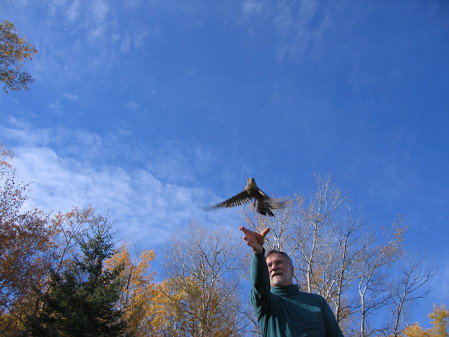
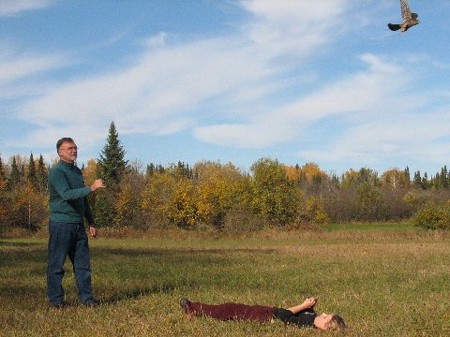
Then she suddenly banked and headed straight for some spruce trees off to my right. At that point she figured out the creance was going to prevent that and she turned on a dime towards me coming up fast on my right. About two seconds after I took the above photo, I realized the creance line was heading straight towards me at about neck level. I hit the ground and heard Jane and Lori yell, "Duck! Quick!" towards the rest of our crew. I heard the line zip over and lifted my head to see the rest of the crew on the ground.

Fortunately, no one was injured and I think it's safe to say that this particular female Cooper's hawk is ready to go off in the wild with moves like that!

releasechuck.jpg

Someone emailed how I get the release shots that I posted last week. Above is a photo I took of Chuck releasing a merlin.

releasehowto.jpg

Here is the same scene taken by Rick Dupont of me getting the above shot of Chuck releasing the merlin.

Holy Crap!

This video is not for everyone, it's a pelican getting a pigeon. If you would like to keep the idea that birds are harmoniously living together in the wild, do not press play. If you are like me and can't help wonder how the mechanics of a pelican eating a pigeon works, then press play.


Pelican Eats Pigeon - video powered by Metacafe

Man, I always thought a sharp-shinned hawk was a bad way to go since they are slow to kill you, but I have seen the inside of a pelican's mouth and it ain't pretty.

A Bird's Ability to Thrive No Matter What

All the photos in this entry are courtesy of Frank Taylor.

I just got in a weekly banding report from Frank Taylor. In it was a an interesting account of a first year sharp-shinned hawk that had impaled it's wing on a twig. Frank said that it had healed up with a bit of the twig still in the wing!

They didn't try to pull out the twig, just clipped the ends that were close to the wing. The bird seemed to be doing just fine and they didn't want to stress it out with a trip to The Raptor Center down in the Cities. Frank used to be curator of birds at TRC and has been a master falconer for longer than I've been alive. He knows a healthy flight in a bird when he sees it, and with a high strung bird like an accipiter, letting it go gave it a better shot at survival than time in a rehab facility.

The injury was healed, I wonder how long ago it happened? Perhaps when it was learning to fly.

Another fine example of how birds will survive no matter what. It would never occur to this bird that, "Hey, I've got a stick in my wing, I don't feel like hunting and heading south to find food. I'm just going to hunker down and sleep today." Birds just do what has to be done in order to survive. I love that.

Really Gross Eagle Post

WARNING! This is a really GROSS post. Quite frankly, I don't know how I'm going to muddle through it. It's interesting and does have a happy ending, but for those of you out there who don't like bugs, especially squishy maggots, I highly recommend avoiding going any further in this post. However, if you're like me and just can't help yourself, keep reading...although, you may not want to be eating anything at the moment.

"Ugh, I've got that not so fresh feeling."

A five week old bald eagle was down in clinic at The Raptor Center today and the vets were kind enough to let me follow with my camera. As vet Jane Goggin was looking over the young bird, it looked in good condition...and then she checked one of its ears.

Instead of finding a clear ear canal, it was chock full of maggots! Are we ready? On the count of three: 1...2...3...EWWWWWWWWWWWWWWWWW! This is not a common occurrence in young raptors, but it happens often enough that when they are brought in, the vets check the ears. Vet Juli Ponder said that generally in nature, the maggots go through their whole life cycle and leave, causing relatively little damage. She did add that they can find this in any raptor, especially great horned owls and bald eagles.

Here are the contents of the ear (one ear, mind you). The vets pluck out the maggots with forceps and then drop them in alcohol to kill them, afterwards swabbing out the ear. Can you imagine having maggots in your ear and not being able to get them out. Think about that, feeling (and hearing) all that squirming and squiggling and itchiness in your ear for days. When Juli said that great horned owls get them too, I thought about how owls are supposed to have better hearing, how does multiple maggot sucking blood in their ear canals rock their world?

Jane checked the young eagle's other ear and found more of the same. 1...2...3...EWWWWWWWW!! So, basically this bird's ears have been plugged up with squirming and sucking. Gross, gross, gross. Think about how big your head is compared to an eagle. Now, can you imagine what it must be like to have 9 maggots wriggling in one ear on such a small head. Ew. Ew. Ew.

"We love our job! It's fun to pick maggots out of bird ears. We rock!"

That's Jane on the left and Julie on the right, smiling after a job well done and seriously, they do rock--I really don't think I could do some of the icky treatments they have to do. I love all the vets in clinic, they all have what's best for the bird in the forefront of their minds. In the photo above they are now testing the bird's feet--which were quite soft because it is so young and hasn't done much perching. Who knew bald eagle feet were so baby soft?

The eagle is now ready to go back to the wild. I wondered if afterwards the young eagle was marveling at all the new sounds it was hearing. It's ears were plugged up for awhile and now they are wide open and cleaned out. In the wild the maggots can clean up on their own, but it never hurts to give the birds a little extra help if they visit the clinic. From now on when I look at raptors soaring and envy their flight capability, I will just remind myself that "Hey, I don't have to worry about maggots in my ears." I think that should calm my envy.

To Pack Or Not To Pack

Hmmmmmm, I'm not sure I will be leaving tomorrow morning with the predicted record snowfall that's supposed to start in earnest around 9pm tonight. Traffic was more than a little slow at the booth today. I think many people left early to try and get home before the big storm hits tonight. This morning there was a layer of ice and about two to three inches of snow. The main highway was not plowed, so instead of going the posted 75 mph, I went 30! The gravel road to Rowe Sanctuary wasn't plowed at all and I was beginning to wish that I had rented that SUB instead of the lower riding Stratus, but I made it there and back in one piece. I'm half heartedly packing, think that there isn't much chance that I will be able to drive to Minnesota tomorrow. On the bright side, the cranes look beautiful in the snowy landscape (but there is no way I can photograph them in the ice that pelts you and stings like a sand storm when you are outside). Today while demonstrating some digiscoping, I noticed two long billed male red-winged blackbirds feeding on the ground at Rowe Sanctuary. Early readers of this blog may remember the long billed peregrine we got in at the banding station in Duluth, MN. Not long after I posted that entry, I got in contact with Bud Anderson who has been tracking what he calls the long billed hawk syndrome. This is also prevalent in passerines as well and I found that Julie Craves at Rouge River Bird Observatory is compiling deformities as is Colleen Handel.

There is so much we're learning but so little we don't know. Part of me was excited when I saw the birds, realizing that this is part of a great mystery, but then I felt sad that this a problem that we don't know the answer to and these birds are going to have a rough go of it as their bills continue to grow. A friend had given me a copy of Bud's PowerPoint Presentation on the long-billed hawk syndrome so I showed some of the examples of birds to the staff at Rowe Sanctuary, there was even a photo of a male red-winged black bird looking just like the blackbirds in my photos.

If you see a long-billed bird, please report it to Bud at bud@frg.org.

More on One Legged Grackle

Well, when I downloaded images today from the camera, I was anxious to see if there was anything more on the one legged common grackle and sure enough the bird showed up in a few photos. What was interersting this time was in the first few photos you can see an immature grackle waiting behind it? A nestling of the one legged grackle?

A few photos later answered my question. In the background of the photo on the left, the one legged grackle is in front of a begging immature grackle, it does have chicks! Today I mixed in some mixed nuts and mealworms and for the grackles, the nuts are definetly preferred over the mealworms. The bird appears to have two chicks and it's kind of inspiring to watch it in the photos continue on with its duty of raising the off spring and carrying on its DNA. I suppose

that is one of the things that makes this species so successful. Of course many people this time of year are having lots of trouble with grackles taking over feeding stations so it does seem kind of silly to get so taken with one, but I just can't help but show interest in an underdog. Grackles really are a cool looking bird, I wonder if they didn't crowd out other birds sometimes when they feed if people would like them more?

On another note I did notice that we have a banded bird hanging out. I thought I saw a banded bird in one of the photos a few days ago, but figured is was a stray seed in a blurry photo, but today you can clearly see the red-winged blackbird male has a silver band on its right leg. Last year we had a couple of banders behind the store out who banded some birds, I wonder if this was one of them. Which reminds me that I need to book those guys again, they are great educators and it's always fun to hang out with banders.