
Birdchick Blog
Bald Eagle Attacks Sandhill Crane
The photos in this blog entry are from Stan Tekiela and Amber Burnette.
 This year's trip to Nebraska was just chock full of "Holy Crap" moments. I mean, the common crane (in the above photo) that we saw within thirty minutes of arrival to the area after driving all day was almost too much to hope for. I just found out that it's on the American Birding Association Blog and is classified as a Code 4 Bird (Casual--Species not recorded annually in the ABA Checklist Area, but with six or more total records—including three or more in the past 30 years—reflecting some pattern of occurrence). As a field trip leader you kind of wonder how you will top a sighting like that for the rest of the weekend--but top it, we did!
The following documented behavior is the type of stuff that a girl like me reads about in magazines and wonders if I'll ever have a chance to witness in real life. Again, I want to thank Stan and Amber for letting me use their photos in the blog to share it with you. Click on the photos if you wish to see the larger version.
We were watching a group of cranes forage in a field when we noticed something was spooking them and causing them to fly off. I was in the bus with half the group and Amber and Stan were outside with the rest getting shots of cranes in flight.
 That's when we all noticed an adult bald eagle in hot pursuit of one of the cranes. Somehow the eagle had managed to get one crane separated from the flock. I started shouting, "It's going for the crane, it's going for the crane, it's going for the crane!" I wondered if the others outside the bus noticed, but Amber's enthusiastic yelling told me they had. Everyone was shouting on the bus, it was like an intense football game but the crowd was unsure of which team to root for--we all loved eagles and we all loved cranes (I think it's a safe assumption that for Raptor Center alums like Amber and me--we were on Team Eagle).
 The bald eagle closed the gap in such a short amount of time, it pumped its wings hard and was soon on top of the crane. It flew past the crane just a little, dove at it and missed.
 Here is the eagle making a second attack.
 The sandhill crane breaks free and starts to drop.
 The eagle makes a quick grab a second time.
 The eagle has the crane in its talsons and is flying while carrying the crane upside down, wings open!
 The bald eagle is holding the sandhill crane for one or two seconds before...
 The eagle lost its grip and the crane starts to fly away with the eagle coming after it.
 The eagle gives one last chase before breaking off from the crane. What was interesting to me was that the crane and the eagle ended up flying right over our bus. As the crane flew over, the eagle appeared to slow and change direction. I'm left with so many questions from this encounter. Did the eagle not want to fly over humans? Did the crane luck out or fly over us on purpose? We did not see where either bird ended up, but did the eagle make a wide circle and wait out the exhausted crane? Did the crane fly away in its weakened state and become coyote chow? How deep did the talons get?
 Out of all the sandhill cranes that took off, why that one bird? Did the eagle see something different or was it just that the crane foolishly went away from the safety of the flock? This was an adult eagle--has it killed a crane successfully before?
Such a cool encounter and yet so many questions unanswered.
Butt Load Of Snow Geese
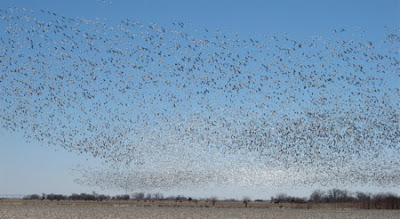
This was a massive flock of snow geese that we found on Friday just driving around Nebraska. It's interesting that the focus of the Platte River birding in Nebraska is the sandhill crane, but the sheer numbers of snow geese are more intriguing to me. When Stan asked about doing a field trip to Nebraska through his nature center, I suggested early March. There may be fewer cranes, but enormous amounts of snow geese. And really, the numbers for both are still pretty amazing--60,000 sandhill cranes, 2 million snow geese.
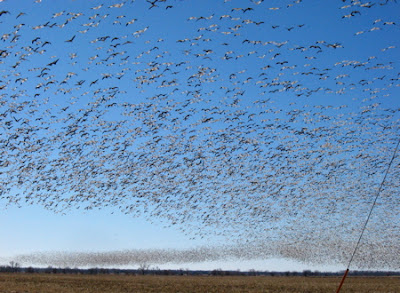
I think this is one of my favorite photos from the trip. This is just a long, long line of snow geese. As cool as this is, it may be cause for environmental concern. According to Birds of North America Online the current estimates of the snow goose population is between 5 and 6 million, a number that may be environmentally unsustainable. When snow geese return to their breeding grounds, they pretty much eat the crap out of the habitat which in the long term could mean that they eat away the habitat so quickly that it won't recover for future breeding seasons causing a crash not only in their population but other species like sandpipers and phalaropes. Despite all of that, it's still pretty overwhelming to witness.
Below is a video of the above flock flying over our heads. You can hear Stan, my buddy Amber and myself giggling like fools. Non Birding Bill says it sounds like we are high.
Common Crane In Nebraska
Below is the photo of the common crane that we saw within 30 minutes of arriving to Rowe Sanctuary in Nebraska on Thursday night. This photo was taken by Stan Tekiela:
 I can't believe our group saw such a rare bird on our trip! I'm also happy to report that others have seen the crane, here is an email from Linda Brown that was posted on NEBirds and has detailed directions for all you big year people who are wanting to go see it:
This morning we followed directions from Sharon Stiteler and Amber Burnett who are part of the Minnesota group of 10 who saw the common crane on Thursday, we drove to the spot after taking in the sunrise at the Gibbon Bridge viewing platform. As we scanned the flock Paul Johnsgard invited us to look at the pale whitish crane about twenty feet in from the west side of the flock. Sure enough I could see the black marking with my naked eye! It helped that all the birds were alert and looking at us so all heads were up and facing us. We put the scope on it and the following persons confirmed the sighting:
Paul Johnsgard, Josef Kren, Jackie Canterbury, Fujiyo Koizumi, Michelle Johnson, Randy Yeager and Linda R. Brown.
Josef, Paul and I drove back so we could give you good directions to the field where it was spotted two days in a row. (I have now been by the field four times in two days and only saw it once. There are two young eagles in the area keeping the flock of sandhills flighty. So, I wish you lots of good luck!)
The GIS coordinates for the crane field (from the road) are 40 degrees,41'940, 098 degrees,46'214. The abandoned eagle nest is at 40 degrees 41'940, 090 degrees,46'648.
1.Directions from Shelton Exit off I-80. Driving directions from Interstate 80, Exit 291, the Shelton exit. Drive south 1.5 miles. The crane field is 1.5 miles west of the Shelton Rd 24th Rd intersection (The field is on 24th-the road going west). The cranes were on the north side of the road. For reference: There is an abandoned eagle nest on the south side of the road 1.9 miles west from the intersection of Shelton Rd and 24th.
2. Directions from Gibbon Exit south off of I-80. Paul wrote out directions from the Gibbon Bridge Crane Viewing Platform. (This large platform is located on about the 5th Platte River channel bridge south of the Gibbon exit off of I-80. This viewing platform is accessed from Elm Island Rd which is the road directly south of the bridge. To see the common crane, drive east of Elm Island Rd to Sodtown Rd. North on Sodtown Rd to 17th, east to Sioux, north to 24th, then east to crane field on north of road. The crane field is 0.4mile east beyond the abandoned eagle nest on the south side of the road.
Linda R. Brown
Lincoln, NE
Coming Out Of The Fever Dreams
First, the caption contest will be decided by tomorrow morning--perhaps we'll pick the winner at Birds and Beers tonight?
Second--I love my readers. I love that you teach me something new all the time. How on earth would I have learned about a website dedicated to Feral Children? Why is that not a show on The Learning Channel?
Third, I totally thought I had a perfect blog entry the other day about a pair of cardinals that were doing a mating display in my apartment and checking out an empty onion bag on my couch as a potential nest site. I even got incredibly excited when Cinnamon hopped up next to the onion bag and the male cardinal tried to puff up and drive her off, but she tried to nibble his tail...then I woke up to blog it and then realized that wow, that was some powerful cold medicine.
Fourth and speaking of fever dreams, I DID NOT TAKE THE FOLLOWING PHOTOS, but they are making the rounds in the email inboxes, so if you haven't seen them check out this great gray owl (I think that was seen Montana, I have no idea if it is recent):
 If you you know who took these photo, let me know--I'd love to give them their props. It's a partially albino great gray owl...although, I don't think we're supposed to call them partially albinos anymore, according to Birding I think we are supposed to call this partial amelanism (because you know, ornithologists like to make things simple for the general public).
 Shnifty bird.
UPDATE: WE KNOW WHO TOOK THE PHOTOS! Thanks to knowledgeable blog readers we now know that the photos were taken by Cheryl Farmer in Montana and you can read more about this bird at the Prairie Ice Blog (which looks like a cool photography blog). Thanks, John!
Those Darned Red-tails
I swear, just going into Google Image Search and typing a bird species name reveals some fun stuff--usually on the part of red-tailed hawks. Those who are on the squeamish side (or have a strong fondness for kestrels) may want to avoid clicking on the links below:
We've seen a red-tail fly away with a live kestrel...and now we can see what that famous red-tail known as Pale Male does after he gets a kestrel.
MSNBC Holy Crap
MSNBC has a story about rabbits on the Internet and it features Cinnamon and Disapproving Rabbits!
Lawrence's Warbler?
As if fall warblers weren't already tricky to identify! Here comes a whopper.
All the photos in this blog entry were taken by bird bander Mary Messerli. She and Robert Fashingbauer were banding birds near Willow River State Park in Wisconsin on August 15, 2007 when they banded these two unusual warblers. Take a look at this:
 At first glance this looks like a golden-winged warbler, however it has way too much yellow. If some of you are jumping to a hybrid conclusion, you are right. Sometimes golden-winged warblers will hybridize with blue-winged warblers.

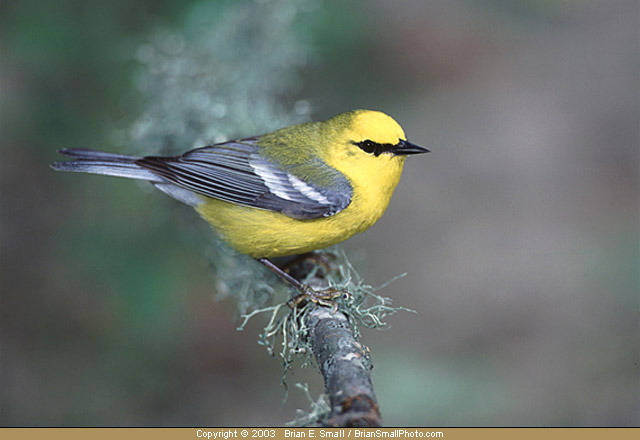
 When a golden-winged warbler mates with a blue-winged warbler, you usually get a hybrid called a Brewster's warbler. This bird doesn't look anything like a Brewster's. It has the masking of a golden-winged, but the yellow wash of the blue-winged warblers. This bird is a backcross--one of it's parents was a Brewster's and the other was either a true golden-winged warbler or true blue-winged warbler. When this happens you get another type of hybrid called a Lawrence's warbler. Confused yet? Were you able to follow that? Well, hold onto your hat, it gets even trickier:

 That same day, those banders caught this bird--another hybrid. Oy! The banders said that this bird had characteristics of being a hatch year bird (it came out of the egg this year) the bird above had characteristics of being an after hatch year bird (at least a year old). But really, it's hard enough to identify hybrids and even harder to age and sex them. I think this is another Lawrence's warbler backcross (a Brewster's hybrid that bred with either a true golden-winged or blue-winged warbler). The banders felt that this bird is of unknown sex, but with the pale mask, I think it is reminiscent of a female golden-winged warbler, so I'd be willing to go out on a limb and call this female.
 I nipped over to BNA Online to see what they had to say about hybrids and found this:
"Molecular analyses of hybridization indicate that Blue-wing mtDNA introgresses asymmetrically and perhaps rapidly into Golden-wing phenotypes without comparable reverse introgression and footprinting of Golden-wing mtDNA into replacement Blue-wing populations."
Holy crap, I though Pyle was hard enough to read. Basically, (I think) this is saying is that all this hybridizing and backcrossing can result in fewer golden-winged warblers and more blue-winged warblers. The hybrids and the backcrosses end up in future generations breeding into blue-winged warblers.
Pigeon Madness--the good kind
There's a new bird club starting in New York called the Pigeon Club of New York City. The initial members appear to have a healthy sense of humor, which I heartily endorse. I highly recommend checking out their video section. Warning, crumb number one is a link to a video similar to the one I linked to of a pelican eating pigeon. This one is much better quality but this time you see a goose chase after the pelican--wonder if that means the pelican has been going for goslings besides pigeons?
Crumb number 2, however is a hilarious prank and worth checking out--especially with your kids. Crumb 3 is a cartoon I'm not familiar with and Crumb 4 is some retro Bert (of Sesame Street) action.
Bald Cardinals and Other Bald Birds
 All of a sudden in the last two weeks, I have been getting comments to an old post from July 25, 2005 (way back when I worked at the bird store). The post is about bald cardinals.
 Every year about late July and early August there are questions from people asking about black headed birds, miniature vultures or bald headed feeder birds. Most of the time, people are describing cardinals without any feathers on their heads, but I've also had reports of bald blue jays and grackles.
 While I was down in Indianapolis, my mom had a bald cardinal coming to her feeding station. So, what is the dealio? No one knows for sure, even Cornell Lab of the Big O admits that the case of the bald cardinal is not well studied. There are two possible explanations. Number one, this is the time of year when many songbirds (including cardinals and blue jays) are molting (shedding old feathers and growing in new feathers). For some reason, the birds drop all of their feathers on their heads at once. I've seen this with captive birds like great horned owls and even our education screech owl at The Raptor Center. The birds are healthy, they just molt everything at once (interesting to note that all of those species mentioned are tufted: cardinal, blue jay, great horned owl, eastern screech owl--hmmmmmmm).
 Alas, my mom didn't have just a bald male cardinal, she also had a bald grackle (so much for the only tufted bird theory). This grackle was much more wary than the cardinal and this was the only shot I got of it. The bird seemed to sense the spotting scope and flush right as I was about to take a photo. I don't blame it, the bird kind of looks like a Skeksis, I wouldn't want my photo taken either. This bird leads me to the number two reason birds can go bald and that is that they can get feather mites. Generally, birds can use their bills to remove pests like mites when they are preening. However, they would be unable to get to mites on their heads and so the mites eat away the feathers. It's tough to say what really is going on, without trapping the bird and looking for the mites, you really can't tell for certain if it's molting or mites causing the lack of feathers.
 There was another grackle coming to mom's feeders that was starting to lose its facial feathers. Interesting to note that the cardinals are dark skinned under the feathers and the grackles are light skinned. Since my mom had at least three birds that were either bald or starting to become bald, I wondered if this was a case of mites being passed around. The birds appeared in good health and were eating well, looking alert--all good signs. And mites don't usually kill a bird. Annoy it and make it look grotesque--yes, but kill birds--not so much. Check out the video I got of the male cardinal eating a berry off of mom's fuschia plant:
Did you note how he scratched the back of his head? That also makes me wonder if mites are the cause. Although, I would bet a bunch of pin feathers growing in at once would be rather itchy.
 By the way, don't feel too bad for him, he's still gettin' some play. Not long after I took that video, this female flew in and he jauntily bounced over to her and fed her some of the fuschia berries--very clear mating behavior. She didn't seem to mind his bald pate one bit (perhaps she likes that Christine Lavin song). Although, if you look right behind her eye, there's a small bald patch--mites? Will she be bare headed soon as well?
 As I was watching the cardinal, I noticed something new. Check out where his ear canal is. Do you see it? It's that large hole right under his eyeball (there's a small red feather over it). How cool--who knew that their ears were just below their eyes...and about the same size. I wonder if anyone has done any studies and the hearing capability of cardinals? So much we don't yet know...
 And just for comparison and to not leave you with grotesque cardinals, here is a photo of a proper male cardinal. Whether the birds in the other photos have mites or an odd molt pattern, don't worry too much. In most cases, the feathers do grow back in plenty of time before the winter sets in and all will be right with the cardinal world once again.
HOLY CRAP! Deer Hunting With A Bird
It's a golden eagle used for falconry taking out a deer. I have no idea of the origin of this video, but wow, you gotta see it!
Digiscoped Images
Fresh Tweets
Would you like to hire me as a speaker for your event?
Email sharon@birdchick.com