Birdchick Blog
Goshawks & Red-tails, Oh My!
Frank Taylor just sent me last weekend's banding report from his hawk trapping station in northern Minnesota. While I was busy with birding in Cape May, NJ over the weekend, he was dealing with goshawks and a double red-tailed hawk capture! So wish I had not been working and had been at the blind with him.
 I just love this photo! This is a red-tailed hawk getting ready to fly into the nets. But look at the great light the hawk is flying in, the sun is hitting some dark clouds in the distance and the vegetation has browns, yellows, whites and green to make a late autumn look--three of my favorite things all in one shot! You'll note I have a similar theme on my banner on the blog. That's how I imagine heaven will be (that and all the angels look like Daniel Craig).
Because Frank bands on the weekends and not during the week, the station is dependent on winds coming out of the northwest just on the weekends to get good numbers of migrating raptors moving through. The weather mojo hasn't been really been that cooperative this year, so most of the weekends have been slow going. Ah well, some years that's the way it crumbles, cookie-wise.
 Although Saturday Frank said, "Not much was moving in the morning and our first bird of the day was a huge second year adult female Goshawk that came in at 11:40 am." Check out how big that girl is! That's Chuck and Rick holding her. She's HUGE. She's no doubt female (in the raptor world females are larger than males and it's more noticeable in bird eating raptors like goshawks).
 Frank noted that she's a second year bird, meaning she hatched in 2007. She's got her adult gray feathers, but her eyes are still quite yellow. The older these accipiters get (accipiters are a type of hawk that includes sharp-shinned hawks and Cooper's hawks), the more red their eyes become. Here's a photo I took a few years ago of an adult gos with those red eyes:
 That red with that delicate gray makes them the most beautiful raptor (in the US) in my book. It also makes them look more maniacal.
 They did get a passage (hatched this year) goshawk too--note the brown feathers and yellow eyes. Ug, this is so painful. I love Cape May and I loved birding and I got some fabulous digiscoping images (I still have a few more to post) but I love goshawks so much, I'm so sorry I missed this weekend at Frank's station. And as awesome as goshawks are, they also had some other excitement in the nets:
 "A lot of birds started moving. First the Crows got up, followed by the Eagles and Ravens, then an explosion of adult Red-tails with some Rough-legs and Shins mixed in. At various times during the day, we could see as many as thirty birds in the air at once. What a day!!! A lot of the Red-tails would swoop in and perch in the trees over the blinds. We had to go out and shoo them away so they wouldn't scare off any of the others that were making their final approach to the nets."
 The highlight of the day came when we got a double of adult Red-tails at 3:35 pm. When they hit, Rick shot out past the one in the front net knowing it was securely caught and grabbed the one in the mist net that was all but out, except for its feet!!! Chuck got on the other one right away. WAY TO GO, GUYS!!!! That was the first time we ever got a double on larger hawks. (We did get a triple on Shins once a few years back.)"
Total for Sunday - 13 Red-tails, 2 Goshawks, & 2 Sharp-shins. Total for the weekend is 19 birds. 13 Red-tails, 3 Goshawks, & 3 Sharp-shins."
Thanks for sharing your photos, Frank. This is his last weekend up at his banding station for 2008. I'll have to wait until next year.
Sigh.
Sky Watch Friday Carver Banding
Doh, it's raining this morning, not sure I'm going banding at Carpenter. Well, I have some banding photos from last weekend and it's SkyWatch Friday, I'll work on that and see if the rain subsides:
 Years ago, the summer before Non Birding Bill and I moved to Minnesota, we were on vacation with his family at Virginia Beach. We were flipping around tv channels one night and found a documentary about Minnesota--we thought this would be good prep work to watch. We had heard that we should be prepared for cold and snow year round, but beyond that, not much else. The documentary had an interview with Garrison Keillor and he said something about there are a few days in October which are perfect days (in every possible way) in Minnesota and people visit during those days and get that impression. For some reason, that was what stuck out in my mind and every October, I try to watch for that. If you are an optimist, October in Minnesota is the THE BEST. Sunny days that might require a fleece, glowing fall leaves, local farm bounties, and cool nights perfect for snuggling with your favorite person. As long as you don't think about the impending snow and cold which could easily last six months is right behind this perfect month.
 Last weekend, I was going to go to Duluth to do go to Frank's hawk blind, but the wind prediction wasn't good and the sparrows were everywhere in the Twin Cities. My buddy Amber had heard that Mark was going to do some migrant banding on Saturday, so I snuck out to join them. Mark normally does banding programs every third Saturday at Lowry Nature Center. This was not a formal program, so Amber spread out a blanket near the nets, Mark set out his equipment and we banded birds in the beautiful October sun. Above is one of the many swamp sparrows moving through. It's such a pretty sparrow, it's too bad they don't visit feeders as much as house sparrows do--people would really dig 'em. I'm going to save that photo, that would be a good hair color at some point.
 We got in quite a few orange-crowned warblers. This is the "drabbest of the drab" first year female orange-crowned. If you are one of the peeps going to the Rio Grande Valley Bird Fest next month, learn this bird's chip note--you'll be hearing it a lot. I know we have them in Minnesota, but I always associate them with South Texas. Speaking of which, there is still time to sign up for the bird blogger discount for the Rio Grande Fest. It's going to be awesome, some of the bird bloggers I know are coming include WildBird on the Fly, Born Again Bird Watcher, birdspot, and Mike from 10,000 Birds--oh, it's on! Looks like there's going to be a Birds and Beers too!
 But I digress, back to the female orange-crowned warbler (and since it's SkyWatch Friday, pay attention to the blue sky in the back). She really doesn't have much orange to speak of, even in hand. She's a pallet of gray, drab olive, and kinda white.
 Here's an adult male--a little more flashy--look at that yellow. And, you can distinctly see the orange in the crown, can't ya? Please tell me I'm not hallucinating, you can see the orange too? Okay, I admit, it is hard to see, so we used the toothpick method to get a look at the orange crown:
 Now you can see the orange in that crown! It's never easy to see when the bird is not in hand. I just check Birds of North America Online to find out when one can see the orange crown on the bird in the wild and found this: "Male threat or alarm display can involve elevation of head feathers to display (barely) the orange crown (Bent 1953)."
 "Don't make me barely show you my orange crown!!" Maybe these small warblers have a color orange phobia, so a little is all that's needed. Although, I'm not sure what a flock of orange-crowned warbler when confronted with a male oriole. Or perhaps, those orange feathers are so powerful that too much could be lethal? So much more study to be done.
It's always so cute when an insect eating bird tries to peck your fingers--those bills are just so soft--look at that orange-crowned warbler go for Mark's thumb. Earlier, his thumb went through much worse:
 Before I arrived, he and Amber got a young male cardinal in the nets. After banding it, he opened his hand to let it go. The male decided to get in one good bite before flying off and then got so into it, refused to let go and hung from his thumb for a moment. It flew off and remarkably, Mark did not need a band aid.
Ah, looks like the rain is easing up, I should hit the road.
The Difference Of Birds In The Hand
 Man oh man, the migrants are all over the Twin Cities right now! The trees are just full of them. Above is one of the many yellow-rumped warblers that can be heard if you listen close for their kiss sounding chip note. I had originally planned to go up to Duluth for some hawk banding, but the winds were supposed to be the worst for banding and the winds in the Twin Cities were pretty good for migrant trapping--Friday at Carpenter was pretty amazing.
 And warblers were the main order in the nets. Here's a rather indignant looking yellow-rumped warbler in hand. It's always amazing to me how different birds look in hand. We use mesh bags to hold the birds after they have been taken out of the net. You look through the mesh to figure out what is inside--the species tells you what size band you use. I at first looked at this bird through the mesh and lamented, "Aw, couldn't I have gotten an identifiable bird?" However, the bird fluttered in the bag, and I soon noticed the yellow rump and knew what it was.
 We got in a few Nashville warblers too. After this bird was banded, I went to take a photo before letting it go and it just looked so non warbler like-just not feisty enough, almost looks like a child that's been naughty. Many of the birds take on a much different posture in hand than they do the wild.
 But, pish at it a few times and it perks right up--feistiness returned.
 And then it gives you as mighty a peck as a tiny insectivore can deliver before flying off.
 This golden-crowned kinglet is another example--a bird that is full of vim and vigor when hopping about from branch to branch, but completely deflates when in hand.
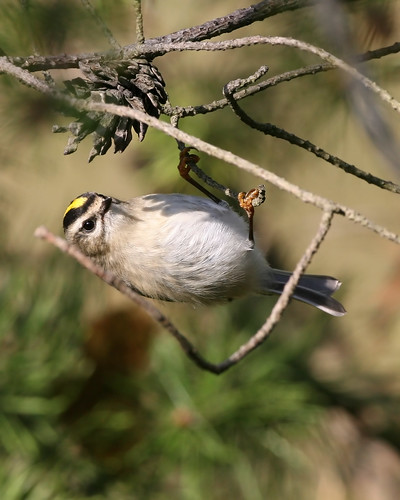
 Check out that buttery-yellow crown, though--drink that in. And again, as soon as this bird was let go, its sassy nature returned.
 One of my favorite birds of the day was a brown creeper...or the hunchback. Looking at the above photo, don't you expect it to say in a Peter Lorre voice, "This way, master." But think about the last time you saw a brown creeper...you never see one perched on a branch like a robin, they are always creeping down a tree, perhaps it is essential for their posture.
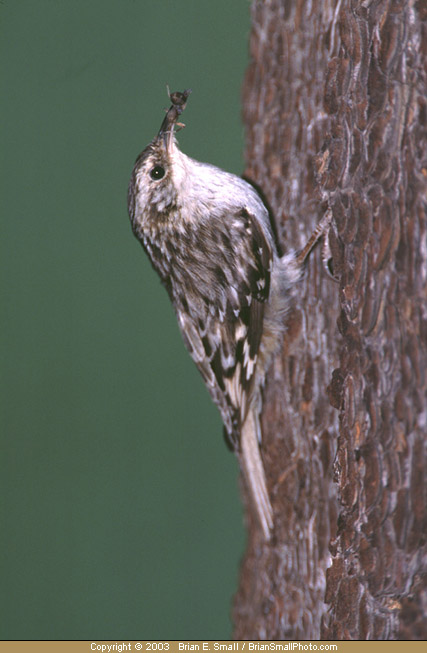
 It's fun to take a close look at all the little bits that make a creeper a creeper--bits that you don't get to see when they are against a tree. Look at how long the toe nails are--each nail is almost longer then the toe itself, essential for life on the side of a tree. Check out that beak, perfect for squeezing into tiny bark crevices to glean spiders and insects. Hm, between the hunch and the diet, this really is the Igor of the bird world.
 The tail is pretty incredible too. It's long with pointy feathers, but unlike woodpecker tail feathers, the creeper tail feathers are quite soft. Perhaps the reason is that a brown creeper isn't chiseling into trees like a woodpecker. Strong, stiff tail feathers to prop the woodpecker body are needed if they are hammering open a hole, but a creeper just needs to slink up the bark of a tree.
 After getting a bunch of tiny birds that looked small and sad in the hand, it was kind of a treat to get a robust white-throated sparrow with a little bit of an attitude. These birds feel so beefy in the hand and have a bit more kick to their bite, since they need that heavier bill to crack seed shells.
 The whole bird is a lovely palette of brown, rust, white, black, yellow and gray. For a brown bird, it's got it going on. Watch for them under feeders (they actually like millet) and around ragweeds, sumac, wild grape, highbush cranberry, mountain ash, dogwoods, and rose hips.
More weekend banding fun to be continued.
Holy Crap! Goldfinch Retrap Info From Mr. Neil's
 Back in September, we had a great day of banding birds at Mr. Neil's. One of the birds we got was an already banded goldfinch--but not banded by any of us. Well, it turns out that the bird was banded in 2004 near Springfield, Illinois by Vernon Kleen! That makes this bird at least 4 years old and how the heck did it get over 450 miles north?
Skywatch Friday With Migrants
Hey, have you sent in your comments regarding the proposed changes to the Endangered Species Act yet? Don't let it slip away (and yes, I'm gonna be a pest about this).
 Well, it's Skywatch Friday again. You can visit their site and click to all the links to every one's photos of sky and if you wish, you can participate by creating your own blog entry with a photo of sky, adding the Skywatch Friday link to your post and then adding your link to their site. As you can see, the vivid blue skies still continue to enhance the gorgeous fall colors at Carpenter Nature Center.
 I tell ya', with the all the negatives adds (on all sides) of the upcoming election and news of the economy it's hard not to get down. If you are anywhere near Hastings, MN make a trip to Carpenter, the colors do not disappoint and the grounds full of birds and a few bees give you peace of mind that money just cannot buy. And if you have a few bucks, now is the time to load up on apples from their orchard--Honeycrisps are in and they have apple cider made right on site (I'm enjoying some now as I type this entry).
 The bright blue sky, mixes with the changing reds and yellows of the trees to make the perfect back drop for photographing or just enjoying birds. Not that downy woodpeckers are fugly to begin with, but their black and white coloration is oh so enhanced with the fall colors. I don't know if anyone needs a cleansing downy woodpecker, but here you are.
 Later, I'll blog more about the banding bonanza that we had at Carpenter today--I banded a lot of birds and I don't think I worked with the same species twice, it was a parade of sparrows, finches, and warblers and note the bird above: I took my first junco (aka snowbird) of the season out of the nets today. I call this my first junco of the season, but it really is not. I have heard there chip notes in the bushes on the bike trail and I have chosen to ignore the blatant sign of winter.
 But if we are talking sky, it's only appropriate that we talk about migration and birds that are pouring out of the skies on their journey south. Carpenter was loaded with white-throated sparrows today (like the bird above) so watch for sparrows lurking under your feeders--and it wouldn't hurt to put out a bit of white millet for them. One of my favorite things about the fall are the nights up at Frank's hawk banding station in Duluth and you can hear white-throated sparrows chipping to each other overhead as large flocks head south. Some of my favorite moments in life have included listening to night migrants with friends...I remember laying on a bench in Cape May, NJ a few years ago do that same thing WildBird on the Fly. Good times.
 Here's a tan morph of white-throated sparrow. Look at those gorgeous rufous feathers mixed in with other shades of brown on its back--what a classy little brown bird! Speaking of migration, blog reader Tammy sent over this news link from the Milwaukee Journal Sentinel about night migration:
"Right around sunrise Tuesday morning the NWS Milwaukee/Sullivan radar (MKX) showed some curious circular reflectivity returns. The echoes developed suddenly and then grew in size between 6:45 AM and 7:30 AM. The MKX staff suspects these to be birds taking off right at sunrise. Some of the echoes initially show returns as high as 30 dBZ, which would equate to a decent shower if the returns were made of rain drops. These are likely dense clusterings of geese heading out early to feed in the fields."
You can read the full story and see the radar images here.
 So, keep your eyes and your ears to those fall skies!
It Was About Quality, Not Quantity
 I met up with my buddy Rick and we carpooled up to Frank Taylor's hawk banding station near Duluth, MN last weekend. The plan was to have a great weekend of hawk banding, timed right during the big broad-winged hawk. I thought we were off to a bang when one of the first birds in was an early morning red-tailed hawk. This immature bird (because it's lacking a red tail) came in not long after the nets were set up.
 I didn't take that many photos of it, I figured more birds would come.
 But not many birds were moving that day, my friend, and we spent a good deal of time scanning empty skies and chatting (still a great time). The clouds came in, the winds were not in our favor and started blowing so hard they billowed the nets, making them easy to see to a keen eyed raptor. Eventually, the clouds cleared, but by that point, the few hawks that were moving through were way too high to even consider coming into our nets.
 Warblers, especially yellow-rumped warblers (like the one above) were swarming around some nearby bushes, hawking insects and sipping juice from the red berries off this bush. If anyone recognizes the berry bush in the warbler photos, please feel free to drop a note in the comments. We were thinking they were honeysuckle, but were not sure. Whatever they were, the berries were a bird magnet--we even saw a Swainson's thrush lurking among the leaves to partake of the fruit.
 However, it is indeed a slow banding day if I can tear myself from the blind to go out and do a bit of digiscoping--and warbler digiscoping at that (not easy to get those little dudes to stay still), but manage I did. However, it is indeed a slow banding day if I can tear myself from the blind to go out and do a bit of digiscoping--and warbler digiscoping at that (not easy to get those little dudes to stay still), but manage I did. We closed up the blind a little early and headed over to the Lighthouse for dinner. After sitting in a blind with cold winds blowing on your face, a hot meal was in order--I ate a lovely pork chop with sour kraut and mashed potatoes (insert Homer Simpson donut noise here). It's amazing to me that I can be a good two and a half hours north of the Twin Cities freezing my tail off and the Twin Cities themselves will be close to eighty degrees. That night, I curled up in my sleeping bag in Frank's van. Again, I would like to say how grateful that despite my girliness, I can still spend the night in a van.

 The more I join the guys at Frank's station in the fall, the more I can relate to deer hunters. You may not always get all the birds you hoped for, but you enjoy just being with your friends and staring at birds. There were other things to keep us amused: friend's of Frank popped in for visits (and cookies), an elder hostile showed up and Frank gave them a tour, listening for trains...
 And Rick Dupont--who is the master of pulling the bait pigeon made a special friend. A Richardson's ground squirrel is living under the blind and the entry and exit hole is on Rick's side of the blind. Rick is generally a quiet guy anyhow, I wondered if he was forming a special bond with the squirrel...was it telling him things like how to pull the pigeon on the harness or that Free Masons rule the country? If you have been to Hawk Ridge, you might have seen Richardson's ground squirrels near the counting area, under the sign.
 We set up the next morning and Rick hoped we would do better than the day before. I was hopeful and said that we only needed two birds and our numbers would have been twice as good as the day before. Frank has a second blind set up on his property that is run by his friend Todd. We can sometimes see birds pop up and head towards the second blind--we'll even radio over potential birds. We watched this immature sharp-shinned hawk pop up and then dive down towards Todd. Frank, Rick, and I wondered if Todd got. Ten seconds later, Todd radioed that he had a shin. There were a couple of times we watched merlins bombing across the field and then they would disappear. Just as we would wonder where the merlin went, Todd would radio a few seconds later that a merlin passed his net twice and moved on. Those tiny falcons make speed look so effortless.
As the morning wore on, the chances of getting any birds looked bleak. While watching a shin that was totally ignoring us, a harrier made a sneak attack from behind the blind and dove down on the pigeon. Fortunately, Rick is always ready to pounce was able to prevent the harrier from getting the pigeon. He harrier had no intent of going into the net, it was very much trying to get the pigeon inside this strange fence. It just didn't realize humans were that close. We debated about what time to close the blind--noon? I said we should stay until 12:30pm, something good was going to come. Well, we noticed some snipe moving through (that's something). One landed fairly close to the blind, so Frank and I thought we would head over to get a shot. We were wandered for about twenty minutes. Rick came out to join us. We looked up and a merlin flew low right above us. We were all too far from the blind and totally missed it. Doh! We walked back to the blind and debated if it was time to close shop. When we were about ten feet from the blind, Frank shouted, "Peregrine!"
I set my scope behind the blind and darted in. Rick just made it to the pigeon line and pulled, Frank whispered to freeze. I saw the large, dark bird approach from the north, it was set and made a beeline for the pigeon. The peregrine made the decent from a low angle and then dropped it's feet like a red-tail would--we call this lowering the landing gear. Usually peregrines do not do this, so it was interesting to see. Two seconds later the bird hit the nets and Rick exploded out of the blind (a peregrine got away from him the weekend before, he wasn't letting this one go).
 There she is--and it's another tundrius peregrine falcon, like Peregrine 568. You can tell by this young bird having a light blond head. Other young peregrines like anatums will have a dark head. She was unbanded and tundrius peregrines come from way up north on the tundra, she could be from the Arctic National Wildlife Refuge (you know that place where Michele Bachmann said there's no trees and wildlife).
 So, I wasn't just talking out of my butt when I told Frank and Rick that we should stay until 12:30pm because something good was coming. All told, for two days of waiting, we got in only 3 birds. But they were quality birds. A red-tailed hawk and a peregrine falcon are great birds to watch fly in. As a matter of fact, I've never watched a peregrine fly in. I've seen them after they were trapped--usually at Todd's net but never got to watch the full flight in. It was pretty awesome. I'm looking forward to making another trip. I'm hoping October will be a busier month than September, but not all years can be epic days of bird after bird flying in.
 And just one more photo because she's so beautiful!

Fall Banding At Carpenter
 The warblers are just drippin' off the trees in Minnesota. We had a great day of banding on Friday at Carpenter Nature Center. Note this palm warbler giving itself a scratch in among the autumn leaves. Again, I have to say that the color at Carpenter is peaking right now, and it is a GREAT time to visit.
 One of this first birds in the nets was this male American redstart. This was one of the easier birds to id--looks kinda like a miniature oriole.
 Some were more challenging--even in hand. Here's a magnolia warbler.
 I missed this, but my buddy Larry sent over a photo of a Wilson's warbler that someone banded.
 A surprise thrush of the day, was this Swainson's thrush...didn't they just arrive, I feel like I was just listening to these guys sing as they were migrating north through my neighborhood. After I downloaded my photos onto my computer, I noticed the weird little spot behind the thrush's eye. I zoomed in on iPhoto, and I think those are ticks.
 Here's a little bit closer view--and a shot of the bird's nictitating membrane (extra eyelid that protects a bird's eye in flight or while eating). Man, I'm also just noticing how large this bird's eye is in relation to its head--it could give an owl a run for its money on big eyes.
 We got in a plethora of vireos and normally this time of year, it's a bunch of red-eyed vireos, but didn't get any of those. But seemed like we were getting anything but. The above bird just confused me. It had a bunch of yellow, so I thought "Ah, Philadelphia vireo!" Alas, no, it's a warbling vireo. That's a vireo I just don't pay that much attention to, the first time I really worked to get a look (you tend to hear them more than see them) I was rewarded with a really drab gray bird. But they can have some splashes of yellow--these are the birds that some birder's describe saying, "If I could seize one, I would squeeze one, and I'd squeeze it 'til it squirts." Not sure what exactly it wants to squeeze or what that birder had on his mind when they made that one up.
 Now, here is a Philadelphia vireo--the yellow goes down the chest. We got in a few of these.
 And then we got in a dazzling yellow-throated vireo. Not a bad day of banding.
Fantastic Banding At Mr. Neil's
Quick notes first: My buddy Amber can be seen in an odd photo I took of a Mandrake Carrot at Lorraine's blog and Mr. Neil's blog. Rumor has it that the MC is working it's way towards our home for a sacrifice to the great Disapproving Rabbit.
Tea and Food linked my Chicken of the Woods post. I have not found any in the usual places this year. I think it's been too dry. I'm worried about not finding my all time fave wild edible - Hen of the Woods. But that's one of the reasons wild food is such a delight when it happens, you just never know for sure if you'll have it.
 Sunday was the day I always knew we could have at Mr. Neil's. I always knew there was great banding potential and great things to be learned. I've asked Mark and Roger to band and they've been out a couple of times and we've gotten some birds, but nothing like this past Sunday. It was good timing with the migration and placement of the nets.
 We had some nets set up around the feeders and another set down in the woods near the creek (but far from the beehives). The nets were so busy around the feeders that after we got birds out, we would furl the nets up so we could quickly process the birds we had. I think we banded a total of 53 birds on Sunday.
 The most common species banded that day? Goldfinches! I'll have to double check Roger's report, but I think he said they banded a total of 27 goldfinches? It was insane around the feeders, they would unfurl the nets and in less than 3 minutes, there would be 6 goldfinches. These are fun to band and I noted some things that banders look at when a bird is in hand. Notice the rough and beat up look of the primary wing feathers? Those are older feathers that have been worn with use. Then notice how some are fresh looking and not too beat up.
 You can do this with all birds and Mark's research with banding is the aging of down and hairy woodpeckers based on feather replacement symmetry and wing feather color. According to his research, you can age a downy or hairy up to four years. Next time you see a downy or hairy woodpecker on your feeder, take a minute to look at the wings. Sometimes, you'll notice that some of the wing feathers will be brownish instead of black--that's all part of Mark's aging system.
 At one point, we had so many birds in the feeder nets that Mark and Roger told Amber and I bag only non banded birds, any birds that already had a band, we were to note the number and let it go. A could were found and Mark and Roger were able to figure out if it was banded last spring or fall. I took out the above goldfinch and noticed right away that the band was on the right foot--we normally put it on the left. I assumed that this was probably a bird they let me band last fall and spring when I was still learning and somehow managed to put it on the wrong foot. I read off the number. Mark and Roger looked at each other and said, "Bag it!" Turns out, this banded goldfinch was not banded by Mark and Roger--it wasn't wearing one of their assigned bands! This is the type of excitement that banders live for. It's exciting to get any of your birds recovered and get the data, but to get someone else's bird is just as exciting. The bird had a brood patch (meaning she's nesting nearby). The band looked fairly new...is someone nearby banding birds? Or did she get banded this past spring and did she travel a good distance? Mark and Roger are going to submit the band number to the Bird Banding Lab and we'll have to wait and see on the results.
UPDATE: We now know where that finch came from!
 It will be interesting to note how many banded goldfinches will stick around--27 is a lot of finches. But towards the end of the day, Amber and I were noticing non banded finches at the feeder--how did we miss you? Finches do wander in the winter, but I'll be keeping an eye out for them at the feeders--and for one with the right foot banded.
 The feeder nets were pretty hoppin' but we also had the nets in the woods. Mark and Roger could hear LOTS of birds in the woods, but they were high in the canopy and we weren't sure if they would come down. We got one bird right away--recognize the species? I wasn't too surprised to find it in the nets, they have nested near where the nets were placed. It's an ovenbird!
 The ovenbird is the species that goes "teacher teacher teacher" in the woods. I got some footage of Mr. Neil's ovenbird earlier this year. Here's the link to that blog entry. I doubt it's the same bird, but nice to know some are still here this week.
 As Amber and I were taking in the beauty of the ovenbird, Amber and I took note of the feathers on the back...hm, kind of olive...
 ...kind of like the olive feathers found stuck to the toes of a sharp-shinned hawk at Frank's banding station the day before. I have to say that if I were a sharpie, I would target an ovenbird--that's one beefy warblers. They are chunky and feel like they would fill you up a lot better than some tiny yellow-rumped warbler.
 The ovenbird is a brown bird, but they do have that crazy rusty cap on their heads and it's a bird that you rarely get to see from the top down and it was fun to just take in every nook and cranny of the feathers. After the ovenbird, the woods net wasn't getting any traffic. We could hear warblers and vireos passing overhead, but couldn't get them down. I started to think about how Hawk Ridge uses owl calls to bring in birds for owl banding in the fall. Why not try that on Mr. Neil's property? Territory song will not work this time of year, but some chip notes would work. I grabbed my iPod and iMainGo Speaker. BirdJam has a new warbler playlist that not only has tracks of songs, but tracks of chip notes for each warbler species. I also have Cornell's Voices of North American Owls which has each type of owl call for every North American species on individual tracks. So, I made a quick mobbing playlist: a single eastern screech owl trill followed by chip notes of a few warbler species I know could be found in Mr. Neil's woods. The whole playlist lasted less than two minutes. I hung my iPod near the nets and walked in the woods a bit with Amber. We walked back to the nets:
 A northern waterthrush! It was so strange to see this bird in hand being so still. When you see them along creeks, they are always bobbing their tails like little Fergies.
 It was a good chance for me to really work on telling northern waterthrushes from Louisiana waterthrushes. This one is for sure a northern because of the yellowish wash and the spotting on the chin. The only other way I did it before was with song, having them in hand is a chance to hone your id skillz.
 We tried the playlist once more and when Amber and I returned to the net, we saw a flycatcher perched just in front of the net. It looked young and we tried walking towards it to see if it would flush into the net. It flew over, but the reason why it flushed was that another bird was already in the net--a great crested flycatcher! After Amber took this guy out of the net and walked it back to the banding table, the other flycatcher kept following us. I think it was a young bird wondering what was going on with its parent, but without DNA tests, can't know for sure.
 This bird is a beauty. They are also cagey as all get out, I always have a tough time digiscoping these dudes and was surprised we got one in the nets. Check out all the yellow on the belly and along the wings.
 And where the bird is brown, it's not just regular brown, it's a beautiful rust. These birds are cavity nesters and I have seen them use a Peterson bluebird box. Periodically, birdhouse manufacturers will try to make great crested flycatcher houses but they never seem to catch on. I think there's a block. When people think flycatcher, they thing drab brownish gray. Wouldn't you love to have a dynamite looking bird like this--and like bluebirds, they're insectivores!
 Even the inside of their beaks are colorful. These guys are known for their loud "reep, reep" call. This guy gave a much whinier version of that. He also snapped his bill a few times, similar to what an owl does when threatened. Just a cool insect eating bird all around.
 Alas, we tried our mobbing playlist two more times and the birds seemed to have figured us out. "Hey, did you notice that screech owl trills the exact same way every time? Hmm, and did you notice that when it's mobbed, the same birds go in the same order, never overlapping each other...call me bird brained, but that is suspicious." Even though we didn't get huge amounts of birds, we got some awesome birds. I'm going to definitely watch the ovenbirds that nest around there next spring and see if either of the pairs are banded.
Weekend Banding Extravaganza Part 1
 Non Birding Bill went away to New York for the weekend and I found myself a bachelorette for a few days. I had some plans for songbird banding at Mr. Neil's on Sunday, but called my buddy Amber and asked if she wanted to go up for the day on Saturday to Frank's to band hawks and then come back on Sunday to band songbirds. She was game and I was glad for the good company. I was a touch worried that I had jinxed our banding weekend. I dropped NBB off at the airport at 4am on Friday, came home and fell asleep, missing Friday banding at Carpenter. I figured I would get in enough practice over the weekend. I worried with the few birds on Saturday that Sunday would be a bummer. I was wrong.
 We got in a couple of sharp-shinned hawks. It's still a bit early in the season, but a slow day in a hawk blind is better than a great day in the office. We didn't see huge amounts of hawks flying the skies but that left time for jokes and witty witty repartee--not unlike the Algonquin Round Table, only substitute painful bird puns for witty repartee and waxy chocolate donuts, cheetos, and gas station coffee for martinis.
 We got in a cute little female kestrel. It's always surprising when a kestrel comes into the nets--they're about the same size as the bait pigeon and it's surprising that they think prey that size is a good idea. She was a passage (hatched this year) bird, so perhaps she's still trying to figure out what is sensible prey.
 After she was banded and released she landed on a spruce. A second female kestrel (on the left) landed on a spruce near her. I wonder if these two were in the same nest this past summer? The bird we released started preening her. Amber's boyfriend says that the birds are muttering, "Damn greasy primates!" after having been handled and banded. The second kestrel soon followed suit, even though she had not been banded. She was cute, she kept rubbing the top of her head on the spruce top--a great way to scratch those itchy feather shafts.
 One of the sharp-shinned hawks that flew in had just hunted successfully. Te toes were covered with blood and had a couple of feathers still stuck to them. The feathers were a bit olive. Amber and I were trying to suss out what the prey could have been--warbler, sparrow? We think we figured it out during the next day's songbird banding.
 We stayed until about 4pm, only three birds had been banded up to that point--2 sharp-shinned hawks and a kestrel. I'll be back up later this season--hopefully with photos of goshawks.
Marathon Birding & Banding Weekend
 Just came off from a wild weekend of banding. I'm feeling as rough as this mid-molt robin looks. We did a little bit of hawk banding and a whole lotta songbird banding. Here is a tiny video of a kestrel that we got into the nets. She was very fascinated with my purple nail polish:
Digiscoped Images
Fresh Tweets
Would you like to hire me as a speaker for your event?
Email sharon@birdchick.com