
Birdchick Blog
Ticks Play Dirty This Spring
 After doing a bit of birding this spring, I was heading home when what looked like a distant sandhill crane caught my attention. I pulled over to the side of the road and grabbed my Swarovskis...only to find a wood tick waiting for me right on the eye cup...ewwww! Ticks, the down side of the outdoors.

As I tried to get my binos in a better position for a photo, the tick obligingly posed. It put its little feelers out as if it were on a blade of grass, waiting for an unsuspecting mammal like myself to brush past so it could latch on and crawl around and find purchase on a tender fleshy area. After I took the above pic, I gave the little tick a flick and away it went. My skin will not be impaled by your hypostome this day, you crazy little arachnid.
Eagle Tracking In Wabasha
 Last week I joined Mark Martell to aid in his quest to put more satellite transmitters on golden eagles in conjunction with the National Eagle Center in Wabasha. It was a lovely drive down along the Mississippi, the hoar frost was thick on the trees and glittered in the sun. He already has one on Golden Eagle 42, but one goldens movements do not tell us the whole story behind that wintering population of goldens along the Mississippi River near Wabasha, MN.

But trapping goldens is tricky business, the birds are cagey and lots of predators like the same bait as the target eagles. But still, watching a goat prairie for a day without actually trapping a golden eagle, beats any day behind a desk in my book. I'd go into more detail, but I wrote up an article for Outdoor News which should be coming out in the next week or two. Rob Drieslein who edits Outdoor News is also one of the hosts of KTLK Outdoors. He asked me to call in to the show this Sunday around 5:15pm and talk some golden eagles.

Mark did help a fellow researcher named Brett Mandernack attach a transmitter to a bald eagle. This was one bruiser of an eagle! When she was trapped, she weighed just under 14 pounds! We assume she is female because females are larger than males, so at that weight, it's a good guess this is a girl. She was part of a different research program to see where eagles that winter along the Mississippi go for their breeding territory. I would guess a girl this size nests in Alaska but who knows what the transmitter will tell?
 The forceps in the above photo are holding together the straps before Mark sews them together. They have to make sure the straps are snug enough to not fall loose and inhibit the eagle's movements but also loose enough to accommodate a bird's fluctuating weight. A hood is placed over the eagle's head to help keep her calm and to also allow Mark to work in peace without the eagle waving her hooked beak around near chest. It helps the process go along faster and safer for the eagle.

Check out those talons! Speaking of eagles, March is a great time to visit the National Eagle Center. March is their Soar with the Eagles month and every weekend they have special events planned and plenty of wild and display birds to be seen. I'll be there this Saturday giving a digiscoping program at noon. It's free and much our time will be spent on the lovely photo subjects around the center. Even if you can't make this weekend, be sure to visit this month if you can.
Follow Up On Banded Trumpeter Swan
First A couple of announcements: I'll be on Showcase Minnesota this morning sometime between 10am - 11am answering your bird questions.
And the next Birds and Beers is scheduled for this Sunday at 4pm at Joe's Garage to try and watch the winter crow roost. Now, the crows have shifted the roost a little bit to the west but we'll still have some crow action.

I got a certificate yesterday from the USGS Patuxent Wildlife Research Center regarding the history of the above trumpeter swan with the neck collar 2M7 at Point Douglas:
This is a male trumpeter swan hatched in 2006 in Ruthven, Iowa by Mr. Guy Zenner.
Still no word on the Canada goose with the tight band, I'll be curious to see if I hear about the origin of that goose.
Neck Bands on Swans and Geese
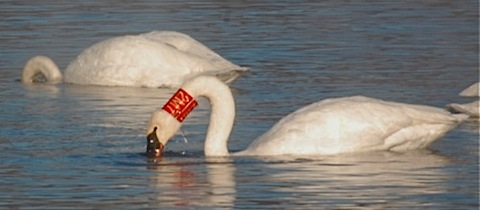
So, when I was out looking at the harlequin duck last week, I found a few banded birds at Point Douglas. It's not the first time, last winter I got video of a banded trumpeter swan. I sent the band info along to the Bird Banding Lab and it turned out the bird was from Iowa. I saw the above swan with a neck band and noticed that it had a different code and sent that along to the lab. I'm still waiting to see where this bird came from. But notice how the band is moving up and down the swan's neck. Above, the bird is just taking its head out of the water and the band has slid towards the head.
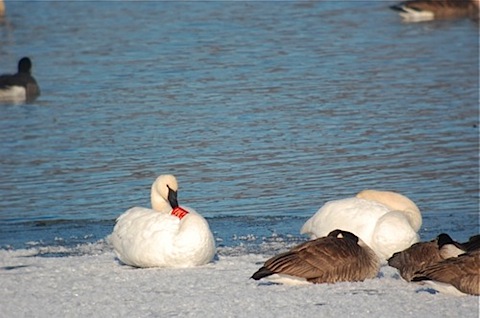
Here that same swan is preening and you can see that the band has moved back down. These types of bands are used on swans and geese to track individuals and where they are going. There's no way you'd be able to do id that particular swan with just a leg band (even if they are out of the water). Those metal bands on the legs are too tiny to read. But the bright plastic neck bands are easy to spot and read with a scope or binoculars. Because of the reintroduction program with trumpeter swans, it's not out of the ordinary to see one here and there.
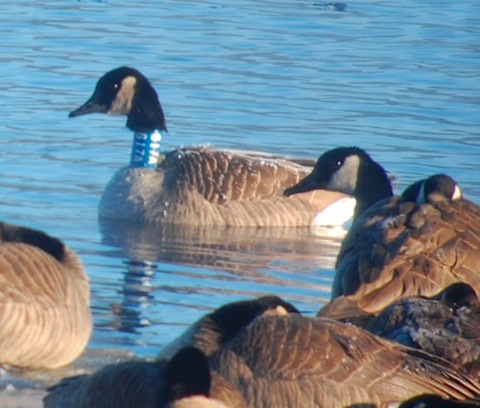
It is, however, unusual to see bands on a Canada goose these days. You used to see it all the time with the Canada goose reintroduction in the 1980s but by now it's an understatement to say that the geese are well established so it's not so common. But what really struck me about this goose was how tight the neck band appeared. I took this photo the same day, during the same time period as I did the trumpeter swan. The goose's band did not move like the swan's neck band did. It did not look comfortable at all. At first, I thought that maybe this was a fluke that maybe I caught this bird at a bad angle, but all my photos look the same, the band looks tight and does not move no matter what position the goose was in.
Then, earlier this week, this story appeared in the Duluth paper about a Canada goose that had Ice build up on its neck band. If you follow the link, you can see photos--the ice is about the size of a dinner plate. It has a happy ending, rescuers were able to get the goose and remove the ice and the collar but it has me questioning neck bands used for Canada geese.
I have to say, I'm a bander, and I see the value of neck bands--I truly do. But I think we need to rethink how neck collars are designed for some species. Even if the Canada goose in my photos is fine and the BBL backs it up with research and studies that say those collars look bad but are comfortable and fine for the geese--it's not a good advertising for banding. If someone knows nothing about banding saw that, they'd have a hard time seeing the value of banding and that it's not harmful for the banded birds.
Golden Eagle 42's Southward Movement
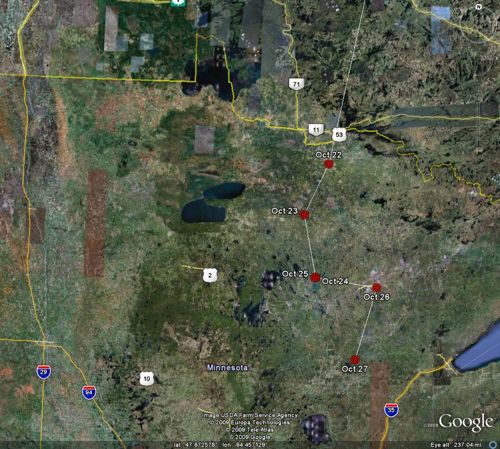 Golden Eagle 42 is still bookin' it south in Minnesota and taking an interesting way down towards Wabasha. Mark Martell reported this morning:
"Our eagle spent last night in Itasca County, MN about 3 mi. NE of Battle Island. He has been steadily making his way south at about 30 – 40 miles per day since Oct 23. The exception being Oct. 24 when he was on the Chippewa National Forest about 16 miles east of Lake Winnibigoshish and he made almost no movement."
There have been 111 Golden Eagles counted over Hawk Ridge so far this year, obviously our bird was not one of them. Is he an outlier and not following the main migratory path, or does this mean there is an even larger and broader migration of golden’s going through northern MN? And if so, where do they winter? Winter counts turn up around 80 eagles in SE Minn, and SW WI, are there more Golden Eagles in the area or are some going further south?"
Now, I'm curious if he will follow the St. Croix to the Mississippi River and then on down to Wabasha? Will he fly over the Twin Cities, mixed in with a flock of bald eagles? Can't wait to see where he goes. Learn more about Golden Eagle 42 at Audubon Minnesota.
Strange Few Days

I think this photo caught with my WingScapes Cam kind of sums of the hodgepodge of the last few days. Check out the red-bellied woodpecker, black-capped chickadee, and female purple finch posing on the feeder (never mind that there are 6 other feeders). Note that the chickadee is sporting a band--that means that my buddies Mark and Roger have been around and it was time for their bi-annual banding at Mr. Neil's. And we got in a ton of birds--so many that I barely had time to take a photo, we got over 50 birds in the nets. We pretty much would put up the nets and in fifteen minutes later they would have to be furled so we could process what we had.
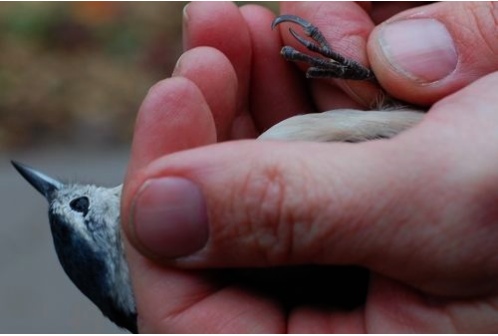
One of the interesting birds what this white-breasted nuthatch who was missing two claws on one foot. Many birds would be able to survive this just fine--but nuthatches use those toes constantly to go down trees. She was a hatch year bird (hatched this summer) so it will be interesting to see if she sticks around and survives awhile--will she ever be a recapture?

Speaking of recaptures, we had a really exciting one! We had a female goldfinch come into the nets with a band. Roger read off the number and Mark asked, "Can you read that again?"
Roger obliged and Mark said, "Huh, not our band number."
We had this happen once before and let me tell you--getting a foreign recapture once is like winning a million bucks in the lottery. Getting that twice, is--well it's just a big fat HOLY COW! Now, the last time this happened, it was a female goldfinch who had been banded four years earlier in Illinois (over 450 miles away). Now, here is where this recapture gets really freaky--we trapped this second bird in the same net as the other recapture and we caught her in the fall too. If this bird ends up being from Illinois too--what kind of crazy reverse goldfinch movement is going on? I have turned in the goldfinch's band number to the Bird Banding Lab...now I have to wait to hear from the original bander.
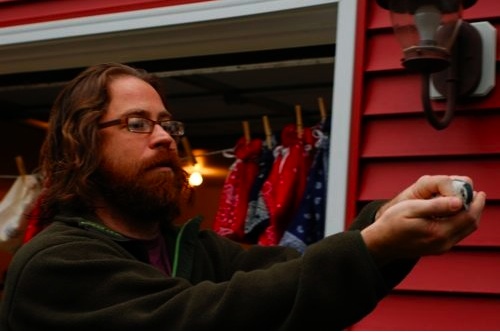
We had a special guest around the banding. If you are hip to the Internet Geek Music scene, you might recognize the bearded fellow releasing a nuthatch above--it's Jonathan Coulton. If you are new to him might I suggest his listening primer and check out the top four songs. Skullcrusher Mountain is a favorite of mine (although I do find myself humming Tom Cruise Crazy quite a bit).
Also around were Paul and Storm of the comedic musical duo...Paul and Storm. If you listen to Bob and Tom, you might be familiar with some of their songs and their alternate band name of the BarryTones (they use the power of barbershop to do things like a rap medley). Check out the songs Count to Ten, Your Town, or The Captain's Wife's Lament.
They recorded a podcast in Mr. Neil's sauna and Non Birding Bill and I got to participate. It's about a half hour long and there are a few four letter words flung around so not the safest for work. Also, some in the podcast are more tipsy than other. The boys tell some funny drunk stories and towards the end, you get a peak into the dynamic of my marriage to NBB. And, Mom, if you are reading this...skip to minute 18:00.
Warblers In Hand
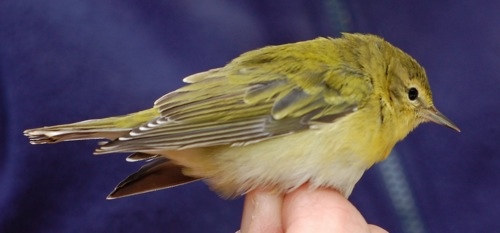
Here's another fall warbler that we still having hanging around in the Twin Cities. This bird hit the nets a few inches from a yellow-rumped warbler. When Amber arrived to take them out, she had to separate them--they were fighting each other! I wonder if they chased each other in? I wasn't sure what this bird was, but suspected orange-crowned warbler. However, Mark and Roger were not so sure and we had to go through a couple of different field guides to figure it out...it didn't help that the bird did not match exactly any description. Even using the vent key in the Peterson warbler guide wasn't 100%. But after a series of "if this than that" we narrowed it down to Tennessee warbler. Whew.
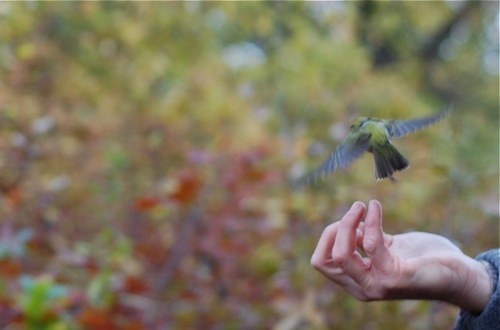
So take heart new birders, even in hand fall warblers can be difficult to id.
Fall Robins
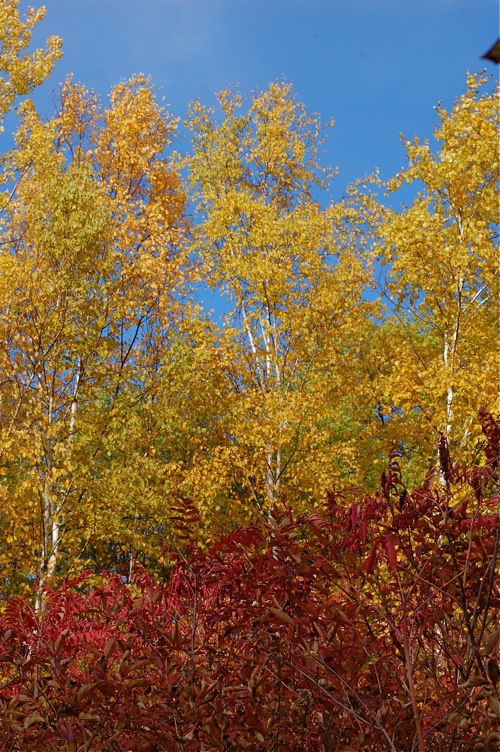
Despite the snow we had in earlier in the month, the autumn appeared to really itself this weekend and give a couple of days of proper October weather. Fall color peak is creeping into the Twin Cities, especially along the Mississippi River. I had the fortune of being able spend a couple mornings around my banding buddies Mark Newstrom and Roger Everhart so expect a few entries about bird banding this week.
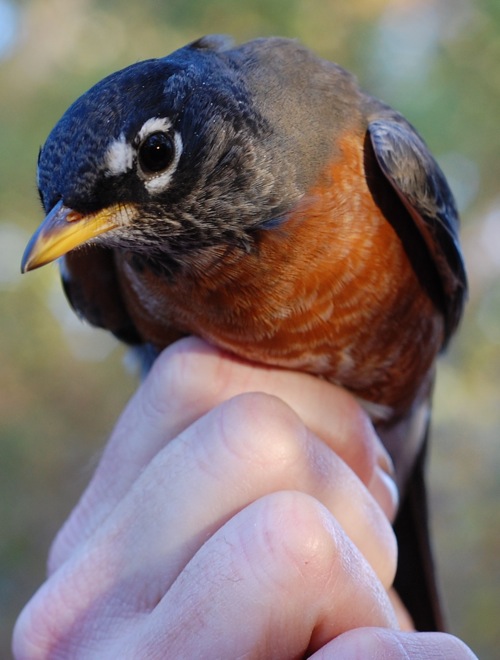
Robins are definitely on the move and the northern robins have moved in to the area. When I left this morning, I could hear them all over in the tops of trees in my neighborhood. Mark and Roger got a few in the nets.
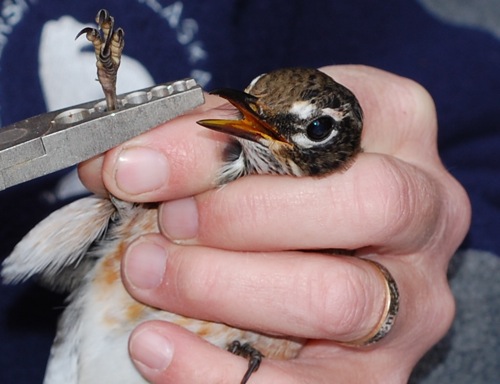
Robins put up quite a fuss when handled, trashing about and squealing. They even try to peck at you, but with that softer bill, they are nothing compared to your hard pecking chickadee or titmouse (birds who also have an instinctual knack for nailing your cuticle). Robins sound loud and squeaky but are in the end about as threatening as a kinglet.
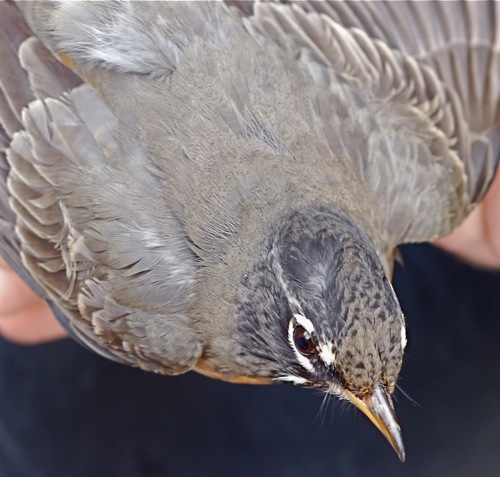
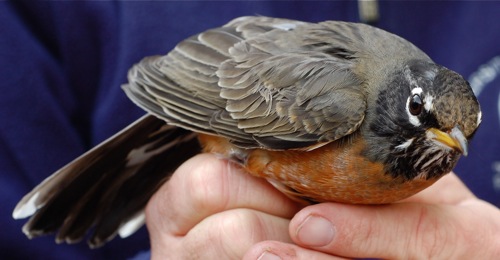
I think all the robins I watched them process where hatch year birds but some looked older than others. Roger pointed out that some hatch year birds could have hatched in April, others as late as August. Some would almost look like an adult, while others like the above bird with a combination of of immature lighter feathers and darker adult feathers.
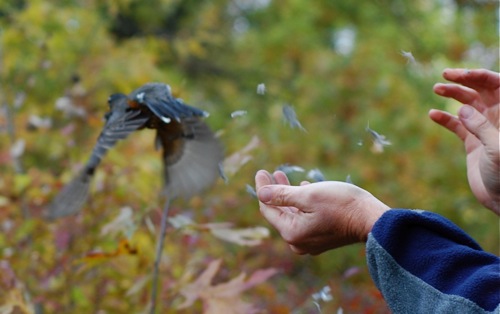
The other thing that is tricky with robins is that they seem prone to "fright molt" or dropping a bunch of feathers when freaked--as evidenced in the poof this one leaves behind as Roger releases it--almost looks as though the bird is releasing one heck of a fart as it takes off. It's believed that birds evolved to lose feathers especially around the rump and tail as a way to escape predators--a predator is more likely to grab in the back and grab feathers first. Doesn't always work, but sometimes birds do get away.
More bird banding tales coming, I leave you with a few random photos of robin releases:
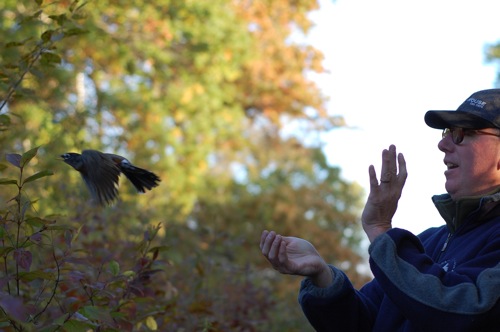
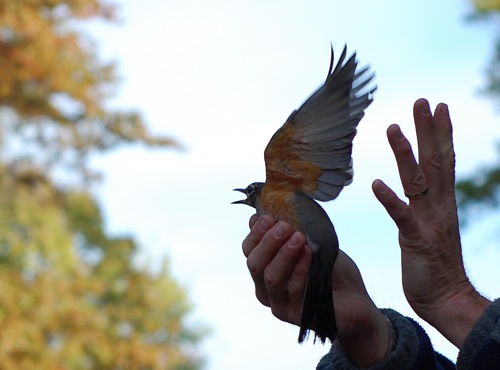
.
Flickers & Bluebirds At Carpenter Nature Center
 Friday was an unbelievably beautiful day at Carpenter Nature Center. I ended spending way more time out there than anticipated. It ended up being a perfect day and now as I look outside my window to see TWO inches of snow with more on the way, I'm glad I took advantage of the fall color and sunlight even if it never made it to 40 degrees. And yes, I did just type two inches of snow. That's a bit insane even for Minneapolis standards. I'm prepared for snow when Halloween hits. But not on October 12. Sigh, if you take into account that five inches in April is a normal occurrence, that means that we have six months of winter ahead.
Mental note: Plan a trip to Panama and possibly Peru this winter--who is in with me on this?
We haven't even gotten our full fall color in the Twin Cities yet. You can see in the above photo that we are right on the cusp. I think all this snow will make all the leaves say, "Screw it!" and just drop off the trees.

Banding was awesome--I got to band a brown creeper--who make sad little chirps in hand. It was a hatch year bird, hope it finds a way to survive the winter and is recovered by another bander some day. We also got in our first junco of the season. We normally get those in little Potter traps. It was weird taking one out of the mist nest (we only use mist nets in warmer weather at Carpenter).

My buddy Larry processed a downy woodpecker that I originally banded in May. That was exciting. When I banded it him in May, I aged him as a second year bird but according to Pyle and his fall plumage he was resembling an after second year bird.

Part of it was his eyes. In the sun, they looked very red. Although this photo shows them to be more brown than red. It's always nice to find an older bird and to have it surviving well.

As Larry and I walked around checking the nets, we watched a fascinating interaction among the birds. Migrants like the above northern flicker and yellow-rumped warbler were all over. We heard some blue jays and crows crabbing at each other. The crows were half heartedly mobbing something, but the blue jays sound a bit more on alert...a bit more like they do at the hawk blind when a sharp-shinned hawk is perched nearby. Then Larry and I heard a flicker give a distress call. We walked over to investigate and sure enough, a shin was actively hunting among the trees. He perched in the open momentarily and is was a juvenile male shin (barely the same weight as a flicker). He was in hot pursuit of flickers, but all of them were on to him and could out fly him. Shins, especially larger females can nail a flicker, but they need element of surprise.
The male shin would chase a flicker, it would give the distress call while the shin chased. As soon as the shin would perch, another flicker would fly right in front of it--almost taunting it. The blue jays would scream and yell like townies at a bar encouraging a fight. What was really interesting was a pileated woodpecker flew into the scene and perched near the shin, keeping a close eye. I've seen this before. I've seen pileateds creep towards a shin and even a male Cooper's hawk that is on the same branch and in both instances chase it away (it's a big woodpecker and I think it's size and bold approach freaks out smaller hawks). The pileated flew off and the shin gave chase--I don't know what it thought it would do if it actually had a pileated in its teeny talons. The pileated easily out flew the shin and perched in a tree. A second pileated hidden nearby gave a soft call, almost as if asking, "You still there?" The chased pileated called back and then took flight, circling the tree that the shin was perched in.
The poor male shin finally gave up and took to a thermal and circled high and out of view. My advice small male sharp-shin? Stick to sparrows and warblers.

A lot of birds were crabby--perhaps they knew better than I did that snow was on the way? Above a yellow-rumped warbler was trying to drive an eastern bluebird out of a tree. The bluebird crabbed back at it. The yellow-rump still mobbed the bluebird and eventually the bluebird lunged and chased it off.

I spent the better part of the afternoon with the bluebirds. They have a great palette to begin with, but I wanted to try and get a picture of that beautiful bird with the fall colors behind it. This bird was most uncooperative. Okay, so perching withe the blue sky behind it does make a statement.

But it kept coughing up berries. I'm not sure what's going on with that. I've seen berry eating birds like robin, waxwings and thrashers do that when they are in the midst of chowing down on a bunch of berries.

The bluebird were raiding the larder of fruit on the dogwood. It's funny, a fellow birder on Facebook had announced on this status the day before that a great front had moved in so watch the dogwood bushes for birds. I love hanging out around dogwood in the fall. Tons of birds eat the berries and all kinds of sparrows will pop out from beneath them. While chasing bluebirds I saw chipping sparrows, Lincoln's sparrows, fox sparrows, field sparrows, and one robust Harris sparrow mixed in among them.

The flocks of bluebirds would drop down and hover over the dogwood and then disappear in the foliage looking for berries.

It was a perfect day for digiscoping.
Rainy Weekend At The Hawk Banding Station
 Minnesota was a little on the dry side this summer and autumn appears to be hell bent on making that up. It is non stop rain and that was certainly the case at Frank Taylor's banding station this weekend. Not that I mind, last weekend was great and we got in a good number of birds and we got to watch some great hawk flights and dives. And at the end of the day, a slow and rainy day in the blind beats any day behind a desk (and wearing uncomfortable government pants) so I was just happy to be there. The camaraderie was great and Frank let Amber and I sleep in his trailer. There's nothing quite like hearing the patter of rain on the roof to put you right to sleep.

I thought for sure with the rain that we would get a peregrine in the nets--or at least see one, but alas we got skunked on the peregrine front. We did see a few merlins and one little tiny passage (hatch year) male came right in--and he was literally half the size of the pigeon. Ah, young males, so impetuous, they think they can take on the world...or at least a ginormous pigeon.

As we were about to let the merlin go, the rain picked up again--you can see it bead up on his head. He looks like he's screaming, "Okay, you have your darned photos, let's get this show on the road. Let me go!" And we did.

We did get in a few sharp-shinned hawks like the above adult male. I think we banded a total of four birds while I was there all day Saturday and for half the day on Sunday.

This sharp-shin is about to get a band on its leg. Considering how few birds we saw on Saturday, that wasn't a bad average. The rain kept raptors out of site. We did have a TON of migrants around us. The woods were still chock full of red-breasted nuthatches, yellow-rumped warblers, black-capped chickadees, ruby-crowned kinglets and palm warblers. You can see photos of some of those birds at my buddy Amber's blog. They were very responsive to pishing. I stood in the woods behind the blind, pished a little and the whole mixed flock dropped from the trees and eyed my warily. One red-breasted nuthatch landed briefly on my hat...of course, I did not have my camera with me. We also had a bunch of lapland longspurs flying around in front of us and it was amazing to watch them disappear into the grass when the flock finally landed. American pipits called frequently from overhead as they too worked their way south.


Adult sharp-shinned hawks are a thing of beauty with their orange fronts and dark blue backs, accented by a red eye. Even though we did not get many in, the few adults that landed in the nets were a treat to see up close. Normally, when we let birds go, I like to lay underneath the releaser and get a shot of the bird in flight from below. Usually, the releaser opens their hand on a count of three and the bird bolts.

This particular sharp-shinned hawk wasn't ready. It paused, just for a moment. I love the way it's looking behind, as if to say, "What now? You thought you wanted me to flap on five?" Don't worry, true to accipiter form and this bird's folk name of Little Blue Darter, it flapped in plenty of time and dove into the woods.

This was a passage (hatch year) male. Look at his little chicken legs! These hawks are so tiny in hand (blue jay sized) and are really skinny--like David Bowie circa Diamond Dogs skinny.
I hope I get to make it up one more time...I did not get a good goshawk fix at the blind.
Digiscoped Images
Fresh Tweets
Would you like to hire me as a speaker for your event?
Email sharon@birdchick.com