
Birdchick Blog
Other Bugs At The Beehive
I've gotten a couple notes that some readers are grossed out by bees and by other bugs. FYI, this post is certainly not for you. We have other bugs in this post, and one photo is slightly gross.
This post is the combination of two days of beeing. Mr. Neil is leaving for a while and I wanted to make sure he got a bee experience before he left. Unsure of what his packing schedule would be, I came out the night before he was to leave so I could be up early and ready to beekeep at a moment's notice. When I arrived, I met up with a woman who is assessing the surrounding woods and will help come up with a plan to get rid of some non native plants and managing the woods for native plants, bees, and wildlife. She mentioned that the bees were very active and loud, crowding at the entrances of their hives.
 I zipped up my bee suit and stoked the smoker to go see what was happening. Olga bees were all over and swarming out of the hive. When I was about 50 feet away, you could hear the buzzing--usually you can't. From that angle, when you first approach the hives you can see the bee super highway as they head up over the tops of the trees on their way to look for nectar and pollen. There was a pretty steady stream of bees coming and going. I don' think it was swarming, I think it was four days of constant rain--they wanted out and wanted to gather winter stores. I didn't open the hives, but just took some time to sit at the entrance of each hive and watch the bees coming and going.
 The Kitty bees were coming back loaded with pollen of various colors. Note that almost every bee in the above photo is loaded with pollen--I love the neon yellow stuff. Goldenrod is blooming all over, so my guess is they are using that.
 Now, look at this one. In the middle is a bee with the neon yellow pollen. But, look in the bottom right hand corner. That bee has pollen that is snow white--where are they getting white pollen? Wish I knew my plants better.
 This bee is so loaded with pollen, she's practically dragging it in.
 When I came to the Kitty hive, there were some grasshoppers (sometimes called by locusts) hanging out. There are always some on one of the hives and I always wonder what the appeal is. Do they like the buzzing? These appear to be two different species. I've been trying to id them with the Kaufman's Field Guide to Insects of North America. I think it might be a two-striped mermiria but am willing to listen to anyone who knows otherwise.
 I think the larger one is a differential grasshopper, but whatever it is, I love the yellow antennae.
 When I went over to the Olga hive...I didn't find any life grasshoppers. Apparently, Olga has a lower tolerance for these guys hanging around their hive. This is a dead Carolina grasshopper. When they jump/fly they resemble a mourning cloak butterfly with dark wings and a light stripe. I found this species in my Songs of Insects book (I love this book. Not only does it a beautiful picture book, but i comes with a CD that identifies the buzzy insect songs of late summer early fall--I'm paying way more attention to the number of species I'm hearing now. Sometimes I just let it loop on my iPod while I'm writing, it's great background noise).
One of the really cool things of just hanging outside of the hive was that I noticed some things I had never seen before. The dead grasshopper got my attention, and then I noticed a worker from the Olga hive dragging out another dead worker bee. She was trying to fly it away far from the hive--this is part of they hygienic behavior my bees are bred for. Here's a video of it:
This helps keep the hive clean and healthy. I wondered if the workers had been putting some of this off because of the rain or if I'd never just had a chance to sit and watch them come and go from the inside of the hive. of just I noticed something interesting. I scanned the ground just outside the entrance and found a few lethargic drones and workers. Then I found this:
 This is a solitary wasp called a beewolf (some books lump it as one word, some make it two separate words) and it's attacking one of my workers. I wondered if this is a lethargic, dying worker and not one of the stronger ones. They paralyze other stinging insects and take them back as prey for their larvae. You can read more about them here.
 The next day Mr. Neil and I went out to check what was going on inside the hives. It was very much the same as last week. Again, I think it's because the workers haven't had a real chance to forage and draw out more comb and produce honey. I'm not too worried about Olga, but I'm going to need to give food to Kitty if she's going to have enough food to supply the colony for the winter.
 We tried putting the queen excluder in last week and I think I'm done with them. The queen excluder is supposed to prevent the larger queen from going up into your honey supers to lay eggs. However, it's very obvious that workers are having a tough time passing through the bars too. This poor girl was so wedged, I had to push her out. The beekeeping community seems to be divided on the queen excluder, but myself, I'm done with them. My other option is to do what's called a reversal--which we did do and is kind of a mess, but it's better than watching a bunch of workers stuck in a metal frame.
 When we opened the Olga hive, about nine moths flew out from just under the roof. One landed on my hood. One concern you have with beekeeping are wax moths (you know the wax worms you get for fishing or sometimes to feed birds--the larvae can wreak havoc on a beehive). The larvae will eat the beeswax and make cocoons in the frames, generally making a dusty, webby mess. This moth doesn't look like a wax moth to me, I think this was more some other type of moth and they were trying to keep out of the rain. Either way, Olga is a nice strong colony and a strong, healthy colony can keep wax moths out.
This post is covered in bees
Hello, all, NBB here.
As Shazz pointed out, I was initially apprehensive about her keeping bees. Given that both her and Neil's schedules are so hectic, I was convinced that his assistant Lorraine and I would end up being the bulk of the work. And while I don't have a bee phobia, the idea of intentionally walking up to a big pile o' bees and tearing their home apart to steal their honey gave me pause.
So it was a little surprising to find myself heading off to inspect the hives today, alone. Well, except for Cabal the beekeeping dog, who really serves only in an advisory capacity.
 I can haz beez?
The really weird thing is that beekeeping isn't all that scary. The suit covers you completely, and the smoker causes them to instantly scurry back into the hive. Whenever we go out there, I'm more concerned about crushing a bee that I am about getting stung.
Another thing is that the bees themselves aren't aggressive. As long as you handle the boxes carefully, and smoke regularly, most of them just go about their business, even as you take the frames out, one by one. You'd think you'd get a bigger reaction, since they live and work in darkness, but opening the hive really only affects a small portion of the hive, who come out and buzz around, but don't immediately attack. Part of this, of course, is because we go out in the middle of the day, when the foragers are out collecting pollen, but still.
The only time they've become deliberately aggressive is when a frame we were handling slipped from the glove, fell about an inch, but landed on the hive with a good, solid, bonk! In a split-second, the buzzing got much louder, and Sharon and I both froze.
"I wish that hadn't happened."
"Me too."
Still, even when they're buzzing around your head, butting against the screen that shields your face, there's not really a sense of attack--though we have been stung in the gloves a couple of times. Maybe it's because before all this, my interaction was with lone bees--foragers, and all you think about is the stingers, rather than them working as a group, building a hive.
So anyway, I like the bees. They're kind of cute. Perhaps it's because they're fuzzy.
And now for your weekly bee report.
Queen Kitty II, by the Grace of God, Defender of etc., etc. had been accepted into the hive and it was hoped that she would start laying workers to replenish the hive. I'm happy to report that I believe this is happening!
Let me first apologize for the quality of the pictures; taking good shots of bees is tough enough, but add in a black screen in front of your face, direct sunlight on the view screen, and sweat dripping onto your glasses, and it's hard to feel the love when you're trying to get out of there as quickly as possible, before you need to find out if you're allergic to bees (and you realize that you left your cell phone back at the house. Screaming "911" doesn't really work as well).
 Plus, and I hate to gossip, but the bees just really didn't take direction well. "Throw back your wings!" I shouted. "Show me how much you love that honey! Stick out your proboscis!" Honestly, it was like they weren't listening at all. Prima donnas.

This is the top box of Kitty. Some activity there, and a lot of buzzing. The last few times we visited the hive was very lethargic (quiet), so I took this as a good sign. Pulling out the end frames:
 Workers, drawing out comb, which means that they're building their own comb on top of the plastic sheets in the middle of the frame. I don't know if you can see it in this picture, but there are a lot of bees in the middle box, below this one. Pulling out the center frame:
 It's almost entirely filled with honey, some of it capped. This actually made me a little apprehensive, because what we hoped for was brood: eggs that would turn into workers. At least, I pretty sure it's all honey. Sharon's the head beekeeper here and I'm just trying to remember what she told me as I watched her inspect the hive. Anyway, not seeing any evidence of eggs, I moved onto the second brood box.
 Tons of activity and a lot of buzzing, which I was happy to hear. On the end of the box they were drawing out more of what looked to be honey, and making more of their funky comb (Kitty hive takes after her namesake). I was pleased by the activity, but knew that I had to keep digging until I could report to Sharon that we had larvae. So, moving into the middle frame of box 2:
 Larvae! Precious, precious larvae! Now, if I remember correctly, the worker cells are relatively flush with the comb while drone cells puff out, because the males need more room for their recliners and beer. So, is this almost all future workers for the Kitty hive. In addition to this, there was a lot more activity going on inside, lots of noisy buzzing. Yay!
Having established that Kitty II was having a prosperous reign, I closed the hive and moved onto Olga.
Olga, as you'll recall, was our big hope for honey after the Kitty I decided to go on tour with her Swarm (which would be a good name for a hair metal band, late 80s. So if you're thinking about traveling back in time and living like a modern cowboy, on a steel horse you'll ride...). However, after having no end of problems with the first honey super (the wax centers kept collapsing), we added a section of plastic rounds, but left the first super on as well, just to see what the bees would do.
 And here it is: The bees are building feral comb in the empty frames, which, if all goes well, will translate into edible honey for us, albeit in a very funky form. Olga, your bees are getting results, but they're not following the rules!
Suddenly I'm a chief inspector in a bad 70s cop show.
Very little activity otherwise. Moving onto the plastic rounds:
 ZILCH.
We're getting completely nooged by the Olga bees, who I think might be onto us. One was constantly buzzing my head, and despite my best efforts to smoke her, she kept right on flying a patrol around my noggin. Lots of bees running around in the plastic rounds, and they'd glued them all together with propolis so tightly I had to pry them out with both hands, but not a single spot of comb.
UPDATE: Turns out the plastic rounds are supposed to have a wax foundation (like the other frames) that goes in between them. After rummaging around in the shipping boxes, I found them, added them to our second set of rounds, and swapped the boxes. Needless to say, the bees don't really appreciate two visits in one day. Ah, life.
So, this concludes your regular bee update. And now, if everyone will please close their browser windows...
A PRIVATE MESSAGE TO SHARON:
Darling, please come home. I'm sorry I made jokes about birds. I'm so, so sorry. I miss you. The pets miss you. Well, Cinnamon doesn't, but you know what I mean. I promise never to make jokes about how brown birds look exactly alike, even though they obviously do. And all those times I said you were nuts to go and stand in a field at 5 a.m.? Well, uhmmm... well, I was right about that, too, but if you come back I'll keep it to myself and only laugh when I think you're not looking.
Please, please come back.
END PRIVATE MESSAGE.
New Caterpillar Madness
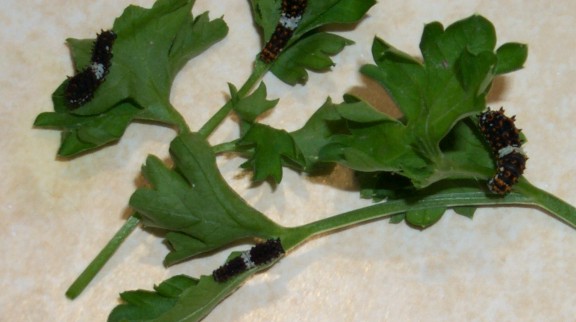
 I've been monarch ranching for awhile, but I've always wanted to ranch some swallowtails. Some species of swallowtail caterpillars feed on parsley. Earlier this spring, I found out that we had accidentally had a black swallowtail living in our apartment (we guess it came in as a caterpillar on some of Cinnamon's parsley) but I wanted to it right this summer, and find the caterpillar and watch it grow. Mr. Neil has some parsley (above) in his garden, so I decided to see if I could find swallowtail caterpillars on that. I find that locating caterpillars takes a long time the first time you look for them, but once you find them, your eyes become trained and in the future, they are easier to find. I sat down and studied the parsley.
 After a good ten minutes of study, I found six small caterpillars. They looked nothing like any of the swallowtail caterpillars in my books. I looked up the general characteristics of the black swallowtail: caterpillars are found on parsley (check), on the top side of the leaf (check), and early stages resembles bird poop (check). But still, if you look at what a large black swallowtail looks like, the books show you this. This tiny thing doesn't look like that at all. Fortunately, with the magic of google, you can narrow your search of images on the internet and I found photos of young black swallowtail caterpillars and they look just like what I found in the above photo--success, we have swallowtails!

 I took four of the six swallowtail caterpillars and put them in my butterfly pavilion. You can see a water bottle inside, holding a bunch of curly parsley for them to feed off of, right along side a water bottle full of milkweed and monarch caterpillars. Next to the pavillion is a bunch of milk weed in a different water bottle--those are plants with monarch eggs on them. I keep the eggs separate until the caterpillars hatch so I don't confuse leaves with eggs with the leaves for feeding. Should be an interesting couple of weeks.
 Meanwhile, we've had an early sampling of our dangerous honey from the Olga hive. Mr. Neil told us to mix some of our honey and comb with some plain Greek yogurt. YUM!
 It's like a decadent dessert, only it's yogurt...and honey... from our own bees--that's got to be healthy, right?
Son Of A Beeswax!
Non Birding Bill and I headed out to check the status of the Kitty hive. Last time, we had placed a new queen in a cage inside the queenless hive. The cage opening was covered with hard candy. The workers were supposed to chew their way inside and by the time they got to her, the whole hive would be under the spell of the new queen's pheromone.
 When we took out the frame with the queen cage, several bees were gathered around the queen, a good sign. They didn't appear to be attacking the cage, but VERY interested as to what was inside. I decided to remove the cage from the wax to see if the queen was still inside.
 You can see on the side of the box is a piece of tape with a hole chewed through it. Behind the tape is the cage's opening. The opening is jammed with hard candy. The hole in the tape and the tunnel in the candy tells us that the workers have been trying to get the queen out--and have almost made it all the way through.
 If you look at the workers on the side of the cage, you can see their proboscis is out to feed the queen nectar through the screen--they look like they are ready to serve under her rule. We did one more test. I had NBB smoke the cage to remove all the workers and we waited to see how long it would take for the workers to come to her again. Not long! They came to the cage before I had a chance to turn on my camera. Watch them come to the queen:
I think it's safe to say that they are assimilated to her. We put her in on Tuesday and here it is, Saturday afternoon and they are all over her cage, and have almost chewed their way through the hard candy. I decided to go ahead and open up the queen cage like we did when we first installed the bees in April. I'm an old pro at that now. I gave NBB the camera and had him make a video of this momentous occasion:
Did you catch what happened there? In case you missed it, that big bee flying away above my hand in the last few seconds of the video is our queen, flying away. HOLY CRAP! That wasn't supposed to happen! As soon as the camera was off, she flew to the right, I almost had her in my hand. She landed on one of the brood boxes. I went to get her and then she flew behind NBB and I lost track of her. It was not unlike the moment in A Christmas Story when Ralphie lost all the screws when he and his dad were changing the tire and he said in slow motion, "Oooooooooooh Fffffffuuuuuuuuuuuuuuuuuuuudge."
Only, I didn't say "fudge." Imagine the worst profanity you can think of and that's pretty much what I said at that moment. What else could possibly go wrong with the Kitty hive? I briefly thought back to just a scant two months ago when Olga was the problem child.
Then, I immediately switched gears to problem solving mode, and thought back to the beekeeping class I took. The instructors warned us that this could happen when we would be hiving our new packages and releasing the queen. They said the thing to do is just stand where you are when the queen left and wait for fifteen minutes. The queen who just flew off is full of eggs and ready to lay and therefore, kinda heavy. She can't fly far and as she leaves she will realize that this isn't really what she wants, she's not going to find what she's looking for on this flight and back track. She'll look for familiar objects from where she she started--what could be more noticeable than two giants dressed all in white?
We stood and waited. I noticed when she flew that she was obviously larger than the workers and flew like a drone--slow and heavy. I went behind NBB to see if I could find her clinging to any nearby bushes, but didn't see her. NBB and I still waited. A large bee flew by my head, I watched it land at the entrance--drat, it was only a drone. The noon time sun combined with my tension of wondering if the queen would come back started to form sweat along my forehead and back. I kept remembering what the instructors told us, that the queen would come back, even if we didn't see her. After fifteen minutes, go ahead and close up the hive, she was probably in there. Although, those instructions were for installing a package in April when there were no leaves on the trees, no flowers, and much cooler weather. This was a warm, sunny day, with clover all around, and trees chock full of leaves--perfect for a queen to hide. Would the same strategy work?
Another large bee bounced off my hood, I watched it fly low to the ground, and then to the entrance. Another #$%& drone.
I started to form another strategy in head. The queen dealer wasn't far, maybe I could pick up another queen and start all over? Boy, that would be embarrassing to explain that I lost another queen. Although, I prudently hadn't killed the queen cell with an egg that we found last week, maybe I could just go with that plan? Suddenly, a large bee came from behind NBB, it was heavy and slow, and very tan. It landed right on the frame where the queen cage had been. Could it be? Was it really? YES! Yes, yes, yes, yes, yes yes! The queen came back! Of course, we videoed her triumphant return:
I'm sure we only waited for less than five minutes, but I have to say that it felt like we were waiting for an hour! In case you are having trouble viewing her in the video, I did get photos:
 She's right in the middle of the photo, surrounded by attendants. Note how her abdomen extends well past her wings. She's also much lighter in color than the original Queen Kitty. We have noticed that our workers in both hives have been changing colors. This hive started with lighter bees and now has darker bees, I'm sure it has to do with what types of drones the queen was mated with. The queen dealer told me that he had mated this queen with a variety of males, including a couple of carniolan drones which should bring me some colorful workers. Since carniolans are black, I wonder if the original Queen Kitty was carniolan?

Anyway, help us, Queen Kitty II, you're our only hope. The workers will show her around, she'll get rid of any queen cells in progress, and commence to layin' some eggs. Man, oh man, what nail biter that hive visit was.
 In other news, the Olga hive continues to be a model of good bee behavior. We got in our new Ross Rounds comb honey super and are going to try that since we are having so many problems with the original comb honey kit. I'm happy to report that not only did the Ross Rounds kit come with instructions (unlike the other kit) but it was already assembled. Since I didn't want to waste time, we didn't paint it, but added it right to the Olga hive. You can tell the Ross super from the rest because it's not painted. Here's hoping we get some good old honey out of that.
Can't Stay Out Of The Hives
I dedicate this entry to Christina, who I inadvertently stood up--I swear I left a message, just on the wrong phone. Here's what kept me away:
 A first for me: placing my ungloved hand on top of a brood box loaded with bees, and not having a complete and utter nervous breakdown. When I realized that the Kitty colony was queenless, I tried to purchase a replacement queen but every place I called had just run out of queens. So, I decided to go for the madcap raising an egg from another hive into a queen plan--risky and time consuming, but my only other option was to combine our two hives and I didn't want to do that unless I absolutely had to--the hive would then be just be too high for me to reach and inspect.
 I recently made friends with some local beekeepers and was telling them about my problems with Kitty and several of them told me of a man nearby who still had queens for sale, but they warned, I had to get her installed now. I called the number, he said he had what I needed, we made an appointment, and in a warehouse out in undisclosed town that could pass for the picture definition of the boonies, the deal went down. We shook hands, he pulled a small wooden box from his pocket, I pulled some cash from my pocket, and the queen was mine. I put her in Non Birding Bill's pocket and from there we hightailed it out to the Kitty hive to install the new queen.
 We threw on the bee suits, NBB lit the smoker (because he is the smoker master), and I gave Mr. Neil the queen for safe keeping. It was late in the day and we had to act fast. The foragers would be back in the hive and those are the most likely to sting you. However, when we opened Kitty, all was surprisingly calm--must be the lack of queen. Mr. Neil took the queen from his pocket and as soon as he took out the box, one of the Kitty bees landed on it. The queen's very first subject! That's it, my pretty, drink in that pheromone, assimilate, assimilate.
Basically, the queen is in a little cage that has a piece of candy covering the opening. When we first put the queen cage in the hive, the workers will want to come and kill the queen--but when they approach, she releases her pheromone and they want to serve her. Her aroma is released through the screen and both she and the other bees chew through the candy to have access to her. Once they get through the candy, they will have worked out their differences and the workers will show the queen around the hive so she can commence laying eggs. Here is the video of attaching the queen cage to one of the frames:
When we pushed in the cage, some of the cells with honey came open and created a small river of honey. In the video, you can see some of the workers start to lap it up. Here's a detailed photo:
 Look at the lines of bee proboscis (tongues) lapping up that honey. Feast, my girls, feast. A new queen has arrived to build up your numbers. Some of you readers may be wondering why I went for a whole new queen if we started some eggs growing in a queen cell? Well, that wouldn't yield any new eggs for two weeks, and then it would be another three weeks until those eggs would hatch into new workers. Now, we have a new queen, fully fertilized and ready to lay. She'll need a few days to work her mojo on all the workers, but then she will get to layin' and I'll have new workers in three weeks instead of five weeks, giving them more time to build up food stores for winter.
 So for the moment, the workers are all over the queen cage, like ugly on a pig, absorbing her pheromone. More bee madness to come this weekend.
Requeening The Kitty Hive
 I took a photo when we opened the Kitty hive and just when I hit the button, a worker went straight for me--INCOMING! Oh, and if you are curious, none of us have been stung through our bees suits...yet.
Today was the day to find out if the mad experiment worked. You may recall that last week, our dear Kitty hive had swarmed and in my efforts to try and prevent it, I removed all the queen cells, but the hive swarmed anyway. Doh! I read about a plan to take eggs from the healthy Olga hive and see if Kitty would raise one of the eggs into a queen...
 But first, I have to show you a really cool new tool I got to make our hive inspections easier. It's a little hanger you attach to a brood box while it's open. When you take out a frame, you can hang it on that, instead of setting the frame on the ground--it was pretty sweet and keeps you from crushing bees or letting the queen crawl onto the ground.
 We had to dig around and look for the queen cells and we found one. This one had LOTS of activity around it. We tried smoking the bees out of the way to see if we could look inside and find an egg or better yet, larvae. Any fertilized honeybee egg can be a queen. What separates an egg from being a worker as opposed to the queen is that the the larvae is fed only royal jelly every day before it pupates. Workers only get royal jelly for three days. All this activity around this cell had me hopeful there was larvae inside, but I couldn't see anything, because it was at a weird angle. We continued our hunt for more queen cells. We found many, but they were empty.
 But then we found two queen cups on the bottom of a frame (queen cups are the early states of a queen cell and low and behold, there was an egg inside the queen cup on the right. Can you see the tiny thing that looks like a grain of rice? That's an egg that has been transferred so it can be raised as a queen. WHOOT! If you're having trouble seeing the egg, try clicking on the picture, that will make it larger. Things are looking up for the queenless Kitty colony. An Olga egg that was originally intended to grow into a worker, is now to become a queen--should I change this hive's name to Anny Boleyn?
Okay, it will be an egg for three days, a larvae for about 5-6 days and pupate for about 7-8 days. When she emerges, she will get a quick tour of the hive for a couple of days, then fly around and fornicate and kill some drones for three days, and then get down to business and layin' some eggs. Hopefully in about two and a half weeks, we'll see some eggs!
 Last week, we had added a honey super to Olga, as well as a propolis trap. I went to check in and see how that was doing. As you can see in the above photo, the trap is well on its way to filling with propolis--yum. The honey is another matter...
 I've been having some issues with the comb honey kit that I ordered. First, there were no instructions that came with it that told me the important step of nailing the comb foundation into the frame, so last week all of our foundation started to melt, bend, and fall out of the frames. I called the place I ordered my kit from and they unhelpfully asked, "Didn't you nail in the foundation?" I told him no because there were no instructions. So, I nailed in all the foundation. Today, when went to look inside, the foundation had fallen out again! And I had nailed it! In the above photo, you can see the foundation laying between frames on the bottom of the box. They bees are using it, but it's going to make inspecting the hive and extracting the honey a pain. Hey, and remember how Olga had a talent for building funky comb? Well, that talent finally came in handy:

 She built her own comb on one of the empty frames! Go Olga bees! Not only did the bees build inside the frame, but on the bottom for good measure. As much as I appreciate Olga's ambition, this may not be the best way to go. I called the company and complained about my dissatisfaction with this comb honey kit and we are going to exchange the kits we have for a comb honey kit called Ross Rounds, hopefully that will work better for all involved. So, if anyone is reading this blog and thinks one day they will try having their bees make comb honey...choose your kit carefully.
In other news, on our way to the hives today, Mr. Neil was telling me about a hen turkey and poults he and Cabal flushed on their way to the hives a couple of days ago. Just as he was describing it, Cabal flushed a turkey right next to us that was hiding in the grass. She popped up and flew in one direction and then Cabal flushed about five poults who flew in the other directions. The poults were about the size of a cantaloupe and could fly already! I didn't know they could fly that young. All the young turkeys made it safely into a tree and Cabal did not get them.

A Skunk In The Beehives?
Don't forget, there's a FABULOUS new shirt available in the Birdchick Store. As Ian and Margery would say: "Kids in Carpool Alert"--parents who read the blog with kids may want to wait until reading alone to check it out. View the shirt here.
I could not escape bees while in North Dakota--not that I really want to. We don't want to overly inspect the hives, so they can get down to comb construction and honey production. We've been giving our girls space and room to grow and I've missed them.
 We saw beehives all over in North Dakota, we passed several. I'm not sure all were permanent residents.
Also, while out on the prairie, I got a call from Mr. Neil about our girls. So far, all of us have been able to meander very close to the hives without our bee suits when not inspecting the hives and the girls go about their business. Mr. Neil and Cabal (the new dog) have been able to run through and I've been watching indigo buntings and digiscoping bobolinks without any trouble. That's now all over.
Mr. Neil and

I'm going to get some carpet tacking and put that outside the hive (hopefully on Thursday), it's supposed to keep the skunk away--also if anyone has any skunk prevention tips, I sure would appreciate any advice.
Memorial Day Bee Update
The bees are plugging along!
 Here's a photo from the back side of one of our frames. You can see some of the pollen stored on the other side. Such beautiful colors.
 During our last visit to the hives, we had added another brood box because the bottom brood boxes were about 80 percent full. The Olga hive was a full 80% filled and Kitty was closer to 75% filled but we added another box to her as well. When we checked on Olga, she had barely begun to draw out any comb whatsoever in the new brood box. Kitty who was a little behind Olga and filled up one full frame already and was well on her way to filling the second. I wonder why the shift production?
 Both hives were feeling less tolerant of us today. Above is Lorraine scraping off some irregular comb, while Non Birding Bill smokes the bees. (Mr. Neil was not around today, so we made sure to document the adventure). A smoker is one of the most important pieces of beekeeping equipment you'll need. My bee instructors said that they would rather visit a hive without a bee suit than without a smoker.
Here is a video demonstrating "smoking the bees". Watch what happens when NBB puffs some smoke on the workers:
Did you see the workers go down? The smoke makes the bees think that there is a forest fire and instinct tells them to go down and eat honey, don't bother to try and drive out the big thing taking apart your hive. Now is not the time to fool with that.
 Above is a photo of the bees eating the honey. If you look closely, you can see their little tongues in the cells lapping it up. This was a part of some burr comb that didn't have any eggs or larvae in it, so we took it out.
 What's interesting is that my bee instructors told us that if we got stung, to immediately smoke the area. When a bee stings you, it releases a pheromone to get other bees to come and attack. If you puff smoke on it, the smell of the smoke masks the pheromone. While working with the Olga hive, I saw a bee sting my glove--I didn't feel it, but I saw what happened--as soon as the stinger went in, five bees were on my glove in a split second. I had NBB puff my glove and all but the stinging bee left the glove. The stinging bee did get loose and I didn't see that she left her stinger--I wonder if she survived?
 Brood has definitely hatched! We actually found some drones today. In the above photo you can see one of them, he's circled--you'll notice his wide, blunt rear end. Drones are the result of an unfertilized egg laid by the queen. They require larger cells than the female larvae in which to pupate. Drones pretty much eat honey and make flights out of the hive to find other queens to mate with. Once they mate with a queen they die. They don't help build comb or gather pollen or make honey. Some people get rid of drone cells--who needs 'em, but I'm hoping some of our hygenic drone genes make it out to other queens and maybe slow down the verroa mite in the US bee population.
 On our last inspection we found Queen Olga but not Queen Kitty. This time we did find Queen Kitty, that's her circled above looking for cells for egg laying. It was so exciting to watch her in the Kitty hive as she was crawling over a clean frame of comb which two weeks ago was chock full of capped brood and now it was empty since our brood had hatched. Whoot!
And like a proud mom, I have a video of both Queen Olga and one of the drones:
The grow up and move so fast!
 We still have a little bit of funky frame building, but this time it was very minimal in each hive. We've been using a frame spacing tool and that really does seem to be help the situation. It's not as easy to use as it looks, the propolis keeps things a bit sticky and I feel like I'm really wearing out my welcome with the girls--they start bumping our helmet and that's the final warning before they sting.
After we finished the Kitty Hive, the bees were all over in the air. I thought I would lay on the ground and get a video of the bees flying above us. It's just hypnotic:
Did you happen to notice NBB saying "Are we done yet?" That was a running theme today. The bees were anxious to have us away from the hives and NBB doesn't want to risk any of them getting killed by stinging us to get us to leave--gotta love that guy.
Anyway, I think this is my favorite video, you'll see why at the end of it...
Again, did you hear NBB, "Are you done?" My little broken record! We have one more video, but I'm having trouble getting it to upload properly. Hopefully we can get that up in the next day or so.
Bee Report - Olga on Track
 The heavens opened up and shone down upon our industrious beehives and made the larvae to sparkle! And it was good. Note the twinkling bee larvae in the above photo? That's gotta be a good omen.
Well, we learned some interesting lessons at the bee hives today. Number 1 - you sweat in all kinds of places when wearing a bee suit in upper eighty degree temperatures while standing in bright sunlight. Hoo wee! Number 2 - Olga is coming along rather splendidly!
 She had about 70% of her frames drawn out with comb! The above photo is one of the center frames that we checked last week that had eggs in it. Now the eggs are larvae and the workers are capping them so they can pupate in peace. You wouldn't believe how heavy a frame full of drawn out comb, brood, and honey feels! This is what a good frame of brood looks like according to the books and classes--what do you know, Olga is finally agreeing with the books--and exceeding Kitty's hive in comb construction. Kitty was a full two frames short of the Olga hive.
 That's not to say that Olga still isn't showing her individuality. There is some unique comb construction going on, but I believe that is more my fault for not spacing the frames properly. Above is an example of some of the funky comb from Olga's hive. It's elevated and curled upon itself. They Kitty hive had a little of this as well, but not to the degree of the Olga hive.
 For some of the comb, we were able to press down onto the frame, but some of it was out so far out, I had to take it off. I felt a pang of guilt because larvae was inside some of the cells--but it had to be done to insure proper frame spacing in the future. There was also some honey mixed in with the larvae from the removed comb that dripped onto my palm. Mr. Neil, Lorraine, and I took a taste. It had honey flavor, not full honey but the potential for flavorful greatness is there. I felt a surge of pride in our girls.
 Here's another shot of some uncapped brood. This larvae will probably be capped off within the next day or two. Imagine, two weeks from now, those gelatinous, squirmy blobs will be just like their sisters above. We did not see either queen today, but we did see lots of eggs in both hives meaning both queens were there, but doing a good job of evading our watchful (albeit sweat covered) gazes.
 Both hives are taking advantage of the nectar feeder and of the pollen patties. Kitty's hive has gone into propolis overdrive. The flat things in the above photo are the pollen patties and the little bits of tan granules around it are propolis. It's starting to get gooey ad sticky in the hot weather. I have a feeling it's gonna get messy later this summer in the Kitty Hive.
 Here's a photo of the workers at the Kitty hive entrance. Notice the yellow around the hole--that's pollen that has fallen off and collected from returning worker bees. It's interesting to observe the more territorial behaviors today. With the Olga hive, we have a very limited time before we wear out our welcome. They start off quiet, but within five minutes, they start bumping our head masks, warning they are about to sting. The buzzing gets more agitated as well. Kitty gives us a bit more time before warning us off. They are an easy going kingdom--to a point. When they've had enough, they get down to the business of driving you out.
 Once our frames in our brood boxes are 80% full, it's time to stack another brood box on there. With they way Olga was working today, I might do that this Saturday. For now, cap away girls, cap away.
Digiscoped Images
Fresh Tweets
Would you like to hire me as a speaker for your event?
Email sharon@birdchick.com