
Birdchick Blog
Honey Bee Nursery
I know I don't do as many bee reports on the blog as I used to but in a lot of respects our bees do the same thing over and over. Not that I don't delight in watching the hive, but how often can I report the same thing? Things that are fun to check are larvae. I especially like frames with black foundation, makes things ten times easier to see and it really pops the color of the bees.
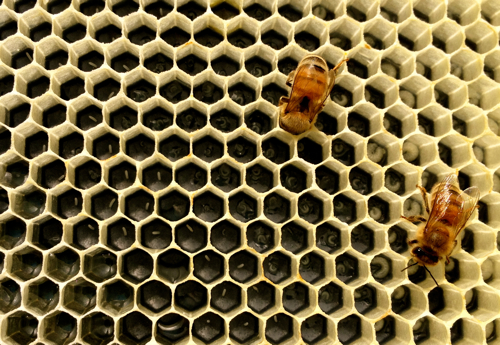
Above are mostly worker bee eggs (the things that look like mini rice) and some larvae off to the right. If you don't find your queen when you're digging around in your hive, you can be relatively confident that a she is alive somewhere in there because eggs stay in that shape for about three days as they are fed royal jelly from the worker bees.
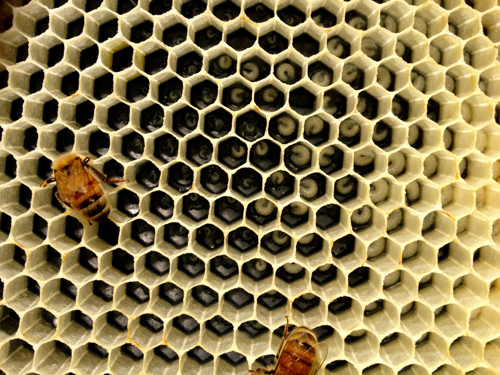
Once the larvae is three days old, it's switched to a mixture of pollen, honey and water (some bee sites call this bee bread). You can see at least one worker up there feeding someboyd as her head is wedged into a cell. The larvae grows and eats for six days.
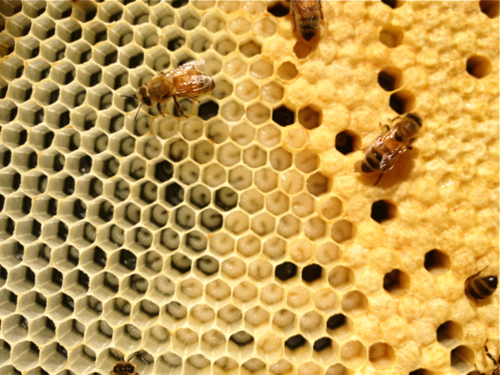
After six days, the workers cap over the brood and they pupate for 12 days as they go from a squishy blob into a segmented, leggy, winged bee complete with stinger.
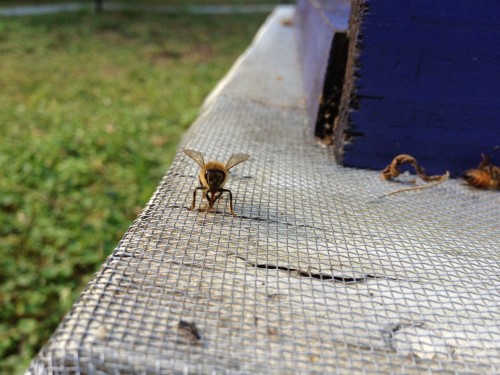
Like this girl! On a side note, while looking up something else entirely I wandered into an article on eating bee larvae. I suppose eating all that honey would make them tasty.
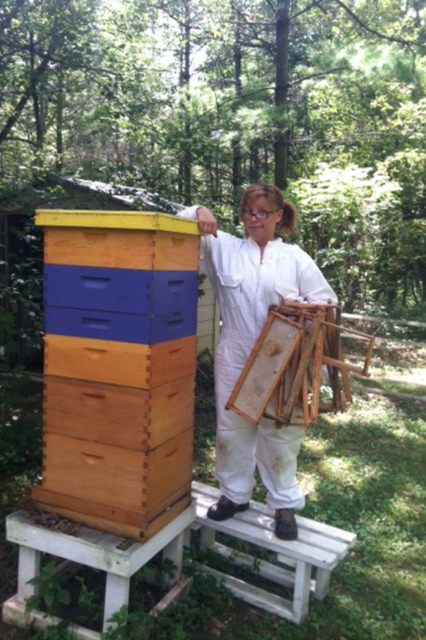
For those curious, I think our hives are doing splendidly this year. Many are as tall or even taller than I am because they are stacked with so many honey supers for us to harvest soon. Though, Lynne was quick to point out that since I'm only 5 feet tall, that's not saying much. Thanks, Lynne. ;)
Drunk bees!
Hello all, NBB here. Yesterday was a pretty shining example of why, three (?) years into this process, I'm still the junior beekeeping assistant, the Barney Fife of the apiary world.
To get everyone up to speed: the bees needed to be fed, Sharon has to work, Neil is out of town, Hans is out of town, and Lorraine is sick as a dog. Which left me. Now, the last time I was sent off alone to check on the bees it was a comedy of errors, if by "comedy" you mean "it's funny because it happened to someone else."
This mission, however, was a simple one: feed the bees. I didn't have to switch boxes, combine any hives, or search for the queen. Just feed the bees by mixing sugar and water in a pail, then add the pail to the hive. A job so simple, an idiot could do it.
Which is why they sent me.
It was a cold day, about 44°, which meant the hives would be less active, they tend to stay inside and cluster for warmth. I got there in plenty of time, figuring to take about an hour to make the sugar water solution. Small problem:

The sugar, having been left in the garage all summer, was not so much as “easy pour” as more of a “solid brick.” After chipping away at the bags, I was able to produce several manageable chunks and also a large mess. So after about an hour I had five pails full of sugar water.
Too bad we have six beehives. Sigh... what can I say? Math is hard! Back to the house to make another pail, then back down to the hives.
Amazing, the bees were still alive by the time I got to them.
[youtube]http://www.youtube.com/watch?v=TsJIUgrF0ws[/youtube]
We didn’t get as much honey as we were expecting this year. I wonder if the wetness of the season had something to do with this, or the fact that we had eight hives competing for pollen rather than two.
Regardless, the remaining hives seemed full. And thirsty...

[youtube]http://www.youtube.com/watch?v=cAv3TBxv7-Y[/youtube]
For reasons that escape me now, I had to reopen one of the hives after I put the pail on. I noticed one of the bees had gotten splashed with the sugar water, making her the most popular girl at the dance.

Her wings were sparkling.
We’re heading towards the end of bee season. Soon we’ll be taking the hives down to two or three brood boxes (filled with honey, which the bees will eat over the winter). We’ll wrap the hives in insulation, put the entrance reducers on (to keep out mice and other pests that would make a honey-filled box a winter home), and that’ll be that. We’ll sneak down in the winter and press our ears to the side to make sure they’re alive, dreaming whatever winter dreams bees have.
Beehives Attract Flycatchers
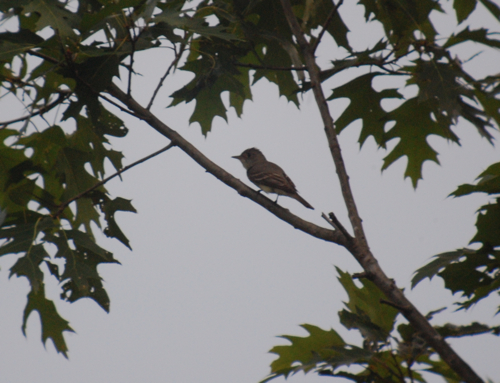 This is an interesting little bird. It's an eastern wood-peewee that was singing out around Mr. Neil's property. Periodically, the peewee would flip out from its perch and grab some insects. I didn't get a photo of it, but as I was watching the peewee through the scope, I noticed it grabbed a bee! That's when I realized this peewee was perched right over our yard hive and is hanging out in what we call the "bee highway" or the main flight path bees follow going to and from the hive.
This is not the first flycatcher I've seen around the hives. Great-crested flycatchers show interest as well. I'm not too worried about it, there are several thousand bees, so a dozen or so eaten by birds is manageable. Plus, I suspect the birds prefer drones--they are bigger, fatter, juicier, slower and being males, they do not sting.
We Just Can't Leave Those Hives Alone
Compared to the first year of beekeeping, we've mellowed out in some ways. There are still discussions and disagreements but we don't often take extraordinary measures to save a hive...for the most part.

Last time, we noticed that one of our new hives was failing--no sign of a functional queen, no new eggs, no larvae, comb barely drawn out, lots of empty space and lots of drones. I was ready to say, "Oh well, we have 7 others, let's move on."
But Mr. Neil, ever the optimist when it comes to our hives wanted to try and help it. The red hive showed signs of swarming and when we looked we could see some queen cells. Mr. Neil suggested putting a frame with a queen cell from the red hive into the failing new hive. I was not a fan of this plan--no more requeening, it never seems to work for us. He reasoned that it was going to fail anyway and not all of the queen cells in the red hive would survive, so what would be the harm. I doubted it would work but saw that there was no way to talk him out his plan.
It did occur to me as we were looking at frames that quite a few queen cells got inadvertently squished as we took them out--queen cells stick out further than the other cells for workers and drones. I also noticed that there wasn't too much in the way of larvae in the hive. I hoped that we hadn't messed up the red hive, she's little and set in her ways but she works hard.


Checking on the failing hive a week later, the new queen did not hatch and we have egg laying workers. Mr. Neil brought up the idea of buying a queen but I strongly against that idea. Requeening does not work for us. Plus, I really don't like the idea of bringing a new queen only to set her up for failure. As we looked in the red hive, we didn't see much in the way of new queen activity after a swarm. Neil brought up that perhaps we may have killed all of the other potential new queens that would have replaced the one who left in the swarm.
He may order a new queen for the red hive, it's early enough and worth saving. But again, I say: Requeening does not work for us. Doh. We still have six other hives.

Meanwhile, we removed the bell jar from the green hive, the bees weren't really doing much other than loitering in there. But off with the bell and on to the honey supers. They have filled almost two with honey and were showing signs of swarming. I looked at Mr. Neil and he said, "You know, I think it's okay if the swarm."
I do too.
Bees on Wall Street
Friends have sent me this link to a story about bees swarming on Wall Street and apparently trying to get into Cipriani (bees with swanky taste no doubt). I think my favorite part of the story is learning that New York City has Officer Anthony Planakis, their official bee handling officer. Now there is a guy that TLC or Discovery needs to to a reality show about. Officer Planakis roams the gritty streets of New York, busting stings and saving bees from a life of freebasing essential oils at swanky perfume boutiques.
Honeybees or Space Ship?
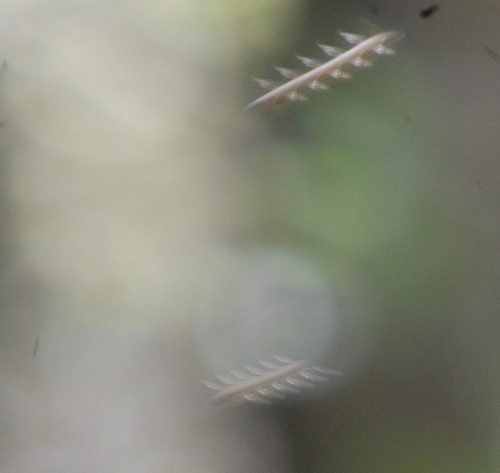 I digiscoped the strangest photo of my bees yesterday. I'm not sure what setting I had the camera on but they look like odd little space ships.
Signs of Spring Bird and Bee Wise
I think I saw an honest to goodness sign of spring this weekend around Mr. Neil's. I did a little driving to look for golden eagles again and I was stunned by the number of horned larks I flushed as I drove along the country roads.
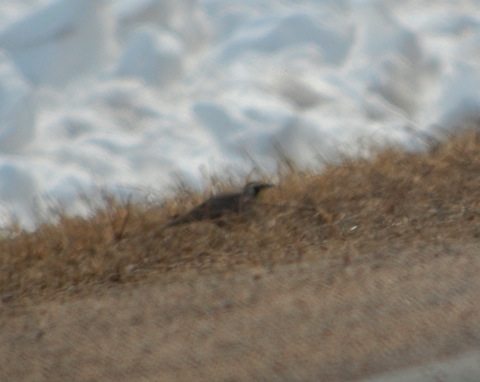
This is a terrible photo of a horned lark--heat shimmer coming off my car does not make for good digiscoping--even with a window mount for my scope. You might be seeing horned larks in your area if you drive down rural roads. Horned larks are commonly seen but if you don't know what to look for, you don't know that they are there. When you see brown birds flush away from a rural road, watch for dark stripes on either side of the tail as they fly--that's a horned lark. They are one of the first birds to return to Minnesota and when you see them that means spring migration is on.
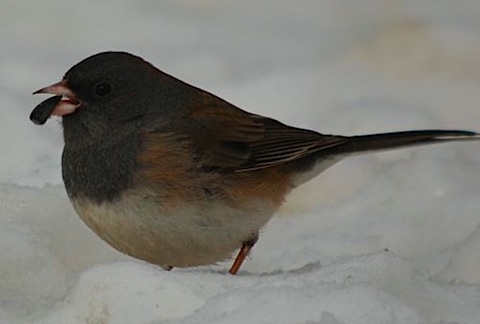
I took a moment to watch the juncos since their time is limited here and they will flock up and eventually head north to their breeding grounds. We have so much snow everywhere. I heard on Minnesota Public Radio that there's a 60% chance of big flooding of the Mississippi River this May and Harriet Island could be flooded. My national park's visitor center is in the Science Museum of Minnesota which is right across the Mississippi River from Harriet Island...should make for some interesting photos if it floods.
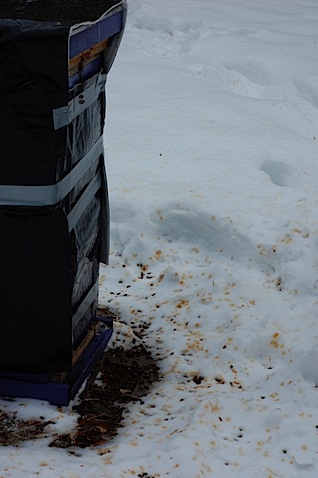
I was surprised to find Mr. Neil at home when I stopped by to take photos of the feeders--he travels more than I do. He checked the hives while I was in Panama and did a wee blog about it. He took me out Saturday so we could see them fly out in the warm weather. All of the hives had little flecks of dull gold dots around the hives. The girls had been coming out for a poop. Hans had been doing a good job of helping our hives this winter. He's been shoveling snow away from the entrances to hopefully help with the ventilation. We watched bees fly out of all four hives--even our red hive which is down to only 2 boxes instead of three like the other hives because she swarmed late in summer. I was surprised that all four were all still going despite some of our bone numbing freezing temperatures in January.
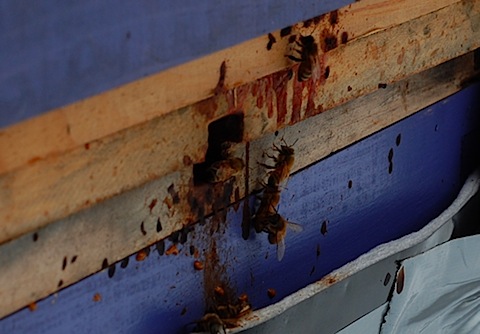
We know not to get too excited about this. Last winter at this time both our hives were in good shape and both died in late March so it ain't over til it's over. We discussed what our plan was. According to the bee class that I took, we should divide our hives this spring to prevent a swarm and save money by dividing one large hive in 2. If we actually get the Russians we ordered last year and are supposed to get this year...that could mean we'd have 9 - 10 hives this spring--YIKES.
Working with queens has been an exercise in heartache for us up to this point: queens arrive before we're ready and die in the cage, queens die in the divide process, new queens are ordered and hives still fail and they get combined into one angry hive. If you have a serious honey operation--dividing hives makes sense if all goes well--one colony becomes two. We don't have a money making honey operation. Neil and I talked about what could be so bad if our hives swarmed and the bees tried to strike out on their own into little feral colonies in his woods? We'd still have plenty of honey from the remaining hive and the feral colony would still pollinate his trees.
I think we will try and divide one hive but let the others go. We congratulated each other at our changing and easy going attitude towards bees. I don't think we're really going to name them anymore. Even if we do we tend to talk to each other about the hives in terms of their box color or in rare cases when a hive has a particular personality--like our ill-fated Lebowski hive (it was a total slacker hive and got robbed by another colony). Mr. Neil smiled that I was seeing the wisdom what he suggested all along--taking a Sue Hubbell approach to bees--the less you do to them, the better off they are. No personal involvement. We will appreciate their pollination, enjoy their honey and hand it out as gifts and watch their industrious nature towards survival with awe.
Then, we noticed a bee flying above us and land on the snow. The snow is so cold that once a bee lands on it, she struggles for about 60 seconds and then freezes to death. Mr. Neil scooped her up from the snow.
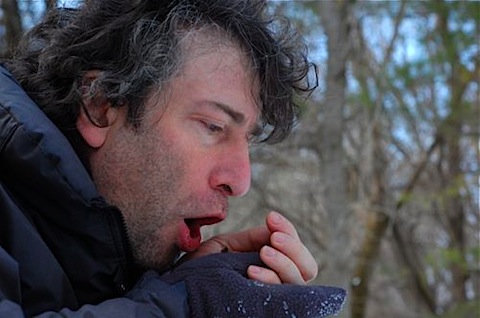
He brushed the snow away and breathed his warm breath on her to keep her going. She didn't seem to anxious to leave his glove. He walked over to the top of the hive to set her down, she stayed on his glove. He decided to leave his glove on the hive for the bee to get her bearings and stay warm on the dark fleece in the sun and hopefully when her returned later to retrieve the glove the bee would gone and presumably have flown into her hive. I smiled as we walked away and said, "I'm glad we just had this conversation about being less involved with our bees and you picked one up from the snow, gave mouth to bee heat, and left your glove behind for her."
He smiled and said, "And one has absolutely nothing to do with the other."
Indeed. Ah, spring.
Odd Baird's Sparrow Song
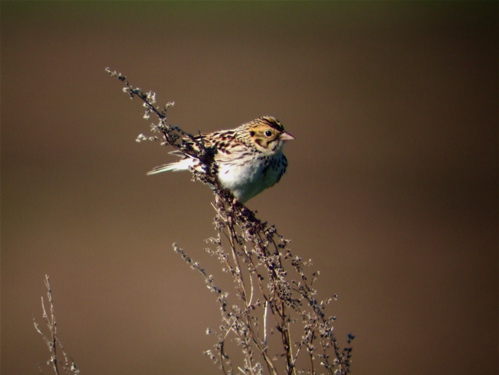 I just returned from the Potholes and Prairie Bird Festival in North Dakota where I go to see some of my favorite songbirds like the above Baird's sparrow. There was one particular Baird's who did not get the memo on his life history. First, this bird had staked out territory on this tiny patch of grass next to a cultivated field, not desirably Baird's habitat. What's interesting is that where you find Baird's sparrow, you usually find Sprague's pipits and there were no Sprague's hanging out with this guy.
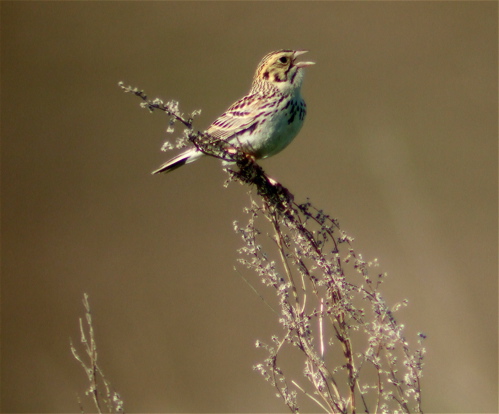
Second his song was just weird. Baird's sparrow should sound like this. I felt kind of bad, he had little chance of attracting the mate with inferior territory and an odd song. Last year, I got a great video of Biard's sparrow and you can hear what their song should sound like:
[youtube]http://www.youtube.com/watch?v=AFLHwAZ601U&eurl=http%3A%2F%2Fwww.birdchick.com%2Fwp%2F2008%2F06%2Fbrown-birds-at-potholes-prairie-bird-festival%2F&feature=player_embedded[/youtube]
Below is a video of the odd Baird's sparro that we heard over the weekend (sorry about the sound, as you can see by the way the bird is whipped around, it was a tad windy on the prairie):
[youtube]http://www.youtube.com/watch?v=mVAF3kwzhUI[/youtube]
You can still hear the basic beautiful tone of the Baird's but the cadence is off. I'm not sure if he was hatched last year and hasn't honed his song or if he is just an odd little misfit trying to break new ground on strange territory.
Adventures In Female Urination
This post maybe TMI for some people. Take note of the title and if that is not your favorite subject or something you don't like imagine other people doing, I would recommend you stop reading and maybe check out this cool post by my buddy Amber about some gannet rescue she did while on vacation in Florida. When I travel, I'm periodically asked by friends to take along a stuffed animal or a Flat Stanley for photos. I almost always decline. Number one--suitcase space is an issue and number two--I always lose something when I travel, whether it be accidental or confiscated by airport staff. Stuff just goes missing. If I lost a friend's treasured critter that's been photographed all over the planet, I'd feel terrible.

So, I got a request from an online rabbit name Audrey from All About You asking if I could take a stunt Audrey with me overseas. She has a blog and it would be a reciprocal blogging thing. I thought, "Okay, they have stunt rabbits, this isn't a treasured animal, I can do this."
So, Audrey came with me and we had a lovely time in Frankfurt. Above she is hanging out with a rather large snail outside our Frankfurt hotel.

We shared a beer in a Frankfurt bar (although, I had to chuckle at her choice of fruity beer--grapefruit beer? Really?).

And then this is the last known photo of Audrey. After getting her photo next to a Frankfurt sign warning that you are being watched, she nestled into my checked luggage for our flight to Kazakhstan...and hasn't been seen since.
ARRRGH! I feel terrible!
And she wasn't the only thing missing from my checked luggage. I had also recently won a female urinary device known as GoGirl at an outdoor convention. I was anxious to try this out. But like Audrey, it was missing from my checked luggage. I don't know why, don't want to know why.

And there were several times I missed my GoGirl. For example, above is one of our restroom stops. Our birding guide in Kazakhstan was more of an ornithologist than tour leader, so his bathroom breaks were stops like this with girls on one side boys on the other. I can go outdoors, but with short legs, there are some challenges, and I have a shy bladder. This was not ideal for me...I like a bush, a shrub for the illusion of privacy. Also, I like something to lean on or prop up against.

If we did have restrooms, they were like this. Let's take a closer look.

I really missed my GoGirl here.

I was excited at this birding spot--if you look in the distance towards the center left, there's an old wall--a perfect spot for female privacy. I went around the wall, away from the birding group, I got in a good leaning position and started to go. All was running smoothly until a slight movement in my peripheral vision caught my attention. I looked and focused on the critter that was the same color as the wall and about to crawl on my exposed area...and that was the moment I got my lifer scorpion. Didn't know they had those in Kazakhstan.
I lept up, there was spray, and a little tumbling. After a moment's recovery, I got my camera out for a photo.

Apparently, my chosen leaning location was a little nook that the scorpion liked to crawl into. All I got was a photo of its tail. It was only about four inches long, but still freaked out this Midwestern girl. I also have a new appreciation for the quick dry material on REI's convertible pants.

On our final day in Kazakhstan we hit a storm and it got very rainy. I asked our guide if we could stop some place for a toilet. He looked around and said, "This place is good," and pointed to the surrounding shrubbery.
I said, "I really need someplace dry and maybe we could go to a gas station, I'll buy the vehicle some gas. A cafe? I'll buy some food, any place but I just want it dry."
He looked skeptical but said he would find me some place dry. Our vehicle stopped and I didn't see any buildings, the terrain was as remote as the above photo. He pointed to a blue railing along the road and said, "See that blue pipe? That is bridge, you go under road, it be dry there."
And it was dry and I appreciated it.
So, Audrey and GoGirl, where ever you two are, I hope you are being put to good use.
New Bee Package Adventures
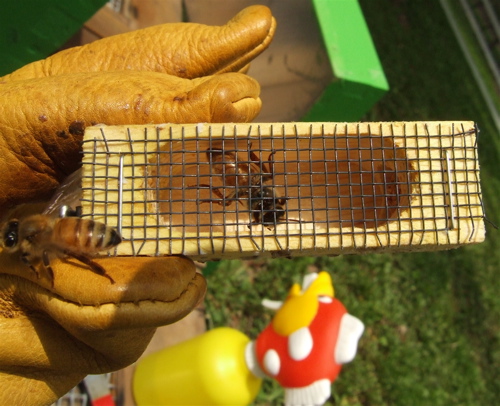 Our bee crew with substitutes headed out to our hives to welcome our four new packages of bees. We started with the Wendy hive, above is the Queen Wendy in her cage (with a worker on my thumb). We we hive the packages, we spray the packages with sugar water, bonk the box so all the workers fall to the bottom, remove the feeder can, spray a bit more, take out the queen cage, make sure she is alive, put her in a pocket, dump the bees in the hive, remove the queen from your pocket, spray her, open her cage and release her into the hive, carefully put in all of the frames, put on the ceiling, put in the sugar water feeder and pollen patty, and close up the hive.
Here's a video of the newly installed Wendy hive checking out all of the new frames to build comb and raise the next generation of workers (I recommend clicking the HQ aka high quality button:
[youtube]http://www.youtube.com/watch?v=TYsckIIWLhQ[/youtube]
After successfully installing the Wendy hive, we moved on to the Juliet hive.
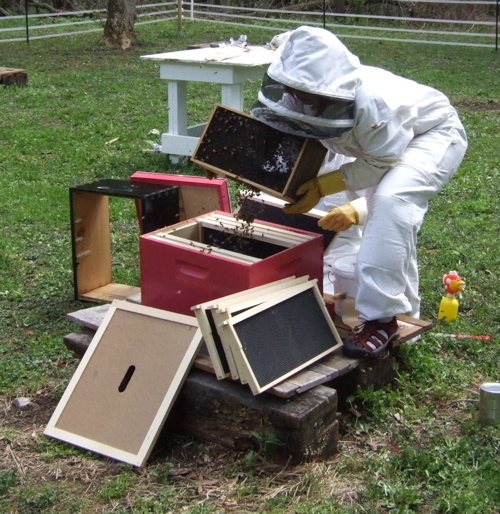
All went well with this hive, but we did notice a wee bit of bonking from these girls as we were pouring them in. Bees are supposed to be fairly docile when you get new packages. They are in swarm mode--they have been moved from their old home with no comb or brood and they are focused on finding a new home not defending a home.
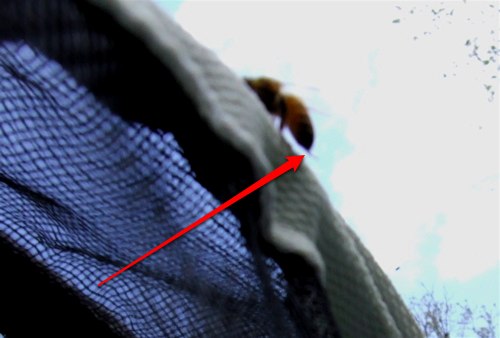
Hans took a picture of a bee angrily buzzing on his hood and even though it's blurry, you can still see the stinger coming out. I don't want to start off on the wrong foot with a hive, but I wonder if the pretty pink Juliet hive will not be so friendly as we do our first bee inspections?
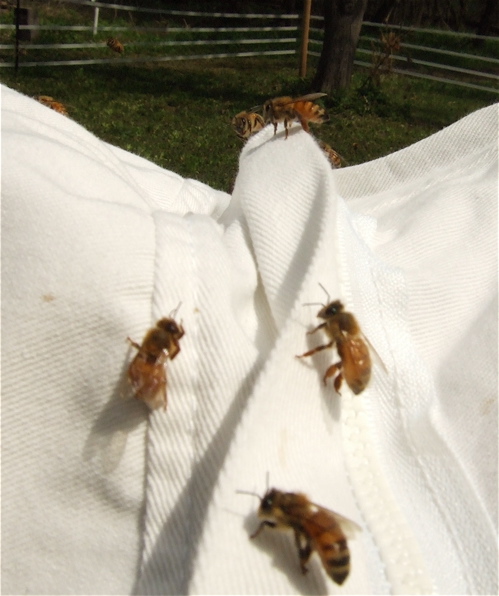
Most of the bees that come our bee suits are pretty low key. These are bees on Merry's suit. They were more after old honey residue and sugar water on our suits than actually climbing around looking for a place to sting. Although, I think Hans would disagree. Here's a video of me pouring in the Yvaine hive bees, most go in, but you can hear Hans say, "Stop bonking me." There's also a very angry bee coming up to attack the camera:
[youtube]http://www.youtube.com/watch?v=UON395ruFwk&feature=channel[/youtube]
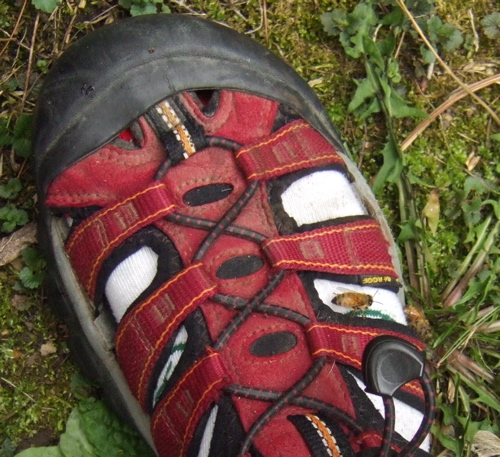
When I was pouring the bees into the last hive, we got a tad rushed. It started out sunny, but then it suddenly clouded over and it started to rain, I wanted to keep our girls dry. As I rushed, I felt something on my foot--a small clump of bees fell on my shoe. I suddenly regretted my lax attitude about the bees' mood during hiving, bees crawled over my turkey vulture socks and I decided not to walk right away so I wouldn't irritate them into stinging. They eventually flew off and it was all good.
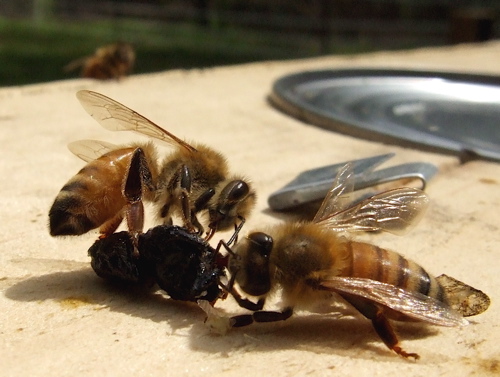
The bees in all hives were ravenous! Even though there's a feeder can, they were licking anything with sugar water on it. Here are two bees frantically licking sugar water that had coated a very dead and very old bee--yuck. There was even a moment when we were at the Hannah hive, about to release the queen and she pointed to my gloved hand. There was a tight cluster of five bees surrounding another--I gulped hard. Was this a queen from another hive?? No, it turned out to be just a very sugar coated worker that was getting a good lick down from the other workers.
Whew. But there was more queen drama to follow.
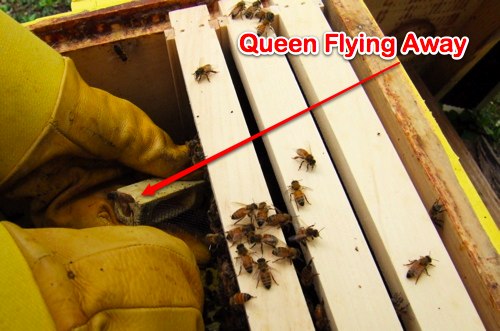
After successfully installing the previous three queens, I didn't worry too much about the final Hannah queen. I opened her cage and instead of her crawling out onto the frame, she opted to try and fly away--Hans captured the moment. Because she is heavy and full of eggs, she flew very slow. I slowly followed with my hands to get her to follow me and then two other workers flew on her and she sank like a stone to the bottom of the hive. I'm sure the workers were just attracted by her pheromones, but it looked like they were saying, "Oh no you don't there Bessie, you're stayin'!"
We carefully put the frames back in and closed her up before too much rain got in the hive.
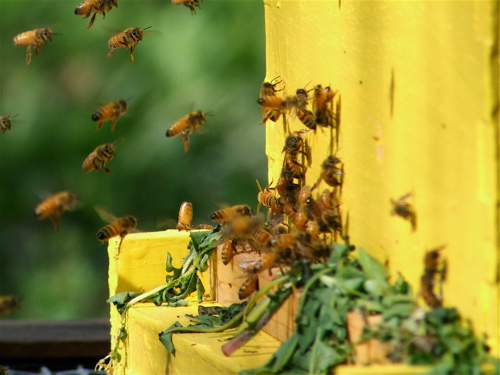
After the hiving, I waited for the rain to pass and then headed into the woods to do some birding. As the day got later, I headed towards the hives to see what was going on. I set up my digiscoping equipment so I could watch them from a safe distance. Almost all of the hives had removed the leaves blocking the entrance (it's supposed to stay there the first day to encourage them to accept the hives. Bees were coming and going from the entrance. Watching them, it looked like quite a few workers were flying around and orienting themselves to the new home so they know where home is when they go out to forage. Some were bees who got lost in the hiving and now have to see if they can get accepted into one of the hives, I'm sure they will work it out.
And so it begins, a fresh bee season. Here's a video of the Yvaine hive workers milling about the entrance of their new homes:
[youtube]http://www.youtube.com/watch?v=9Yko6dEGvgU[/youtube]
Welcome girls.
Digiscoped Images
Fresh Tweets
Would you like to hire me as a speaker for your event?
Email sharon@birdchick.com