Birdchick Blog
Singing Chipping Sparrow
[youtube]http://www.youtube.com/watch?v=QNQYRdBCGYM[/youtube] You can hear why they call them chipping sparrows.
Brown Bird Migration
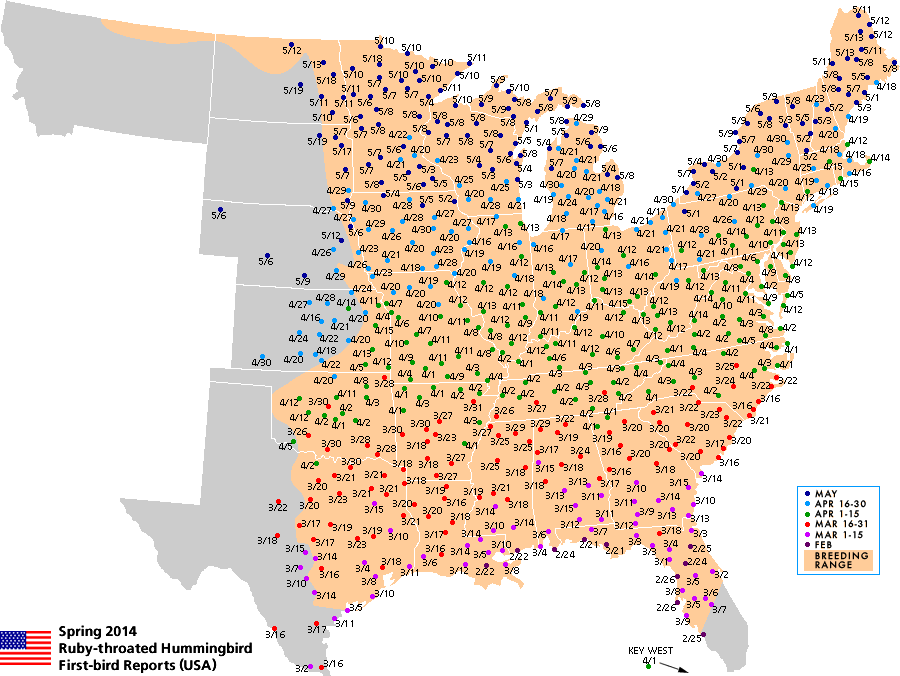
A quick public service announcement to those in Minnesota: you might want to put your hummingbird feeders out. This hummer migration map shows their arrival is eminent (to Mom in Indiana, your feeder should already be out).
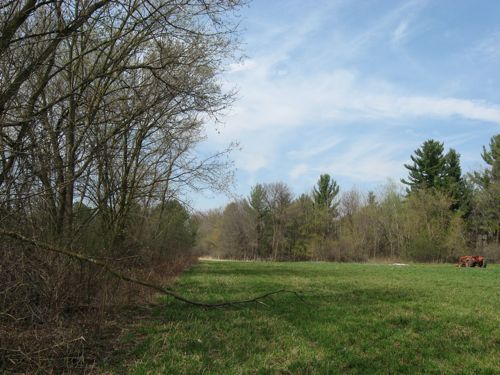
We ended up spending another night at Mr. Neil's and leaving for home this morning. I did not want to leave, migration is hot and heavy--I barely paid attention to the bees yesterday. As I was packing my birding gear back in the car, I heard a newly arrived brown thrasher. I was about to unload it for a quick video when rain began to pour as if someone turned on a faucet. We had to leave to get Non Birding Bill into town to get to work on time and I momentarily wondered if he wished the rain into existence to keep me on schedule.
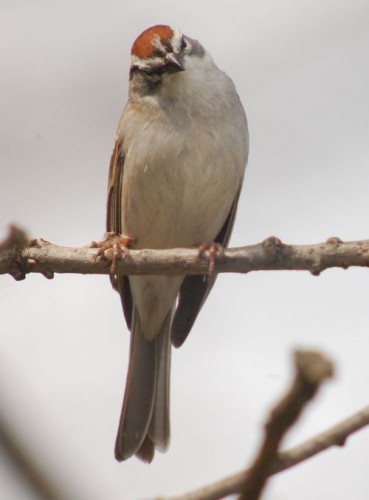
Chipping sparrows were the most vocal arrival. There loud extended trill was all over the yard--such a clear sign of spring. I have to say that I am totally digging eBird's BirdsEye app for the iPhone and iTouch for migration. I did a quick check to see what birds had already been reported in and around the area with it before we headed out to Mr. Neil's and had an idea of what to expect around our bee yard. I also could see what had not been reported yet and give myself a little goal of trying to find it.
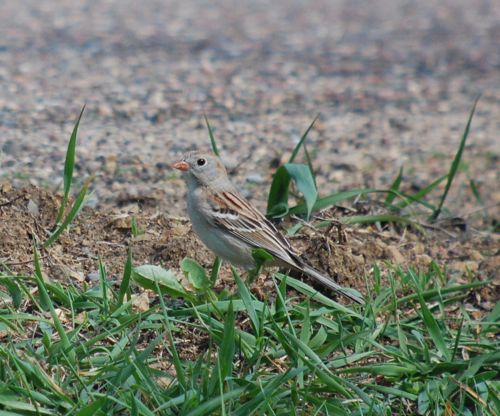
Every bird needed to be checked when I was out yesterday. What at first appeared to be a flock of chipping sparrows would have unexpected jems like this little field sparrow. I was hoping to hear it sing, but it was focused on foraging and loading up for a flight further northward. As I worked the sparrows, I heard a familiar call. I scanned the nearby field and found:
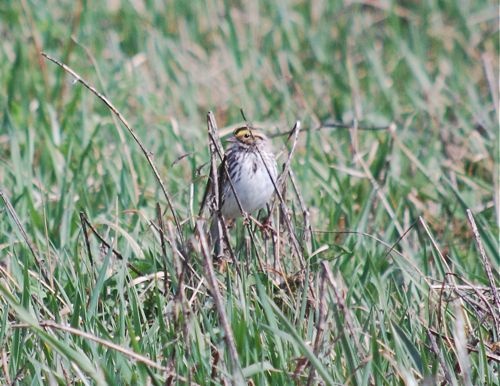
It was the soft song of the Savannah sparrow, there were at least three of them in the field. I tried to convince myself that I had never heard them this early but after a check of the Minnesota Ornithologists' Union migration arrival dates, this bird is right on time. Perhaps I don't recall April including 74 degree days.
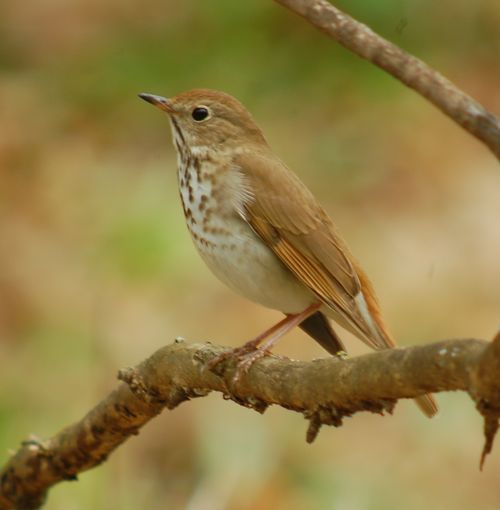
Someone emailed recently asking where the hermit thrushes are. I check the BirdsEye app and that was one of the birds that's been reported so I kept an eye out for them. Sure enough, down by the creek was a small flock quietly foraging on the ground. That's a bird I wish I could have heard, they have a gorgeous song but I guess I will have to wait a few weeks more. Ah well, at least I have them as one of my ring tones on my Blackberry Manilow.
I didn't want to come back to the Cities this morning but I have lots of work to get through and I'll have more chances to see birds this weekend. If you like, you can join me Saturday at Coon Rapids Dam at 9am for a digiscoping workshop and bird walk and there will be great birds along the Mississippi River to see.
Also, this Sunday is the Birds and Beers Woodcock Edition gathering. Hope you can make it for some birding and birder camaraderie. We're gonna lek out with a our woodcocks out!
Odd Broad-winged Hawk & Odd Warbler
Migration was in full spring today. It was a brown bird explosion which makes me so happy--new sparrows everywhere and this morning I was especially pleased to notice a small but steady stream of broad-winged hawks over our bee yard. I noticed the birds were fairly low and trying to get into thermals. I saw them close to the 10 am mark which made me wonder if this was a small flock that roosted nearby for the night and if this was a morning lift off?
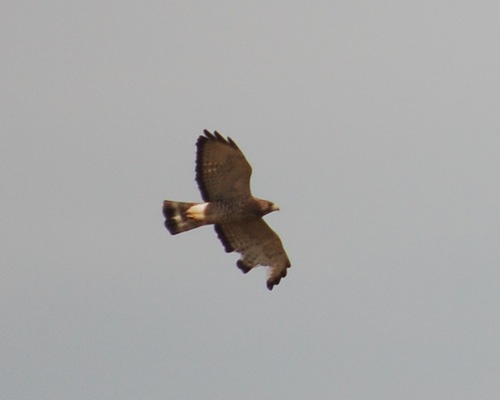
One broad-winged hawk really stood out. Check out that right wing--it's almost as if something took a bite out of it. It's missing a chunk of primary and secondary wing feathers. I don't think this is a molting issue but not sure how it happend--altercation with a larger aerial predator? Attack from some South American predator over the winter? That's a significant chunk to lose on one wing and it must affect the bird's ability to soar and dive after prey.
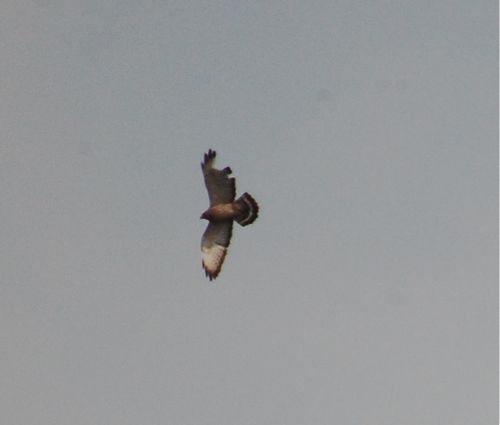
As I was digiscoping this bird, I thought about how migration is hard enough, but to do it with a chunk of flight feathers missing must be a real bummer. However, the bird has made it this far, perhaps it is only going to the northern part of the state--they do breed here and it's journey may be almost over. As always, this is a testament to a wild bird's ability to survive in nature no matter what. Kind of puts those bad hair days into perspective.
In other interesting bird news Ryan Terrill posted a link to some photos on ID Frontiers of what appears to be a bilateral gynandromorphic black-throated blue warbler (ie: it looks male one on side, female on the other). As if warblers weren't hard enough--sheesh! The bird was banded recently in Jamaica. To make this even more interesting, last fall birdspot posted photos on Twitpic that she took in Central Park, NY of what appears to be a first year gynandromophic black-throated blue warbler seen here and here...is this the same bird? In both Ryan's photos and birdspot's photos the male and female parts seem to be on the same bird...
We have absolutely no way of knowing since it wasn't banded last fall, but it does bring up one intriguing possibility that it could be the same bird. Gynandromophia is unusual but so is refinding the same bird in a different country on migration.
Some Spring Sounds
This is the type of morning a birder lives for. The shift in bird species from migration is palpable. Everywhere I walk I hear an old friend from summers past who are newly arrived. Overhead I have a small and steady stream of northward broad-winged hawks (which really has me excited for my digiscoping workshop at HMANA on Friday). I tried to get a video of the eastern bluebird male who has claimed our bluebird houses as his territory. But his song was muted compared to the chipping sparrows, chorus frogs and red-bellied woodpeckers. Still, a fun sample of the spring birds: [youtube]http://www.youtube.com/watch?v=MdnAOkTeEZg[/youtube]
Bluebirds Checking Our Boxes
 Wow, the dawn song near the beehives is very different this morning from last week. This time last week we had the usual titmice, chickadees, nuthatches with robins, phoebes, house finches and goldfinches singing. This morning we have that plus solitary sandpiper, sandhill cranes, ruby-crowned kinglets, bluebirds and a peewee. The bluebirds (above) are really going to town. Non Birding Bill and I cleaned out the boxes last week and this morning a pair was flying back and forth between the two houses. The male seems to like them, he just needs to get a female to agree with him.

The male sits on top of the box and alternates flipping wing in the air to get her attention. She flies over, sits on top, perches on the box, looks inside--she needs to determine is this is the type of dark box that she can incubate in comfortably for the next few weeks.

I hope they choose one. We get birds nesting in these boxes every year--but rarely bluebirds. Usually chickadees or house wrens, it will be nice to get the birds the boxes were actually intended.
Typical Monday
I walked into my bedroom today to find a most unexpected sight:

A pigeon on my unmade bed! The unmade bed was not a surprise--but the bird sure was. It's spring so the windows are open in our apartment and I had a screen up near our bird feeders and I suspect that's where this dude came from. I left the window open and tried to scoot it towards the wild blue yonder. The pigeon had no desire to go. I even gave it a light toss and the bird responded by doing a U Turn and flew right back in to my bedroom. I even tried leaving a trail of seed out the window to encourage the bird to leave. It didn't work.

Based on the bird's reaction to me, I began to suspect that this was not a wild pigeon after all. I had an idea of where this bird came from. We have some neighbors who had a pigeon and I wondered if it was their bird. I walked over and asked if their pigeon was missing. They told me that they raised it and let it go and for some reason it keeps coming back. I mentioned that I had a pigeon in my bedroom and suspected it was their pigeon. They did not want it back, they were done with it. I had a choice at this moment: give them the lecture about about why you can't raise a bird indoors, release it and expect it to know everything it needs to know about how to find food, avoid predators and interact with others of its kind, or find a permanent home for it.
Since this was a rock pigeon (formerly known as rock dove and known in many cities as a flying rat) it is legal to keep them as a pet, they are a non native species to North America, so you do not have to have state or federal permits to have one in your possession). I could not in good conscience release this bird back outdoors, it would soon be Cooper's hawk food. Also, it had been out the last few days and it was sad to watch it fly desperately against windows trying to get back inside to what it had grown up to know as safety and comfort. After it was in my apartment for awhile, it noticed my cockatiel's cage and tried to fly towards it (a bird raised indoors will associate a cage with comfort and food). I blocked the pigeon and set it on my coffee table--I wasn't sure of this bird's history and did not want to risk exposing my cockatiel to any diseases. I went to the bathroom to wash my hands after handling the pigeon and...

...it flew in after me and lit once more upon my head. That's it, this bird was too people friendly--I had to find it a home. In this photo you can kind of see the bird's stunted tail. It had been in a cage too small for it and the tail feathers were trashed. I did the only thing a chick of the modern era could do--I put the word (and photos) out on Twitter and Facebook that I had a pigeon who needed a home.

At first, I received advice that perhaps if I sang to the pigeon a la the movie Enchanted that it might clean my apartment. Alas, either my singing was way off or this bird had not seen the movie because no matter what I sang to it, my apartment remained in woeful disarray. Still, it was a pleasant enough bird, not too loud and screechy like my cockatiel, it bobbed its head and liked to perch on my furniture where it could have a good look at its surroundings. This was by far the friendliest and most interactive pigeon I have ever dealt with. When I offered it a measuring cup filled with water, it gracefully inserted its beak and sipped it up. It dozed on our Lazy Boy and when it was jarred awake by car alarm, it cooed quietly in disdain. I could see why people enjoy pigeons as pets.

I offered it some seed, but most of the seed in my apartment is the type to keep pigeons from taking over my bird feeders. I offered it some of the muffins we make for our cockatiel and it showed mild interest. It did enjoy sunflowers out of the shell, so I called Non Birding Bill and asked him to pick up some sunflower hearts on his way home. He was glad to do it but was quick to remind me that we did not need a pigeon in the apartment and he was right. I did momentarily fantasize that I could turn this into my own personal education bird on urban birding programs with the National Park Service or train it to stay still for digiscoping workshops, but then thought better of it when it crapped the furniture with wanton abandon.
We did find a friend who was willing to take the pigeon--Melissa Kaercher has had turtle doves in the past and was actually looking at getting a bird. She graciously came to our apartment and picked up the pigeon and offered it a new life with her--far better than the life I could offer in a one bedroom apartment with only Cinnamon's travel crate for shelter. Thanks, Melissa, for taking it in...and for not minding my messy apartment when you picked it up.
Caribou Coffee Maybe Going All Shade-grown All The Time?
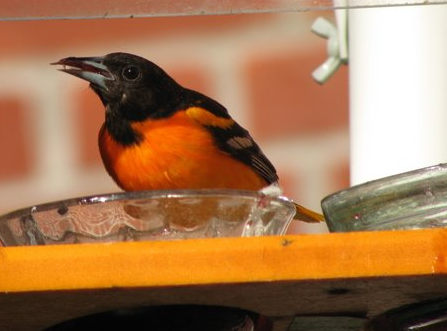 I've mentioned shade-grown coffee in here before. It's beneficial for many birds you see in your backyard in North America in the summer birds by giving them wintering habitat--like the above Baltimore oriole. There are some challenges with shade-grown coffee: some taste nasty, it tends to be higher priced, it's not always easy and convenient to find at your local store or coffee shop and sometimes the bag can read "shade-grown" and the coffee plantation only has one tree.
There are some brands like Birds and Beans which has some very tasty versions of shade-grown coffee--I'm a big fan of the Chestnut-sided Warbler Blend--it's worth every penny. It is also certified shade-grown by Smithsonian Migratory Bird Center and Rainforest Alliance--both very trusted seals to know that the coffee was indeed grown in the shade, in a sustainable way and the workers were treated fairly. Even so, I have to order that by mail and none of my local coffee shops or grocery stores carry that brand. If I'm out, I can't just bike down the street and pick some up.
Well, over the next year, my options are going to improve. In my neck of the woods we have Caribou Coffee shops and yesterday they announced that they want to be the first major U.S. coffeehouse committing to 100% Rainforest Alliance certification for all of its coffees -- a goal the company has set to achieve by the end of 2011!
If you are in one of the 21 states that has a Caribou Coffee, make sure you stop in with your binoculars and let them know that you support their changes and how their changes benefit birds. I've visited shade-grown plantations in Guatemala and I've seen some our breeding species there: painted buntings, Baltimore orioles, Wilson's warblers, and indigo buntings just to name a few.
Coming Workshops
 This Sunday, I’ll appear in a National Park Ranger capacity at Freedom Park in Prescott, WI. This will be a slide show of birds along the upper Mississippi Flyway like the above hooded merganser and along the park’s borders, the Mississippi National River and Recreation Area. I’ll share photos I’ve taken of some of these great birds, tell some stories about finding them and give tips on the best places to visit. Freedom Park has a fantastic view of the river and it’s great for waterfowl and eagle watching–I’ve even watched coyotes hunting along the banks. This is a fun place to spend an early spring afternoon (and don’t forget to allow time for some of the tasty restaurants in downtown Prescott).

I also got booked last minute for the Hawk Migration Association of North America Conference in Duluth, MN on April 16. It will be a digiscoping workshop (using a point and shoot digital camera or digital slr camera with your spotting scope to take photos. I think afterwards we can walk to one of the nearby peregrine falcon nest boxes and practice taking photos.
For anyone attending either workshop--feel free to bring your digiscoping equipment, especially if you have trouble getting photos with your set up. If you are not sure if you can digiscope and you only have the camera or only have the scope, bring them along and we can discuss options for you.

MPR Segement
Hey, mom, here's a link to that heron rookery segment that you can listen to online.
Digiscoped Images
Fresh Tweets
Would you like to hire me as a speaker for your event?
Email sharon@birdchick.com