
Supporters

NBB’s Guide to the Birds You Saw

Sharon’s taking a much needed Blog Vacation, and I have been asked to fill in for her once again. So without further ado, we present the following helpful series for the unwilling birdwatcher.

Birdwatching: hobby for the insane?

Surprisingly, no! Even those who are merely married to a birder can learn to appreciate our fine feathered friends, albeit against your will. In an effort to help the non-birding spouse, I’ll be collecting my thoughts on birds here on the Birdchick Blog. Think of it as a field guide, except it’s a) free and b) useful.

I like birds. My nickname is Non Birding Bill not because I hate birds, but because I don’t go birdwatching (also because my wife knows a lot of Bills, and saying “My Husband” was too complicated, apparently). In fact, everybody likes birds, and knowing a few bird facts can be a nice ice breaker with people who are completely out of the loop, birding wise (i.e., sane).

The first thing you need to know is that in the city, every bird you see is a House Sparrow. Unless it’s a duck, of course. But otherwise, it’s a sparrow. They’re the small brown birds that you see bee bopping around when you’re outside. And I mean everywhere: the reason you need to learn how to ID a sparrow is that any time you see a bird, it’s a sparrow. In fact the likelihood of a bird being a sparrow is directly proportional to your certaintly that it is not a sparrow. Think you’ve got a Chestnut-sided Warbler in your yard? It’s a sparrow. Unusual hummingbird at your feeder? Sparrow. Small farm animals being carried off in the night? Sparrow.
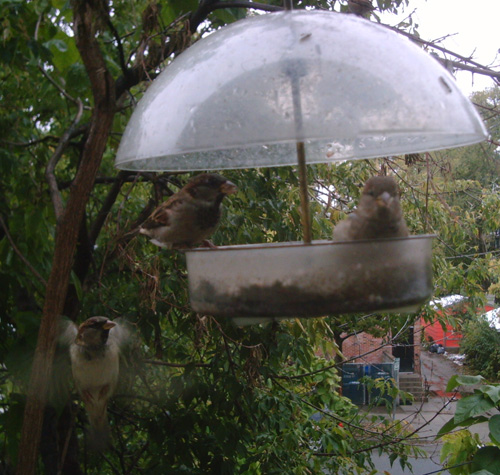
WSBC0267Look into the face of a killer.

Sparrows are the hydrogen molecule of birds; they’re so common they make a handy point of reference, and every other bird can be expressed in terms of how much like or unlike a sparrow it is. So, if youre going to watch a bird, you need to know the sparrow.

What else do you need to know about sparrows? For starters, they’re complete bastards. Totally, completely evil birds. They don’t bother people because in addition to being evil, they’re smart, and have figured out that the key to surviving is not bothering people. So they bebop around, acting all cute and harmless and “oh look at me, I’m stealing a breadcrumb! I’m so naughty!” And then they fly off, find a bluebird sitting on a nest, and kill her by pecking her to death while she’s on her eggs. Seriously.

House Sparrows were introduced to America (“Hello, nice to meet you.”) by a dude who wanted every bird in Shakespeare to be present in America, which is just another reason to hate Shakespeare in my wife’s book. The odd thing is that while they’re over here commiting more murders than the franchises of CSI and Law and Order put together, House Sparrows are on the decline in Europe.

That, in a nutshell, is everything I know, and therefore, everything your non-birding spouse, needs to know about the evil, evil House Sparrow, who’s preferred seed mix is the blood of the innocent.


And now a few words from etc, etc:

The above feeder is a Seed Saver Domed Feeder, and the picture was taken with a Wingscapes Birdcam. Both items are available at the Birdchick’s OpenSky Store, and 20% of the profits are donated to the ABA’s kids programs.

As an added bonus, if you enter the coupon code Sharon1009, you’ll get an additional 10% off your OpenSky order.

16 comments to NBB’s Guide to the Birds You Saw

  • Anne

    Wow, that was just brilliant. ROFL!

  • Wow, that explains a lot! And somehow brought to mind Monty Python, too.

  • Canaduck

    Haha that was hilarious. NBB, you should write more often.

  • Larry Sirvio

    Way to go NBB. You’ve got one down, 6599 to go.

  • Nancy Ortiz

    Excellent and very informative post! I cannot tell one sparrow from another except for the house and song sparrows. All the rest look the same to me and if someone goes on about white chins and eye lines I’ll scream. You will be happy to know that down here in SWGA the house sparrow seems to be on the decline. That is, house and purple finches outnumber them considerably. The only place with any substantial number is the Lowes Home Despot store where they peck holes in the bird seed bags and live the life of Riley. Otherwise, not so much in evidence as even 10 years ago. There is justice in the world, Mr. NBB. Thanks for the great post. Nancy Ortiz

  • NBB

    Nancy,

    There is no difference between sparrows.

    -NBB

  • And there I was, wondering whether some of the brown birds who come and poop on my deck rail might actually be different types of sparrow. But no longer! Screw ‘em.

  • Lucy Jefferson

    Oh, c’mon people. They aren’t that hard to tell apart. Different sparrows have different shapes, act differently, and sound very different. And it’s amusing to wow(or bore) the uninformed with the ability to tell them apart, though obviously, some of you live in places that they ARE all english sparrows which makes the job of learning differences quite a bit harder.

  • Bill, thank you for such a great laugh! I’m now imagining a sliding scale chart of 0 – 100% sparrow-ness to identify birds. Forget the dichotomous key! :)

    And thank you for explaining why you were Non-Birding Bill. Inquiring minds…

  • NBB; thank you so much for easing my guilt. I’m happy to report that we had a 30 foot cypress in front of our house; each year the noise was unbearable; it was a rookery for the little monsters; as was the entire line of cypress that surround my neighbors house (there are at least 40 of them; they stand 25 to 30 feet tall like giant spikes of death).

    Within a couple years after we moved in; my THEN outdoor cat Ms. Stella O’Houligan personally took it upon herself to aid the Bluebird society by ridding the yard of any house sparrows that came within 7 feet (vertically) of our yard. No kidding! All our cats are indoor now and at the feeder in the back (my neighbors used to razz me that our feeders should have been called ‘bait’) bright yellow birds and only in summer (except for the giant blue one that came in of it’s own accord and promptly got stuck. I had to chase it round the house till I caught it (before Ms. O’Houligan did) and for my services it bit me severely which would have been ok on the hand; but as I had run out of the shower to rescue it and was using my towel to net it…well. nevermind…

    I look much forward to your further postings.

  • pamela

    Thank you for a very funny post…ended a stressful day on a happy note.

  • Peg

    This was such fun to read, thank you NBB for your guilt-free perspective.!

  • Kevin

    House sparrows ARE smart and evil. They use to bamboozle our laborador, leaving her sniffing behind a cedar tree so they could raid the feeder in peace!

  • Liz

    I totally agree about house sparrows, and I’m always trying to educate people about them as invasive species. It’s important to explain that the reason that HOSP is a problem is because it evolved elsewhere and puts our native species at a disadvantage, just like many other invasive plant and animal species. They are completely unrelated to our native sparrows, which evolved here along with other species and exist in harmony with them. It’s not a sparrow issue – it’s an invasive species issue.

  • Abbs

    Excellent post NNB! Alas European Starlings, another invader thanks to the bard lovers.
    Well done! Thanks again.

  • katiemur

    Well, when Zoom munched down a fledgeling sparrow one day, the baby’s mom was none too pleased and spent a good hour scolding Zoom. It mustn’t have tasted too good, as she stopped eating after having gagged down its poor head; but, once the head was off, it was no good as a baby bird. All of zoom’s guilty looks – and there were rather a lot – couldn’t shut up the poor mother bird…

    I actually quite like sparrows, but I call them “street urchins”; they are often the only sign of life on the pavements of this old city, so they’re nice to see, playing on the pavement or scrounging at the market.