eBird Wants Oiled Bird Reports
My niece Nicole posted, "I know the oil spill should encourage me to be green, instead I feel defeated." That is exactly the way I feel about it. Defeated. But it can't end there. If we accept defeat, we will be.
Being a birder, people helpfully send links and I see the news forwarded on from friends on Twitter and Facebook of oil covered birds and though I often don't click through--I know it's horrendous, I debate about adding them here or linking them on. But as awful as the photos are, we need to stay on task and hold those responsible for this apparently unstoppable mess accountable for their actions--specifically, not having a plan in place to stop a spill of this magnitude should it ever happen.
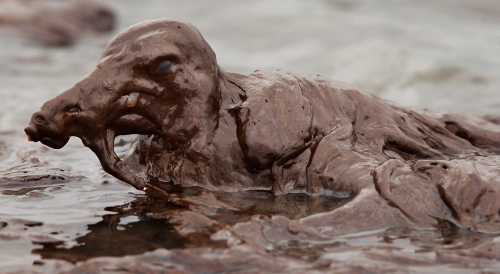
I can't even tell what species of bird is in this photo taken by Charlie Riedel on the East Grand Terre Island in Louisiana. Perhaps a gannet?
The spill needs to be tracked, not only by BP but by independent observers. When you see BP doing things questionable things like hiring in workers when President Obama visited only to have the workers disappear when the President left, you get suspicious of their efforts. BP is also brushing off clean up workers' complaints of nausea and respiratory ailments as "food poisoning." Who knows what else might get swept under the rug? Would they also under report the size of the spill and the amount of wildlife affected? Now is the time to be vigilant.
Cornell Lab of Ornithology's eBird has now created a platform so birders on the Gulf Coast can report oiled or sick birds. Though tragic and painful to watch, this is important work as we need to document species affected and where the spill is coming ashore. If you live or are visiting potentially affected areas over the next several months, please consider submitting reports.
I just received a press release that Underwater World at the Mall of America is putting out a request for toothbrushes for sea turtles and marine mammals for cleaning--it's not just birds being affected out there. This is the combined effort with the Louisiana Marine Mammal and Sea Turtle Rescue Program and Audubon Aquarium of the Americas. Underwater world is also collecting towels and scrub brushes for the effort. Please drop off donations no later than June 13, 2010.
Wildlife is being killed and the wildlife that is "rescued" has a slim chance at surviving wildlife rehab and will only be released to an environment with still more oil polluting it. Not only is this a dangerous environment for birds to forage for food and raise young, but no doubt the oil will deplete some of the food the birds (and other wildlife need). But people are helping where they can because...what else can you do? And even as I question whether or not an oiled bird or turtle should be rereleased, I know I would not leave a live and struggling bird alone on the beach, I would want to help.
If you would like to help with this effort with donations for birds, the International Bird Rescue and Research Center appears to be the best organization at mobilizing the various local wildlife rehabilitation centers to coordinate their efforts.
Here's a video explaining the process of cleaning birds produced by the Miami Herald and Steve Johnson of IBRRC:
[youtube]http://www.youtube.com/watch?v=gQSubToXKDo&feature=player_embedded[/youtube]
One thing that people may not realize about these birds is that pelicans some other water birds regurgitate when nervous or stressed. I learned the hard way when I banded pelicans, gulls and cormorants several years ago. Anyone who works with this type of birds is doing stinky work.
I recall with the passing of the health care bill that Vice President Biden remarked it was a big "effing" deal. If I would like to see any profanity from the higher office, it would be now. Enough of everyone giving carefully worded and not so carefully worded statements of dismay and apologies without taking responsibility. I want President Obama to channel some Samuel L. Jackson in Snakes on a Plane in dealing with BP. I want an immediately assembled "think tank" of the world's underwater engineering experts, wildlife experts, middle school and high school science fair winners and the entire staff of MythBusters to pitch ideas on how to stop the leak.