Birdchick Blog
A Little Kleptoparasitism
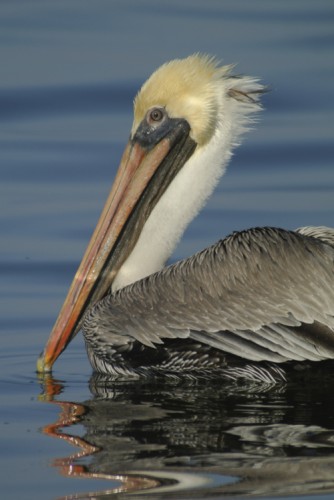
The fun thing about Florida is you can see both American white pelicans and brown pelicans (the above bird). This bird was hanging out near a boat launch in Titusville. Some of the brown pelicans can be quite "tame" around there. And I've heard different theories that some brown pelicans learn to beg from people, may just be ill or are almost completely blind from cornea damage sustained from their spectacular dives into the water for fish. I can't seem to find any articles to support that but with a pelican's natural ability to barf on you when stress, I can't imagine a ton of people wanting to line up and study that.
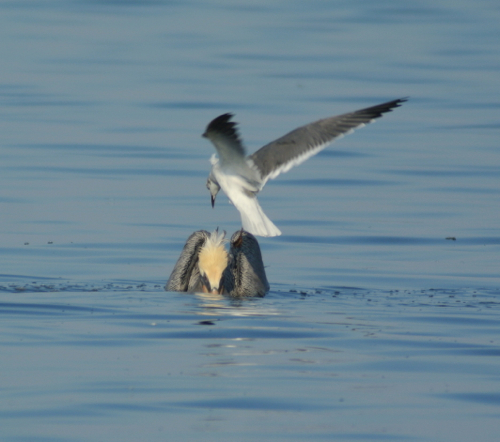
This bird did some half-hearded dives, not from very high up, but at one point the brown pelican appeared to have a fish and a laughing gull was ready to steal it. Certain species of gulls and terns will try to steal food from pelicans as they bring their bills up out from the surface and pour out the water from their gular pouch (the baggy part of the pelican bill). This is called kleptoparasitism--fun word. Laughing gulls who are so adept at grabbing oyster crackers in midair as people toss them are also very adept as hovering or even landing on a pelican to steal their catch.
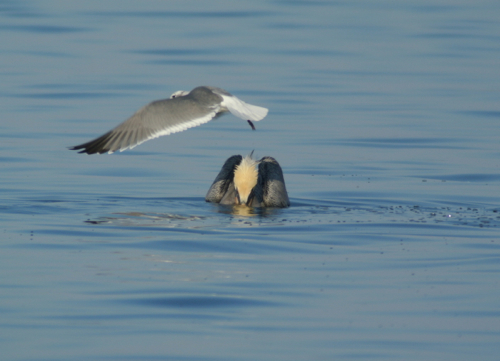
This pelican was wise to the kleptoparasitism routine and kept its bill in the water until the gull got bored and moved on.
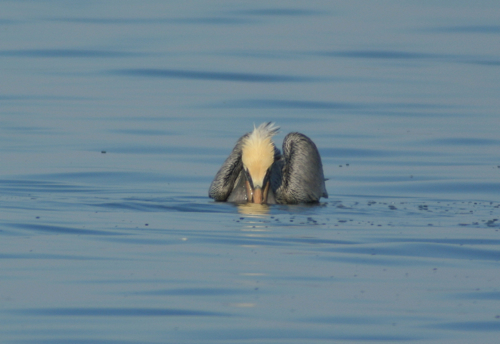
"Is the laughing gull finally gone?"
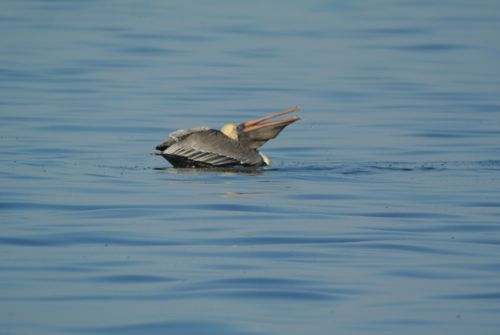
"Finally, I can swallow my fish in peace."
Great Horned Owl Nesting In Planter
So, with all my crazy travels, it's been tough to keep up with all my back emails. Boy, have I missed a whopper! Thank you, so, so much to Robbyn Spratt for sending this my way! Brace yourself, are you ready for this? Okay, here it goes:
There's a great horned owl nesting in a planter in Viera, FL.
 Yes, you read that correctly. Viera, FL home of one of my all time favorite birding spots, Viera Wetlands has an owl nesting in a pot! Apparently, a pair of great horned owls chose to use a planter outside of the Brevard County Commission and the eggs have hatched--there is even a LIVE owl cam. The camera does not appear to be visible at night, however, there are clips that you can watch any time, so bookmark the Brevard County Owl Cam for some on the job entertainment.
This is an awesome diversion, especially since the owls at the Valmont Owl Cam appear to be having issues.
Pelagic Birding Off The Florida Coast
NOTE: I just noticed on the Space Coast Birding and Wildlife Festival that they have some items that attendees left behind. If you attended the festival, check it out.
 My final day at the Space Coast Bird Festival in Florida involved a 12 hour pelagic birding trip with the Explorer Fishing Charters. Above is a photo of our boat heading out to sea with a large flock of gulls following us (because we were chumming the water). Pelagic bird trips involve taking a boat out into the ocean to try and see birds that only come to land for breeding. You watch for birds with crazy names like petrels, jaegers, fulmars. Pelagic birding isn't for everyone--and yet for many people, it' the only way to get certain birds on your list. Even if you're not prone to seasickness, watching birds through your binoculars on a bobbing boat can make you barf. It's also a challenge for me because I can't really digiscope from the boat and we have to rely on what ever my little point and shoot can do all on its own.
 The other challenge to pelagic is that there is a lot of gross stuff around. You need to attract birds to the boat and a great way to do that is to dribble some fish oil behind the boat. If you do feel yourself getting sick on a pelagic trip, it's best to go to the back of the boat and blow chow there. If you do it in front or from the side, people behind you could get some residual spray. But it you go in back, you barf can contribute to the chum, but if you're back there with the oil and the fish, it might make you vomit some more.
 Also, along with the fish oil, the crew chops up chunks of fish to toss out. Once you get a large flock of common gulls following you, it attracts the attention of other birds. There are several thing you can do to ward off from seasickness. One, the day before don't go out drinking lot alcohol. Have a good dinner--you may think having an empty stomach will make so you have nothing to hurl, but you need a good dinner so you body can function at it' best. The night before take a Dramamine or Bonine. About an hour before you're on the boat, take another Dramamine or Bonine--you need it in your system before you're on the boat for the med to work. If you take it on the boat, chances are good you could just barf it back up. There are also patches, ginger chews, ginger ales that you can use too.
 I myself like to tempt fate on a pelagic. I was going to get a shot of me holding one of the frozen fish, when one of the crew put one in his mouth and dared me to do the same. He said not to swallow any ice on the fish and I would be fine--so I went for it. I actually take Bonine, it makes me less drowsy. I do have some motion sickness issues - I can't read in a car or I get nauseous. But I'm fortunate in that the few times I found myself getting woozy on a pelagic, I notice that if I focus on the horizon for a minute, it goes away.
 We got some fun birds mixed in with the gulls. Above is a young northern gannet. I love these guys, especially when they dive for food. I have a dream of someday visiting their nesting colony in Newfoundland. I tried to find video of them diving (there's great footage on the Life of Birds). But I found one homemade video here (you may need to hit mute if you're at work, there's a fun little song along with it) and there here is a video of a crew watching sardines. About a minute and twenty-five seconds into it, you see the gannets from underwater--I didn't realize how much they swim once they dive in!
 We also saw sandwich terns - note how this tern has a black bill (with a yellow tip) and not orange like some of the others you may have seen in the blog.
 I was hoping for some jaegers and we got them. We saw quite a few pomarine jaegers. These are predatory birds that only come to land to nest up in the Arctic and spend the rest of the time out at see. On their breeding territories, they eat mostly lemmings, but when out to sea they will follow ships for scraps and steal fish from birds like black-legged kittiwakes.
 Part of the fun of a pelagic trip is seeing other species besides birds, like the sea turtle above. We did see one leatherback and some Man O' Wars, so it wasn't all about the birds. Unlike birding in the landfill, it was a little more challenging pointing out critters on the ocean--there weren't too many landmarks. The Man O' Wars look almost like blue plastic bags floating on the surface--"Hey see what looks like a blue plastic bag at about 2 o'clock? That's a jellyfish!"
 We had a big pod of dolphins, both bottle nose and spotted come check out boat out. I'm sure they were interested in the bit of fish trailing out boat. It was fun to watch groups of about seven line up side by side and swim along with out boat.
 They came in quite close to the boat, you could almost see them smiling.
 As we started the day, it was still chilly. As the boat got closer and closer to the Gulf Stream to look for birds, it got a bit warmer and some of us shed our layers. Most people kept them on. The front of the boat was very crowded and being short I headed towards the upper deck to get a view of the birds. We were lucky in that the seas were quiet and we didn't have too much rocking, blowing, or waves crashing.
 But periodically, waves would splash up--especially if the captain was turning to get a the group a better look at a bird. Notice how wet Leica Rep Jeff Bouton got. He loved it, it's a chance to demonstrate how Leica bins can take a water beating and appeals to his adventurous spirit. Jeff also brought his young son, Austin along for the ride. Austin was my savior at a couple of points when he would head down inside to get me coffee. I paid him in donuts. It was and awesome partnership. If you read WildBird Magazine, Jeff has a column about his birding adventures with young Austin.
As it got warmer, I too shed some layers, one being my earmuffs, which were more for keeping my hat on. Now that I have short hair, I don't have the long ponytail to help hold the hat in place. Two minutes later, the wind blew my hat and gave it to the ocean.
 I was a tad bummed, it was a hat from the Rio Grande Valley bird fest--black with an embroidered green jay. I have twenty other hats, so it wasn't that big of a loss, but I felt terrible about accidentally littering the ocean. Before I knew what was going on, the boat turned around...the captain was going back for my hat!
 We went around, both Bouton from Leica and a shipmate tried to fish it out with long hooks. They missed, the captain circled again for the hat. I was shocked at the effort that was being put forth for my hat. I didn't ask for them to go back, they just did.
 On the second turn, the got my hat! I was stunned. I think I now have an official lucky hat. It was dripping wet when they handed it to me...
 Here's the crewman who fished out my hat. I put it on right way for a photo. I told the captain, "I can't believe you went back for my hat." He said that I looked so sad when it flew off that he had no choice. Bouton told me that he has lost several hats on pelagics and no captain has ever fished one out for him.
Pete Dunne asked, "Hey, Sharon, are you going to blog about the carbon footprint left from going back for your hat?"
I asked, "Would you rather that I littered the ocean there, Pete?"
*On a side note, I just noticed that Pete Dunne has an entry on wikipedia--who knew??? Birder making strides in the mainstream.
 After a full day on the ocean of great sea birds and no vomiting, the group headed back with a large parade of laughing gulls following us.
 The brown pelicans started following us in too. I love this shot, it looks like the pelican is standing right on the water's surface.
 As we got closer, the captain announced that we had to stop chumming the water. We couldn't go into harbor with hundreds of birds following us, no matter how cool those gannets are. They were a great crew and worked really hard to get us better looks at the fast moving birds on the water. We were all exhausted from the adventure at sea, but it was a great time. To me, any day that involves a boat on open water seems like an adventure.
Laughing Gulls
Heads up: I'm going to Guatemala at the end of February. Mike from 10,000 Birds and Patrick from Hawk Owl's Nest should be there too. Since it sounds like internet access might be iffy while I'm there, Swarovski is going to help me hold a guest blog contest! More details are coming but if you are a blogger who would like to introduce some of your material to my readers or if you have read my blog and thought, "Hey, I can do this, I'd like to give that whole blogging thing a try," this contest will be for you. Details will be up tomorrow (Friday).
I'm wrapping up all my coverage of the Space Coast Birding and Wildlife Festival. I think I have about 2 or 3 more things to blog about. It was an action packed festival, I was there for a full seven days. Even if you can't do a full festival schedule, just doing 2 days gives you a lot of bang for your buck. Right now, I'm compiling all my photos for our pelagic birding trip (birding by boat to look for seabirds)!
Here's a video of some laughing gulls that were following out boat out to sea. The crew was tossing out chum and what amazes me is that even as we're bookin' it out, and the gulls are pumping their wings to keep up--they still manage to catch fish chunks thrown at them:
The Gulls At Daytona Beach
 I got to debut one of my favorite new birding shirts while at the Space Coast Birding & Wildlife Festival. Can I say how much I love the shirts at Magnificent Frigatebird? I blogged about some of these shirts around the holidays. I love the sense of humor that the company has and I love that they don't just carry the Hanes Beefy Tee. On behalf of female birders every where, thank you for carrying a variety of sizes and styles and for not making female birders look like a sack of potatoes with a bird logo. Check out their shirts, there's something for everybody. If you can buy a shirt, please do, we need to support companies that add some hip to the birder wardrobe, because Tilly hats are not helping. FYI, the new way to id a birder is not by the vest with pockets, but by a Tilly hat with the cord strapped firmly under the chin). Above I'm wearing the Birding Slut t-shirt (I got lots of compliments for it--even from a Dunkin Donuts employee).
Speaking of Dunkin Donuts, some may remember my rant a couple of years ago about how many Dunkin Donuts quit making the flavor I loved. When I'm in a new state, I usually stop at one. I love the coffee and a small part of me hopes that I'll find the one DD still carrying the vanilla creme donuts. After birding at the landfill and taking a break before heading to Daytona Beach for some hot all-gull action, I found a Dunkin. I walked in and found that they had both vanilla creme and chocolate creme. It took a photo and sent it to Twitter. I even got a reply from for the Dunkin Donuts Twitter Feed: "@birdchick, we are glad, when you are glad. Please report back when you see a White-tailed Tropicbird or an Antillian Nighthawk."
I got to debut one of my favorite new birding shirts while at the Space Coast Birding & Wildlife Festival. Can I say how much I love the shirts at Magnificent Frigatebird? I blogged about some of these shirts around the holidays. I love the sense of humor that the company has and I love that they don't just carry the Hanes Beefy Tee. On behalf of female birders every where, thank you for carrying a variety of sizes and styles and for not making female birders look like a sack of potatoes with a bird logo. Check out their shirts, there's something for everybody. If you can buy a shirt, please do, we need to support companies that add some hip to the birder wardrobe, because Tilly hats are not helping. FYI, the new way to id a birder is not by the vest with pockets, but by a Tilly hat with the cord strapped firmly under the chin). Above I'm wearing the Birding Slut t-shirt (I got lots of compliments for it--even from a Dunkin Donuts employee).
Speaking of Dunkin Donuts, some may remember my rant a couple of years ago about how many Dunkin Donuts quit making the flavor I loved. When I'm in a new state, I usually stop at one. I love the coffee and a small part of me hopes that I'll find the one DD still carrying the vanilla creme donuts. After birding at the landfill and taking a break before heading to Daytona Beach for some hot all-gull action, I found a Dunkin. I walked in and found that they had both vanilla creme and chocolate creme. It took a photo and sent it to Twitter. I even got a reply from for the Dunkin Donuts Twitter Feed: "@birdchick, we are glad, when you are glad. Please report back when you see a White-tailed Tropicbird or an Antillian Nighthawk."
Wait, DD watches birds?? No wonder I love their coffee and their donuts! Probably just as well that the creme donuts are harder to find, makes it easier for me to fit in the cute birding t-shirts.
 Word on the street among gull watchers was that Daytona Beach in late afternoon was the place to be. It's near the Tamoka Landfill. I'm sure many of the gulls we saw there ended up on the beach. The gulls are staging along the beach before flying out to the ocean to sleep at night. Rumor had it that there could be 50,000 gulls coming into the beach. And if you were in the mood for a game of Where's Waldo, you could pick out some interesting gulls among the many common ones like the ring-billed gull above.
 Some were easy to pick out right away. Above is a tern and not a gull, this is a royal tern. Other fun ones we picked out included that famous lesser black-backed gull and also the Iceland gull that I blogged earlier.
 One of the challenges of birding along the beach was the public. We had joggers plowing though the gulls oblivious to the dozen or so people with scopes aimed where they ran. Kids also thought it was a great time to run through the gulls to watch the flock swirl around them. I can't say that I blame them. Having walked through a few clouds of birds myself, I can totally understand the excitement.
I did have one tense moment. I could see a girl who looked to be about 8 - 10 years old running down the beach scaring up birds. She was running towards us and we had just gotten the Iceland gull into our scopes after working the beach for some time. I tried to signal to her to stop. The two older women with her (I assume one was her mother) were oblivious. The young girl slowed her pace at my hand signal, but got a mischievous glint in her eye stopped right in front of where my scope was aimed, blocking the gull. I turned my scope to the side and stared at her. I figured if I moved my scope, she would move on. She had slowed enough so the flock wouldn't move, but she stayed, and the battle of wills had begun. I heard one of the women call behind me, "Baby, you keep dancin', ignore those people, it's okay."
A confrontation was out of the question, the two women could have easily pummeled me had I said, "Oy! We're trying to photograph a bird here." The young girl stayed put, smiling at this odd game of wills. I was surprised she stayed, "Seriously, you just gonna stand there and be a stinker?"
Then, it suddenly hit me, "Duh, Sharon, now is your chance!" I called to the girl, "Hey, you want to see a super rare bird through my scope?"
She smiled and shook her head yes and ran over.
 I got the Iceland gull centered in the scope. I told her that this bird came all the way down from the Arctic to Florida and it was very rare to see one here. She peered through the scope and turned to look at me with wide eyes. She seemed genuinely wowed. The two older ladies came over and looked too. They were very excited. They said that they had noticed many people with scopes and wondered if we were a photography club. I told them about the different gulls and they were surprised.
 I also pointed out the glaucous gulls. There were a couple and they were such a stand out to the naked eye. The women took down the name of both the gulls and told the little girl that they would have to learn more about them on Google when they got back home. Who knows, maybe that little girl will be a future birder, or worse, gull watcher. I can't believe I didn't think of it sooner when she first came down the beach. I came dangerously close to being the cranky old woman who shakes her fist at the young kids who don't understand and didn't do it as well as when I was a kid.
 The glaucous gulls were quite helpful for our gull watching. Since there were so many birders out with their scopes and some of us were digiscoping, many people on the beach came up to ask what we were doing. Since the glaucous gulls stuck out even with the naked eye, I just said, "See that big white gull, it's not supposed to be here."
That almost always did the trick. It's so much easier to point to a big white bird and say, "See that one that's obviously different, we birders are really excited about that." It's the young first year gulls where you say, "See all those brown looking gulls that are all the same size? Well, the one in the middle has wing tips that are slightly less dark brown than all the others. We birders are really excited about that one!" That's when a non birder backs away with that frightened look in their eye that they have just encountered someone who is either high or relatively unstable or both.
 I must say, I had a lot of fun with the glaucous gulls, there were two of them and both were fairly light. It had finally warmed up at this point and we were enjoying the breezes on the beach. What a difference to watch a glaucous on a balmy beach in a t-shirt instead of bundled up in sub zero weather on a patch of open river near a power plant.
 As the tide started to come in, the gulls came closer to us. This glaucous gull got so close, I couldn't fit the whole body in my field of view. I took the opportunity to take some head shots. The glaucous gull really is beautiful. You have the white frosty look, and the beak and feet are a pretty pink. See it in the bill?
I don't know if I'm going to be jumping onto those hardcore birding listservs where they discuss an unusual gull for about three weeks, but I'm not going to shy away from them either. I once met someone who said he tried to learn 3-4 warbler species each spring. Then after ten years, he'd have them down. Perhaps I should treat gulls the same way. Just learn a few each year and then in a decade, I might have them down.
Certainly having them up close did help.
More Birding Fun At Viera Wetlands
We take a small break from gulls to talk about a few other species.
 I have a few more birds to share from our second field trip that we led to Viera Wetlands while at the Space Coast Birding and Wildlife Festival. One of the funny things was after I got my lifer limpkin earlier in the week, I kept getting them again and again and again. I could not escape the limpkin. It's funny how some birds are like that: so tough to get in the first place and then once you have them on your list, they're everywhere! I even got to hear their crazy loud calls, which was a bonus.
I was doing a bit of reading on limpkins on Birds of North America Online and I must have been making sounds while reading because Non Birding Bill asked what was so interesting. I read to him, "Limpkin has previously been allied with a wide range of bird families, including with ibises and spoonbills based on bird lice. Relationship of finfoots and sungrebes to other gruiforms and Limpkin has caused confusion."
To which he started laughing. I'm not sure if he was laughing about birds having allies, or birds being classified based on lice, for the idea that there is a bird species out there called finfoot or just laughing at birding in general (as is his usual fashion). Anyway, the bottom line is that no one can seem to agree as to where this apple snail eatin' bird fits taxonomically. Is it a rail, is it a crane? Who can say?
 Oh, I've been asked to clarify something about Viera Wetlands. It's not a sewage treatment area, but the wetlands filter for the St. Johns River. Years ago, this area was drained for crops and cattle. The wetlands' plants absorb metals and other contaminants, a cheaper way to filter waste water than mechanically at the sewer plant. Whatever it is, if I were going to introduce someone to birding, this would be a great place to take someone, great birds, crazy looking birds, close and easy to see. Many bird photographers love it because the birds are accessible and the lighting is fabulous.
 Check out this little sora. It crept out of the reeds and put on a show for a good portion of the morning. I couldn't take my digiscoping equipment off of it. How often do you get a sora posing for you out in the open. They're nothing but a bunch of Lurky McLurkLurks up in Minnesota. These are amazing little rails that walk about in marshes eating mostly vegetation, although they do eat some invertebrates. Their feet are about as big as their bodies. It's legal in some states to hunt them, but I can't imagine that you would A. get very much meat to eat and B. that they would not taste very well.
 We had a film crew that was out with this particular field trip and they even got some sora footage. Not being birders, they didn't have an idea of how hard it can be to see a sora, much less film one. While watching the sora, I looked up and noticed some movement in the reeds not too far away...
 ...low and behold, it was an American bittern. I think I've been to Viera about four times now and every time I go, I see a bittern. This was kind of a bonus bittern, we saw one earlier in the morning but didn't get a great look. We only saw it when it flew and then it buried itself proper into some reeds. This one had the sun right on it and was easy to get in the scope. The American bittern was nice, but when we asked our group in the morning what bird they'd like to see, almost the whole group answered, "least bittern." Word had spread through the festival about our success earlier in the week at finding a least bittern and this group hoped for the same. While our group was going around the ponds, we ran into my buddy Clay Taylor. I told him to give me a call if he happened to see the bittern so we could bring our group over.
 Later in the morning we got the call. Clay had the least bittern and our group should drive over. After a few missed directions, we made it towards Clay, he had stayed on the least bittern for us. He instructed me to stop the bus an for all of us to get on the opposite side of the bittern and approach him slowly, the least bittern was a bit nervous. The group snuck over about as well as a group of anxious 20 twenty birders could sneak and we got he scopes on the least bittern.
 And there was the tiny bittern yet again. It was nice of Clay to stay on the bird for us, even though he wasn't part of the field trip. I joked to everyone that if this was a life bird, it was sponsored by Swarovski. I made sure to treat Clay to dinner at Dixie Crossroad later as a thank you. Check out the crazy yellow eye that least bittern has going on. Awesome bird!
 The whole trip wasn't just about rails and herons, we did have some sparrow action. If you had never experienced a savanna sparrow, Viera wetlands was a great place to go, these birds were everywhere. If you stood in one spot, you could easily find one foraging near you in less than two minutes. As we were winding up our trip, we noticed Clay had his digiscoping equipment up on another bird...
 ...he loaned me the photo of the great egret trying to eat a huge frog, isn't it awesome?! And now that I think about, Clay has a knack of digiscoping birds trying to eat food that's too big for them. There was the recent anhinga vs fish and a while ago there was the ring-necked duck trying to eat a large snail. I didn't get to see the egret finish eating the frog, too many eyes were watching it. It's hard enough to eat large food, but this egret must also contend with other birds that would want to steal the food from it. I kind of giggled watching the egret. When you looked at it without binoculars or a scope, it looked kind of like it had a little man in its beak.
One of the pleasures of this trip was that we also had Jonathan Rosen along with us. He was a keynote speaker for the festival. I unfortunately missed it, I had to meet a field trip at 4:30am the night he spoke and went to bed way early. He was very understanding and it was great to spend some birding time with him. I haven't read Life of the Skies, but I really want to now. I hope we get to see him more on the bird festival circuit.
I Digiscoped A Famous Lesser Black-backed Gull!
 While doing some gull watching at Daytona beach during the Space Coast Birding and Wildlife Festival, some of the more experienced gull watchers were super excited about a lesser black-backed gull. It's not so much that it was there, it's not out of the realm of possibility for a lesser black-backed gull to show up, but this one was banded, and one of the gull watchers (Michael Brothers) knew where this bird came from--and we all know how much I love a good bird banding story!
Lesser black-backed gulls breed in Europe. They have been showing up more and more in North America and the suspicion has been that it's a matter of time before they start breeding in on this side of the Atlantic, if they have not already, but no one had documented a nest. That is, until the last two years. In 2007, a lesser black-backed gull was paired up and tending a nest with a herring gull on an island off of New Hampshire.
While doing some gull watching at Daytona beach during the Space Coast Birding and Wildlife Festival, some of the more experienced gull watchers were super excited about a lesser black-backed gull. It's not so much that it was there, it's not out of the realm of possibility for a lesser black-backed gull to show up, but this one was banded, and one of the gull watchers (Michael Brothers) knew where this bird came from--and we all know how much I love a good bird banding story!
Lesser black-backed gulls breed in Europe. They have been showing up more and more in North America and the suspicion has been that it's a matter of time before they start breeding in on this side of the Atlantic, if they have not already, but no one had documented a nest. That is, until the last two years. In 2007, a lesser black-backed gull was paired up and tending a nest with a herring gull on an island off of New Hampshire.
A same pairing was observed in the summer of 2008 and it is presumed that this is the same lesser black-backed gull, but this time, researchers were able to band the lesser black-backed gull and the herring gull and they also witnessed the copulation between the two--determining that the lesser black-backed was the male. They gave him the usual metal band, but also a green plastic band that is easier to read in the field: F05!
F05 apparently likes to spend his winters in Florida--this is so exciting! It's rare to get a recovery when it comes to banding, but the chance to track one while it's alive is such a treat. Thanks to the internet we can find his history and have some answers. You can read the whole story of the pairing, the banding process, and the hybrid chicks at this website. If you check it out, you can see that the bird I digiscoped above is wearing the same band as the lesser black-backed on the island off of New Hampshire.
Also, if you are frustrated with gulls and the fact that there are wacky hybrids that make gull id even more difficult, you can blame this dude, he's not helping.
Alvaro Jaramillo On Learning Love Gull Watching
Alvaro Jaramillo one of the field trip leaders at the Space Coast Birding and Nature Festival speaks on learning to love watchin' the larids (aka gulls):
Landfill Birding
 Before I went to Space Coast Birding and Wildlife Festival, I listed all the field trips that I would be on and one of them was a gull id workshop at at Tomoka Landfill. See all the gulls in the above photo, that landfill was jam packed with birds! I had a bit of a panic, gulls are not my strong suit and let's face it, if you are on the outside looking in at people who enjoy watching gulls, it seems kinda nutty and impossible to do. I used being on the workshop as an incentive to learn my gulls (at least in Minnesota) and I have increased my gull power but fortunately on this trip there were several great local guides and one brought in from the big leagues--Alvaro Jaromillo, author and professional guide for Field Guides.
 Now, in the above photo, Alvaro almost looks like he's saying, "Yeah, gull watchers are cuckoo." However, he is describing facial features to look for on herring gulls. One of the awesome things about this particular birding trip was that all of the guides were nice, acknowledged that gull watching was hard and if you made an error, they nicely helped you hone your skills. There was no attitude of "I can't believe you thought that was a herring gull, give back your birder card, loser." Alvaro strayed from the traditional terms used for gull id like "primary projection" and used phrases like "does the face look kinda goofy" or "does it look angry like it would kill you if it could." He admitted that these were not terms that you would find in gull guides, but they work. All of us begged him to write a beginner gull guide to give us hope. He did such a great job of making the identification of gulls approachable and more importantly, fun. In truth, all the guides made it fun.
 So, essentially gull watching and identification is really a cross between Where's Waldo and logic problems. You look at all the common ones and really learn them and learn them well. Above is a large flock of laughing gulls with a few ring-billed gulls thrown in. There were also quite a few herring gulls hanging out at the landfill as well.
 So, you look through all those common ones and you try to find that Waldo, that one gull that isn't quite like the others, that is different. Note the above, we have several large adult herring gulls and smaller adult ring-billed gulls, but then we have someone in the middle who is different. Now the logic problem end of this comes in. You ask yourself why this isn't one of the common gulls. First you can tell by it's plumage that it's a younger gull. It's large, so why is this not a young herring gull? The legs are pink like on a herring gull...but Alvaro told us to look at the beak, it was all black, chunky...not quite herring gull. Another guide, Mike Brothers mentioned that this bird didn't have the "smudgy look" on the back like a young herring gull, it was more patterned (it's hard to tell in this photo). So this was identified as a young lesser black-backed gull.
If you don't see it, don't worry, you'll get there when you're ready. Here is one that might be easier:
 We have some smaller laughing gulls on the left, a large herring gull (with a ring-billed gull right behind it) and a large lesser black-backed gull. Again, you're looking for the Waldo, the gull that is different from all the common ones. So you see already that there are two large gulls. One is light gray on the back (that is the herring gull) the other is darker (that is the lesser black-backed gull). Also, note the leg color too. The herring has pink legs, the lesser-black backed has yellow legs. Alvaro and the other guides freely admitted that there will be weirdos that don't fit the books, they could be hybrids or they could just be weird, some will have to go unidentified and it happens to the most expert of gull watchers. My buddy Clay Taylor told me about some herring gulls that were observed at a fish processing plant and all had yellow legs (how exactly were those fish being processed if the herring gulls were eating the leftovers and turning their pink legs yellow?).
 Besides all of the gulls, there were TONS of other birds hanging out at the landfill. When you looked at the piles of trash with your naked eye, you saw movement that you thought was maybe some white plastic bags waving in the wind, but looking through the scope, it was thousands of birds of several different species. I posted a video of it earlier. I expected gulls, vultures, crows, starlings, grackles and even a few bald eagles. The surprise to me were all the ibis, herons, and egrets. Earlier I blogged about how Florida is a study in specialist birds like the Florida scrub-jay who need a very specific and exact habitat in order to survive. Species that learn how to expand their food foraging ability are the ones that will continue to survive.
 Earlier someone commented on the blog about how sad it is to see these birds crowding for food at a landfill eating food that is bad for them. I'm not sure how bad it is. These birds have been eating at the landfill for decades and a quick glance at Birds of North America Online showed that most of the species we observed are experiencing a population increase. The few that were on the decline were down more for water management issues disturbing nesting habitat. I'm certainly not saying that this is the best idea ever for birds to be eating at a landfill. Sure a bird like a turkey vulture has the digestive system to be able to eat that rotten chicken tucked away in the garbage bag, but what may have spilled on that chicken? Old chocolate sauce? Did that old bottle of detergent that didn't get recycled leak a bit on there? Tough to say, we don't have the answers at the moment.
 And as we were enjoying all of these birds (like this cattle egret above) and trying to learn from the wise Alvaro, we had a challenge from not only the din of calling gulls, crows, and eagles but the Dayton 24 race was going on nearby and roaring cars rivaled the sound of thousands of birds. One birder mentioned allowed that race fans must not be that bright to sit and watch cars go round and round in a circle. I thought that was fancy talk coming from a man spending a sunny Sunday morning in a landfill to watch birds.
 One of the pluses of birding with a group at a landfill is that it's super easy to point out birds. You could point out the oddball gull quick and easy by the many landmarks. You could say, "From about two o'clock of the pile of boxes is a bright green piece of plastic, it's just to the right of the plastic. It was also interesting to note things like a pile of cardboard boxes with a bald eagle perched on one side and a great egret on the other.
 There were dozens of bald eagles all over the landfill and they perched on anything that wouldn't move. Periodically, young thug eagles would fly over the gulls and cause them all to fly into the air in a tizzy.
 When we drove around in the morning, the trees were chock full of birds from black vultures to grackles to cowbirds to starlings. This must be a popular roosting area, not too many people come in at night to disturb them.
 The birds had a relatively aloof view of humans. These black vultures were not digiscoped, I took this photo right off the road from my car window. To them, humans (especially in vehicles) brought more trash/food. So unless you were running right at them, they were too concerned with you.
 This trio was watching us as were watching the gulls, almost wondering what could we be doing if we weren't delivering food.
 And though I should have been taking photos of gulls, I could not keep my digiscoping equipment off of the turkey vultures. Even if you are not into gulls, if you go to the Space Coast festival in the future, sign up for the landfill trip, you get close to some crazy birds. And though there is a viewing area specifically for birders, the landfill made a special exception and we were allowed to go on top of areas that birders are not usually allowed on, like Mount Trashmore a high hill of covered garbage (that leaks out methane so absolutely NO SMOKING there). The methane from that his is also channeled to help run the landfill and the leftover energy is added to the local power grid.
 As the day got later, many of the vultures, crows, and gulls took flight and circled on the thermals (warm currents of air that spiral upwards). With so many scavengers overhead, you couldn't help but feel a little like a dying animal.
Overall, I had such a great time with the gang and watching gulls, I wasn't ready for it to end. Word from the local guides was that Mike Brothers had discovered that about 50,000 gulls came into the nearby Daytona Beaches to stage before flying out to see to roost for the night. The show started at about 3pm. It was already a little afternoon 12pm. I was supposed to head the 45 miles back for a social at the festival, but the guys had me hooked on gulls, so I decided to relax a bit in Daytona and watch the evening gull show.
That is for another blog entry.
Skywatch Friday Florida
 It's Skywatch Friday! You can create a blog post with a photo of sky and then link on over to their site and share in the magic. The above photo is from the pelagic birding trip offered at the Space Coast Birding and Wildlife Festival. We were heading out on the boat to see some seabirds. We started at dawn and as our boat headed out to see we started dropping some chum and whirlwind of laughing gulls and herring gulls followed our boat.
 I had another fun moment at Space Coast. While co-leading a trip to Viera Wetlands, a man approached our groups and asked me, "Are you Birdchick?" I said that I was and he introduced himself as Klaus--one of the guys behind Skywatch Fridays. I geeked, but only a little.
So, head on over to Skywatch Friday and check out all the forms of sky people have submitted this week.
Digiscoped Images
Fresh Tweets
Would you like to hire me as a speaker for your event?
Email sharon@birdchick.com