Birdchick Blog
Blue Jay & Hairy Woodpecker Interaction
Well, we're about to get Snomaggedon in the Twin Cities this weekend (12 inches with blizzard conditions). The birds are going bonkers at the feeders so I set out the Wingscapes camera to grab some images.
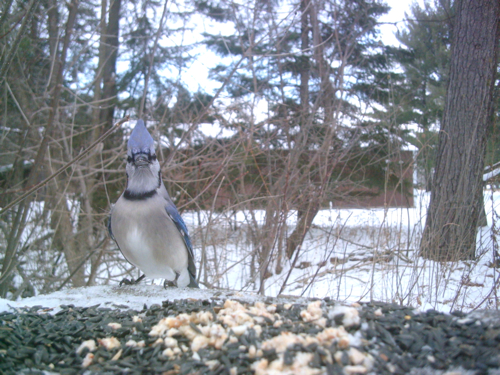
The jaunty blue jay is loving the crumpled up peanut suet mixed with black-oil sunflower seeds.
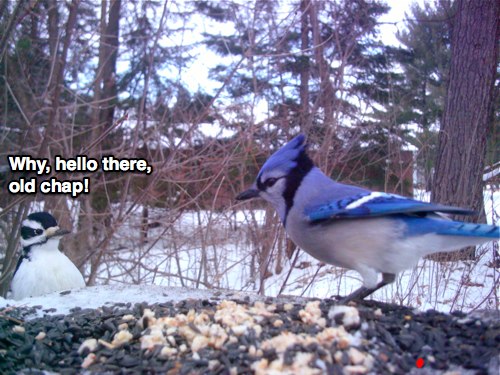
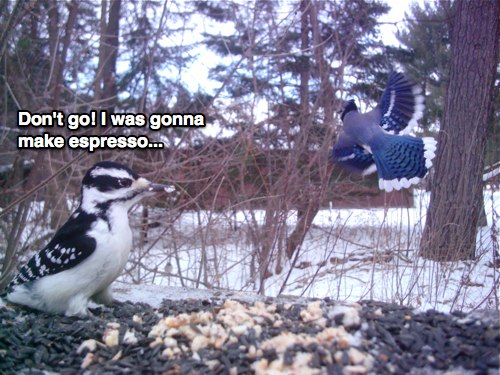
And then he is joined by a hairy woodpecker.
Birds of Snowpocalypse
For those like my mother who lives in Indianapolis (who are getting Rainmageddon) and cannot experience the white Christmas we are enjoying in the Twin Cities, I thought I'd put out my Wingscapes cam to get some photos of birds and the falling snow. I forgot that I had it set to take video, so here is a cardinal in the snow:
I love the crow who seems to be on cue giving periodic two caws for ambient noise. Love the little dome over the tray to keep the seeds dry and uncovered.
Happy Holidays to everyone--however you celebrate it.
Thank you so much for taking the time to visit my blog throughout the year and a special thank you to everyone who sends to that read, "I've never really noticed birds before reading your blog, but..." and then you send me your bird story. That's what makes sharing my bird stuff so fun.
The One That Got Away
A couple of weeks ago, I saw a squirrel loafed out on the top of the telephone pole outside our kitchen window. It seemed to be staring in, willing me to put seed out on the ledge of the kitchen window. It would then be able to walk the wires to gain access. I'm not really supposed to feed birds there. That window is right over the back door of our building. But I figured one little handful wouldn't hurt. It would snow soon, covering any evidence of empty seed shells below.
But the squirrel ignored the seed. A week went by. It snowed. Nobody ate the seeds, nobody noticed the seeds. That is, until today, a curious chickadee found the stash and quietly spirited away the black-oilers one by one (leaving the white millet untouched--no surprise there).
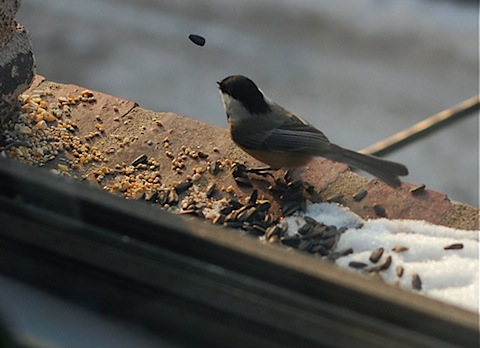
Although, one seed did escape the little bird. You could almost here a Homer Simpson-esque, "Doh!" as it slipped over the side.
Now, let's see how much I toe the line and sneak bird seed on this ledge over the winter. I think as long as the pigeons and house sparrows don't find it, I can manage my bird feeding addiction.
Growing Nyjer Thistle In North America
Last Saturday was the Minnesota Ornithologists' Union Paper Session (a boring term for annual gathering). One of the presentations was from John and Lisa Loegering about attempts to produce Nyjer in North America.
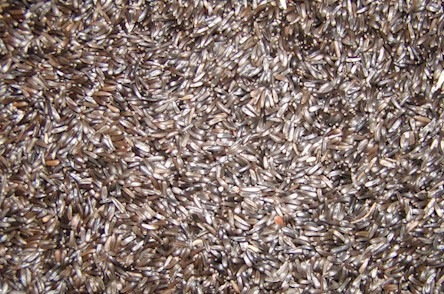
Let's get some basics down about this seed first, on the off chance that someone reading this doesn't know about the tiny seed for finches. Above is a picture of Nyjer also known as Niger and Thistle. Most of what you purchase for goldfinches at your local feed store comes from Singapore, Burma (I remember seeing that location frequently when I got in 50# bags at the bird store I managed), Ethiopia, and Myanmar. This is not a seed grown in North America. It is in no way related to the noxious weed thistle. It was originally called Niger but frequently got mispronounced as a racial slur. So many retailers referred to it as thistle. Since some got confused that it might be seeds of the noxious weed thistle, some cities tried to ban its sale. The Wild Bird Feeding Industry has pushed for the name to be changed to a phonetic spelling: Nyjer.
Confused yet? Basically at bird stores: Nyjer = Niger = Thistle, it is all the same seed. It's that tiny seed you put out for finches, siskins and redpolls and it's not grown in North America--one of the reasons it's one of the more expensive seeds.
According to the Loegerings, attempts have been made to grow a type of Nyjer in North America. A Niger Growers Group was even formed. By 2002, a plant had been developed and seeds were produced...and no bird would touch it. The group contacted the Loegerings and asked them to figure out why birds wouldn't eat the seeds. They set up 15 different feeding stations with the North American Nyjer in one feeder and Ethiopian Nyjer in the second. They measured the amount of seed put in the feeder, the amount the birds ate, the type of birds and the flock composition. The most common birds coming to the feeding stations were goldfinches and redpolls. Sure enough, if the birds had their choice, they ate the Ethiopian Nyjer more than the North American Nyjer.
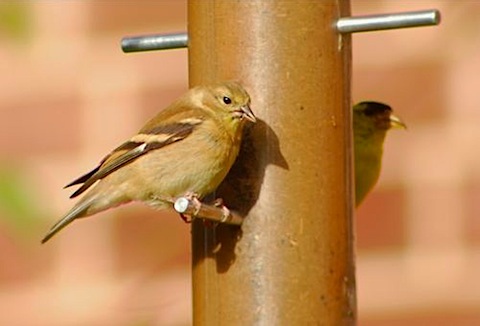
Loegering wondered what was different. One of the first things that came to mind was that Ethiopian Nyjer is supposed to be heat treated to prevent it from germinating in North American soil (we all know how successful that is...not). So he got the directions for the exact process and heat treated the North American Nyjer and restarted the experiment. This time, the finches ate both types of Nyjer at the same rate. Now why would they prefer the heat treated seed? Does the heat remove the moisture to make the shell easier to crack? Does it make for a better tasting seed? Does it look different in the UV color spectrum? We don't know.
Now, this does not mean you will be finding locally grown Nyjer anytime soon. The Nyjer Growers Group has since disbanded. Part of the reason is that there is no farm equipment available to separate the tiny seeds from the chaff. Nyjer is all hand harvested overseas, think about that when you are pouring it into your feeder--that is a hand harvested seed. Kind of makes you wonder about the age of the harvesters and if they are paid a fair wage for harvesting that bird seed. Between that and tariffs, you can understand why it's an expensive feed to put out. The other reason was that when corn prices went crazy on all the ethanol speculation, many farmers gave up trying to grow bird food like Nyjer or sunflower (it's costly since you have to protect from the very creatures it is being grown for) in favor of growing corn. They also gave up some of their CRP land, so birds got a raw deal from ethanol...no bird can live in a corn field.
And now a few words from one of my site's sponsors:
Hey! While we're talking Nyjer and finches, you might need one and some are available at the Birdchick's OpenSky Store. One that is pictured quite a bit in my blog and used by thousands of finches is the Finch Flocker (a 36" feeder). There's also the Droll Yankee Clever Clean Series for finches too.
Remember that 20% of the profits of my store are donated to the ABA's kids programs.
Bird Feeding In Britian Affects Birds
Well, now here is an interesting article from BBC News on how bird feeding id affecting birds over in Europe. The traditional thinking with bird feeding is that birds use feeding stations as a small part of their diet, using various other sources for food. But a study on a European warbler called a blackcap is changing that. Scientists seem to think the bird is in the very early stages of evolving into a new species:
The birds' natural wintering ground is southern Spain, where they feed on the fruits that grow there.
Researchers describe the impact this well-intentioned activity has had on the birds in Current Biology journal.
Dr Martin Schaefer from the University of Freiburg in Germany led the research. He and his team found that blackcaps that migrated to the UK for the winter were in the very earliest stages of forming a new species. He explained that some blackcaps (Sylvia areicapilla) would always have migrated "a little further north" than others and eventually "ended up in Britain in the winter".
"But those birds would have had nothing to eat," he said.
It was when garden bird feeders became more popular in the UK, that an evolutionary division began to emerge.
"As soon as the British provided a lot of bird food, those birds would have had a much higher probability of surviving the winter."
And because the UK is closer to their breeding ground, those birds would also have returned earlier to claim the best territory. The researchers, from Germany and Canada, set out to discover if the birds that spent the winter availing themselves of garden bird-feeders were in fact a distinct group. To do this, they studied the blackcaps at a breeding ground in Germany. The team were able to use a chemical "signature" from the birds' claws to identify where they spent the winter, and what food they ate.
"Then we took blood samples and analysed those to assess whether... we had two distinct populations. And that's exactly what we found," said Dr Schaefer. To a very large extent the birds only mate [with] birds with the same overwintering grounds as them."
This initial "reproductive isolation", Dr Schaefer explained, is the very first step in the evolution of a new species.
"This tells us that by feeding birds in winter we... produce an evolutionary split. And we have produced these initial steps in as little as 50 years."
The team also observed differences in the birds' beaks, wings and plumage. Blackcaps that migrated along the shorter route to the UK had rounder wings, and longer, narrower beaks. The scientists said these differences were evidence that the birds had adapted to their shorter journey, and to eating seeds and fat from bird-feeders, rather than fruit from shrubs and trees. But, Dr Schaefer pointed out that the evolution of a new bird species "could take 100,000 to a million years".
"At this stage this is reversible," he added. "And it's hard to envision a species change, because if there's another economic crisis and people stop feeding the birds, the whole system might just collapse."
In this case, Dr Schaefer thinks the human impact on blackcaps has been a positive thing.
"[The birds have] found a better overwintering area that is closer to the breeding ground, where they can obtain food easily. And I also think its positive news for us, because it means not all the changes we produce are necessarily bad, and that some species have the potential to adapt quickly to the changes."
You can read the full article here.

Which now makes me wonder if more in depth banding and blood samples need to done on North American birds--like goldfinches. Are feeders making a change in some of their winter movements? It's kind of mind blowing if you think of that research on the blackcap. It's one thing to affect a bird species population and seasonal movement, quite another to cause a species split.
This also makes me think of the trumpeter swans in Monticello, MN. As trumpeters were being reintroduced to Minnesota in the mid 1980s, a woman in Monticello, MN was casually feeding ducks and geese from her yard on the Mississippi River every winter. In 1986 a few trumpeter swans joined the group for the winter. The Mississippi water stays open all winter long because of the nearby power plant, giving the swans a safe place to roost at night. Over the years, more and more swans showed up and now it's a tourist attraction to see the 1000 - 2000 trumpeter swans wintering in her neighborhood in Monticello. The woman still feeds the trumpeter swans and puts out over 1400 pounds of corn a day!
That's one woman who has changed a migratory population of birds and added a tourist attraction to her town to boot.
It's Dark-eyed Junco Time
After we did some work at the beehives I took a few moments to get some photos at the bird feeders. I scattered a little bit of millet since I've seen juncos flitting around on the Twin Cities bike trails and along the country roads near Mr. Neil's. Sure enough, a junco hopped on the stump with the millet...as did a hairy woodpecker. The suet feeders were full and I even put some old mixed nuts out and still this woodpecker went to explore the millet pile. There were some black oil sunflowers mixed in with this, so I'm sure that's what the hairy was after. It was fun to watch the two species interact. The hairy doesn't appear to care about the junco. The junco doesn't mind the hairy, but does keep a close watch on the larger bird and seems to make sure that the woodpecker does not violate his personal space. [youtube]http://www.youtube.com/watch?v=yYXhW2WN1EI[/youtube]
I love the nuthatch that sneaks in at the end.
Mesh Tube Bird Feeding Video & Links
There are some way cool links out there. One is over at Round Robin Blog and it's all about an Albatross Cam! It is so cool. One of the photos from the albrotross backpack cam shows them feeding along with killer whales--how cool is that? Sigh, I would love to hang out at an albatross colony for a day. I may never see one, but I love knowing they are out there. Another fun link is about a satellite transmitter on a whimbrel and another is a person's photos of a great horned owl rescue. The owl is apparently doing fine, but the photos are awesome, especially just the one eye staring at the photographer from the box. Sinister box indeed.
Bill and I also completed another video for OpenSky about one of the mesh feeders I really like. You may recognize it from some of the photos in the blog over the years. Why even Mr. Neil has taken photos of birds on it.
[youtube]http://www.youtube.com/watch?v=I7ozd6dQiwQ[/youtube]
If you like the feeder, you can get it here.
Wild Birds Unlimited's Wildlife Blend Recalled In Some States
The North Carolina Department of Agriculture and Consumer Services' Food and Drug Protection Division issued a statement that Burkmann Feeds is voluntarily recalling a seed blend that they make for Wild Birds Unlimited called Wildlife Blend, due to concerns over deaths of wild birds due to salmonella.
The bags carry the manufacturing date code of 81132200291608124.
You can read more at MSNBC and Wild Birds Unlimited has issued a press release.
“Wild Birds Unlimited is committed to keeping everyone safe and informed about issues that may affect the hobby of bird feeding,” said Jim Carpenter, founder and president of Wild Birds Unlimited. “People’s safety and the health of wildlife are our primary concern.”
The press release went on to say that initial tests have established no correlation between any bird deaths and the recalled food; a different strain of Salmonella was found in deceased birds in North Carolina than what was detected in the recalled food.
Customers who purchased WBU Wildlife Blend or WBU Woodpecker Blend are advised to contact their local Wild Birds Unlimited to determine if their product was manufactured by Burkmann Feeds and is part of this recall. Recalled products should be discarded. Consumers are also advised to avoid touching unsealed product and to wash their hands thoroughly after touching any unsealed product. A full replacement, credit or refund for these recalled Burkmann Feeds products will be made available at the store of purchase.
You can read the full press release here.
This is also a good reminder to keep your bird feeding area clean, especially with the influx of large flocks of pine siskins and common redpolls. Dirty feeders do more damage to birds than not putting any food out at all.
How Would You Like These At Your Feeder?
A bird feeder at Los Tarrales in Guatemala. Would you like a blue-gray tanager and golden-fronted woodpecker coming?
Scott's Wild Food Bird Recall
When I last blogged about the peanut butter salmonella recall, I was able to find companies that had statements saying their suets and peanut products are safe. However, I was unable to get a response from Scott's Wild Bird Food. Yesterday, I got this email from Jillian Leiter, Consumer Response Representative:
Thank you for your interest in Scotts and for the opportunity to help you with your lawn and garden endeavors.
I do apologize for the delay in our response but at this time we do not have information available regarding our Morning Song products and the recent peanut recall. Once we have the information available we will forward it on to you.
Well, this press release just hit my inbox:
Scotts Miracle-Gro Co. is keeping an eye out for birds and bird-lovers.
The Marysville-based lawn and garden giant’s Scotts Co. LLC subsidiary this week launched a voluntary recall of five varieties of suet wild bird food products over concerns that they might contain peanut meal bought from Lynchburg, Va.-based Peanut Corp. of America’s Blakely, Ga., plant. Peanut Corp.’s products have become the center of a federal probe into a salmonella outbreak that has involved scores of illnesses and several deaths, including two in Ohio.
Peanut Corp. originally only recalled peanut butter and paste but recently expanded efforts to include all peanut products made in Blakely since Jan. 1, 2007, Scotts said. The company said salmonella not only can affect animals but can pose a risk to humans who handle products tainted with it. No illnesses have been reported and products from the Blakely facility are no longer being used, Scotts said.
Bird food included in the recall involves about $500,000 in annual revenue, less than 1 percent of the company’s sales for its bird food business.
Click here to download details on product manufacturing dates and UPC numbers involved in the recall. Products involved in the recall, only for items manufactured between Dec. 27 and Jan. 17, are:
• Morning Song Nutty Safari Suet, 11 oz.
• Morning Song Woodpecker Suet 3 pack, 1.78 lbs.
• Royal Wing Raisin Suet, 11.75 oz.
• Morning Melodies Variety Suet (3 count).
• Morning Song Variety 15-pack suet, multi-pack with 15 suets and feeder.
Digiscoped Images
Fresh Tweets
Would you like to hire me as a speaker for your event?
Email sharon@birdchick.com