
So, in an effort to find out what bird species made the Mystery Nest, I did a bit of searching on Google. Rick Wright mentioned that yellow warblers sometimes make multiple nests and so I googled the words "yellow warbler nest cowbird" and found a link to a bald cardinal feeding a young cowbird (cardinals, I expected more from you). Thank you, and here's to the weird stuff you find on Google.
Mysterious Robber Bees
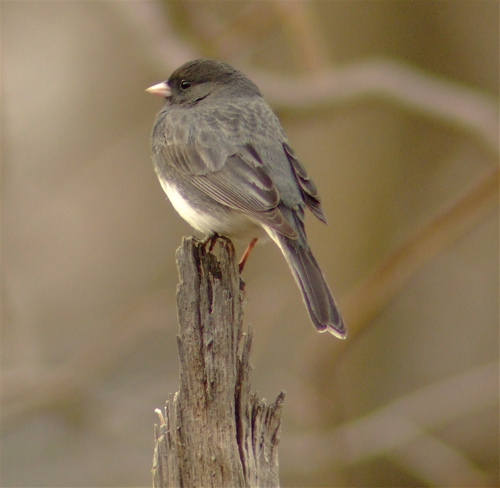 We still have juncos moving through, many were starting to sing some of their territory songs over the weekend. Some even chased each other through the brush piles as the flocks start their northward migration.
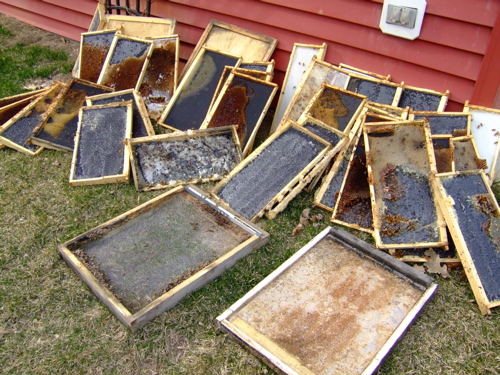
Lorraine has been gleaning honey from the remainders of the Kelli and Kitty hives. As she put the wrecked frames outside, we got some robber bees coming in to them!
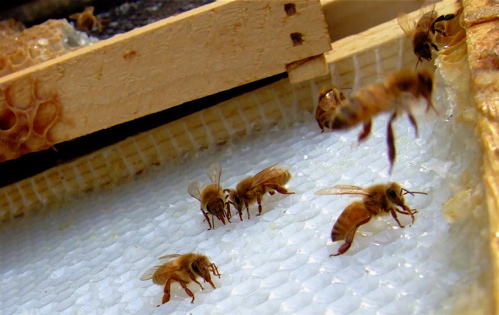
Little honeybees came in to claim what honey we had not. We currently have no active hives in our beeyard...where are these girls coming from? Is it possible that these are bees from our first summer that swarmed off of the Kitty hive? Or is a neighbor also keeping bees? Honeybees will fly 2.5 - 5 miles away from the hive in search of food, so it is conceivable that these are from a neighboring hive. But it's more fun to think them being the Kitty bees. Oh, how I wish I had a little robotic, remote-controlled, helicopter bee cam!
Cardinal Cam
I gotta say, that I love the internet age and the ability to do some online birding! At first we would get some still images updated from falcon cams, eventually that moved on to next box cams like owls and the occasional chickadee cam, now it's all sorts of species, not just raptors and the video is live, with sound! Cornell's Nestcam site has a new streaming video of cardinals starting their nest in New York. Check out one of the highlights:
[youtube]http://www.youtube.com/watch?v=K7sjVqBYFZU&feature=player_embedded[/youtube]
If you have some favorite species cam sites, don't hesitate to share them in the comments.
Pigeons Getting Busy In My Neighborhood
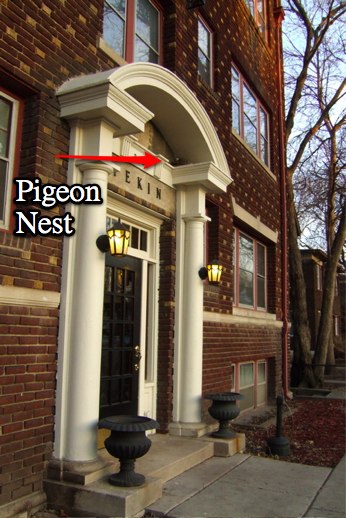 I noticed some pigeons nesting on a nearby apartment in my neighborhood. This is not out of the ordinary, you would expect to see pigeons nesting in early spring in Minnesota, but it's what they are nesting on that makes me chuckle.

See the board with all the little nails on it? That was put up to keep the pigoens from hanging out on the ledge. Pidgeon says, "In your face, building manager!"
This pigeon is part of a pair that nests in this general area and also lost their chicks this time last spring to some crows. Hopefully, they will have better luck this year. This bird has a distinctive pattern and I can always tell when it's at my feeding station--its also rather bossy to the other birds.
This is a video from an eagle center in Denmark called EagleWorld. The birds is a Stellar's sea eagle and I'm not sure what they're training it for, but I can't help but giggle at the bird's giant schnoz and feathery pants--especially when it's running down hill. [youtube]http://www.youtube.com/watch?v=iNs8yEWR4_E[/youtube]
Saturday Birding Program
For those interested, I'll be doing a Spring Birding Program at Kroening Interpretive Center at North Mississippi Regional Park from 1 - 3pm this Saturday, April 11. We'll start with a talk about attracting birds, then go out and watch them. I'll have my digiscoping equipment if you have any questions on that too. I believe that there is a park fee, so do call ahead 763-694-7693. The weather should be fantastic and we should get some great spring migrants.
Birding Among Bullets In Malta
Holy Crap, I was sent a trailer for Birds, Bins, and Bullets a documentary about Eurpoeans fighting back against the illegal hunting of migrating birds in Malta. Here is the trailer: [youtube]http://www.youtube.com/watch?v=GaC1u4D8bUA[/youtube]
You can watch an excerpt of this distrubing documentary here. It's incredible to see these European birders, going right into the heart of the poaching area to try and stop this. You may be wondering why you should care about some small island off the coast of Italy should be of any concern to you--it's an important flyover for many migratory species of European birds. I'm not against hunting, but many of these birds are protected and the poachers are just shooting them, not taking the meat--that I don't like.
This is not unlike the fight that Audubon first faced to stop the Christmas Bird Hunt or the days of shooting hawks for sport in the fall along places like Hawk Ridge, MN or Hawk Mountain, PA.
Since Malta joined the EU, they've been gradually shifting the hunting laws to fall more in line with the rest of the union, however the illegal hunting still goes on (if you watched the trailer, you saw the protest against the Royal Society for the Protection of Birds being protested by the people who still wanted to poach the protected birds). This year, the Maltese Government, feeling the pressure, has announced that there will be no 2009 spring hunting season, but will that stop a poacher who still feels it is their right?
So, watching this, one might think, "Perhaps boycotting Malta is the best thing?" Well, that's not going to stop the shooting. Bird Life Malta is going to some great effort, like hosting a Spring Watch April 11 - 26.
Basically, on the camp, you are on illegal hunting surveillance and migration monitoring--this is not your ordinary listing trip. They also offer a Raptor Camp in the fall with similar objectives. Reading about the previous camps on the website, it sounds like it's a combination of reward, frustration and danger. Last year, some participants have their windshield shot out and tires slashed, but on the other hand, much of the illegal hunting was curtailed and some poacher arrested.
It's an interesting situation and really makes one wonder if birders can make a difference. They certainly are struggling to in Europe.
Golden Eagle 42 Did An About Face
I got an update from Mark Martell at Audubon Minnesota about Golden Eagle 42. It looks like the bird started to head north, changed it's mind and went south again. "Our bird’s northward movement during the first 3 days after his release which saw him move north into Chippewa Co., WI ended there when he did an abrupt turn-around and headed back south to Buffalo County on the morning of March 29.
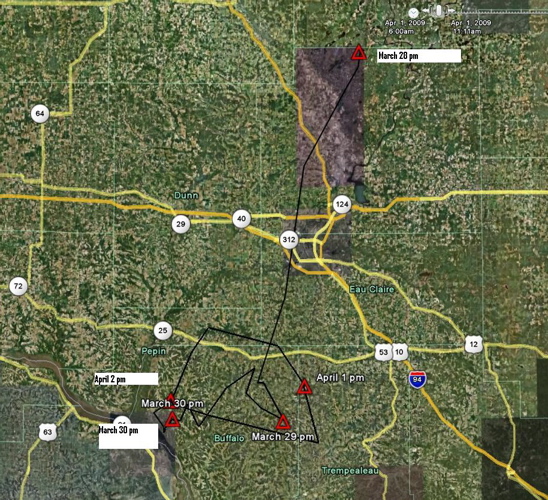
Our most recent data is through April 2 and he remained in the general area of northern Buffalo County. He moved around the area quite a bit during the day and chose different evening roost sites every night although he spent 3 nights in the general area east/northeast of Nelson, WI. The area he is traversing, and the evening roost sites he chose are consistent with the observations Scott Mehus and I made of other golden eagles during Jan and Feb. and fit with Scott’s overall impressions gained in the past years. We believe most of the adult golden’s have started moving north so we would expect this bird to do the same in the near future."
12 Great Backyard Bird Count: Year of the Siskin
Cornell Lab of Ornithology and the National Audubon Society's 12th annual Great Backyard Bird Count had a record number of pine siskins and participants. More than more than 93,600 checklists were submitted and identified 619 species.

One of the big stories coming from the GBBC this year was the massive invasion of Pine Siskins and White-Winged Crossbills over much of the eastern United States. According to the GBBC, "These feisty little birds moved southward because of seed crop failures in their usual wintering grounds in Canada and the boreal forests. GBBC participants reported 279,469 pine siskins on 18,528 checklists, compared to the previous high of 38,977 birds on 4,069 checklists in 2005.
 Hey, check out this shirt design for the winter finch invasion that Magnificent Frigate Bird came up with. You can see all the products available with the logo here. I love birders with a sense of humor.
White-winged crossbills were not as common, but their invasion was still impressive with 4,824 birds on 589 checklists representing a new record over the previous high of 2,854 birds on 135 checklists in 2007."
In downer news, the GBBC showed continuing declines in some common birds, like loggerhead shrike. However some species that have been in decline like northern bobwhites and eastern meadowlarks were both up slightly from last year. Though an increase is positive, their numbers are still lower than they were in 2004.
Species reported for the first time during the GBBC included two oceanic species--Pink-footed Shearwater and Xantus's Murrelet, both in California. Other first-timers included Baird's Sandpiper, Black-billed Cuckoo, and Blackpoll Warbler. Two rare Mexican species appeared on GBBC checklists from Arizona for the first time: the first Sinaloa Wren ever found north of the border, and a Blue Mockingbird.
For a more detailed summary of this year's results, visit the GBBC website. You can explore 2009 data, compare with other years, and find the exact counts for each species in a particular state, province, or town.
If you didn't participate this year, you can sign up next year to be part of this big count. The next Great Backyard Bird Count is February 15-18, 2010!
Top 10 most-frequently reported birds in the 2009 GBBC: 1) Northern Cardinal 2) Mourning Dove 3) Dark-eyed Junco 4) American Goldfinch 5) Downy Woodpecker 6) Blue Jay 7) House Finch 8) Tufted Titmouse 9) American Crow 10) Black-capped Chickadee
Test
Just testing with this barn owl clip to see if I can set this post to pubish at a later date. [youtube]http://www.youtube.com/watch?v=v0uerPJInU0&feature=player_embedded[/youtube]