
Birdchick Blog
Common Yellowthroat & Another Contest
Okay, I know I wrote in the comments of the previous entry that I would update after breakfast, but truth be told the gorgeous spring day took hold of me. Once outside, there was not going back indoors. I do have enough material for a whole week's worth of entries and I'm not sure when I'll have time to get them up.
 First up, the correct answer for the photo id in the eyeball contest was common yellowthroat, a bird we banded at Carpenter Nature Center on Friday. These are those tiny birds in marshy areas that sing "whichity whichity whichity" from the reeds and are very pishable.
 Here is the eyeball...
 And here is the whole original photo. Aren't they just gorgeous little guys?
 I love the macro feature on my Nikon Coolpix 4500, it really can capture the magic of seeing these birds in hand. The photos though make the common yellowthroat look much bigger than it really is.
The winner of the eyeball contest already has a copy of the book, so the prize is still available. So, here's another eyeball contest--however, this one is much more diabolical than the last! Mwa ha ha ha ha ha ha ha:
 What bird species belongs to the eyeball? First correct answer in the comments section with a name wins the prize--a paperback Singing Life of Birds with CD (you can use anonymous as a blogger id, but put your name in at the end of the comment if you want the book). The first correct answer with no name wins self satisfaction. Something for everybody!
Banding at North Coast Nature
One of my favorite things to do is banding and they had a great demo at the North Coast Nature Festival.
 Here is one of my favorite photos of the weekend. That's master bander Tom Bartlett showing a goldfinch to some awestruck kids. Look at that little boy in sunglasses--that look about says it all!
 Kids got the chance to release some of the birds after they were banded. This little girl just opened her hand the finch flung himself from the palm of her hand in a split second.
 Here's a handsome little chipping sparrow that came into the nets. I have to say, Tom is one of the fastest banders I have ever seen. Birds were banded, measured, weighed and outta there in less than two minutes.
 I also really appreciated how patient and enthusiastic he was around the kids. His missioned appeared to go beyond just banding the birds, but sharing their beauty with them. If kids wanted to, they had a chance to touch the birds. Several years ago, I was against this. I thought it was cruel to the bird and wondered why do kids have to touch everything. One day I realized that touch is how to make something real and understandable to a kid, and when done in a respectful manner, is not that stressful to the bird.
 Sometimes, there can be issues. This female brown-headed cowbird gave one little boy a good hard nip on the finger with her bill. It stung, but he survived. He was lucky it wasn't a cardinal.
 Tom got several woodpeckers in the net that day, including this male downy woodpecker. You can really see all those downy feathers around his bill...and his tiny spear like tongue.
 And off he goes. If you'd like a chance to watch Tom in action, he will be banding at Kelleys Island later this month.
Friday's Aventures Part 1
Holy Cow! A big thanks to Leanne for nominating me for a Blogger's Choice Award! I'm up for best Animal Blog--I have two votes already--whoot! Although I wonder if I should say Cinnamon is up for best animal--she has a very loyal fan base. We're celebrating with some parsley. If you enjoy the blog, please consider voting. That would be pretty cool to get recognition for birding...and disapproving rabbits.
Friday was an action packed day, I'm to have to divide the entries up. We started at Carpenter, which at first seemed like it was going to be a morning of nothing but juncos but then some excitement came in with a sharp-shinned hawk (above). We were watching a fox sparrow hop and kick around one of the traps and I was trying to use my mind power to get it to go into one of the traps, when all of a sudden all the birds flew towards the window, missing it and ducked for cover. One of the staff announced: "Hawk!"
Hellziggy took the above photo. A junco had already come into a trap further away from us and an adult sharp-shinned hawk was trying to get it in the trap. I wonder if this is the same sharp-shin that nailed a junco in a trap from last December? The hawk spent quite a bit of time flying and clamping down on the trap--it did not seem to understand that it was not going to be able to get the junco out. Jim Fitzpatrick dug around for a balchatri trap (works well for raptors), bated it and set it outside. When he went out, the hawk flew up in the tree, but as soon as the bated trap was out, it went right back down for the balchatri.

After about fifteen minutes, but the hawk finally got caught on the trap and we brought it in for banding. Before it got its toes caught in the nooses on the trap was on the trap, I digiscoped a few photos.
The bird was an adult male. Isn't he beautiful. It's kind of strange, I'm sued to seeing these guys up close when we band them in the fall, not in the spring. He did not have a full crop, but he did have some meat on this chest, he'd been eating well this winter.
Hellziggy made it to banding and we ended up going to lunch and birding in a few other areas. I was glad she made it today, she got to be the one to release the sharp-shinned hawk. New people at banding always seem to bring good luck and cool birds into the traps!
Incidentally, the junco that had been in the trap that brought the sharp-shin in was let go--it had been through enough that morning, it didn't need the added stress of human handling and banding. Although, when he gets to his mating territory, he will pretty fierce thinking, "Yeah, I did a round or two with a sharp-shin, I can take on any male junco in a territory battle." Although, banding must not be too stressful, the above junco we trapped yesterday has been re caught NINE times since it's original trapping in December of 2004. Nine times and it still goes into the the potters traps and hangs out around Carpenter in the winter. It's not like the traps are the only places on the property with food and seed, there are plenty of feeders and spilled seed for juncos to get to without being trapped.
After banding I thought we would check open water for ducks. We stopped at the St Croix and the wind was brutal. It's been below freezing the last for days and today the wind was twenty - thirty miles an hour at least. The river was covered with hundreds of tree swallows (above) trying to glean what little food they can from just above the water. This is the weather that separates the strong from the weak. Usually tree swallows are already nesting, but this cold has put a stop to that. This report came in yesterday from Wisconsin by Patrick Ready:
Today while monitoring my state park trail boxes I opened a box I was concerned had a house sparrow nest in it. Instead of house sparrows about 12 Tree Swallows came bursting out of the nest box.
These birds are under severe stress with this frigid weather and are bunching up in nest boxes to stay warm to survive. The magnitude of this behavior is very unusual due to the fact that so many tree swallows returned very early this year.
Kent Hall in Stevens Point reported finding 17 in one of his boxes this afternoon and promptly quit monitoring. Anyone needing to check nest boxes during this cold spell should stop and look into the entrance hole to see if any tree swallows can be seen before proceeding. Even this is risky as some boxes may only have 3-4 birds and may not be visible until the box is open and the they'd take flight. Better to hold off monitoring until temperatures return to normal. When night time temps drop below freezing avoid checking boxes until later in the morning in case swallows have gathered inside to stay warm.
I don't know if anyone saw Julie's post last month about dead bluebirds in her box, but I think this is a good warning to readers who have bluebird trails. One of the risks that birds take when arriving back in early spring is dealing with low food supplies and harsh temperatures--this helps ensure the strongest survive, but it hard for us to watch. If you would like to help a little, now is an excellent time to stock up on mealworms at your local bird store and attach cups full of worms to your bird houses or just mix some in with your tray feeder. I also scatter suet into my tray feeders to for migrants.
More on Friday's birding adventures later.
Another Break
You know what's fun? That bee people really aren't that different than bird people. During the bee class there's been a guy behind me answering questions loud enough for all in the immediate area to hear. He hasn't raised any bees but has read so much, he is an expert (his words, not mine).
So, we're at another break in the bee class so I thought I would catch up on the doin's that transpired at Carpenter banding yesterday.
 It was a veritable junco 'sploxion. we trapped and banded a ton yesterday. And they were a little chirpy. I wonder if the warmer weather was stimulating them? They will be heading north soon.
 We didn't have the mist nets up, only the Potter's traps to get smaller birds. Somehow this female mourning dove lumbered her way in. Interesting: you can sex mourning doves in hand by checking their neck. If there is quite a bit of iridescent rosy pink the bird is male. If there is mostly tan coloration then it is female. She had mostly tan on her neck.
 After banding, it was so warm out I couldn't just go home and decided to head down to Red Wing to take a quick look at eagles. I passed a bank sign that said the temperature was 47 degrees. I ditched my coat, gloves, earmuffs and scarf and wandered around the marina.
 The warm weather was helping the eagles feel the love and there was some flirting going. Above are two eagles on the same branch. That's the raptor equivalent of second base. There is a nest at the marina and I did see an eagle sitting inside the nest.
 Many were across the marina, but a few lurk in the trees right over the walking path at Colville Park, fairly oblivious to humans. That's what I love about this area, these eagles are not delicate flowers to be given distance. They see the humans, they get what we're about and they will hang out fairly close to us. Heck, they nest right off of highways and here at the marina with high boat traffic. These birds made an informed decision and will nest in an open area, easy for humans to watch and enjoy. Raptors nests aren't always as fragile as some would like you to think.
 While at the park an eagle picked off a large fish, probably a carp. As soon as it landed in the tree all the other dozens of eagles in the trees were screaming and squeaking. I'm not sure if they are saying, "Way to go, dude, nice catch!" or they are saying, "Aw man, I'm so hungry. It's not fair, I was thinking of going for that fish."
While this guy was eating, another eagle came over to check out the situation (above).
 This eagle was really, really interested on watching the other eagle eating its fish.
 It kept looking down at its toes. Our eagles at the Raptor Center do that all the time. I wasn't sure if this bird was watching fish bits fall and debating with itself if it would be worthwhile to go get them or if it was hoping that at some point a fish would magically appear in its talons.
Breaks over.
Wowsers!
I just bought a used camera from one of the Leica guys, a Nikon Coolpix 4500. I bought it for digiscoping and because it's supposed to have an incredible macro feature. I tried it out banding at Carpenter Nature Center today and was VERY pleased with my close ups.
It was a cardinal bonanza today in all the traps, much to the chagrin of the banders' fingers. Those bills are so perfect for ripping open sunflower husks are quite capable of slicing flesh.
 We trapped and banded the above male cardinal on September 15, 2006. Note, he was going through that gawky stage transitioning from brown juvenile plumage into is adult male red plumage. Look at all those pin feathers--aka bird acne. He even has a sad little stubby crest. Hmm, this is taking me back to my seventh grade school photo. Shutter.
 Here is the same bird retrapped today! What a difference four months make! He looks like he's thinking, "I can't believe how good I look!"
Just take a moment and soak that bird in. Breathe in. Breathe out. Ahhhhhhhhh.
Good night, how red do you need to be? Interesting to note, this bird had a birthday on January 1, 2007. Even though he was probably about two or three months when we first banded him, according to banding rules all wild birds turn a year older the first of the year. He is now an official second year bird--even though it has been less than a year since he hatched. I don't make the banding lab rules, I just follow them.
 I'm really digging the macro feature of this Nikon Camera--it really picks up great feather detail. I could just get lost in this female cardinal's patchwork of reds and tans.
 Here she is head on. I'm fascinated by the area where all the feather connect with her bill. Such a combination of heard, bright, and shiny contrasted with soft, gray, brown, red, subtle. I just want to run my finger right along that line...I can't because of the whole biting issue, but still...
Well, can't wait to see further results with this camera and future banding sessions.
Of course the fun part of purchasing used cameras is that sometimes not all the old photos are deleted. I found this photo:
 It's Pete Dunne and it looks like he's visiting Panama's Canopy Tower. I wonder if he got in?
What A Great Day!
I found a new pair of Keens on sale, got a fabulous haircut AND we now know where the green-tailed towhee came from!
 The above photo was taken by Dave Cahlander in early January 2007 in Mountain Lake, MN. He sent an email yesterday saying:
"With the help of photos taken by Steve Roman, we now have a complete band number for the Green-tailed Towhee. 8051-98299 I've submitted this to the bird banding lab, but they don't have a record of this band being used. I'll check with them in a day or two and report any information that they have."
And then today Terry Brashear found that the Mountain Lake Green-tailed Towhee was banded at the Long Point Bird Observatory in Ontario, Canada on June 10, 2006.
According to Jon McCracken of the Bird Banding Lab:
"Yes, incredibly enough this is the bird that John Woodcock banded at TCBO on 10 June/06. It was an after second year male (wings = 78mm; weight = 29.0g; fat =trace) captured in the Heligoland Trap. Wow! It would be great to get all the details (incl location) on the MN sighting. Even if it didn't venture very far, it'd make a great "latest news" blurb.
 Here is a photo of the exact same towhee taken by John Woodcock, the day he banded him June 10, 2006 in Thunder Bay! You can read the note about this bird at here.
This is the bird banding equivalent of winning the lottery. It's not often you trap and band a bird and find it again still alive and still traveling. To have it be so out of range and a rarity for Canada and Minnesota is very exciting. We have an idea of his sex and age--this is not just a young bird who got lost or has crossed wires. This bird has been around the block and is at least three years old. Where else has he been?
I'm so grateful for all the banders and photographers involved to get to the bottom of this very cool bird mystery...although, now I wonder...where was it hatched?
Okay, now I seriously have to pack for Atlanta, I'm leaving tomorrow morning.
Green-tailed Towhee Banding Mystery
 Bird-wise we got totally nooged at Carpenter today. The traps were birdless, although there was some excitement over a Townsend's Solitaire that was found on the trail. We went to go look for it, but did not find it. Although, I was rewarded with a view of a gorgeous gully (above) that I've never noticed at Carpenter. I tend to hang at the banding station and today made a mental note to take a walk on the trails more often.
 Fortunately, we have a very sweet banding mystery to chew on. We've had a rare bird show up in Mountain Lake in Cottonwood County--a green-tailed towhee (a western species not typically found in Minnesota). The photo above was taken by Dave Cahlander and if you look at the leg, you can see that the towhee is banded. Dave is one heck of a photog, and he even tried to photograph the band! No one in Minnesota is claiming to have banded the towhee, so where did it come from? Dave said, "It looks like the numbers are 8051 ?8299, where I can't read the ? number."

He submitted the digits and photos to the BBL and here is a response from Danny Bystrak,
Wildlife Biologist at BBL:
"... It is one of the more fascinating reports I've ever seen here, but so far, I have not made any progress in finding the bander. The problem is that, assuming the 8051 is correct (which it seems to be) and the ?8299 is correct (which it also seems to be), all the possible numbers for the ? are accounted for except two. One of the two was issued to a bander in S.D. who has never banded a Green-tailed Towhee, and the other was issued to a bander in Canada. If it was banded in Canada, the banding record is as far out of range as the sighting!
I will check with the Canadian Banding Office to see who it was issued to, but it is starting to look like maybe the above numbers may not be correct. "
More pictures would be great, if there's any chance we could get that missing number in the picture. "
Where did this bird come from? Anyone out there reading this in Canada banded a green-tailed towhee? I love a good banding mystery!
**There's been an update to the towhee and we now know where it was banded. Check the blog entry for January 10, 2007.
Retrapping at Carpenter
On Friday at Carpenter Nature Center we didn't get in loads of birds and I think all of the ones we got were re traps--birds that have been banded before. But that's important because it gives you an idea of age and territory habits--these birds are year round residents or in the case of juncos the birds are returning to the same spot.
 They were passing around a sheet with ages of birds documented through banding. It had both the records for the Bird Banding Lab (BBL) and for Carpenter. According to Carpenter's records, they oldest black-capped chickadee they have documented was 7 years and 4 months. The BBL's oldest black-capped chickadee record was 12 years and 7 months, the sheet didn't say what state the record came from. I went to the BBL website to see if I could find the state the 12 year old chickadee had been banded but it didn't give that info. Interestingly, the website reads that the oldest chickadee is 12 years and 5 months. But I have a feeling that the site hasn't been updated recently and the 12 years and 7 months is a recent record.
So, keep an eye on the chickadees in your backyard. Just think one of the little dudes you are watching right now could be between 7 - 12 years old. Think of that: the storms in your yard, the snows, the cold, the heat, the predators--that tiny bird is capable of surviving well past a decade.
If you are interested in the oldest species on record according to banding records from the BBL, check this link here. I think I need to start eating more fish.
 Above is a photo of a cardinal that we banded on September 15 of this year. Because of the black patches on the bill and some of the brown feathers mixed in, we knew this male had been hatched in the spring of 2006. We re trapped him on Friday.
 He was now completely red, with just a hint of black on the tip. I tried to take a photo outside and the first one was without a flash. You can see how red he is but he is out of focus. I decided to try the flash.
 Ack! Total washout! I am so not a nature photographer. Although, it's interesting that the flash made some of the feathers yellow. I almost need to take a class to figure out all the bells and whistles with this new Fuji Camera.
Incidentally, the oldest cardinal that Carpenter has documented was 9 years and 9 months. BBL's was 15 years and and 9 months.
Getting Some Work Done At Carpenter
Stopped in to watch the Friday morning banding at Carpenter Nature Center this morning. I haven't been able to go for a few weeks and I was glad to hang with the guys again. I was able to get two birds with one stone (so to speak) since I took the Wingscapes Camera with me to test out. For the moment, those photos go on their blog.
It started out as a slow morning. It was about ten degrees but we didn't have any snow. With it being that cold, we didn't put up any nets, but set out potters traps.
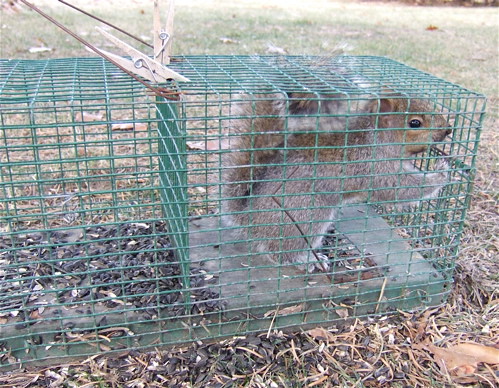
A squirrel managed to find its way into one of the traps. Ooops! It was very perplexed and alarmed--as were the banders. Some birds can be a little nippy when they are in the hand, imagine what a squirrel can do. Larry got a stick and opened the trap and the squirrel scampered to freedom unbanded.

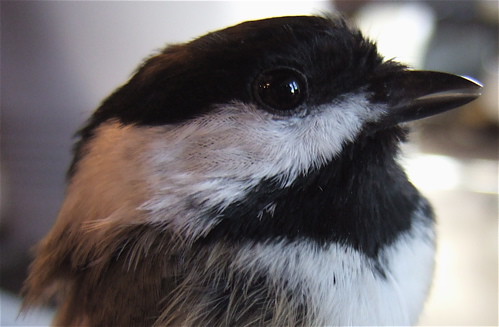
We did get in quite a few black-capped chickadees. One very exciting bird already had a band and turned out to have been banded in 2002! This tiny guy lasting close to five years in the wild--amazing. By the way, is it me or does this bird's bill look a little big for a chickadee? I can't tell if I'm getting overly paranoid about birds with overgrown bills or if it's normal.

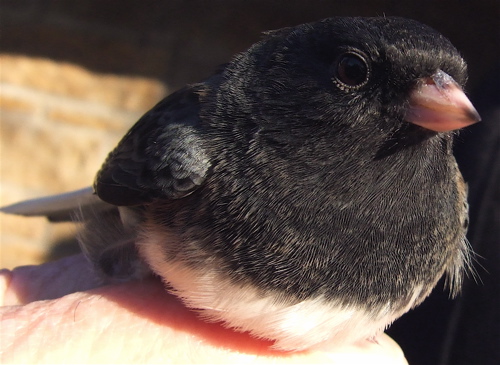
Juncoes were busting out all over. I love dark-eyed juncos, they kind of remind me of little penguins. Something interesting at Carpenter is that they bait all of their traps with black oil sunflower seeds and the juncos still go in. Working at a bird store and with personal experience, I have always found these guys love white millet, sunflower hearts and Nyjer and not black oilers. I wonder if they are actually cracking open the sunflower or if they see seed and just check it out?
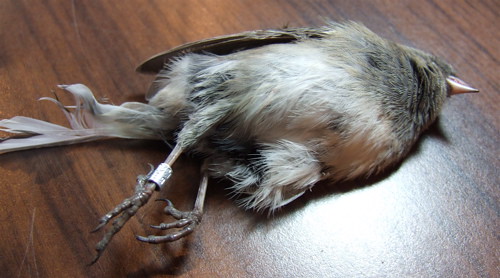
There was a minor junco tragedy. When the guys went out to check all the traps, a sharp-shinned hawk was flushed and left behind a freshly killed junco. The bird was banded, so this was one of the few times when a dead bird could be fully documented we have an idea of where its life ended and how old it was. I think this bird was in its second year. Don't worry raptor enthusiasts, the dead junco was put back outside and the sharpie did return for it.
Frank Taylor Photo Contest
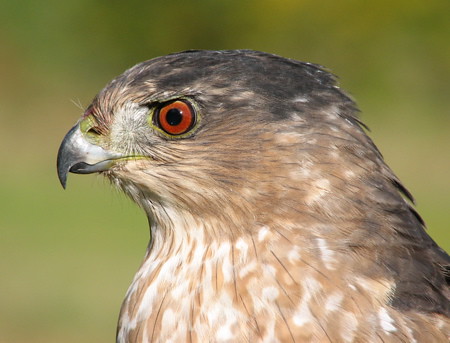
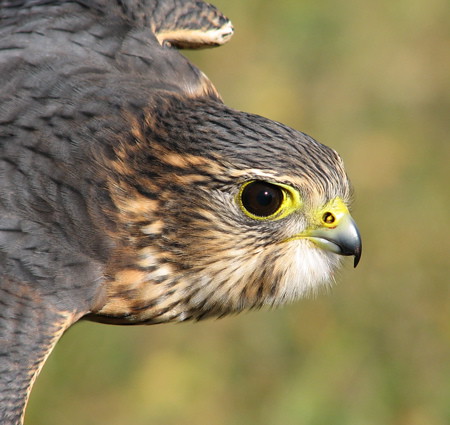
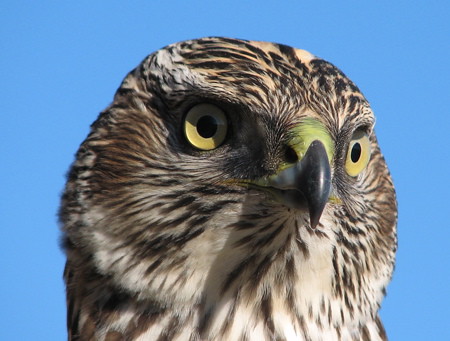
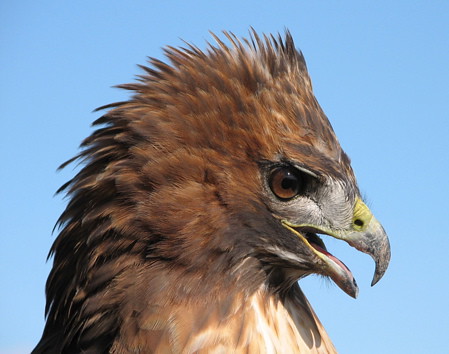
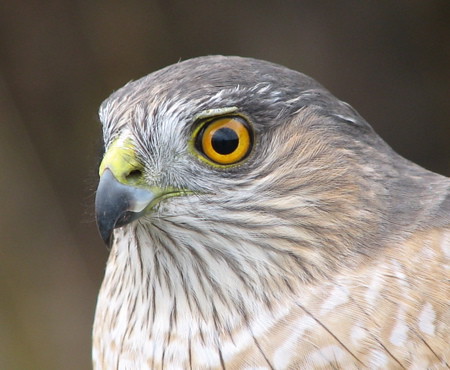
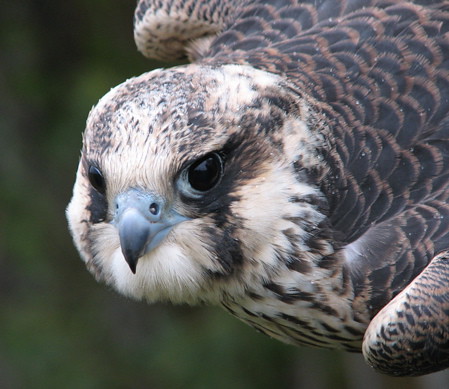
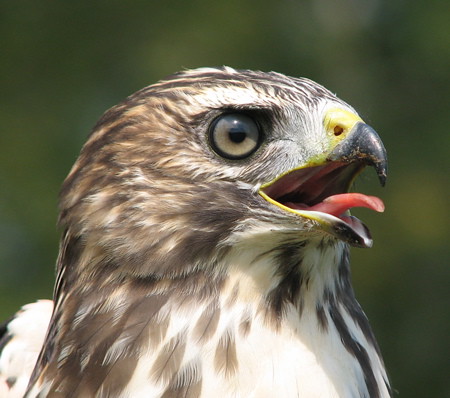
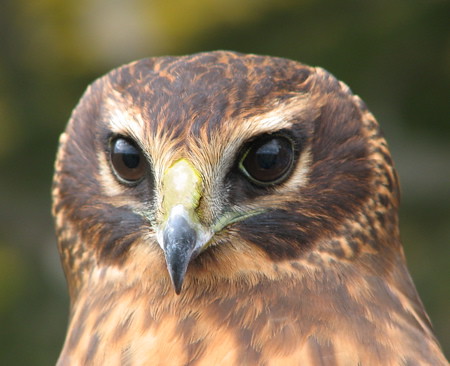
Anyway, Frank Taylor sent over is final banding report for the 2006 Season and he included some great raptor head shots. So, can you identify all the raptor head shots in order? The prize is a Zeiss Lens Cloths and a Leupold Tote Bag (with a cool meadowlark graphic).
1.
2.
3.
4.
5.
6.
7.
8.
9.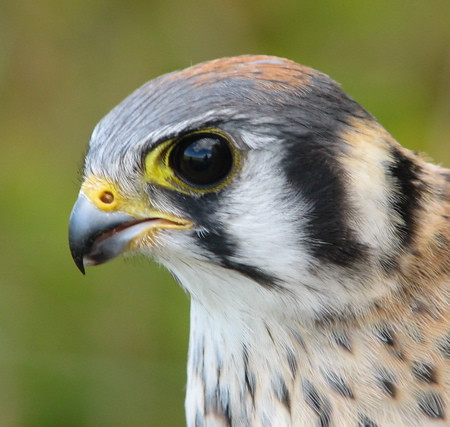
Even if you can't identify all the birds in this contest, it's fun just to take in Frank's photos.
Digiscoped Images
Fresh Tweets
Would you like to hire me as a speaker for your event?
Email sharon@birdchick.com