
Birdchick Blog
Banding Brown Birds
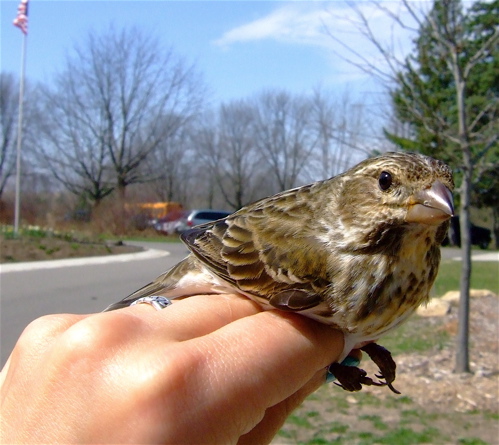 It was a busy day of banding brown birds at Carpenter Nature Center last Friday. Above is a female purple finch that flew into the nets. It was interesting to not the changing of the guard we had going on migration wise.

Although, the first bird I banded was not a migrant, but a house sparrow. I know this is a non native species and they can wreak havoc with bluebird and purple martin nest boxes, but the males in breeding plumage are a very striking bird. Check out that jet black bill. If you are not familiar with house sparrows in the US, they were brought over from Europe. House sparrows are cavity nesters and will aggressively compete with our native birds (like bluebirds, wrens, tree swallows, chickadees, nuthatches and purple martins) for nest holes. If a house sparrow wants an already taken nest cavity, they will use that thick and pointy bill to attack whoever is already in there. They will peck a hole in the back of the heads of the adult or young birds and even build their own nest on top of the carcasses. I once found a freshly dead white-breasted nuthatch on a birding trail. It had a hole in the back of its head. I looked straight up from where the nuthatch was on the ground and saw a small cavity in the tree trunk with a house sparrow poking its head out.
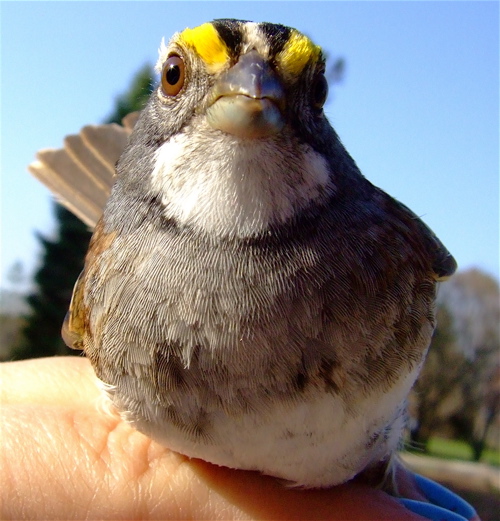
But the most common sparrow we banded last Friday were white-throated sparrows. Yikes, the way that white-throated sparrow looks in the above photo, I think he roughed up poor Sam Peabody. It was funny, the Friday previous we had nothing but juncos, however a week later there were absolutely no juncos and tons of white-throats. These guys are on their way to Canada for nesting, but watch for them foraging for millet under your bird feeders.
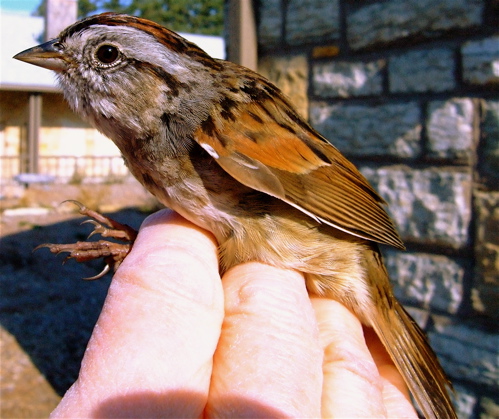
Here was fun sparrow that we weren't expecting--a swamp sparrow. The last time I saw one of these guys was at Cape May, NJ last October. Incidentally, these sparrows have the longest legs of any other sparrow in the US, most likely to help with foraging in water in a swamp.

Here's another sparrow that is a spring favorite for me--a field sparrow. They have one of the best bird songs out there. Check out how long this bird's tail is. Many of the birds we banded had longish tails.
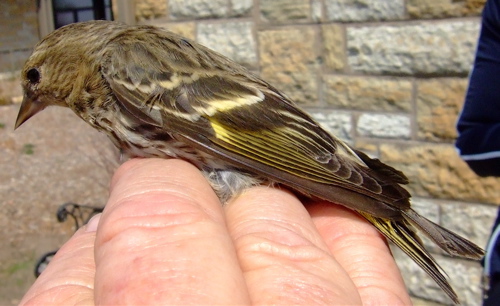
It kind of threw me when we got in some pine siskins and they barely have a tail at all. They were so stubby, just something I had not noticed until they were in hand.
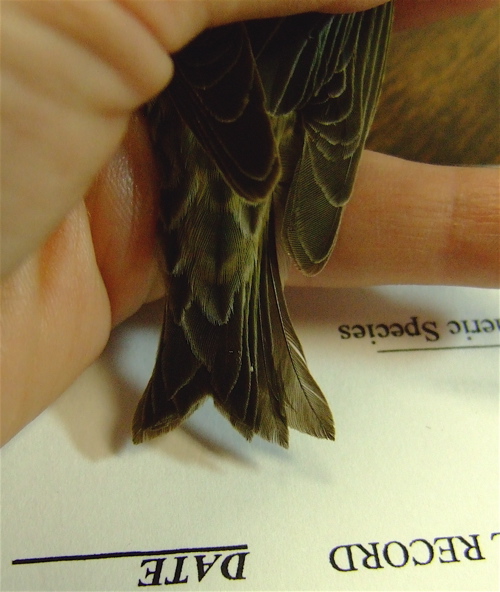
Here's an up close view of the little stub tail. Many of us had big numbers of pine siskins this winter and I've heard through the Minnesota birding grapevine that some are already building nests in Minnesota.
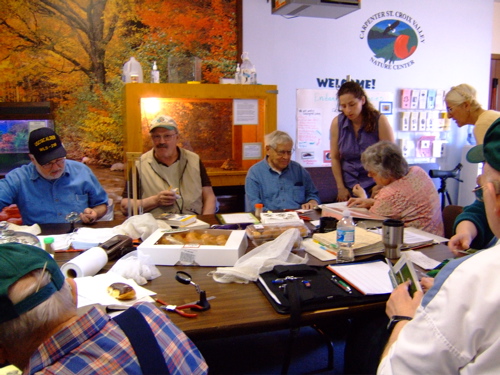
Above is our banding crew at Carpenter. If you'd like to watch our banding, we open it to the public every fourth Friday of the month. Although, we band every Friday so if you're at Carpenter on a Friday morning, you'll see us milling around, checking nets.
This Saturday, you can watch my buds Mark Newstrom and Roger Everhart at Lowry Nature Center as part of the Youth Birding Clinic. It’s geared for kids between the ages of 10 - 19 and includes bird banding, forest bird hikes, grassland bird hikes, wetland bird hikes, a session on digital photography, and birding by bike. I’ll even give a presentation on techno birding. All sessions take place at Lowry Nature Center. You need to register for the event, so call 763-559-6700.
What Is Golden Eagle 42 Up To?
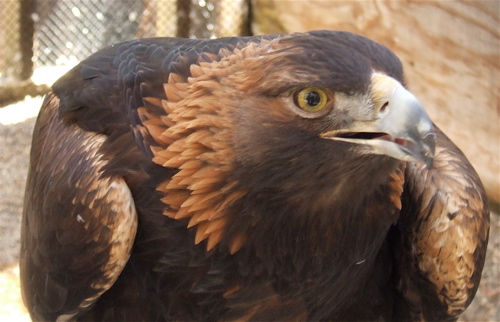 Well, we're getting some unexpected results of the golden eagle that was injured and released with a satellite transmitter. The bird is part of a population of golden eagles that spends the winter along the Mississippi River along the Minnesota/Wisconsin border. The speculation is that the birds breed in Canada, but we don't know for sure.
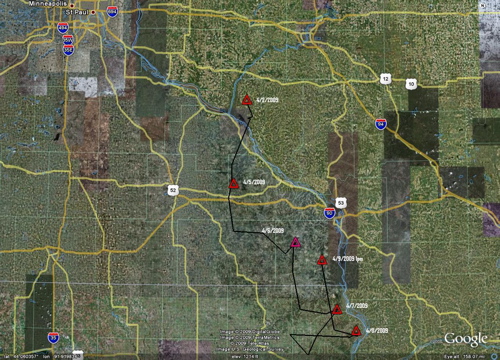
The golden eagle is supposed to be on its northward migration--but went south! Here's the report from Mark Martell:
"Data came in for the past 5 days and our golden eagle decided to take a trip to Iowa. We have a data gap for April 3 & 4 but by April 5 the eagle had started moving away from Nelson, WI where he had been the previous week and was in Minnesota. He spent the evening of April 6 just south of Houston, MN and the evening of April 7 found him near Lansing, IA. He wandered around Allamakee Co., IA on the 8th and spent the evening just west of the Mississippi River near the Yellow River IBA. On April 9 he started heading north and by 1pm, the last signal we have in this batch, he was back in Houston Co., MN
I hope this is just some pre-migratory wandering but of course there is no way to know if this is normal until we get a few more birds tagged."
I'm wondering too if this is normal, or since this eagle was in captivity recovering from a leg injury (from one of those awful leg hold traps, which I wish would be banned) is this bird is taking its time to get its bearings? Cannot wait to see where this bird ends up from the breeding season.
Tracking Golden Eagle 42
My buddy, Mark Martell who works for Audubon Minnesota is working on a project with the National Eagle Center, the Minnesota Department of Natural Resources Nongame Program, and the Wisconsin Department of Natural Resources – Endangered Resources Program studying golden eagles wintering along the Mississippi River.
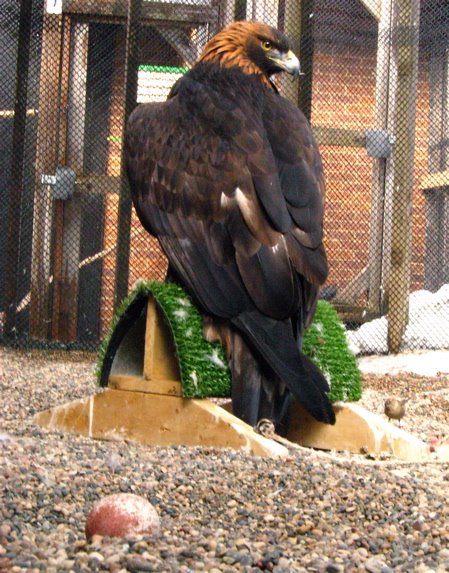
Golden eagles do not breed in Minnesota and Wisconsin and have not been considered regular users of the Mississippi River during the winter, but in the last few years, there have been several reports, especially near the Wabasha area. The National Eagle Center organized a volunteer survey program and have counted as many as 60 golden eagles using the coulees and bluffs along the Mississippi River from Red Wing, MN to LaCrosse, WI. This wintering population does not mix with the much larger and better known population of wintering and breeding bald eagles found in the same area. I actually got to see one of the golden eagles last winter whenn I went out with Joan from the Eagle Center.
Many who have counted the golden eagles wonder, where are these birds coming from? They could be breeding in Canada and the size of the breeding population in northern Ontario is thought to be small and thus vulnerable. If the birds are moving from western breeding areas they could be severely impacted by wind generator projects proposed for the Great Plains and western Minnesota.We need to find out where they go and what their migratory route is.
One of the ways they are going to do that is by putting satellite transmitters on golden eagles. This winter, a golden eagle that was found injured in a coyote trap (a nice name for a leg-hold trap--can't we ban those types of traps please) on the Wisconsin side of the Mississippi River where the golden eagles are wintering. It was treated at The Raptor Center and was released on March 25, 2009. When the bird was let go, Mark was able to attach a transmitter and given the name, Golden Eagle 42. You can read about it and watch video on MPR or the Star Tribune.
While in Indianapolis, I got this email update:
"After its release the bird spent the evening of the 25th near its release point then began moving north. By the evening of the 28th it was in northern Chippewa County (Wisconsin)."
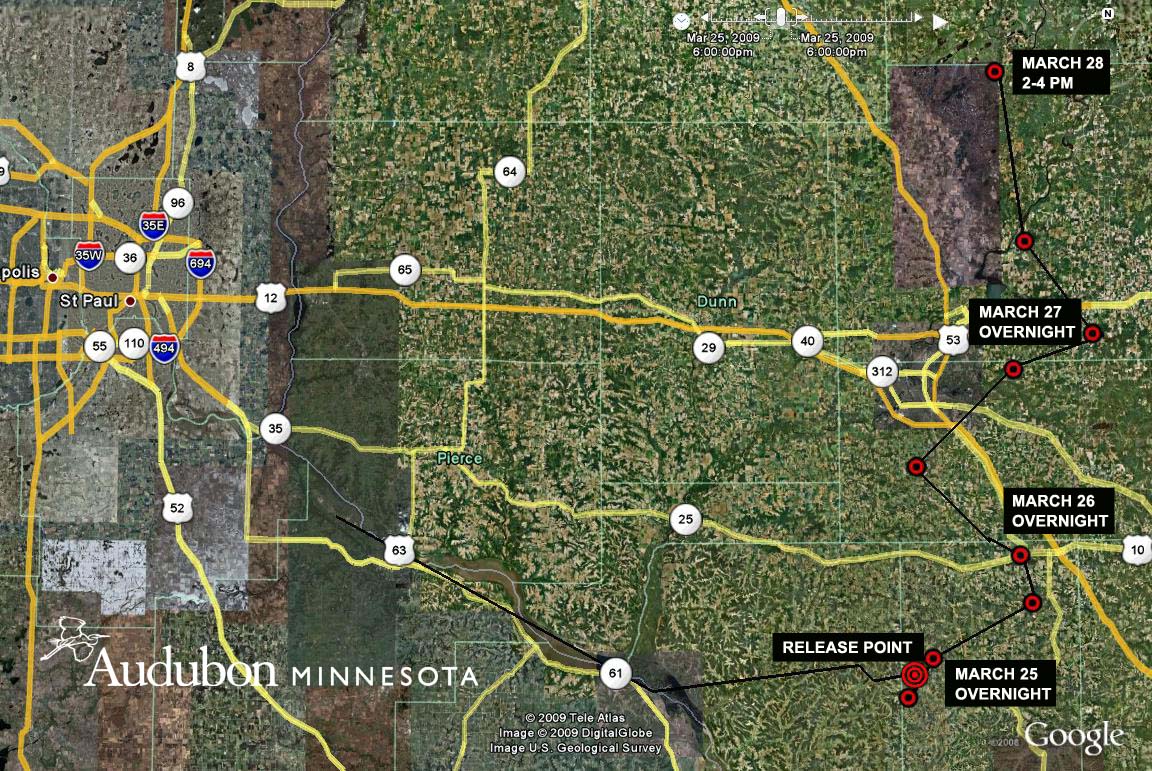 If this map is hard to read, just click on it and you can see a larger version.
"On the attached map the release point and evening stopover sites are noted by a circle and text. Circles not marked with text are other points were the bird was tracked in between those times. The black line indicates the shortest route between known points where the bird was, but we cannot be sure the bird actually took that route."
Maps and other information will be posted on the Audubon Minnesota website, their goal is to update every 3 days as the birds makes its way north. I'll add links and updates here and on Twitter as I get them.
I Digiscoped A Famous Lesser Black-backed Gull!
 While doing some gull watching at Daytona beach during the Space Coast Birding and Wildlife Festival, some of the more experienced gull watchers were super excited about a lesser black-backed gull. It's not so much that it was there, it's not out of the realm of possibility for a lesser black-backed gull to show up, but this one was banded, and one of the gull watchers (Michael Brothers) knew where this bird came from--and we all know how much I love a good bird banding story!
Lesser black-backed gulls breed in Europe. They have been showing up more and more in North America and the suspicion has been that it's a matter of time before they start breeding in on this side of the Atlantic, if they have not already, but no one had documented a nest. That is, until the last two years. In 2007, a lesser black-backed gull was paired up and tending a nest with a herring gull on an island off of New Hampshire.
While doing some gull watching at Daytona beach during the Space Coast Birding and Wildlife Festival, some of the more experienced gull watchers were super excited about a lesser black-backed gull. It's not so much that it was there, it's not out of the realm of possibility for a lesser black-backed gull to show up, but this one was banded, and one of the gull watchers (Michael Brothers) knew where this bird came from--and we all know how much I love a good bird banding story!
Lesser black-backed gulls breed in Europe. They have been showing up more and more in North America and the suspicion has been that it's a matter of time before they start breeding in on this side of the Atlantic, if they have not already, but no one had documented a nest. That is, until the last two years. In 2007, a lesser black-backed gull was paired up and tending a nest with a herring gull on an island off of New Hampshire.
A same pairing was observed in the summer of 2008 and it is presumed that this is the same lesser black-backed gull, but this time, researchers were able to band the lesser black-backed gull and the herring gull and they also witnessed the copulation between the two--determining that the lesser black-backed was the male. They gave him the usual metal band, but also a green plastic band that is easier to read in the field: F05!
F05 apparently likes to spend his winters in Florida--this is so exciting! It's rare to get a recovery when it comes to banding, but the chance to track one while it's alive is such a treat. Thanks to the internet we can find his history and have some answers. You can read the whole story of the pairing, the banding process, and the hybrid chicks at this website. If you check it out, you can see that the bird I digiscoped above is wearing the same band as the lesser black-backed on the island off of New Hampshire.
Also, if you are frustrated with gulls and the fact that there are wacky hybrids that make gull id even more difficult, you can blame this dude, he's not helping.
New Year Is Off To A Bang Thanks To The Blog
 I'm playing with a host of motion sensitive cameras lately--I'm loving all the pine siskin action this winter.
 My favorite photos are the ones where the birds fly a little to fast and the camera speed can't keep up, so they come out a little funky. I'm noticing that quite a few of the birds that Mark and Roger have banded are still sticking around, like the above titmouse. We haven't banded too many of those, perhaps it is the titmouse from this banding session?
So, I'm off to a kind of funky week--funky in a good way. I am Non Birding Bill-deprived. He left Monday for Mac World Expo. I leave Thursday for Bird Watch America. NBB returns on Friday, I return on Sunday. It's unusual for us to travel separately at the same time and of course, it's always strange with the spouse is away. So the week is weird to begin with.
Then, I got a call the other night. It was Guatemala. They wanted to know if I'd like to come on a fam tour (kind of like a press tour) in February.
After I picked up the pieces of my exploded brain, I said, "Can I have 24 hours to make sure I can get the time off from the park service?"
I also needed some time to figure out my passport. Well, thanks to some great advice from well traveled friends, the help of my mom and brother gathering up a certified copy of my birth certificate down in Indiana the process is plugging along. If all goes well, at the end of February, I'll be bringing you some fun entries of the Central American birding experience. Does anyone have anything specific you'd like me to look into in Guatemala--or advice?
I have to thank Mike over at 10,000 Birds for putting the good word in for me in Guatemala. The bonus is that I'll get hang with him while I'm down there. When we end up at bird festivals, we're both so busy, we barely have time to talk. Speaking of Mike, did you hear is weird little explanation of the "12 Days of Christmas" over on the December 24, 2008 podcast of Birdwatch Radio? Check it out if you didn't, it's worth a giggle.
And I got a nice note from Julie Zickefoose in an interview she did for Nature Blog Network. She got started blogging by guest blogging for me when I went on the Ivory-billed Woodpecker search the first two weeks of December 2005. Here's one of my favorite Chet Baker entries that she did. It was strictly selfish. She's one of my favorite writers and I hoped that if she got hooked on blogging she would start her own. She did.
Anyway, it's an interesting interview, check it out.
Okay, now I need to get my stuff together for Atlanta. I'll be heading to Bird Watch America to see the latest and greatest in birding product coming down the pike. Is anyone looking for anything in particular? Let me know, and I'll see what I can find out.
A Little Post Holiday Banding A Carpenter
 After several days of butt chilling temperatures, we finally had some warm weather. It started on Christmas Day. Non Birding Bill and I noticed the temps were in the twenties and then stepped outside. It was so warm, we took a walk to Lake Calhoun. By Friday morning the temps were down right balmy in the thirties. The snow started to melt and fog took over the landscape as did a little freezing drizzle, but it made for somewhat pleasant weather banding birds at Carpenter Nature Center. We had several juncos in the traps (like the bird above).
 I processed one that had a very odd eye! It was oval instead of round. It looked as though there was some type of swelling above the eye and feathers out of place. The bird had been banded earlier this winter, but there was no notation that it was injured when it was originally banded. I had to look at the eye color under a light to try and determine age and the pupil seemed fine. We let it go. I'll be curious is to see if we get it again.
 Among all the juncos, we got in a few of the dreaded cardinals. Dreaded because of that bill and their ability to squirm just right and nail one of you digits. Owie. One of the nice things about cardinals is that you can sex them fairly quick--this is a male based on plumage color. But aging is a different story. I wondered if he was hatched this summer since he had a bit of black on the tip of his beak (juvenile cardinals have black beaks). Our banding leader, Jim Fitzpatrick had me look at the iris of the cardinal and it was dark brown. That coupled with feather condition of some wing and tail feathers made this bird an AHY (After Hatch Year, which basically means we don't know exactly how old it is, but we know he didn't hatch this year).
 While I was processing the male cardinal, Jim was processing a female cardinal. They came into the traps at the same time. We had some members of the public watching us process the birds and they asked if the cardinals were a mated pair. It's not the breeding season and cardinals are typically in large winter flocks this time of year. However, there can be pairs in a flock and according to Birds of North America Online, some cardinal pairs will stay on their same territory all year. I wasn't sure if these two cardinals were in the same trap, but my guess was that were. We also couldn't say for sure if they were pair, but it was a possibility.
 After we processed them, I tried to get one more photo before we let them go. Note the male is still giving my thumb the what for. We opened our hands and off they flew. Sometimes when we release two of the same species like that, they split in different directions. These two not only took off in the exact same direction, but landed on the same branch of a tree! I dashed back into the center to grab my digiscoping equipment.
 They adjusted themselves in the tree and by the time I got my scope on them, the female had perched a bit higher. They seemed relaxed with each other and I think it's a good guess that this is a mated pair. They stayed that way for several minutes. The clouds, fog, and drizzle did not make for the best photo, but it's bloggable.
 I took a few more shots of the male I had just banded while he perched in the tree. I noticed that he had some brown feathers on his flanks. I showed the photo to Jim and the other banders. I asked if we should rethink whether or not he was a hatch year bird since there was some brown. Jim wisely pointed out that the base feathers for cardinals are brown (I assumed black, since their skin is black). He also reminded me that the male's eye color was dark brown. Had he been a hatch year bird, we would have seen gray brown. Only Peter Pyle can take a seemingly easy bird to id (like a cardinal) and make it a challenge!
 After I let the cardinal go, I got a shot of my thumb--check out the indentations he left! It's now turned to a minor blood blister. Thanks, dude. After banding, we went down to where the Mississippi River and St Croix River meet along the Minnesota/Wisoconsin border to look for ducks and gulls.
 There had been a a harlequin duck reported and we had little trouble finding it among all the goldeyes. The fog made for terrible digiscoping conditions and I'm going to have to go back to see if I can get it on a sunnier day. That's a cooling looking duck that deserves a better photo.
Birds & Beers & Banding
 The last Birds and Beers was a huge gathering. Some regulars and some new peeps came to join in the fun.
 We had a drawing from some prizes courtesy of Woodlink. We gave away a few of their "Happy Hour Hummingbird Feeders." They're nectar feeders in the shape of a daiquiri, margarita, and martini--how appropriate! In the background of this photo is Liz Stanley who runs The Overlook Circle Feeder Cam. She warns on her site that images are uploaded every 30 seconds during daylight hours, Central Time. During the winters here, days are short so daylight is only 7:30am to 4:30pm. In the summer, it's much longer, lasting from 5:30am to 9:30pm. If the image is completely dark, please check back in the morning. Check it out! There's also Jim Ryan in the background who runs Jim Ryan Outdoors Blog.
 The big excitement came when Mark Newstrom arrived with extra copies of the new Peter Pyle book, Identification Guide to North American Birds Part II. Some readers have seen Pyle referenced in this blog before, it's a sleep inducing tome essential to aging and sexing birds if you are a bander. Up to this point, we've only had Part I which had warblers, chickadees, sparrows, vireos, etc. This year part II was released which tells banders how to age and sex waterfowl, boobies and spoonbills. We took turns doing dramatic readings of Part II. There's a bit more talk of distended cloacas (great band name) and duck penises in this volume, but that's about as exciting as it gets. Here's a sentence from the zone-tailed hawk section:
"Shape and color pattern to the retrices by feather generation and sex in Zone-tailed Hawk. R5 is shown and is usualy the last feather replaced during molts and the most likely to be retained during the PB2 and DPB."
Or there's this on molt in Canada geese:
"PF partial-incomplete (Sep/Nov-Jan/Apr in HY/SYs), PB2 complete (Jun-Nov in non-breeding SYs), DPB complete (Jul-Dec in breeding AHYs); PA absent."
And if you can understand either of those sentences, then you'll want a copy of the Peter Pyle book. If you don't, take heart that you have a life and run before you get sucked in to the point of no return.
 Speaking of banding, we had an interesting and busy morning at Carpenter Nature Center on Friday--lots of juncos! I think they sensed the impending blizzard that was about to hit. Above is a Potter's Trap and it has 2 doors and usually only gets 1 or 2 birds at a time. This trap had three juncos in it!
 We also got in some chickadees and a blue jay (the blue jay got in the traps before I arrived, so no photo).
 We did get another interesting retrap. I was processing this black-capped chickadee that already had a band. When I read the number to Mary who helps us track the data, she looked it up and found that we originally banded this chickadee on November 10, 2006. I checked the archives of the blog to see if I had a photo of when it was first banded, but discovered that I was in Harlingen, TX at that time and wouldn't have been there on its original processing date.
Friday Banding & Birding
 It was jam packed at Carpenter Nature Center banding on Friday. It was the day after Thanksgiving and many people stopped by--including a hilarious 4 year old named Dylan. She kept asking to band a bird herself. I was doing a junco when she came to me and said, "I was going to do that one!"
I asked if she took the banding class. She looked to the side and back at me and said, "Yes." Can't blame a girl for trying. My favorite part was a the end of the morning, she was leaving and we said, "Bye, Dylan, it was nice to meet you," and she replied, "Yes, it was."
 The big excitement of the day was getting one of the oodles of pine siskins around the Twin Cities. Tom Bell banded this bird and he noted how fine their bills are--perfect for going into those thin slits on finch feeders.
 The yellow is subtle on these little birds, mostly in the edging on the primary wing feathers and the tail feathers. I don't think we were able to determine the sex of this bird, but we did determine that it was a hatch year bird.
 Ecobirder was also there, he's going to help Carpenter a bit with their website. When we were finished, I drove over to Douglas Point and found him taking photos. I left him peace, I know how I am when I get in a good groove. The weather was so warm, it was 40 degrees that I decided to go for a bike ride when I came home.
 I decided to go over to Lake Calhoun to see if I could get a photo of the long-tailed duck in better light. Plus, I've been curious if I could take my whole digiscoping setup with me on my bike. Non Birding Bill and I were both feeling the effects of eating too much and he also joined me for the ride (as long as I promised not to spend an hour trying to get the perfect photo of a duck).
 The light was awesome and waterfowl like Canada geese and hooded mergansers were up close...but not the long-tailed duck, it was WAAAY out on the lake and not worth digiscoping.
 The light was so perfect that I hated to waste it and took a few photos of geese. I could hear joggers behind me say, "Why would you want to take photos of those ducks?" I wanted to turn around and point out the scaup and goldeneyes and say there's more out there than just mallards and geese, but did not. And of course, since I was birding in a public place, someone came up to me and said, "Hey, is that bald eagle still over there?"
"I don't know," I said, "I'm not looking for that."
"It was over on the north side, in that tree, the lighter one on the left there." He paused and I could tell by the look in his eye that he was waiting for me to move my scope on it. The eagle was out further than the long-tailed duck. I was not on the clock and I was focusing on a shoveler, I didn't move my scope.
"It's right over there," he pointed. "I saw it when I was jogging over there. It was just sitting there."
"That's awesome," I said, "I'm glad you got to see that." I could see NBB in my peripheral vision over by our bikes. He was grinning that someone was pointing out an eagle yet again when I'm after something else.
 I showed him the shoveler in my scope and he showed about as much interest in the northern shoveler as I was in his eagle. I explained about the long-tailed duck and he seemed even less interested in that. Finally, he moved on.
It was fun to squeeze in another bike ride in early winter and it was fun to look at the waterfowl and I was only a tiny bit bummed at missing a good photo of the long-tailed duck. When I checked my email this morning I found this report from yesterday about the long-tailed duck from local birder Terry Brashear:
"The Long-tailed Duck was seen at 2PM close to the west shore, but an adult Bald Eagle came by and the group of Hooded Merganser and Common Goldeneye it was with took flight. It spent the remainder of the day out in the middle of Lake Calhoun till I left at 3:30PM."
Which was about the time NBB and I were biking around the lake. That stupid bald eagle that dude was trying to point out is the one that moved the duck so far to the center of the lake.
I'm shaking my fist at that bald eagle and saying in a tone like a villain at the end of a Scooby Doo cartoon, "I would have gotten that photo too if hadn't been for that meddling eagle."
Interesting Recaptured Chickadee
We had an interesting recaptured bird at Carpenter Nature Center last Friday!
 We don't have our nets setup right now, it's too cold. Birds tangled in a net can't use their feathers as well to regulate their body temperatures so we don't up them up when it's below freezing. We do set up little cage traps around the feeding areas though. Birds get trapped inside, but they can move around and still use their feathers to stay warm. The above chickadee got into one of the traps and was already banded. These are the birds we really need--recaptures. We can look at the band number, figure out its original capture date, how many times it's been captured, age, sometimes sex, just all sorts of info!
The above black-capped chickadee was banded on July 12, 2002! On its original capture date, the bird was identified as a hatch year bird. So we know based on its plumage that it hatched the summer of 2002. However, we don't know the sex of this particular chickadee. We can only do that in the summer. Females will have brood patches, swollen bare skin for incubating eggs (often called a BP by banders). Males will have a cloacal protuberance for...mating (often called CP by banders).


This six year old chickadee has been retrapped 10 times. Alas, it has always been in the winter. So the first year we banded it, the chickadee was recently hatched and would not have a BP or a CP. And in the winter, males and females are not in the mating mode and they do not have a CP or BP and even though we've had it 10 more times, never at a time when it could sexed.
Still amazing to think that this bird has survived six Minnesota winters. I wonder where it has set up its nesting territory?
Birds And Beers Turns Into Birds And Scotch
I've spent the last 48 finally catching up from all my travels: unpacking and cleaning my apartment. Regular blogging should resume soon, I still have a few more Texas entries coming.
 It was a wild time at Birds and Beers tonight at Merlin's Rest. We had a good mix of people from regulars to at least one new face. I also brought a bunch of books I've been reading to share with the group.
 Some of the excitement surrounded a white-breasted nuthatch foot that I brought along with me. On Saturday, I was filling Mr. Neil's feeders. I noticed the seed storage bin (old garbage can) had the smell of a dead mouse. When I took the seed out, I found a dead nuthatch in the bottom. I think the bird had flown into the garage, somehow made it over to the seed (the lid was off), got stuck against the inside wall of the bin which was too smooth for it to get any good traction and got stuck. I felt incredibly guilty and sad and wonder if we might look into some of the seed storage bins at Credit River?
 The nuthatch was most likely banded by Mark and Roger (who periodically band birds at Mr. Neil's and also attend Birds and Beers), so I brought them the foot. I also turned the band number into the Bird Banding Lab website. Above, Roger is handing the foot to Merlin's Rest regular Bill Watkins.
 I think we made have weirded him out.
 The rest of the birders like Curt from National Camera (in Golden Valley, MN) were wowed by the incredibly tiny toes and insanely long claws of the nuthatch. We're not sure how long ago the nuthatch was banded, Mark and Roger weren't quite sure, but we'll find out soon enough.
 The big excitement for the evening came when some of used the bathroom and noticed the sign on the door promoting a visit from Winston a rep for The Glenlivet. The sign mentioned that he would be in a kilt, so after my trip to the bathroom, I sought out a man in a kilt. I found him right away and told him that I periodically fill my Swarovski flask with their 18 year old single malt.
 Winston came over to give our group a private tasting! It went from Birds and Beers to Birds and Scotch. We tried the 12, the 15, the Nadurra 16, and the 21. The 15 year old was my favorite, not too heavy and with good spicy taste.
 Our group got our photo taken with with Winston of Glenlivet. Above from left to right is most of the Birds and Beers crowd: Gordon, Roger, Curt, me, Winston, Kirk, Adele, Michelle, Mark, Linda, and Diane.
 Winston resumed his spot in the bar to continue his single malt scotch tasting, but I snuck back the bottle of 21 year old single malt for some photo shenanigans (no, I would not actually chug that). Nice: a Cape May Bird Observatory shirt and a bottle of scotch--see what birding can drive you to do?
 This Birds and Beers lasted to almost 11pm! That's one of the longest. Kirk, Roger, Curt, and I stayed awhile discussing topics from movies, cool environmental education experiences, silly birding mistakes, kids, just the gamut. I've enjoyed all the Birds and Beers, but this one was really great!
Now, I just need to remember to sign up for a Christmas Bird Count.
Digiscoped Images
Fresh Tweets
Would you like to hire me as a speaker for your event?
Email sharon@birdchick.com