
Birdchick Blog
Bird Die Offs
There are more bird die offs being reported--now in other countries. I have mixed feelings about this. On the one hand, I'm irritated that every dead flock is being reported with added commentary (like CNN's Anderson Cooper interviewing Kirk Cameron about the birds kills) asking if this is a sign of the "end times." On the other hand, I'm happy that flocks of dead birds are reported and that people know this happens. Let me be clear about one thing: THIS IS NOT THE END TIMES. This happens A LOT. We just don't hear about it. To give you some perspective, millions of birds (of several species) are killed by windows, cell phone towers, wires, free roaming cats and vehicles every year. The numbers may not be seen, the dead birds are often eaten in the night by opportune scavengers.
According to Bird Conservation Network: at least 100,000,000 birds are killed and even more are injured every year across North America by collisions with windows.
An estimated 5,000 to 10,000 birds, mostly lapland longspurs were killed on the night of January 22, 1998, at a 420 foot tall communications tower in western Kansas--cause for serious concern and panic...especially since this sort of thing happens a lot and few people hear of it.
According to US Fish and Wildlife: At least 4 million and as many as 50 million birds are killed annually in tower collisions, the US Fish and Wildlife Service estimates. Here is a GREAT document from US Fish and Wildlife about birds and collision injuries.
From my perspective, incredibly common birds like red-winged blackbirds, grackles and starlings that have a tendency to move around in tight knit flocks of hundreds of birds getting wiped out by colliding into power lines, vehicles, each other via panic from fireworks is a concern but not a panic.
Cause for panic is BP trying to say that the Gulf of Mexico is fine and only 2000 birds were killed. There were more, they are not easily recovered in the water and we have yet to see how wintering ducks are going to fare (not to mention how many birds their response teams killed by driving over their nesting colonies). Will there be enough food for years to come. I'm still far more concerned with the BP big picture than I am with the Arkansas Aflockalypse.
If you doubt that millions of birds are killed every year, here's a great example. On September 11 of last year, they put up the Tribute of Light for the fallen Twin Towers and thousands of birds were trapped in it. New York is on a major migratory bird route. The winds were right for fall migration and birds were on the move. With the tower lights on, they were attracted and couldn't leave. The lights had to be turned off several times to get the birds to leave rather than spending the night trapped in the lights, exhausting their energy resources and possibly killing them. This is just one night in one spot. That to me is cause for panic. Thousands of birds of several different species. Many of these birds are the insect eating kind, not the "pest kind" like blackbirds who raid fields. Here's a video of the event:
[youtube]http://www.youtube.com/watch?v=EZAQSw0qCAI&feature=player_embedded#![/youtube]
So, listen to those news reports, don't freak out that the end is near but do find ways that you can help solve these collision problems in your neighborhood and city.
Aflockalypse Now?
Good grief! First we had the story of the 3000 - 5000 dead birds in a one mile area in Arkansas...and now we have another report of 500 birds dead on Louisiana. What the heck could be going on? Flockmaggedon?? Here's my take: I agree that the New Year's Eve incident in Arkansas was probably the result of fireworks startling a sleeping flock and that birds either ran into each other or into houses and trees resulting in collision trauma. The reports say that the collision injuries were in the front of the birds--as if they flew hard into something. If the trauma was caused from their fall from the sky, then the necropsy would show the trauma on different sides of each bird, as each bird would fall and hit at different angles. So, barring that the red-winged blackbirds, grackles, cowbirds and starlings flew into an invisible alien spaceship, I think the fireworks theory is plausible.
Let's take a look at some images of blackbird flocks. I went into Google and searched for "blackbird flock" and "starling flock." They're flocks can look similar:
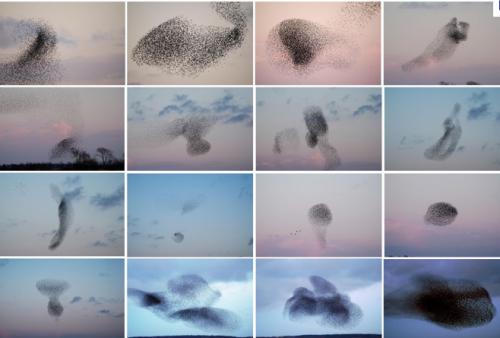
I did not take any of these photos. These are all flocks of blackbirds. This gives you an idea of what those roosting flocks can look like. If you've never seen a winter roost starling flock or a blackbird flock, it is a strange presence in the sky. It reminds me a bit of the eeriness of an Aurora Borealis. Here's another flock photo:
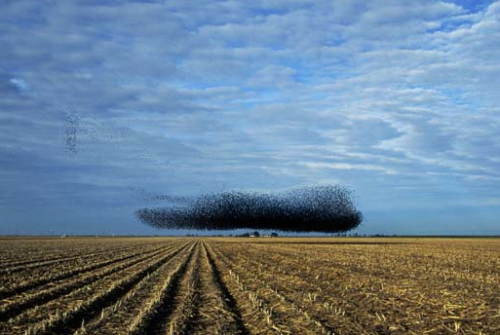
Again, I did not take this photo, but I found via Google Image Search. Look at how tightly packed those birds are. That is a group out during the day, in the wide open. They can move and swirl and function more as a whole without flying into each other in the daylight. At night, in a full blown panic, that many birds will run into each other. If they were roosting, they were probably low to the ground to begin with. If fireworks were going off overhead, they sure as heck would not fly up, they would try to fly below it. In the dark and in a panic, they'd run into each other, trees, poles and buildings.
Now, here is a photo of the dead blackbirds in Louisiana:
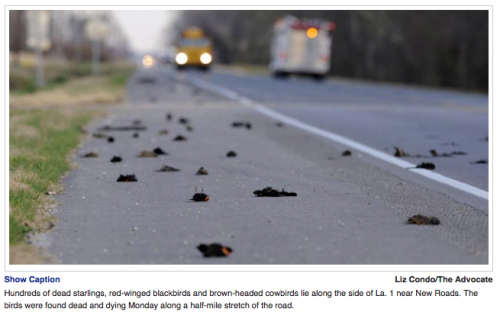
This photo is from The Advocate. Keep in mind how tight those blackbird flights can be. Now, note the blurred vehicles in the above photo. See the bus? I wonder if semis also come down this road. I think a flock of blackbirds flew hard into a large vehicle and died. It's happened before. I remember reading about a case in the 1990s. It doesn't even have to have happened at night. It could have happened at dawn or dusk. The startling factor for the blackbirds may not have been fireworks, but a Cooper's hawk. This probably would have gone unreported had it not been for the Arkansas story.
Mysterious things happen to large flocks of birds,they don't get quite the media play as this story did. Here's a story you may have missed about several hundred turkey vultures found floating just off the Florida coast near the Keys from last November. It's sad that we lost a lot of blackbirds. Is it cause for concern and should we try to find out the reason? Yes! Should we panic for the coming apocalypse? No.
And I end this with a starling flock video: crazy stuff:
[youtube]http://www.youtube.com/watch?v=XH-groCeKbE[/youtube]
Last night on Facebook people were posting vague links other possible die offs, but I could find no news organizations reporting on them.
Random Lineated Woodpecker
Going through photos of last year and I found a Panama woodpecker that I didn't post:
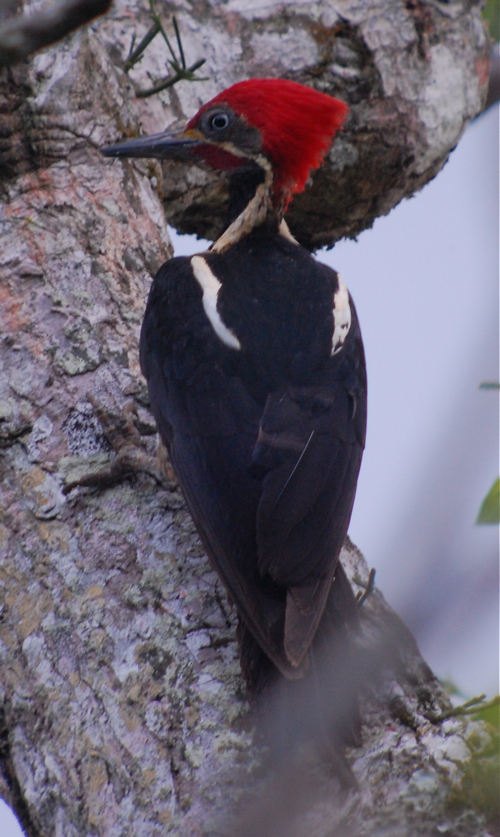
This is a Central American cousin of the pileated woodpecker and about the same size.
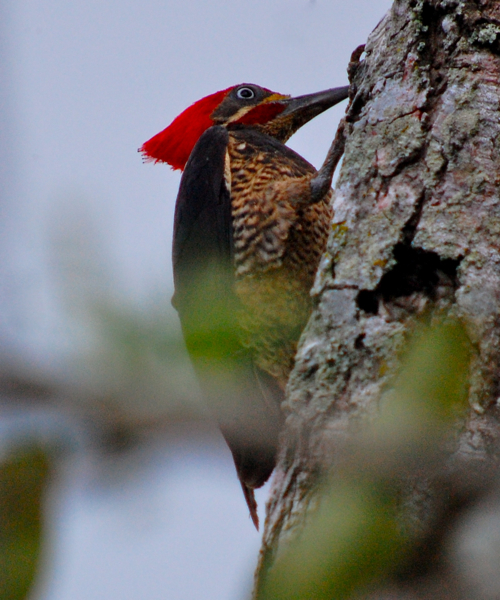
I ended up seeing them on field trips based both from Canopy Tower and Canopy Lodge. They weren't super common but, like a pileated, if you hang out a bit in the places they are most likely to be found, you'll see one.
Thousands of Dead Blackbirds in Arkansas
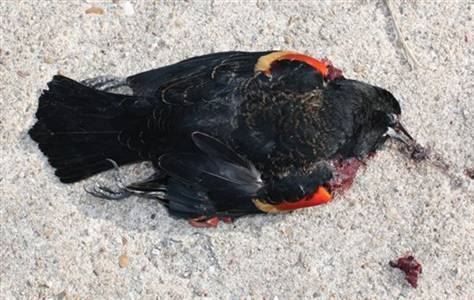 The news wires are buzzing with a story of thousands of blackbirds (mostly red-winged with a few grackles mixed in) literally falling from the sky in an Arkansas town on New Year's Eve.
The Arkansas Game and Fish Commission said its enforcement officers began receiving reports about the dead birds about 11:30 p.m. Friday. The birds fell over a one-mile area of the city, and an aerial survey indicated that no other dead birds were found outside of that area, officials said.
Commission ornithologist Karen Rowe said that similar events have occurred elsewhere and that test results "usually were inconclusive."
The birds showed physical trauma, said Rowe, who surmised that "the flock could have been hit by lightning or high-altitude hail."
The agency also said another possibility is that New Year's Eve revelers shooting off fireworks in the area could have startled the birds from their roost and caused them to die from stress.
It's doubtful the birds were poisoned, Rowe said, "since it only involved a flock of blackbirds and only involved them falling out of the sky." She said a necropsy is the only way to determine if the birds were poisoned.
This is an interesting incident. I agree with the ornithologist that since the birds fell in a concentrated area and appear to be species that would be in a mixed winter flock, something in the air happened and injured them. Could it have been lightening or hail from the storms that blew through? Arkansas was hit with tornadoes that night. Or could it have been fireworks from New Year's celebrations? I guess it will depend if they find burn marks on the birds.
This reminds me of the time I went to the first Ivory-billed Woodpecker Festival in Brinkley, Arkansas in 2006. When we arrived to set up our booths, there were huge flocks of thousands blackbirds all over the area which we thought was kind of cool. Their flocks would wheel and spin in the sky, forming fluid and temporary shapes in the sky. This was a wintering area for several icterids including red-winged blackirds, grackles and cowbirds. Some of the flocks were coming in to land on the trees surrounding the parking lot for the festival's meeting area at the convention center and we watched as they would dip onto the trees and take off for the sky again.
Suddenly, we heard some banging and I saw some young men with guns firing at the blackbirds landing in trees around the parking lot. The also set bottle rockets off towards them. We marveled that a festival would be so naive to think that birders would understand shooting birds outside of a bird festival. We were also baffled that they did not see the beauty of the blackbirds swarming in odd shapes in the sky.
I went to the festival's contact to talk to her about it. She was discussing last minute details with the mayor of Brinkley. I told her that she might want to curb the firing squad on the blackbirds because birders could take offense to that sort of thing happening at a bird festival.
The mayor leaned towards me and said in his southern drawl, "This ain't no blackbird festival, this is an ivory-billed woodpecker festival."
I tried to explain that birders liked all sorts of birds and would appreciate the spectacle of the multitude of blackbirds. Both were skeptical and explained that no one would care for the smell of the droppings or the mess of bird poop in the morning.
Well, birders did not find bird poop in the parking lot at the festival the next morning...they found dead birds littering the ground instead. Couple that with what appears to be a non existent woodpecker, you can see why that festival doesn't happen any more.
Here's a link to a great video of starlings coming in to roost on the trees. There are so many birds, the trees literally bend under the flock's weight.
2 Caracaras In 1 Year
Winter and lots of snow brings with it cabin fever. We have lots of modern conveniences that help ease that tension, like Netflix Watch Instantly and Amazon Streaming and alcohol! You don't have to go to a rental facility, you don't even have to wait for Netflix to arrive in the mail--you can have most any movie...even things you shouldn't watch like Dagmar's Hot Pants delivered right to your tv with the press of a button. But that leads to things like watching Inception several times in a row, which for me leads me to vexing states: either I need a more exciting job or I have no idea what reality I'm living in. Bwaaaaaa. But being cooped up is a great time to go through photos and put them in storage since I'm running out of space on my laptop. I have so many birds that I have not blogged! Holy crap, I completely forgot the caracaras!

One species was observed during the Rio Grande Valley Bird Festival at Laguna Atascosa. I remember looking at their images in field guides as a kid and thinking, "How cool would it be to see one of those?" They are one of the birds that attract me to Texas.

Man, stick a cigar out the side of this bird's beak and you could confuse it with Groucho Marx. I'm not sure if you can make it out in the above 2 photos, but there's a yellow bulge on the caracara--that's a full crop. These birds eat quite a bit of roadkill and will forage for insects too. Man, what must it be like to get a nice big fat food baby in the middle of your chest and then have to fly around.

I have to admit, it kind of grossed me out to watch the bird preening around the bulge.

The second species of caracara I saw in 2010 is a yellow-headed caracara on one of the field trips with Canopy Tower in Panama. I didn't get the weird crop/saggy yellow boob view on this one, but it was cool to see nonetheless.
So random bird blogging coming soon.

Golden Eagle Survey Time Again!
First, an interesting news story that popped up over the Holidays: According to a story in The New York Times blog in the last week a red-tailed hawk was picked up in New York and eventually made its way to The Raptor Trust. Turns out that the hawk is over 27 years old! I was curious if this was the oldest wild red-tailed hawk recovered in the wild...it's not. According to the Bird Banding Lab the oldest known wild red-tailed hawk was 29 years and 9 months old. Interesting was that this bird was also recovered in New York.
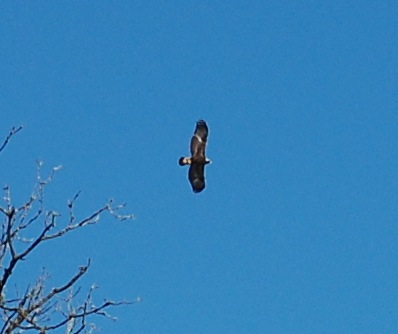
Since it's now officially winter, it's getting to be golden eagle season along the Upper Mississippi River. The National Eagle Center in Wabasha, MN will hold its annual Winter Golden Eagle Survey on January 15, 2011. The above photo is one that I took during the survey last winter. I took a route near our beehives and ended up finding 3 golden eagles. If you do not feel comfortable with your golden eagle vs immature bald eagle id skills, the National Eagle Center offers seminars to teach you how. These are helpful because they show the habitat you are more likely to find a golden eagle than you would an immature bald eagle. The next seminar is on January 8. If you are in the area, you should sing up. It's beautiful country in the winter and at the very least, you'll see lots of bald eagles, if not a few golden eagles.
Robins & Starlings Out My Window
All afternoon robins and starlings have been using a puddle on the roof across the alley as a birdbath. The robins are only using it for drinking, but the starlings are going hog wild and bathing up a storm. As soon as they finish, they head to a nearby chimney to warm up and dry off so I've yet to see any die right away. [youtube]http://www.youtube.com/watch?v=bvMnLHGZ2MU[/youtube]
January Birds and Beers at the Loring Crow Roost!
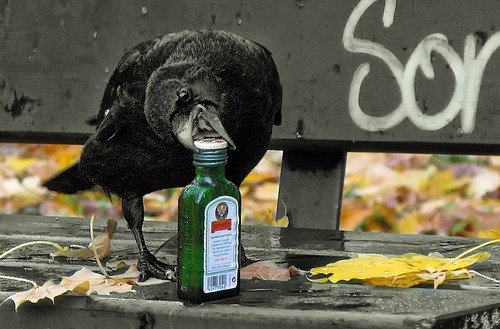 The next Birds and Beers is on January 22, 2011 at 4:30pm at Joe’s Garage. This is the one where we watch the millions of crows fly into Loring Park!
I'm looking forward to this one, the crows at Loring Park are a spectacular sight and last year's gathering was the biggest Birds and Beers we've ever had! The only downside is that we have to pay for parking for this event but we get a spectacular show in exchange. Birds and Beers is an informal gathering of birders of all abilities–if you’re interested in birds, you’re invited. You can meet other birders–maybe find a carpool buddy, ask about where to find target birds, share cool research projects you might be working on, ask a bird feeding question, share life lists, share some digiscoping tips, promote your blog–the sky is the limit. It’s low key and it’s fun.
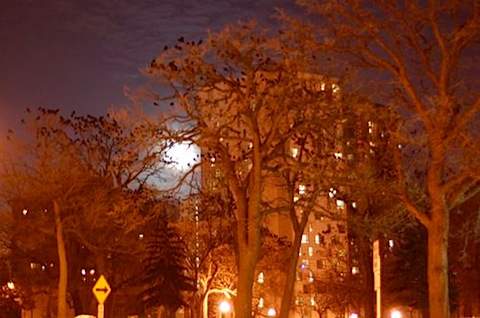
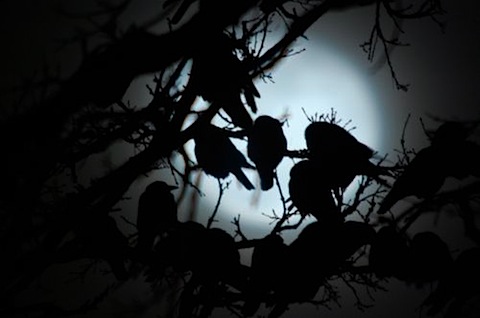
Non Birding Bill and I stopped by Joe's Garage the day after Thanksgiving to check out the crow roost and even took a moment to walk beneath the crows in the dark. Loring is a busy city park, these birds are used to a bit of pedestrian traffic. As we walked through, one of the flocks abandon their tree. For a second I was worried that we startled them but then NBB said, "That doesn't look like a crow..."
Sure enough, it was a great horned owl passing through the roost, no doubt looking for a vulnerable crow for a meal. Hope you can make it and again this is a great way to spend a Saturday afternoon and meet some new birding friends, promote your bird club or group.
Birds and Beers This Week
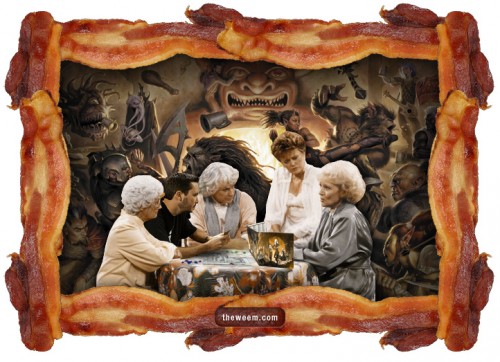 So, what does a bacon framed photo of the Golden Girls playing Dungeons and Dragons with Wil Wheaton have to do with anything. It serves as a reminder that tonight is the final night to see Non Birding Bill and me in the Golden Girls Christmas Carol at the Bryant Lake Bowl.
This is also a heads up that there is a Birds and Beers this week on Thursday, December 16, 2010 at 6pm at Merlins Rest. We can discuss the snow, the birds, the Ross's gulls popping up all over the US or the upcoming Christmas Bird Counts.
So, what does a bacon framed photo of the Golden Girls playing Dungeons and Dragons with Wil Wheaton have to do with anything. It serves as a reminder that tonight is the final night to see Non Birding Bill and me in the Golden Girls Christmas Carol at the Bryant Lake Bowl.
This is also a heads up that there is a Birds and Beers this week on Thursday, December 16, 2010 at 6pm at Merlins Rest. We can discuss the snow, the birds, the Ross's gulls popping up all over the US or the upcoming Christmas Bird Counts.
Speaking of CBCs, WildBird on the Fly had a very interesting post about alerting communities that those freaky people with optics in your neighborhood may not be casing your joint, but counting birds. It's a good idea. May be too late for this year, but for the future, consider writing letters to the editor of local papers warning about the counts.
Digiscoped Images
Fresh Tweets
Would you like to hire me as a speaker for your event?
Email sharon@birdchick.com