
Birdchick Blog
Snowpacalypse 2010
We got a wee bit of snow. We're still trying to dig out of it. After watching the feeding frenzy at Neil's on Friday, I felt certain that the weather folks were "for serious" when they reported one to two feet of snow was eminent the next day.

Saturday morning I woke up to seven inches of snow, with more falling. I would fill out my window feeders, only to have snow block the food ports ten minutes later. It reminded me of the time in 2006 when Cinnamon and I were stranded in a blizzard after the Sandhill Crane festival in Nebraska. At least this time we were home and not trying to entertain ourselves in a hotel room with nothing but an Irish/Mexican restaurant to feed us.

Non Birding Bill and I spent half the day moving cars before the Snow Emergency kicked in (for those who don't live in the Twin Cities, local communities declare a snow emergency and you have to pay attention to the parking rules or one of three things happen to you: you get ticketed, towed or plowed in). Above is a car entombed in a snow bank, the plows hadn't even gotten to this street yet, if they didn't get it out soon, they'd be plowed in and stuck for some time.

Our little car was blocked by a snow bank too, but between the two of us and a shovel, we got the Stiteler Mobile out. We even helped shovel the ally when one of our neighbors was stuck and she needed to get to a wedding.

Ah, this is the spirit of our neighborhood--take to the streets with your cross country ski gear when a blizzard hits! The side walks were totally impassable on Saturday. The only way to get anywhere was in the street, either walking or on skis.

Since we were spending show much energy moving cars, we spent the other half of the day eating. While I was bottling up honey on Friday, NBB was gathering supplies for survival during Snowmaggedon which included alcohol infused whipped cream. As tasty as this is on hot chocolate and an Irish Coffee, I find the warnings about not refridgerating it--even after opening, a little disturbing. What kind of cream are they using in there anyway?
And so we kept tabs on the news and learned of various highways closing, theater performances canceling, bus service was halted and even snow plow drivers were taken off the road because they were getting stuck. Some local bars sent out messages on Twitter that if you could walk to them, they would buy you your first drink. We met up with one of our neighbors at Moto-i for drinks and some appetizers marveling at how crazy it was to walk around a city almost completely shut down. Minneapolis usually is on the ball when it comes to snow removal, but getting 17 0 21 inches (depending on where you lived) was too much. And there are only so many places the city can put the snow.
We went to bed and when we awoke the next day, we got the news that the snow was so heavy, the Metrodome (home to the Vikings) collapsed. For my family who has not seen the video footage--here it is:
[youtube]http://www.youtube.com/watch?v=kh5iE5FA84g&feature=player_embedded[/youtube]
Holy crap!
I was supposed to work at the park service on Sunday morning, but learned that we would be opening three hours late. That game me plenty of time to dig out our car and help others in my neighborhood. When I eventually could drive to work, it was no picnic. It was about as much fun as getting a TSA pat down from Barney the Dinosaur. During the storm, the temps were in the 20s. After it finished, it plummeted to below zero, rendering most of the snow melting techniques used by the salt/sand trucks ineffective. It looked as though none of the streets had been visited by a plow in the last 24 hours.

This poor car owner that did not heed the Snow Emergency rules was so boned. Blocked by a snow drift one one side and plowed in completely on the other side. There is probably a parking ticket attached to the car windshield beneath the snow. The only reason this car did not get towed was that the tow drivers saw that it was too packed in with snow to be worth the bother.

The roads were so narrow from all the snow, that often only one car could fit. Everyone was trying to move their cars at once before a new set of Snow Emergency parking rules were about to take effect. If you were walking the streets with a shovel, hungover hipsters would accost you, "Dude, can you help me dig out?"
They stood before you in their pajamas in the -3 degree F temperature with their sad ice scrapers trying to dig out their no-wheel drive cars--how could you say no? Actually, that's one of the things I love about where I live. If you are out about after a hard snow and you see someone struggling with their car, you help--no questions asked. That's just what you do. One poor dope was stuck in the middle of the street. Four of us tried pushing his car but could not get it to budge more than six inches at a time. His wheels spun hopelessly in the snow while he was blocking traffic both ways. Finally, I decided to use my little Kia to push him to a street with less snow (that's what bumpers are for, right?). That did the trick and he was on his way to safer parking ground.

Not even bicycles were immune to the fury of the snow plows. Believe it or not, quite a few people ride continue to ride their bikes in winter up here. NBB and I saw a couple during the blizzard and a few on Sunday. I hope the person who owns this bike gets it out soon. The below zero temps will soon turn the snow banks into rock solid slabs of ice.

I marveled at all the robins in my neighborhood. We saw quite a few watching the birds at my feeding station during the storm, but none of them came to the window. We have quite a few hackberry trees loaded with fruit and that appears to be a big source of food for them this year. Still, even though the robins we see in winter are from Canada, I wonder if they wished they could go further south?

Here it is the third day after the storm and life is not completely back to normal. I realized with a grin that it's still technically Autumn and we haven't had the Winter Solstice yet. I do enjoy the snow and that's one of the reasons I chose to live here, but it will be interesting to see how this winter plays out.
Bayer & EPA Causing Colony Collapse Disorder With Clothianidin?
This is an interesting story and is not getting as much play as it should. It is the first news that has made me think we may have a serious idea of what might be causing bee colonies to disappear, commonly called Colony Collapse Disorder.

This is a must read--why? Because a pesticide called clothianidin was approved for use in the US in 2003 (this pesticide is banned in France, Germany, Italy and Slovenia). Colony Collapse Disorder was first on the Beekeeper RADAR in the winter of 2004/2005 and became a media headline in 2006.
A beekeeper by the name of Tom Theobald wrote an article for Bee Culture magazine this past summer about clothianidin. It is a pesticide produced by Bayer that is absorbed by plants and then released in pollen and nectar to kill pests. Basically, anything that pollinates can get a dose.
After the article came out, an Environmental Protection Agency employee contacted Theobald and told him that his article led to a study about the pesticide. He asked if could get a copy of the study and the EPA employee emailed it over . You can look at a PDF of it here.

Here are some interesting quotes from that memo that raised BIG RED FLAGS to me in several areas of my life:
As a beekeeper:
"Clothianidin’s major risk concern is to nontarget insects (that is, honey bees). Clothianidin is a neonicotinoid insecticide that is both persistent and systemic. Acute toxicity studies to honey bees show that clothianidin is highly toxic on both a contact and an oral basis. Although EFED does not conduct RQ based risk assessments on non-target insects, information from standard tests and field studies, as well as incident reports involving other neonicotinoids insecticides (e.g., imidacloprid) suggest the potential for long term toxic risk to honey bees and other beneficial insects. An incident in Germany already illustrated the toxicity of clothianidin to honeybees when allowed to drift off-site from treated seed during planting."
"This compound is toxic to honey bees. The persistence of residues and potential residual toxicity of Clothianidin in nectar and pollen suggests the possibility of chronic toxic risk to honey bee larvae and the eventual instability of the hive."
As a birder:
"This compound is toxic to birds and mammals. Treated clothianidin seeds exposed on soil surface may be hazardous to birds and mammals. Cover or collect clothianidin seeds spilled during loading."
And can I point out as a birder who loves hummingbirds, which are a native pollinator--are they affected by this too??
As a fishing enthusiast:
"This product is toxic to aquatic invertebrates. Do not apply directly to water or to areas where surface water is present or to intertidal areas below the mean high-water mark. Do not contaminate water when cleaning equipment or disposing of equipment washwaters. Do not apply where runoff is likely to occur. Runoff from treated areas may be hazardous to aquatic organisms in neighboring areas. Apply this product only as specified on the label.

What do we need to do? Get the EPA to recall this pesticide now! This is not a matter of "Oh no, Neil and I might lose our cute bees," this is a matter of, "Holy crap, this affects the world wide food supply!"
Banded Birds At My Bird Feeder Camera
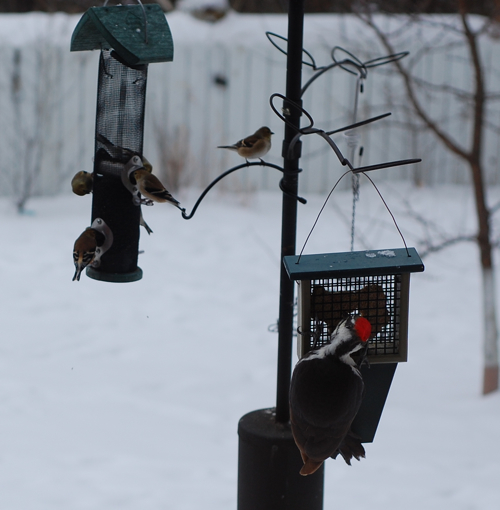 In case you have not heard, we're buried under an old school blizzard dumping up here. The local weather folk were predicting with barely restrained glee the potential for a massive storm. And though many of us have heard in the Twin Cities that we could get 1 - 2 feet of snow, many of us eyed this impending Snowmaggedon with skepticism. It often amounts to only a few inches. But to to be safe, I head out to Neil's for some last minute honey bottling finished--I need to get some together to mail to family for the holidays. I generally use birds at the feeder as an indication if the weather predictions are true. On Friday all feathers pointed to us getting seriously slammed on Saturday. The goldfinches were draining the thistle feeder and even the pileated woodpecker chowed down on the suet feeder closest to the window.
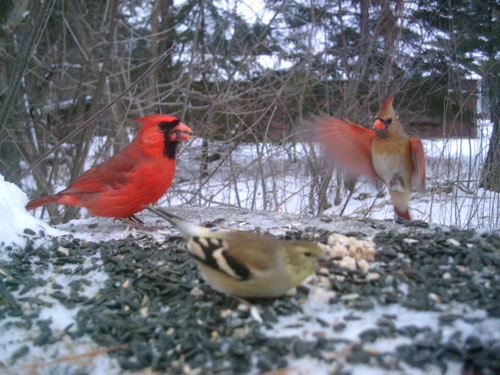
While I was dealing with the honey (more on that later), I set up my WingScapes Camera out on a stump and covered it with some bird food. Above is a male and female cardinal along with a winter plumage goldfinch.
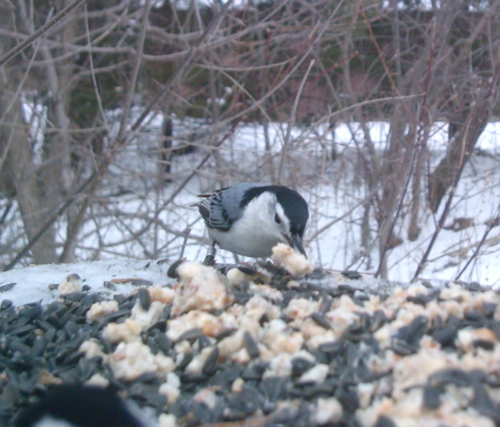
Check out this ambitious white-breasted nuthatch! Besides black oil sunflower seed, I crumpled up some peanut suet and the nuthatch was grabbing one of the larger chunks. I also noted the nuthatch was banded. Most likely the handy work of my buddies Mark and Roger who come out to band birds twice a year. There were quite a few banded birds coming in to the cam:
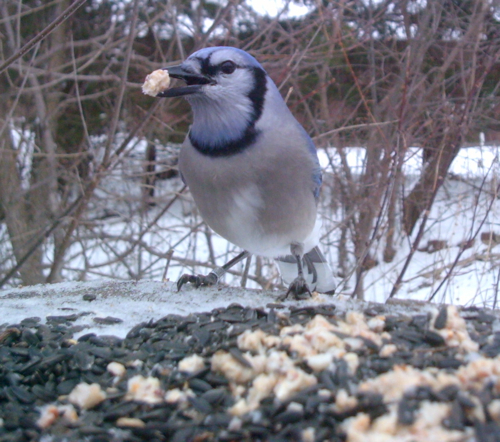
Here's a banded blue jay--I think it's been a few years since Mark and Roger got one of these in the nets, so this bird could be a few years old. Can't say for sure, since I can't read the band number, I can't say for sure. It could even be someone else's banded bird.
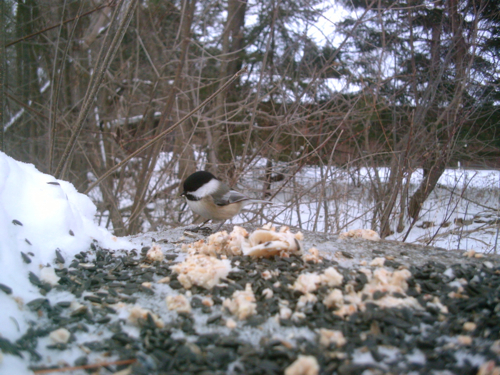
Here's one of several banded black-capped chickadees. Are they all photos of the same banded bird or several banded chickadees coming in to the seed, each taking a turn?
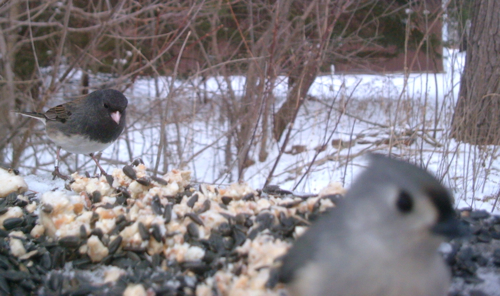
Here's a banded dark-eyed junco. With the dark gray head and the brown on the back feathers, its looks like a first year junco, probably banded this fall.
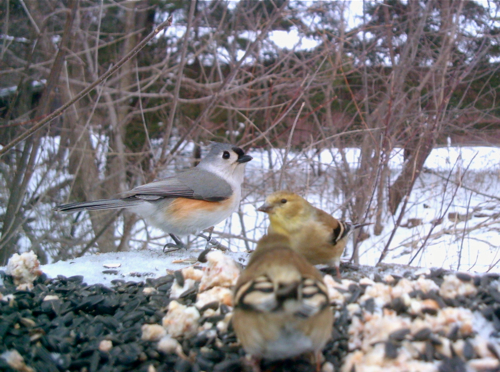
And here is a banded titmouse. It's nice to see all of the banded birds surviving and still coming to the feeding station, despite the nets going up twice a year.
There were a few other interesting photos that the cam picked up:
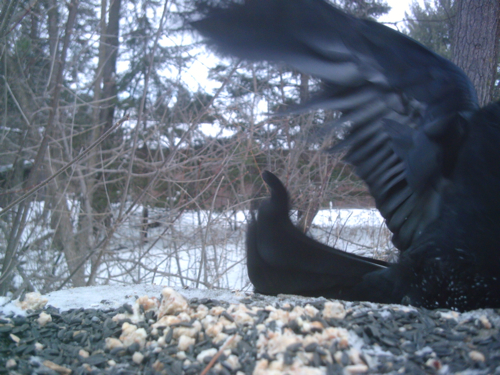
I find that crows are the hardest birds to capture on a motion sensitive camera. This crow was watching the other birds go after the suet and it really, really wanted it. It watched the stump for about ten minutes, trying to work out what the camera was all about. After watching dozens of smaller birds go down for the suet, it tried. But as soon as it landed, it bounced off the stump. I wonder if it can hear the digital camera go off? Can it see some change in the shutter? It never grabbed any suet and it never returned to the stump--which suited the smaller birds just fine.
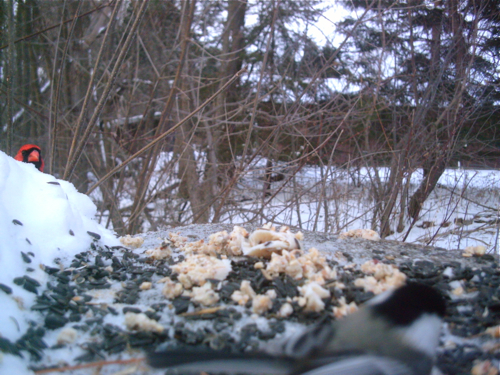
This photo cracks me up. It looks like the cardinal is totally planning to ambush the chickadee.
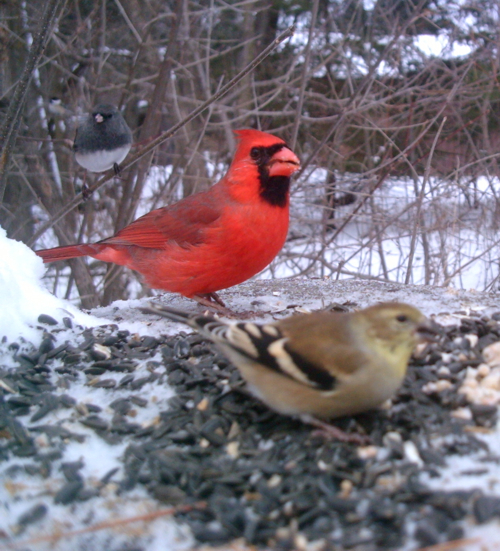
These are just a small fraction of the hundreds of photos my Wingscapes Cam grabbed that afternoon. The birds didn't lie, we got slammed with snow. Even though the storm was Saturday, I can hear a semi truck in my neighborhood squealing it's tires as I type this. It's been stuck in a bank of snow for the last 45 minutes. Minneapolis is pretty savvy when it comes to snow removal, but this one came so fast and there's only so any places that a city can put it, we're still a few days away from normality.
Mom, I'll post photos of our neighborhood later
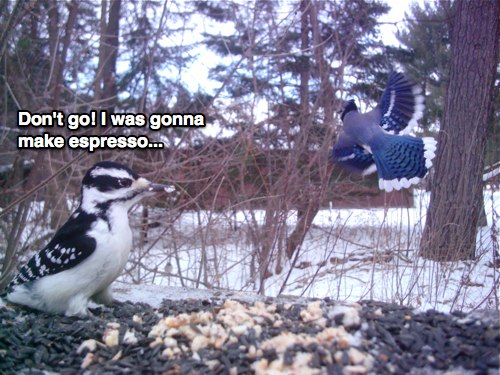
Blue Jay & Hairy Woodpecker Interaction
Well, we're about to get Snomaggedon in the Twin Cities this weekend (12 inches with blizzard conditions). The birds are going bonkers at the feeders so I set out the Wingscapes camera to grab some images.
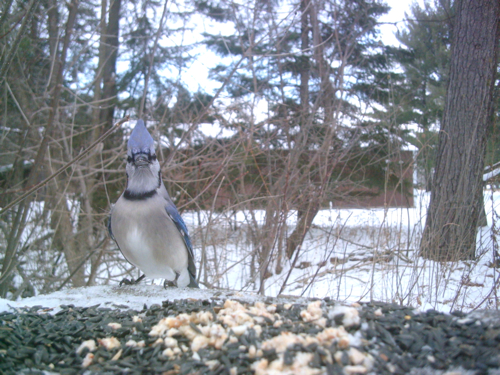
The jaunty blue jay is loving the crumpled up peanut suet mixed with black-oil sunflower seeds.
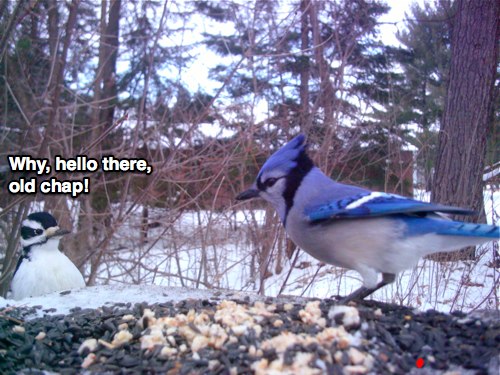
And then he is joined by a hairy woodpecker.
Buy A Duck Stamp Now! It's a great gift
Hey Minnesota--this story from Outdoor News is troubling: "Hunters this year bought fewer state duck stamps than they ever have before.
As of earlier this week, the DNR had sold just more than 87,700 stamps. While the goose season still is open, it's unlikely hunters will buy enough stamps to match the previous low sales point - 89,228 in 1988."

Birders, bird lovers, bird enthusiasts, nature lovers, fishermen, beekeepers, tree huggers, botany lovers, shroomers, nerds, geeks, countrymen...we MUST not let that happen this year, this can't be the lowest year for the Minnesota Duck Stamp. The Duck Stamp is not just for hunters and if fewer hunters buy it and no one else picks up the slack, the stamp will be done away with and all of us who enjoy walking in natural areas will lose out--especially all the critters who use them.
Why is the Duck Stamp so cool?
The Minnesota State Duck Stamp is similar to the Federal Duck Stamp. Birders and others who care about wildlife and wetlands can help protect habitat by purchasing Minnesota waterfowl stamps. Improved waterfowl habitat naturally benefits cranes, bitterns, warblers, and other species too--think of all the animals and plants that are found where ducks are found. The Minnesota DNR says that state duck stamp dollars (about $750,000 annually) pays for about 17% of the waterfowl habitat work done by the DNR. The money goes to things like water-control structures and eliminating rough fish, as well as waterfowl research, including aerial waterfowl surveys (you know, those things I do up in the plane in the fall).
So, if you have to do any gift giving this year and don't know what to get someone, consider a Minnesota Duck Stamp or a Federal Duck Stamp. They're perfect for anyone who enjoys the outdoors. You're not only giving the stamp, but you're also giving a gift of conservation.
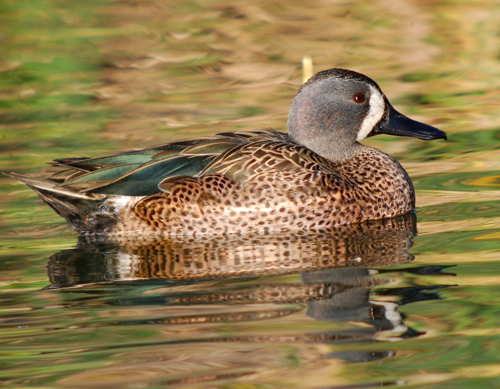
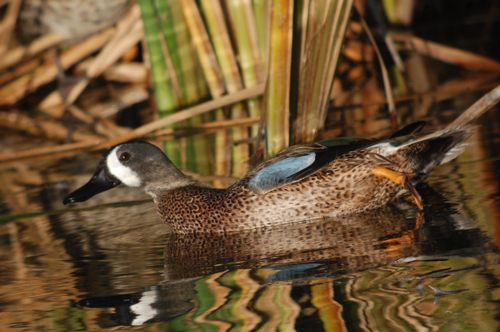
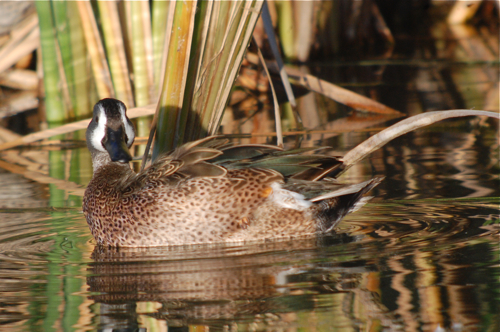
Gratuitous Grebes!
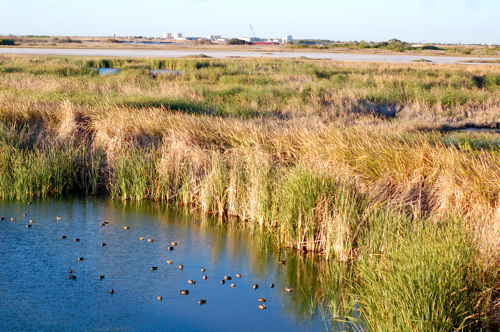
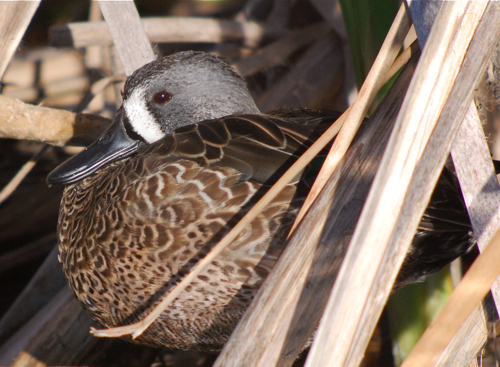
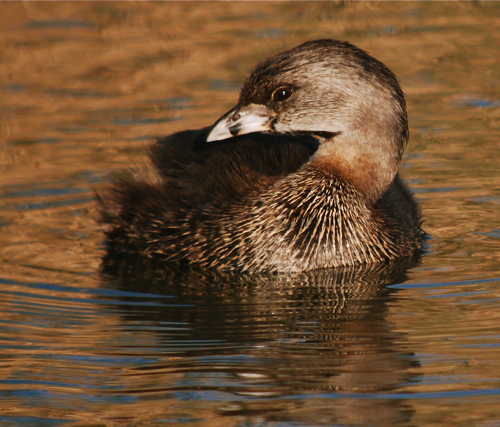 One thing I love about visiting southern states is that some of the birds I see in Minnesota are so much more camera friendly. Pied-billed grebes are shifty in Minnesota, they don't trust anyone staring at them for too long or they submerge and resurface further away. While in Corpus Christi, my buddy Clay took me to a place with a ton of great waterfowl and some rather obliging grebes. The above bird is an adult pied-billed grebe.
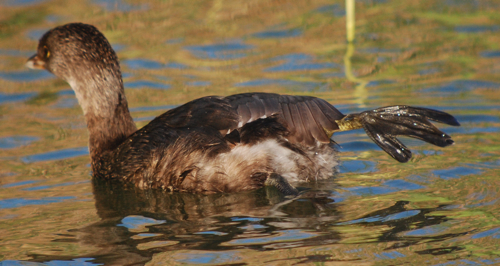
They even showed me their grebe toes. How do you like them apples, not webbed like a duck at all. Let's get a closer look:
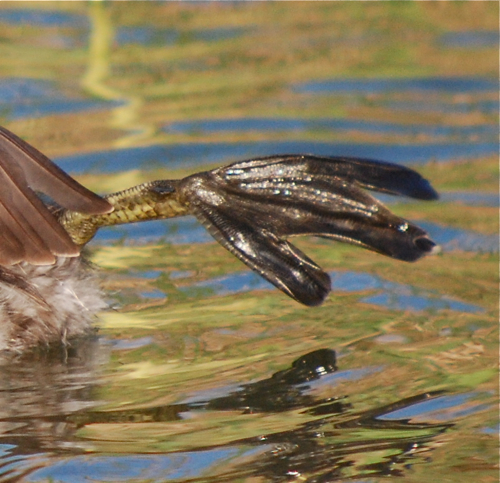
Look at that crazy foot...wonder if this will lead to a slew of foot fetish comments getting clogged in the blog spam filter? The feet of the grebe are far back on the body and the lobed toes do aid it as it swims underwater. They really can't walk on land very well. Ask yourself if you have ever seen one on land?
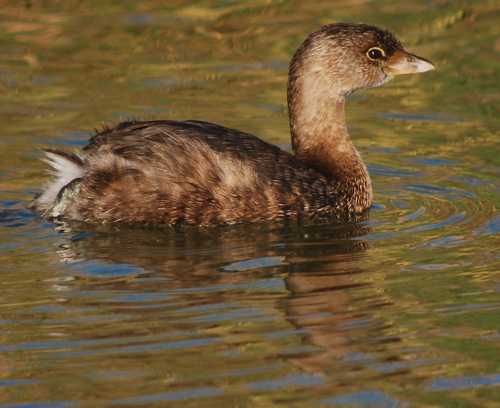
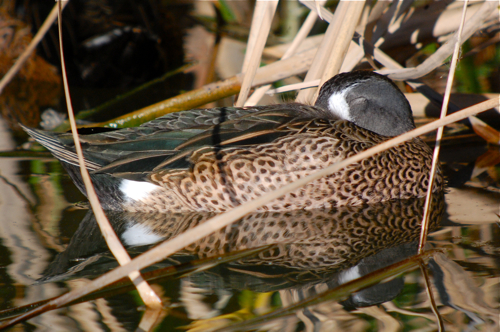
Here's a first year pied-billed grebe--it barely has any pie on its bill.
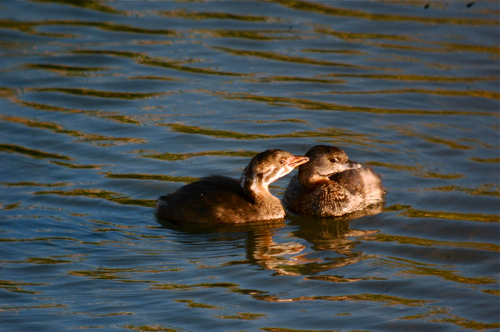
This grebe was so young that it still had the stripes on its face and was begging for food aggressively from its parent.
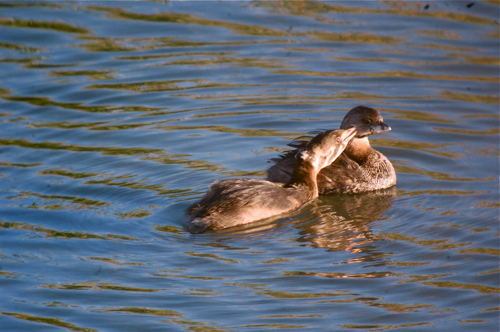
The adult bird was trying to preen its feathers, but the younger bird pecked and pecked while peeping in a high pitched tone incessantly. Periodically the adult would nonchalantly reach down, grab a minnow and hand it to the begging young and then go back to preening. I wonder how the adults teach the young to get their own food when the young are this aggressive when they are about the same size as the adult. Perhaps the adults just flee in terror of the incessant begging?
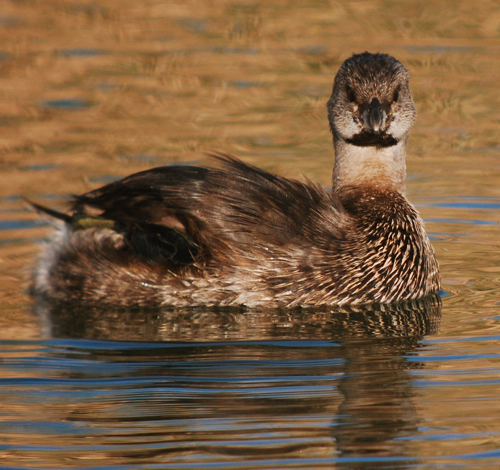
Anyway, it was fun to spend time with brown birds with freaky toes.
Big Year Movie News & Rumors
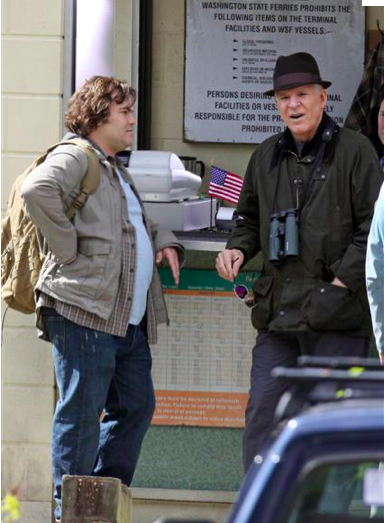 I had a very interesting day tracking down information about the movie The Big Year (the movie based on the book with the same name about 3 guys who try to see the most birds in North America in one year) starring Jack Black (above), Steve Martin (above) and Owen Wilson.
First, let's clear up some gossip that was making the rounds on the bird festival circuit this fall.
1. The movie will open July 4th weekend in 2011. According the movie's publicist, there is no release date scheduled as of today. And I believe that, because last night I got the following email from someone I will call a Henchman of my National Secret Network:
"I just saw the movie, The Big Year in NYC. It was a focus group. I never heard of the movie prior to tonight, and I know nothing about birding. Steve Martin was at the showing. If you'd like to ask me any questions, I'd be happy to answer. I googled the movie and saw your website."
More on that later in this email (WARNING THERE MIGHT BE SPOILERS).
If the production company is doing focus groups, they are deep in editing and wouldn't come up with a release date until they got a sense of how the movie would work with audiences.
2. And this rumor is a Doozie: Debra Shearwater of Shearwater Journeys is suing the production company over something to do with the film, most likely her portrayal in the movie by Anjelica Huston.
NOT TRUE. I sent Debi a message telling her what I had heard (which I was surprised because I had heard how excited she was about the production). According to Debi, "There is no chance of this rumor being true!!"
Big Year publicist knew nothing of it either.
Now...let's get back to the email I received from my Henchman...and again, there may be spoilers in here so if you want the movie to be a total surprise, stop reading. If you've read the book, you kind of know what happens and this fills in actors with characters in the book (and not in the book). So here we go with the Henchman's notes:

General Movie:
Henchman said, "I would describe the movie an informational dramedy."
Birds looked real except for one owl that appeared to be CGI (and that they were still in the process of editing it, it was black).
Jim Parsons plays a blogger who tracks the three main characters on his blog called Ichabod Crane.
John Cleese narrates the movie and subtitles are used to give bird info throughout the movie.
A big part of the drama was keeping the fact that all three were doing a big year secret. Almost every birding scene involved small groups of background actors doing the same. They discussed the weather and the "fallout" from El Nino a good bit.
A birder takes his new wife to Attu and she expects it to be a an exotic getaway (oh, how many non birding spouses have fallen for that one?).

Steve Martin is playing the Al Levantin character in the book. I have heard from other sources that the characters will not have the same names as they had in the book. I'm sure it has something to do with not having to get permission from the actual people they are based on.
Steve Martin's character reminded Henchman of the CEO in the movie Meet Joe Black, except he didn't care what happened to the business he created. He was just ready to move on in life and birds.
Martin's character doesn't have many of the jokes, but the woman playing his wife is funny (I think that is JoBeth Williams). He's constantly pestered by employees of his company while he's out birding--even when he's on Attu--yes, Attu is in the movie.
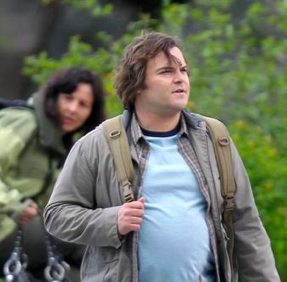
Jack Black is the Greg Miller character.
Jack Black's character can id any bird by sound and is tested on this quite a bit. His father is played by Brian Dennehy.
Jack Black's love interest was shown to be the only person involved for the love of birds (which I believe is played by Rashida Jones). Of course they all love birds, but the competition was priority number one. Her life list is less than their year lists.
Black's character gets most of the jokes.
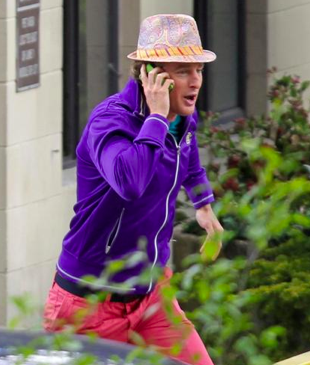
Owen Wilson is the Sandy Komito character.
His nemesis bird is a Snowy Owl, he keeps missing it.
According to Henchman, Wilson's best scenes are with Anjelica Huston when he starts a mutiny on her boat because he wants to go for a bird and she steers it towards a whale instead. She wasn't in the movie enough.
Owen's character is married and his wife is pregnant, but birds come first for him and the wife and baby come second (I think his wife is played by Rosamund Pike).
So, a big thank you to my mysterious Henchman who fed me his notes on the movie. One final thing he said was that the first part of the movie was slow, the last two thirds moved faster. He found it good and that birders will probably get more out of it, "I think you will love the movie while I thought it was merely "good" because I was expecting so much from that cast."
Hooded Crows vs Cats with a Twist #birding
Perhaps tired of the slowness of the Cats Indoors campaign to take hold, a pair of hooded crows appear to be starting some you know what with cats: [youtube]http://www.youtube.com/watch?v=PNqNfxo42J8[/youtube]
I love the Predator soundtrack that was added to this video. This may become a meme, as I see that someone has also put this video to the music of West Side Story. I applaud the hooded crows and see this as further proof of corvid intelligence. If humans are not going to stop the scourge of cats killing birds for "play" it appears the birds have begun pitting the cats against each other. Brilliant! Well played, hooded crows, well played.
Stokes Field Guide to Birds of North America
There are some new photographic field guides coming down the pike, one is the newly available Stokes Field Guide to the Birds of North America by Donald and Lillian Stokes. I've sat with it for a few weeks to get to know it before I gave my review.
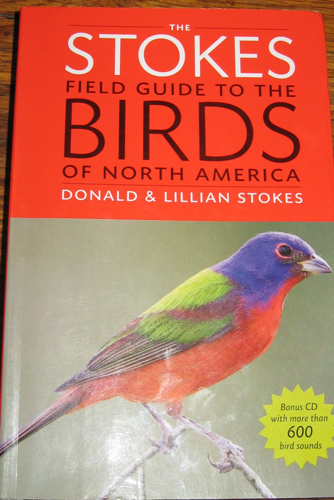
So here it is, if you are a fan of photographic field guides--you'll really like this guide for reference. If you are dedicated to using illustrated guides, you will not care for it. Birders seem to be divided on this issue. Growing up, I always preferred photographic guides. I think my issue is that illustrators pose the birds in a way that you can see as many filed marks as possible on the bird and birds are rarely that cooperative in the field. There's something about a photo that communicates posture, shape and color very clearly to me that an illustration cannot. I think it depends on how your brain works. But the Stokes Eastern Guide was my preferred field guide growing up. I liked it better than National Geographic or Peterson.
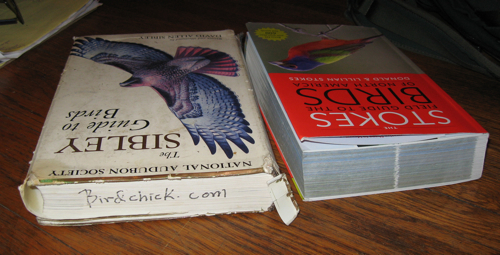
The one downside that people might find with this guide is the size--it's bigger and heavier than the Sibley guide making it unwieldy in the field. Some birders would argue that you shouldn't be taking a field guide out birding with you anyway because you'd spend too much time with your nose in a book and not enough time studying the actual bird in front of you. So, it's sheer size and weight will make you want to keep it at home.
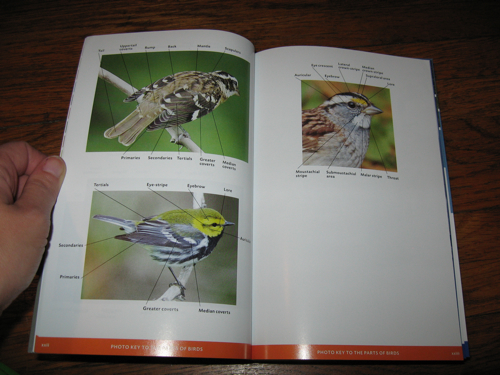
You get a lot of great information and photos for the weight. The photos are fantastic and a marked improvement over the previous guides put out by the Stokes. The front is especially helpful using up close shots of birds in various poses to teach the reader about bird anatomy and what the authors are talking about when naming field marks.
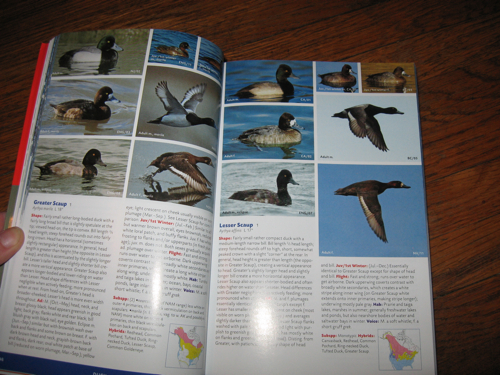
The Stokes did a great job of using the photos for comparisons of difficult birds like greater scaup versus lesser scaup. I especially appreciated the field marks shown on the wing, as this is what I need when we do our aerial surveys. This
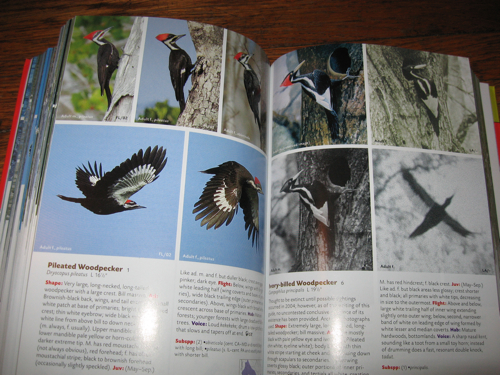
They even went the extra mile and included a colorized image of an ivory-billed woodpecker next to the pileated woodpecker. This is definitely the most comprehensive photographic guide available. The guide includes 853 North American bird species (unlike the previous guides which were divided into Eastern and Western regions) and also includes a CD of bird calls of 683 species in the book. It's incredible how much birding bang for your buck you can get in a field guide now. To get all of this info in the year 2000, I would have had to have purchased both the guides and the separate CDs for each region totaling close to $80. Now, I can get it all packed in this guide for $24.99 or less. Amazing.
This is a very good guide, I do not know that I would call it revolutionary. Revolutionary would be turning this book into an iPhone or iPod Touch app or even better, I'd love for this guide to be available on an iPad. This book might be intimidating to a new birder, but for someone who already has their toes in the water with a state birding guide, this would be a good "next step" guide. This is also idea for the hardcore birder who is forever searching for another guide to use as reference--you can never have too many field guides.
Digiscoped Images
Fresh Tweets
Would you like to hire me as a speaker for your event?
Email sharon@birdchick.com