
Birdchick Blog
Bison & Lazuli Buntings
For some reason, buntings are a hard bird for me to get. Both painted buntings and lazuli buntings were always fluttering out of sight just before I would arrive to see one. A common phrase, "Oh a whole flock just flew past here like five minutes ago." I finally got painted a couple of years ago in Florida but the lazuli seemed intent on pouring salt on my wounds. When we went to Las Vegas to make bird videos, Non Birding Bill saw one and when he pointed it out, the lazuli bunting flew away and all I saw was a small bird flashing blue. Gr.

When I was at the Great Salt Lake Bird Festival this past spring, word on the street was that a flock of lazulis were hanging out at feeding station near the barn on Antelope Island State Park. I consulted Bill Thompson about this and he gave good directions. I had a tough time finding the exact location of the feeder, it was sort of hidden away in some trees. There was the above bison pen nearby but the beast was fenced up so I could keep my ungulate phobia in check. I was getting the old ungulate stare down though. That's right, bison, I'm just going about my birding business, you stay there.

The feeders were absolutely dead. There was a sprinkler nearby and some birds were using the water source. I decided to stake myself out among some bushes, set up my scope and camera and hope for the best. I figured that this would be another opportunity to NOT see a lazuli and concentrated on the few birds that did come in like the above white-crowned sparrow. Suddenly, a large flock of pine siskins descended on the feeder and I aimed my digiscoping set up on them. The feeder was in the shade and it wasn't easy to get photos, but digiscoping passed the time as I waited for a lazuli.

And then magically among the siskins was a lazuli bunting! As soon as I got this shot it took off. As it flew, I heard chip notes and then the same chip notes from other buntings in the trees above me. More were around and I'm sure this little migratory flock couldn't resist coming down to this food source. So I waited.

And in about 10 minutes, a flock of lazuli buntings were on the ground. It was a challenge getting any photos because the birds were in the shade and my camera didn't want to give me the shutter speed I needed. So I played around and used the timer.

And I did manage to get some fun shots. Note the tiny white millet seed on the tip of the beak of this male? Most birding feeding guides say to not use millet or at least not very much, but colorful buntings are one of the few species of birds that really, really like it and it's worth having a bit in your seed mixes during the spring and fall migration.

As I was living la vie da lazuli, I suddenly heard a heavy "thump, thump, thump" and it sounded like an ungulate in full trot mode right behind me. I turned around to the sound and discovered...

The bison that was in the first photo of this post was now very much out of the pen and trotting around behind me. It started trotting right at me, then turned and went the opposite direction. I tried to take a shot as it headed towards the left of the barn (you know, one of those last known photos they could find in my trampled camera next to my trampled body). The bison pretty much went in the direction I needed to go in order to get back to my car. I stayed where I was, heart pounding and recalled the video of the woman who got charged by a bison because her idiot brother-in-law threw a stick at it to get his attention. I wouldn't do anything like that, but what if I inadvertently startled it? I've said it before and I'll say it again--large ungulates make me nervous and I really don't think my Sand People technique of startling cows would work well with a bison. They are unpredictable and it's really just a matter of time until they realize how big they are and stampede the heck out of me. I went back into the trees to stay out of the bison's line of vision and debated with myself on how to get out with a rogue bison on the loose. I soon saw one of the Antelope Island rangers and went up to here, "Uh, your bison is on the loose!"
I was also going to ask for a ranger escort back to my car but she said, "Oh yeah, he's fine, it's feeding time."
I was not going to get a ranger escort back to my car. They have signs all over this island that read, "Stay away from bison" and so I found her mellow attitude about the loose animal unnerving but I also realized that I have a larger fear of bison than most and decided to man up and walk myself back to the car. I didn't encounter that particular animal...but...

...my bison encounter was not over. Bison roam this island and on the road back to the exit, a small herd was grazing along the side. I slowed and the bison decided to cross. I had to get a shot of how close this one was to the road--see the mirror of my rental car on the right hand side? I slowly drove past, the bison watched me and I assumed the sort of upright posture most drivers do when passing a police or sheriff's car that says, "No, sir, I'm not speeding, I'm a good citizen."
Small price to pay I guess for finally getting my lifer lazuli bunting.
Merlin vs Red-bellied Woodpecker
Non Birding Bill and I were over at Mr. Neil's to do some fall beehive prep (for those who follow, the bees seemed to take my Ned Stark speech well and all but one of the hives actually bumped up production). After we finished checking the hives we were back in the house surfing the net, dealing with emails when I heard a heard a sound. "Distressed woodpecker sound," my brain noted as I read an email. Then my brain kicked me, "DISTRESSED WOODPECKER SOUND! RAPTOR! ALL HANDS ON DECK!"
Then it sunk in--"Holy cow, look out the window, stupid!" I turned to look out the window and saw a small raptor gliding away with a red-bellied woodpecker. I figured the raptor was most likely a male Cooper's hawk or a female sharp-shinned hawk--both a fairly regular bird in Mr. Neil's yard, especially during migration. I dashed to the front room and was shocked to see...

...a small dark falcon killing a large woodpecker. "Holy crap! It's a merlin," I shouted...well, I'm sure there was more profanity than that but you get the idea. Falcons have a notch in their bill that they use to sever the spine from the head and kill prey fairly quickly. The merlin went in for a bite, but she had to go in for a second to really put the woodpecker out. While she did that, I scrambled off for my digiscoping equipment.

Look at that face! She's so adorable--Nature's Perfect Killing Machine! You can even make out those little malar stripes under each eye that all falcons have! I digiscoped this photo of her after she killed the woodpecker. It's not as in focus as I would like, but I was shooting through an old farmhouse window and my scope picks up imperfections in window glass. I didn't want to open the window because this small falcon had worked hard for her kill and I didn't want to risk flushing her off her food. This is the first time I've seen a merlin in Mr. Neil's yard. This bird is possible for the area, but mostly as a migrant. If she was on a long journey to migrate south, she needed a good hearty meal and my need to get a perfectly in focus shot was not as important as her need to get nourishment.
She was fairly close to the driveway with her kill and I noticed a car coming down. She mantled a bit over her kill but didn't fly away from it. I heard voices and noted that Non Birding Bill, Mr. Neil and the newly arrived Steve Manfred hadn't followed me into the front room to watch the merlin. I shouted, "Hey, you guys really need to come see this, this is a really cool bird!" Again, the "really" in the previous sentence was most likely profanity. They soon followed and had to concede a merlin with a red-belly was pretty badass. Cameras started clicking and both Neil and I got photos. I immediately called this bird a "she" and Neil asked why. First, in raptors females are larger than males. Based on this bird taking out a red-bellied woodpecker I knew she was female. Now, merlins are one of the few raptor species where you can tell male from female apart based on plumage. Females are brown on back and males are blue:

These are a couple of males that we trapped up at Frank Taylor's banding station in Duluth. See the blue on the wing feathers? That's male. This gets tricky in young birds. Merlins hatched this year will be brown on back--both male and female. That's where size comes in handy.

Here's a shot that Mr. Neil took of the merlin. Note how all the feathers on the back are uniform? They all look like they grew in at the same time--that's something you would only see in a bird hatched this year. Adults would still have some molting going on and you'd see worn, older feathers mixed in that would be a slightly different color. The tail has some light colored bands through it. The look tawny or buff. If this were a male, those bands would look gray. Again, females are larger than males and this small falcon took out a red-bellied woodpecker--it's large, she's female.

This is another shot Mr. Neil got with his camera. I had to chuckle because the woodpecker looks almost "cartoon dead." See the tongue hanging out of the beak? The only thing missing is the little "X" over the eye. Note the size of the red-bellied woodpecker next to the merlin--I've had both in hand and always thought of them to be similar in size. I decided to do a little digging on the Internet on merlin size vs red-bellied woodpecker size.
According to Cornell Lab of Ornithology's All About Birds red-bellied woodpeckers are about 9.4 inches long, have a wingspan of 13 - 16.5 inches and weigh about 3 oz.
- Merlins are 9.4 - 11.8 inches in length, have a wingspan of 20.9–26.8 inches and weigh 5.6 - 8.5 oz. Figure that the smaller numbers are males and the larger numbers are females.

- So according to Cornell, a male merlin could be about as long as a red-bellied woodpecker. This is another photo taken by Mr. Neil from the second level of his house. Here you can see that the merlin is larger than the woodpecker, again identifying her as female. What was interesting was that most of the birds left her alone. There was some mobbing noise from a hairy woodpecker and goldfinches, but no blue jays came in to scold. A few crows did and the merlin did not like that at all.

- She stopped eating and watched them. The crows didn't caw like crazy at her like they would an owl or larger hawk. They cawed but not as frantic, as if not wanting to provoke her but let each other know, hey Nature's Perfect Killing Machine Down here. I've seen merlins chase the heck out crows and even heard of accounts of merlins killing crows to take over a nest site. They will go for something larger than they are and if any small raptor is capable of getting the job done, it's a merlin. She watched them for several minutes and then to my surprise, took off with the woodpecker in her talons and dove at the crows. I watched her bank to some trees and tried to go out to follow where she landed to eat but lost her completely.
- I had hoped if I found her that I could see the woodpecker carcass she finished eating to see if the woodpecker was banded. Sometimes friends of mine come out to band birds here and have ringed a few red-bellies. It would have been to fun to have that as a banding record. If the woodpecker was banded we would had an idea of her age and a notation of the really interesting way to die. I mean, getting killed by a merlin is one of the coolest ways to go. As I was editing photos for this blog entry, something caught my eye:

- In one very crappy photo that I took, I noticed that the merlin was banded. Noooooooooooo! Why didn't I get more photos of her foot to id the band number? BLARG! Based on where Mr. Neil lives this is most likely a bird banded at Hawk Ridge this fall. She was hatched this year so there are only so many raptor banding stations north of here. There is a chance that my buddy Frank Taylor banded her, but I'm not sure if he's had a merlin in the nets yet this year. Most likely a first year female banded on her migration south. Without the number we will never know for sure but I'm curious of my buddy Frank Taylor or Hawk Ridge has banded any hatch year merlins because chances are good, she is one of their birds.
- Man I love unexpected merlins but to have one make such an interesting kill and be banded just really made my Thursday.
Flicker Shenanigans With A Kestrel
I was out and about doing bird surveys yesterday and I got to watch an interesting interaction between a small falcon and a large woodpecker.
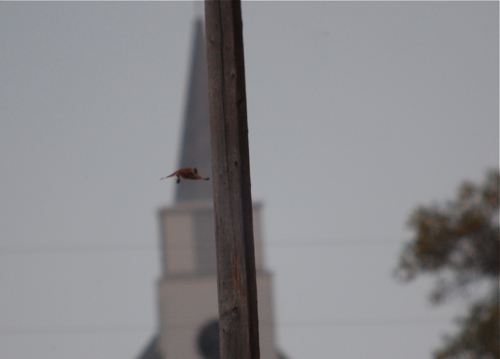
Here's an American kestrel, minding her own business, hovering and looking for mice with leaky bladders or whatever to eat.
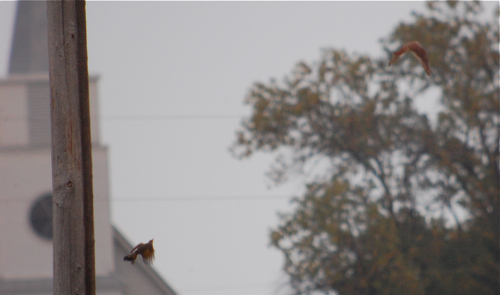
There were lots of northern flickers moving through during my survey. Most tried to avoid predators. Multiple visits to Hawk Ridge during the hawk migration has taught me that at the end of the day, flickers have a body built for food that many hawks like to eat. I guess this flicker was feeling his Wheaties and went in to hassle the hovering kestrel, vengeance for fallen and eaten brethren?
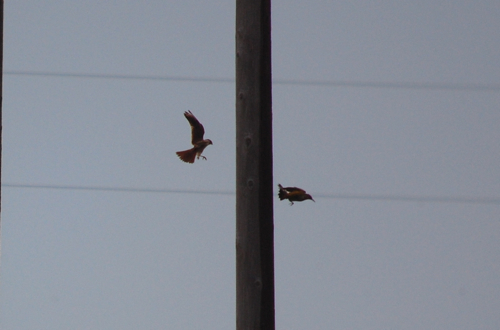
After getting properly buzzed, the kestrel did an about face and went for the flicker. Both are about the same size and I think if the kestrel had been a Cooper's hawk that the flicker wouldn't have engaged in any mobbing shenanigans.
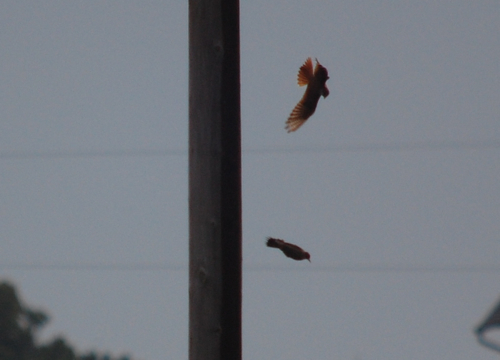
Again, these aren't the best shots in the world, I digiscoped them at 400 meters. But had fun watching the behavior. The birds chased each other for at least five minutes (could have been longer, but I had to move on to my next survey point), sometimes the flicker was chasing the kestrel and at other times, she was chasing the woodpecker. Periodically, both would perch on the same wire--sizing the other up?

Barred Owl On The Bike Trail
On Saturday Non Birding Bill and I were taking advantage of the beautiful weather and the Twin Cities bike trail system. We passed into a neighborhood and hear blue jays, cardinals and nuthatches going bonkers. I took a quick glance but figured since NBB was with me, I might as well ignore whatever was being mobbed by birds. Then I heard NBB say, "Got it! Owl!" I stopped, pulled over and saw NBB behind me pointing to a tree. "Great horned?"
"No," he said, "I think it's barred owl."
It sure was. We finished our circuit and on the way back found the owl in the same spot but it was no longer being mobbed. When we heard the blue jays earlier, they some sounded young and I wondered if the adults were using the owl as a chance to teach mobbing behavior. Did the young ones lose interest when the owl didn't do anything?
When we got home, I debated about biking back to get a scope. I have a system for packing up my Swarovski scope and camera, but the owl was in a residential neighborhood and I don't like to take my scope in those areas if I don't have to. Plus, my thighs were putting up a bit of a protest. I decided to go for it and figured the worse case scenario would be that the owl was gone and I'd get a little more exercise on a gorgeous summer day.

As I suspected, the owl was still there. This is a well used neighborhood for bike riders, joggers and walkers. This owl was used to roosting over people and not a lot was going to make it flush.

I aimed my scope, taking special care to never aim it at any windows or house and getting shots of the owl. What a cutie--I even got to hear it call a few times.

The head feathers of the owl looked like it hadn't quite filled out with the rest of the body and there seemed to be hints of down. Is this a young barred owl? I took a quick look under the tree and found a pellet. Just as a grabbed it, the person who lived in the home came out. I hoped that I wouldn't have too much explaining to do and she smiled and asked, "Is the owl here?"
Whew--I wasn't assumed a bicycle perv but assumed to be a birder--yay! She was really nice and told me that they had seen the owls all summer and that the babies even hung out on the porch rails when learning to fly. Her young daughter came out and said, "The sat on the porch on my birthday!"
What an awesome birthday treat!
We talked bird a little bit and then I headed home suddenly aware that I was in my bike clothes, sweaty and stinky. I can only imagine what my mother would say about doing sweaty stinky bird chat with strangers.

Relaxed owl toes! What a bonus for biking--a random barred owl. I love the variety of nesting predators we have in my general neighborhood. Birding truly can be done anywhere, even in an urban area.
Common Nighthawk Medical Exam
Nighthawks are migrating like crazy through the Twin Cities right now. I've seen them when we've been grilling this week and on Saturday we were on the St Croix River with some friends and a steady stream passed over the boat all afternoon and well into the night (I'm not ready to face fall migration). Injuries are inevitable during migration and here's a video of a common nighthawk medical exam at the Wildlife Rehabilitation Center of Minnesota this week--watch how big that mouth gets with the bird starts fussing during the exam:
[youtube]http://www.youtube.com/watch?v=qpBWTZmkoSQ&feature=uploademail[/youtube]
Singing Wood Thrush LOL
So the other day I posted a short video showing a hermit thrush singing from the folks over at Music of Nature. I noticed that they also have a wood thrush video on their YouTube channel too (this is another bird that is a moral imperative to listen to): [youtube]http://www.youtube.com/watch?v=jrmxlez2cAg[/youtube]
This video cracked me up. Did you notice how many times the bird sang a phrase and then flew? I was actually surprised that the videographer got the bird perched for more than one phrase--but noted how the bird was always obscured by a branch or leaves. It reminded me of when I was a kid and my parents moved to a new home and we had one of these singing in the yard. You didn't have access to all the bird id CDs and apps back then like you do today.
So one Saturday morning my mom and I spent an hour trying to track this bird down in the tops of the trees. After each song phrase it fluttered to another leafy branch, hiding in obscurity. The longer it took, the more I fantasized this would be something cool and so beautiful it HAS to hide, maybe even a painted bunting. I remember feeling like such a chump that that it was brown and fairly colorless. How could something so brown have a song so pretty?
Now I know better and it's one of my favorite songs and sometimes I get to hear it out around the beehives. But all that searching we did to see it makes me appreciate all the work the videographer went through to give us such a wonderful glimpse to a secretive singer.
Attempted Murder care of NBB
 Although, I think these are actually ravens. Still makes me larf.
I Whip My Caterpillar Back & Forth
We did a check of our bees on Sunday (they are all slacking off this summer). Under the roof of one of our hives was this caterpillar:

This isn't just a cute looking inch worm posture, this was a threatening posture. This is one of the most badass caterpillars I have ever come across. It's not unusual for us to find other bugs inside an active hive. Lots of spiders, daddy longlegs, ants and caterpillars work their way up to the shelter of the roof of the hive. As long as they stay out of the honeybees' way, no one gets killed and mummified in propolis. But when I find buts, especially caterpillars, I usually move them out. This particular caterpillar did not want to go gently. Check out this video I took of it (you will hear both me and Non Birding Bill in the background):
[youtube]http://www.youtube.com/watch?v=5glrrpWFzhY&[/youtube]
What the frickity frak was that all about?? It's a defense posture. Something comes up to try and eat the caterpillar and it goes all Tom Cruise crazy and the potential predator thinks, "Yeah, maybe not." We've seen caterpillars have some pretty interesting displays. Back when I ranched some black swallowtails we made a video of their defense--they whip out horns of stinkiness:
[youtube]http://www.youtube.com/watch?v=vj1jNu3aEDc[/youtube]
I think the caterpillar we found in the beehive is from the subfamily Hypeninae--although any bug experts can feel free to correct me, I'm not CaterpillarChick. But reading in my Caterpillars of Eastern North America Guide, it comes the closest. Also in the Remarks section for Green Cloverworm it reads, " Like other hypenines the caterpillars hurl themselves from their perch when disturbed, by rapidly contracting and twisting their bodies in a fashion reminiscent of tightly wound rubber band."
Ah, Nature, you never cease to entertain and educate me.
Post Tornado Heron ReNesting Has Chicks!
Well the big theme story in the blog this summer was the tornado ravaged great blue herons. Their rookery was blown away in May and some birds attempted to re-nest at Coon Rapids Dam and Marshall Terrace Park. I headed out last week to Marshall Terrace to see if chicks were visible. I had heard from people boating on the river that the chicks are calling from the nest.
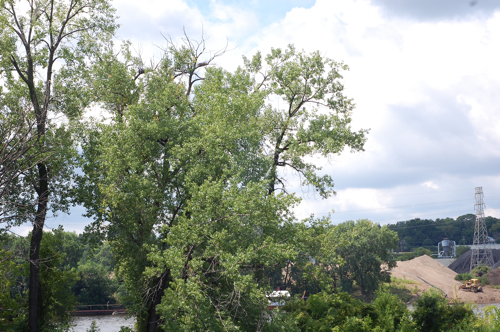
When I arrived at the park and walked to the river trail, I was sad to see that the nests built on the island right across from the park were all abandoned. However, I could clearly hear heron chick begging calls. Just north of the park is the Riverside Power Plant and there is another island in front of it that some herons were also using. It's harder to see that island but if you take the stairs all the way down to the river and have binoculars or a scope, you can see some nests.
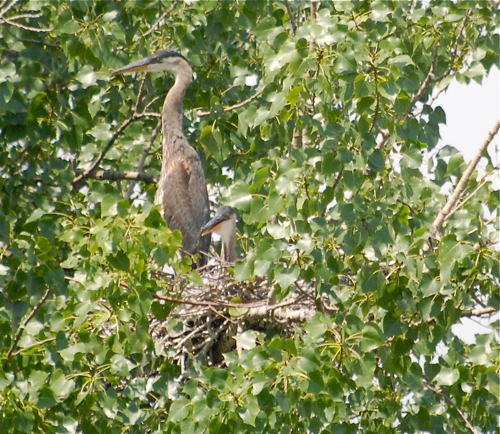
I scanned the trees with my scope and found quite a few young heron chicks and a few adults flying in to feed them! Yay! Now if the adults can get them squared away on foraging and migration before all the water freezes up, they'll have as good a shot as any other young heron hatched this summer. There's still time. This makes me happier than the herons from wildlife rehab being released--the adults attempted a second nesting on their own and it worked!
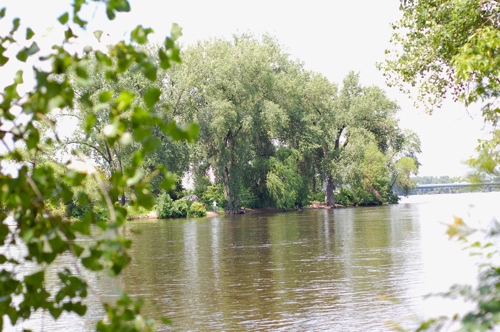
I also noticed something very interesting about the island with the active heron nests. It's hard to see in this photo, but there were campers on this island. So, of course, I digiscoped them.
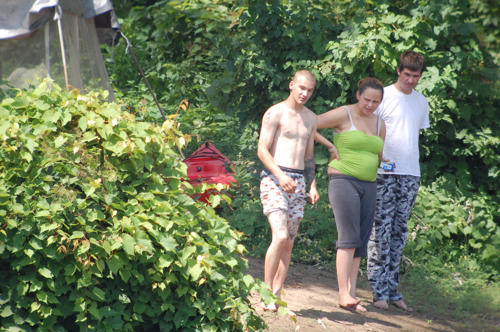
Looks like they kayaked in and pitched a tent. Interesting because there's not really any place you can legally camp on the Mississippi River through the Twin Cities. Can't say that I blame them for camping there, lovely spot in the urban Twin Cities landscape, but ew right below a heron rookery? The stink from the droppings and the non stop heron begging would be enough to keep me away--regardless of the legality. I'm fairly certain this island is owned by Xcel Energy. It's interesting to note how relaxed some rules have become post 9/11. The Head of Navigation is on one side of this island and a power plant for a major metro area is on the other. Usually, security is forces people away from those areas fairly quickly. The campers were not the only visitors to the island.
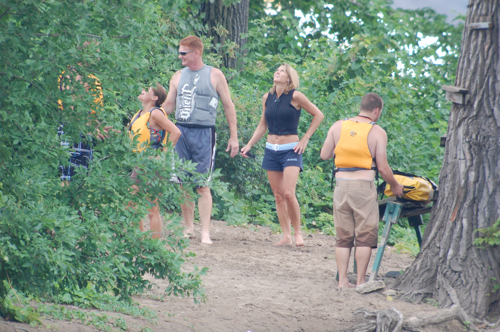
A half dozen people on paddle boards landed on the island. A couple of them noticed the little stinky fish smelling poop factory above them. They weren't there to camp, but to rest and grab a drink from their coolers.

And use the rope swing on the island. The herons don't seem to mind and I'm sure people landed on their old island. If you are going to nest in an urban landscape, you have to learn to deal with the humans, that's the way it is. The nests are high enough that the humans wouldn't be a threat and if someone were foolish enough to climb up to a nest, they'd learn the hard way what a messy business it is getting face to face with a heron chick--they can vomit up fish when scared just like a pelican. Nasty, nasty stuff.
All in all, it's just really great for me to see that herons are re-nesting and testing out new areas on the river. I'll be curious to see what they do next year.
Digiscoped Images
Fresh Tweets
Would you like to hire me as a speaker for your event?
Email sharon@birdchick.com