Birdchick Blog
Drunk Birds
I can now add "sober ride for drunk birds" to my resume.

I usually do not answer my phone while bike riding, but I could tell by the ringtone that it was my neighbor Zoe. She doesn’t spend her social time foolishly, so I knew if she called, she had something important to say.
“I’m on Hennepin and there’s a bird that can’t fly,” she said. “It’s kind of flapping, but it looks like it’s trying to push its beak in the ground and kind of spinning in circles.”
Generally, when people contact me, I encourage them to type in the words, “find a wildlife rehabber near you” into the search engine of their choice and a very helpful website pops up that connects you with the nearest licensed wildlife doctor to you. This also keeps me from becoming a full time bird ambulance during nesting season when everyone finds a baby bird.
However, I was biking and only a few blocks from Zoe and I thought I might as well head over. Also, my neighbor only said the word, “bird” not “pigeon” or “sparrow.” Chances were it was something interesting.
I headed over and five minutes later found my neighbor and a stranger she bonded with as they stood vigil over of the soft brown ball of feathers flopping on the ground. I immediately identified it as a Cedar Waxwing.
The bird indeed was trying unsuccessfully to fly and pushing its head into the ground. It was unable to stand and lurched around in a circle. I’ve volunteered for a couple of bird hospitals and know enough to when a bird is in serious trouble. I picked it up and felt around for broken bones and all felt intact. I blew on the waxwing’s breast, spreading the feathers apart to look at its transparent skin and get an idea of its physical state. The bird was robust with healthy muscle tissue, it was not starving and surviving well enough to find plenty to eat during our cold wet spring.
“What do you think is wrong with it,” Zoe asked.
“I think we have a drunk bird,” I answered.

Above is a picture of our little drunkard. Love all the colors on the waxwing, the soft brown and gray, highlight by bright red waxy tips and yellow tail band. In spring, frugivorous birds like waxwings and robins will sometimes feed on berries from the previous summer which have had months to lose moisture and allow the sugars to ferment. As the birds feed in a frenzy, the berries may not get digested right away and those fast metabolisms process the berries and voila, you get drunk birds. Sometimes the results are quite tragic as the intoxicated birds fly impaired and slam into windows. They are also highly susceptible to predators like Cooper’s hawks.
While it was possible that this particular bird could have been poisoned in a yard, waxwings are well known for getting intoxicated. If it had been poisoned, its chances of recovery were low, whereas if it was just drunk, it needed a quiet, dark place to sober up and then could be released right away.

I said, “I think it just needs to sleep it off away from the street, I will take it home and see what it’s like in a few hours."
I carefully placed the waxwing in my empty bike satchel, giving the weary and confused bird a soft spot to rest, but not allow it to move too much and risk damaging its feathers. The blitzed bird gave me that all too familiar glare we’ve seen many a drunk friend do. The look that says, “Look man, just turn off the lights and leave (bleep) me alone.”

At home, I set the satchel in the kitchen. Two hours later I peaked in. The waxwing had thrown up and was now at least standing. Ah, we really aren’t that much different from wildlife are we? A good hard puke after too alcohol and we feel a bit better.

I lifted the waxwing out of the bag, it stared unsteadily back at me. I realized that our little drunken bird was going to spend the night.
We took a pet carrier, fashioned a sort of perch for the waxwing and set it in. I also put in a very shallow dish of water and I chopped up some cherries in case it got well enough to eat on its own and set the carrier on the futon.

The next morning, the waxwing was sleepy and though hopping around, seemed a bit slow. This bird clearly needed a hangover breakfast and hydration. I opened the door and took a few drops of the water and set one drop on the very tip of its closed beak. It took a taste and you could see the lightbulb turn on, “Yes, more of that, please.”
Never underestimate the value of hydration when intoxicated.

I picked up a piece of cherry and slowly brought it to the bird’s beak. It opened it’s beak and took the proffered food. It held on to it for a moment, then swallowed. I tried again and got the same result. As cool as I thought it was to hand feed a Cedar Waxwing, I was highly concerned that it was so readily letting me hand feed it. By the third piece, it was as if realization set in and it flew to the back of the carrier in fear.
An hour later as the bird looked a bit more perky, I thought we would take it for a test flight outside. We went behind our apartment building and opened the door, the waxwing flew away to a branch in a hackberry tree high above. When we went back to our second floor apartment, I could easily watch our hungover house guest out the kitchen window. It preened and readjusted its feathers. Then it rubbed its head on a branch, as if thinking, “I can’t believe how blitzed I was last night! I'm never doing that ever again. How embarrassing.”
Then the waxwing went to sleep and I worried that I released it too soon. As I was questioning myself, I heard the high trilly whistle of a flock of waxwings flying over. The hung over bird immediately woke up, called back and did the flight of shame right into the flock. Whew.
Party on, dude.
Here's the vomit the bird left behind...at least it's far cleaner than any puke a drunk human has left behind.

Lawrence's Warbler Around The Beehives
With all my travel, I was worried I was going to miss one of my favorite parts of spring:
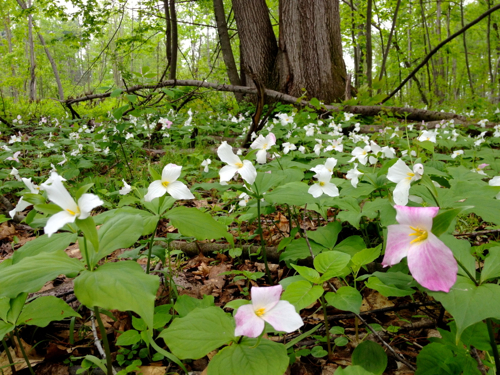
But thanks to the cold, wet spring, the wildflowers were late and I did have some quality time among some trillium at Mr. Neil's. I think I have missed the morel window but there's so much to pay attention to in early spring, that missing that edible fungus is negotiable in my mind.
While dealing with beehives yesterday, I couldn't help but mentally note all the birds singing and what warblers were still around. Some breed there like American redstart, common yellowthroat, pine warbler and ovenbird. Others are late movers like Tennessee warbler and blackburnian warbler. There have been blue-winged warblers that have nested there in the past. And then last year, I was surprised to find a Lawrence's warbler where the blue-wings have traditionally nested.
After checking the bees, I was debating about morel hunting or getting shots of birds for my Digiscoping Big Year. Heading down the hill into the woods towards the morel patch, I heard a blue-winged warbler call...only it wasn't a blue-winged warbler...it was the Lawrence's and it followed us around, making my attention towards morels shaky at best. I decided to plant myself down in the woods to get some photos. Of course, the Lawrence's disappeared, but like anything, if you sit quietly in one spot, if the bird you are after is on territory, it will return.
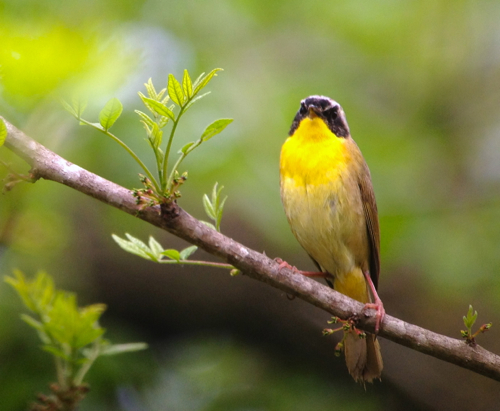
The nearby common yellowthroat was very cooperative and I got shots of it with both my Nikon V1 through my scope and with my iPhone 4s through my scope. I love the above--Disapproving Yellowthroat! That was taken with an iPhone 4s through the scope.
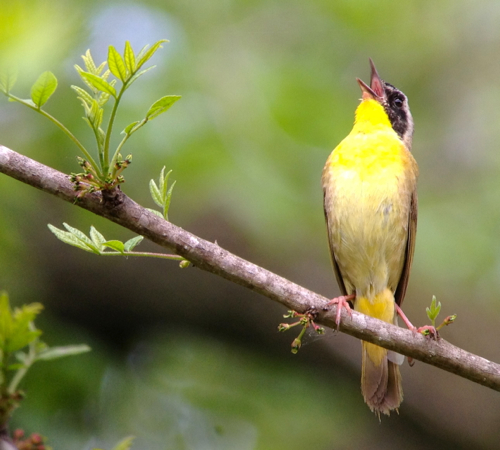
Since the bird was singing and out, I thought I'd experiment and get a video. As I was filming him, I heard the blue-winged warbler call again...
http://www.youtube.com/watch?v=_6dUl5bKZUE&feature=youtu.be
So above you can see and hear the Lawrence's warbler. I'm betting this is the same bird as last year. But without banding it, how can I be certain? I know Lawrence's is a hybrid of blue-winged and golden-winged warblers but can never remember the actual combo.
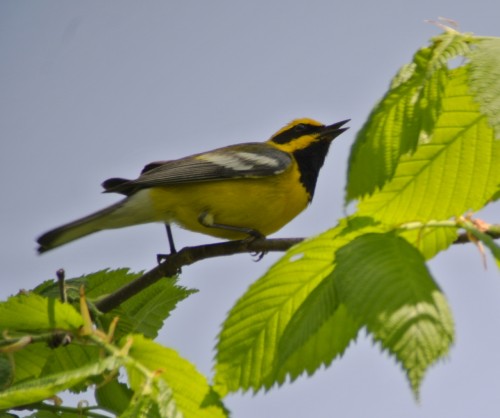
Here's the thing...there's a lot we don't know. Blue-winged warblers and golden-winged warblers will hybridize and produce what's called a Brewster's warbler. A Lawrence's is believed to be the result of a Brewster's backcrossing with a blue-winged warbler. Note that word, "believed?" There's still quite a bit we don't know, golden-wings could still be in the mix somewhere. Given what I know about the birds breeding around Mr. Neil's I think that is likely this bird is the result of the Brewster's and blue-winged warbler pairing. Last year, this bird was singing in the exact spot that the blue-winged warblers have nested and this habitat isn't the best for golden-winged warblers. I've only had one or two golden-wings during migration.
So, now I'm wondering...was there a Brewster's three or four years ago breeding with the blue-winged warbler and I missed it? The blue-wings have become such regulars and I don't like to disturb them where I know they nest. And I get distracted during bee season, I think it is highly likely that I could miss a Brewster's.
However this bird got here, I couldn't help but lay on the (most likely tick infested) ground and listen to this bird make it's rounds on territory while singing--how many crazy nature things went into it being where I was. Assuming it's the same bird as last year: It's survived migrating into South America at least twice. It is the result of its grandparents hybridizing and its hybrid parent backcrossing with a blue-winged (or possible golden-winged warbler). So much I can know about this bird and yet so much I don't.
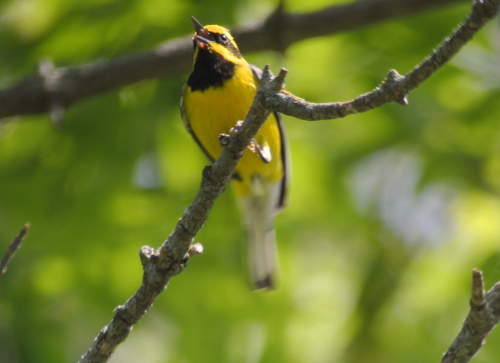
I mentioned earlier that I wasn't sure I could count aplomado falcon on my Digiscoping Big Year because it's considered and introduced population and not sustainable on its own. But, it's a species and that bird wasn't banded so it could actually be a wild bird that flew up from Mexico. And this is about getting pictures of birds in the wild, so I counted it. But hybrids are not countable on the ABA list either. They aren't even included as a check in eBird. But I'm counting this bird. I'm not really following ABA guidelines and it was work to digiscope this bird, so Lawrence's warbler is 170 on my Digiscoping Big Year.
If you would like to read more about golden-winged warbler and blue-winged warbler hybrids here are some good articles here and here.
Wood Frogs
Just a random video of wood frogs that I digiscoped. http://youtu.be/mvmXgOgtcw4
Book Signings for 1001 Secrets
In case you weren't aware...I had a new book come out in May.
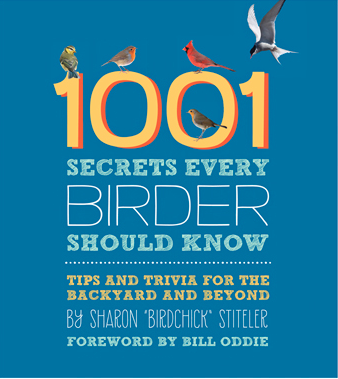
I've had some book signings already, but not everyone has been able to make them and I've had emails asking how to get them signed. We have a few copies here that I can sign and send out if you would like to have one. If you want one before Father's Day, order before June 4, 2013 (I leave for Europe that day and won't be able to sign any until I get back in the middle of the month).
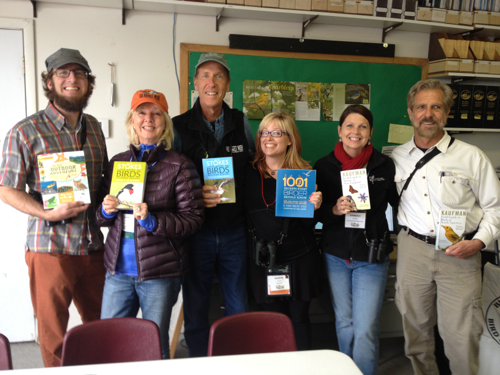
I have to say that I've had some very surreal moments this spring. This was from a book signing at Biggest Week and at one point I looked to my left and saw Kenn Kaufman signing and two my right were the Stokes--all influential in my early birding days. I kept asking in my head, "How did I get here signing my own book along side them?"
In the above photo we have Ken Keffer, Lillian Stokes, Don Stokes, me, Kimberly Kaufman and Kenn Kaufman. Wow.
I do have more signing coming, they will be listed here. I'm excited that I'll have a signing in my own neighborhood bookstore Magers and Quinn and The Raptor Center will be there with a live bird! I bet I could be talked into a Birds and Beers when it's over.
Biggest Week 2013
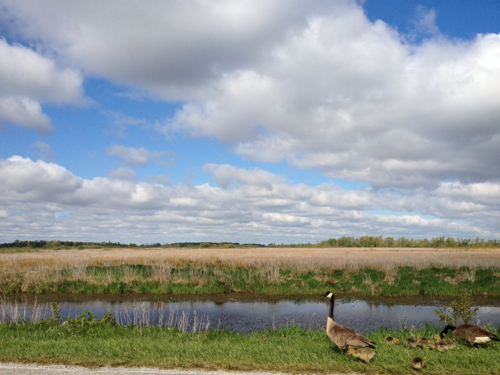
The view from the drive in to Magee Marsh in Ohio and one of the few sunny days I've been allotted this spring.
Well here I am at the end of May and barely a month left to complete my Big Half Year goal of digisoping 250 species by June 30. I'm only at 170 and spring did not play out quite like I thought it would. I'm missing quite a few "gimme" species like rose-breasted grosbeak, indigo bunting and American goldfinch but part of that comes from me knowing that if I could get a sunny day and time at Mr. Neil's, that would be easy cheesy...yet this spring has been incredibly cold, cloudy and rainy. I didn't rack up nearly as many species (digiscoping wise) at Biggest Week or Detroit Lakes like I thought I would because of the weather. But, ah well.
I do have one more trip that includes Austria, Paris and Amsterdam in June but those are not the birdiest destinations out there. However, they could easily help me get the total to 250. We shall see. As much as I love bird watching, I kinda just want to eat my way through Paris and not have to drag my digiscoping equipment down the Champs-Élysées with me if I don't have to.
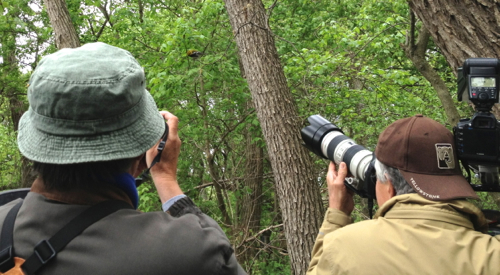
The Biggest Week in American Birding is great for warbler watching and a bit of a challenge photography-wise. For one thing, if the conditions are right, like on this particular Sunday when it was cool and the winds prevented the warblers from crossing Lake Erie the birds are too dang close.
Also, there are lots of people and with tiny birds that move fast, it's a challenge to get shots.
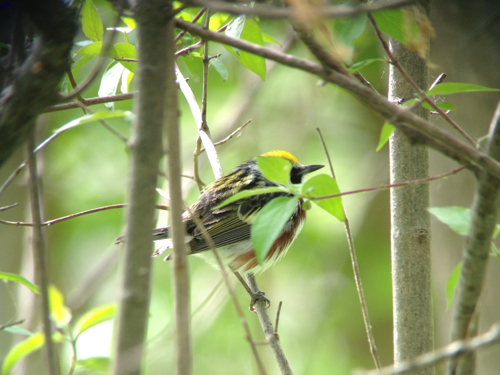 I did get photos--I got lots like this. I swear, some day I will write a field guide to how you will really see birds--often obscured by leaves. I couldn't get my mojo going with this chestnut-sided warbler. I had great and stunning looks at them, but I couldn't digiscope this bird to save my life.
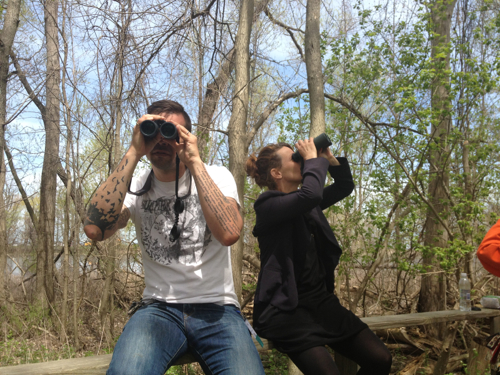
But if you haven't been to this festival before, you essentially hang out on the boardwalk at Magee Marsh, the trees are dripping with warblers, vireos, orioles and a whole host of other spring migrants. Anywhere you look could reveal a cool bird. The west of the boardwalk is jammed packed and a bit of sardine birding, where as the east can have all the same birds but not so jam packed with people. Or you can be smart like my friends Paul and Lili above and sit on the boardwalk rail and get some space from the birding hoard.
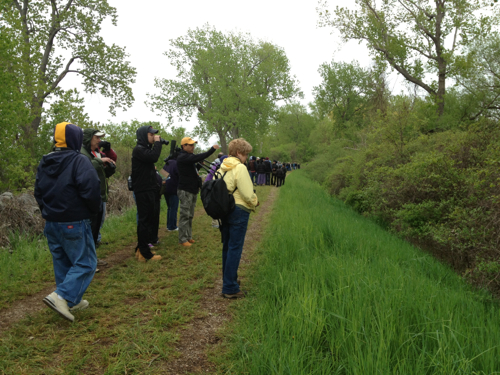
You can check out the trails along the shore of Lake Erie (but those can swarm with birders too, but you don't feel as confined as you do on the boardwalk). You can also visit Black Swamp Bird Observatory and Ottawa NWR. There are guided field trips, but I end up spending almost all of my time out on the boardwalk.
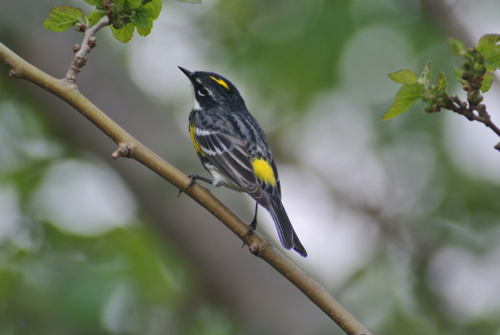
But warblers abound and are quite easy to see (they may not be easy to photograph). Above is one of the many yellow-rumped warblers.
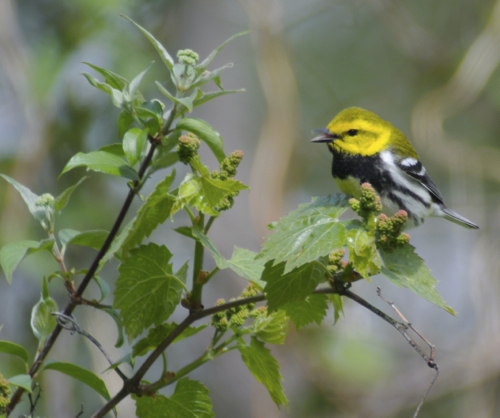
Here's another one of my favorites, the black-throated green warbler. Easy to see an came down quite close. When it was cold and windy, the warblers would be at eye level.
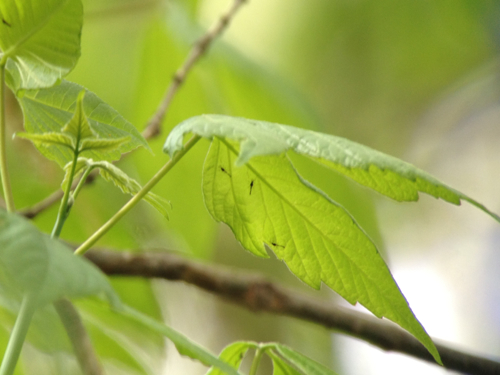
If you looked under the leaves, you could see some of the insects the warblers were after.
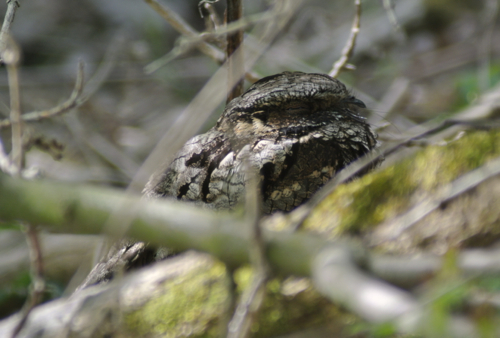
I'm not a fan of the sardine birding so usually I hang out on the less crowded east end or find something like the above whip-poor-will and set my scope on it. People can get their lifer whip-poor-will (and I usually help people get photos with their smart phones) and the beauty is that while I sit there, the warblers work their way past and I get almost all the same birds that people get at the crowded west end.
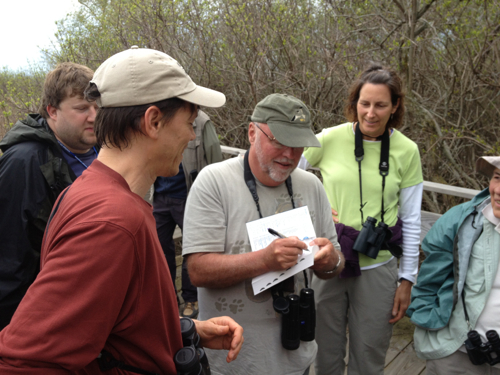
As I had my scope on the above whip-poor-will, someone asked why it was a whip and not a chuck-wills-widow (a bird I have very little experience with). The best answer I could give was that the guy who wrote the National Geographic Field Guide (Jon Dunn) text pointed it out to me. He returned a few hours later and I asked him specifically how whips were different from chucks and he gave an impromptu identification class--and autographed guides. All part of the fun of just hanging out on the boardwalk.
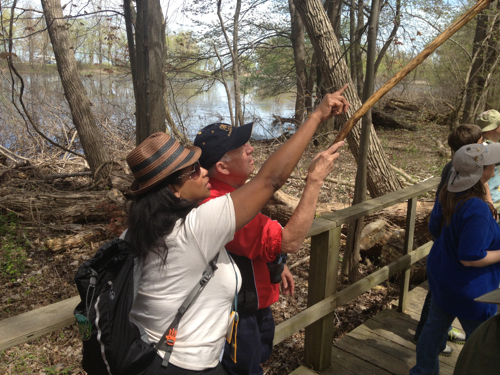
It's interesting how quickly people become experts on the boardwalk and get caught up in the enthusiasm of sharing birds on the boardwalk. This is my buddy Rue Mapp from Outdoor Afro who is a newer birder and there she was, putting people on an eastern screech-owl like a boss!
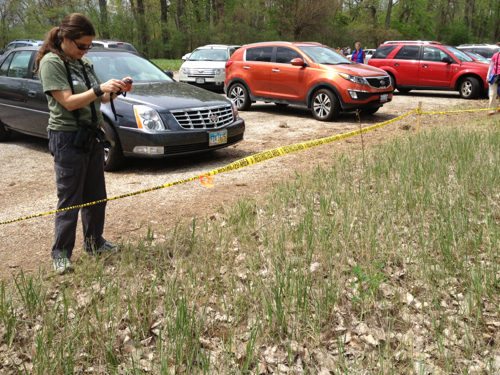
I think that this year, this fest in Ohio should have been called the Biggest Week in Woodcocks (I suggested that but was met with skepticism as that might attract the wrong sorts of people). But woodcocks were all over the freakin' place. Above is a little grassy knoll in the parking lot at Magee Marsh and there's a female woodcock incubating eggs. She's very had to see, but she's there.
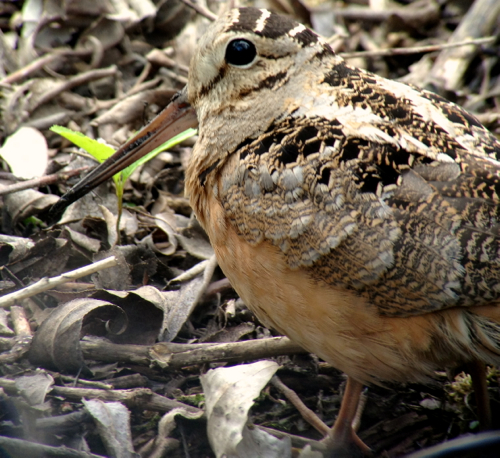
But they were a common and easy to see sight along the boardwalk at Magee too. I saw them every single day I was there, not to mention the birds that were peenting outside of our cabin at Maumee Bay State Park.
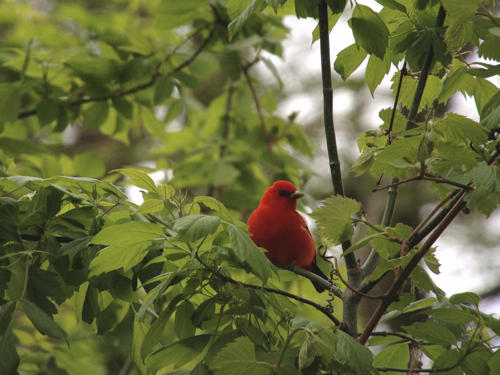
There's also something to be said for just hanging out in the parking lot of Magee Marsh--a male scarlet tanager put on quite the show and made the rounds several time, down low for anyone to get a photo.
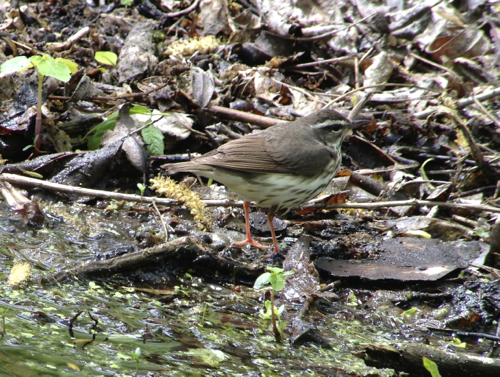
As I was staked out waiting for warblers to come by, a waterthrush flew in. Being in Ohio, I was on the look out for a Louisiana, not just a northern. This bird had bright pink legs and I grabbed some shots with my iPhone through my scope. I wasn't 100% on my id on this one and wanted a consult to confirm I had a Louisiana
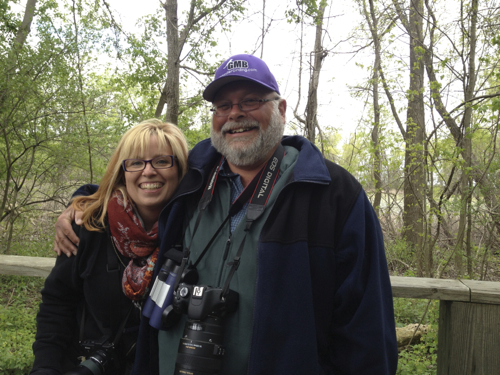 Low and behold, I run into Greg Miller on the boardwalk and he confirms that is Louisiana. For non birders, Greg Miller was Jack Black's character in the movie The Big Year. And that's kind of what makes the Biggest Week a cool event: amazing birds and really cool people.
Judging A Birding Tattoo Contest
It has been a crazy two weeks. An example:
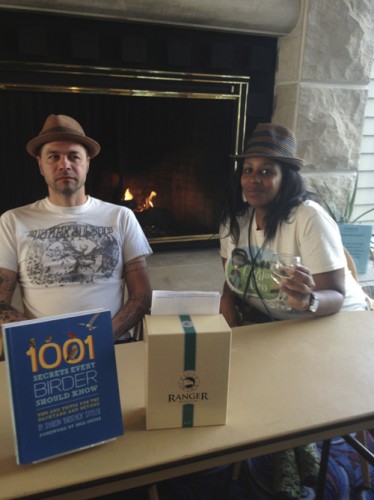
My new book was a prize in a tattoo contest at a bird festival...said no person ever until Biggest Week in Birding 2013. Above is Paul Riss from Punk Rock Big Year and Rue Mapp from Outdoor Afro who were among the five judges. When Kim Kaufman asked if I would be part of the tattoo contest, I wasn't sure if she meant as a participant since I have a couple of tattoos, but she meant as a judge.
I happily agreed and then I wondered how many entries there would be...we had 11 which is 10 more than I expected.
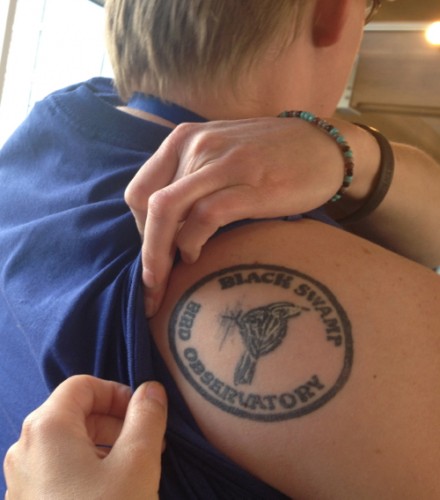
This one surprised me--the logo for Black Swamp Bird Observatory. That's one heck of an organization that can inspire such loyalty from it's employees.
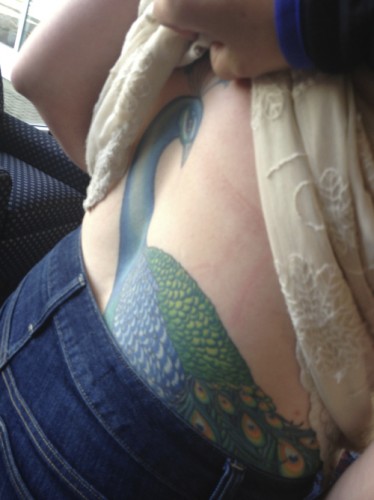
There were the expected tattoo birds, like a peacock tattoo so large that we could not see the whole thing without the contest suddenly being rated R. But still quality bird work.
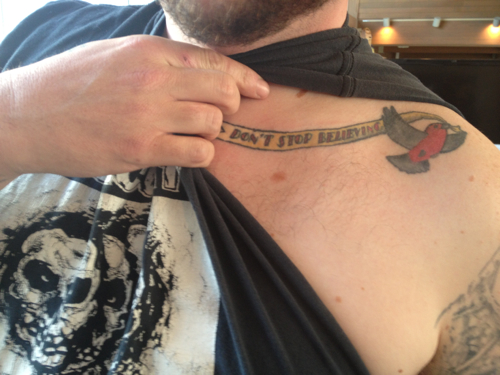
There were charming ones like a scarlet tanager with the song title, "Don't Stop Believing."
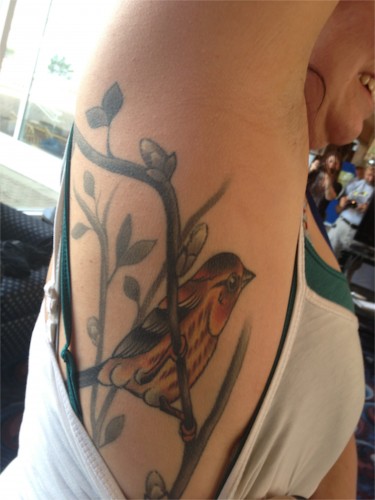
There were really beautiful and artistic ones like this Cape May warbler which had been a nemesis bird and she had it applied to her side after finally getting one at Biggest Week in 2012.
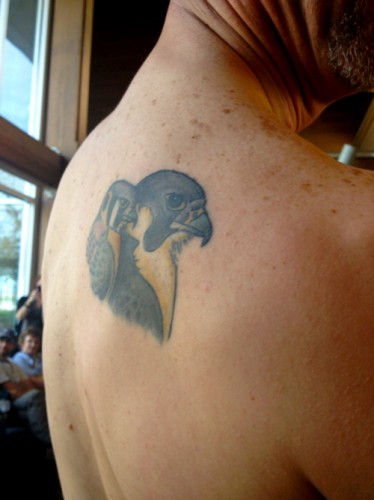
There was a Roger Tory Peterson art tattoo. This kestrel and peregrine falcon are from his cover of the Peterson Guide to Hawks.
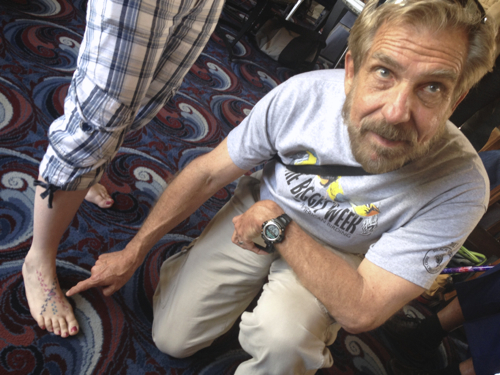
One contestant went the extra mile and hand a tattoo of crossbill feet designed by field guide author Kenn Kaufman who was even on hand to explain how accurate the bird feet were...lol, she brought in a ringer!
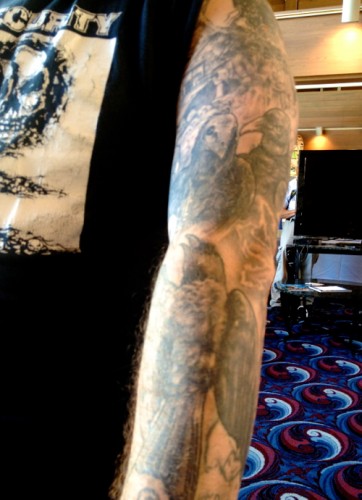
Then the tattoos got serious. There are multiple birds on here like a drongo and above that you can see a black vulture and turkey vulture head. I thought that we had our overall grand prize winner here...
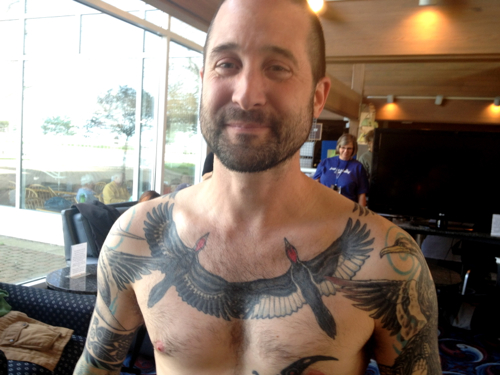
Until this guy took off his shirt. He had bird tattoos all over (even a raven that was about to chomp his nipple which I can't believe I didn't get a shot of. But look at the flying pileated woodpecker/ivory-billed woodpecker tattoos. Wow. On his left shoulder, you can see a double-crested cormorant--who gets a cormorant as a tattoo? This guy, because it was his spark bird. He had more like herons and a few storks flying on his back but he wowed us the most and won the overall contest and a pair of Eagle Optics binoculars.
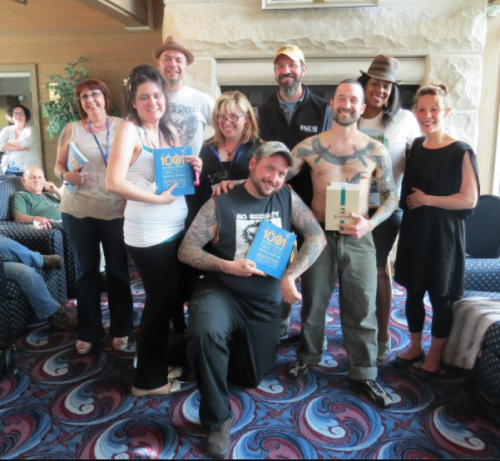
This was posted on the Biggest Week Facebook page, the judges and that winners. I think the contest was a bigger hit than any of us anticipated and word on the street is that there will be another one next year. Get your ink on now. I've already had two people tell me what they are going to get tattooed on for next year. As they say when you get inked: go big or go home...or maybe just go birding.
Late Spring Snow
So a couple of seeks ago we had some snow in April in Minnesota and people freaked out about birds. Yeah, I know I live in Minnesota and we get a ton of snow, but snow in April is brutal even for us. But people worried because we had a ton of robins in our area, some were birds that spent the winter and were ready to head north and couldn't. Others were birds just arriving on territory and aggressive to the birds still here. Everybody was bitter and prone to fights because that's what happens when there's a spring snow. I wasn't too worried because birds like robins are tough, robust birds. They can take a snow storm.
Last week we have a few 70 degree days and it was beautiful. Most of the snow melted. Migration progressed. I saw tree swallows and chimney swifts and relaxed that they had survived a crazy spring migration...then 15 inches hit the southeastern part of the state yesterday and more today. Now I am worried. Crazy images are showing up on Facebook like this one from Greg Munson:
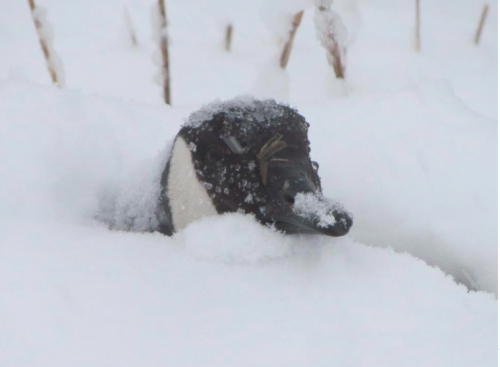
Here's the description with the photo, "Greg, Munson, Quarry Hill Nature Center naturalist in Rochester. The mother goose has been sitting on her 9 eggs for 2 weeks and she wasn't about to let a little snow interrupt her task."
I linked to it on the Birdchick Facebook page and people were wowed and concerned. Someone suggested clearing the snow off of her. That's a risky idea--number one a goose on the nest is dangerous to you. Number two, she most likely would flush, exposing the eggs to snow and would she come back in time to keep them warm enough to hatch.
This morning there's an email from Greg that reads, "The goose is still surviving in the snow and it appears water may have even gone down an inch overnight. Hard telling what the melt will do to pond levels, probably starting tomorrow. "
We'll have to wait and see if the eggs hatch.
Though we had no snow in Minneapolis yesterday (different story today), it was too cold for insects. We had a yellow-rumped warbler fallout in my neighborhood.
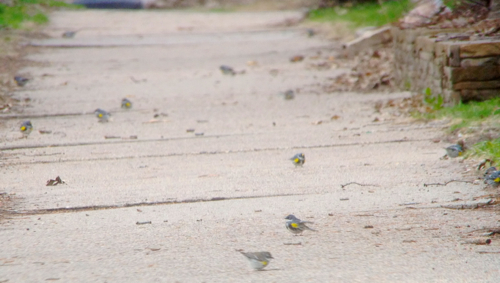
Yellow-rumps were everywhere! They covered the streets and the sidewalks gleaning any sort of food they could. Peter Nichols posted this photo of yellow-rumps covering his feeder. And this video of a yellow-rumped warbler feeding frenzy:
http://youtu.be/bZcXVmomngw
I know some of these birds can take it, but I do worry about the purple martins and the chimney swifts who have to wait it out under cover and not eat until any flying insects finally come out. Will we lose some of those birds? No doubt? Can their overall population take that loss? Usually, yes. But birds face so many challenges: habitat loss, cats, cellphone towers, windows. It's a vexing winter for sure.
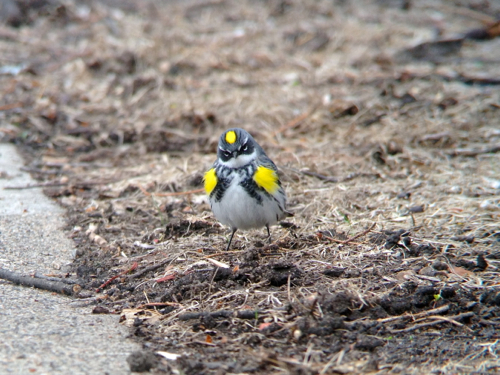
I do take some comfort in the yellow-rumped warblers and their sassy attitude. So cute, so fierce, they almost look as though they defy winter and all it's obstacles. Here's hoping it ends soon without the appearance of White Walkers.
1001 Secrets Every Birder Should Know Book Release Party

For those in the Twin Cities area next week, we are having a book launch for my newest book 1001 Secrets Every Birder Should Know on May 7 from 7 pm - 8:30 pm. And I'm super excited because it will be at Glam Doll Donuts!

These ladies make super tasty donuts! From the Showgirl (maple icing and bacon), the Calendar Girl (salted caramel and chocolate) to the Bombshell (my favorite, spicy Mexican chocolate and cayenne pecans and the surprisingly savory Girl Next Door (provolone and muenster) they will wow you with donutty flavor. Don't worry, they have regular donuts too.
But I'm happy to celebrate the release of my book and show off an awesome new donut place in my neighborhood. I'll be happy to answer any crazy bird question that you have. The book has been getting some great attention so far, even from All Things Considered!
We'll have some books on hand to sell, but if you already bought one and would like it signed, feel free to bring it. You can also bring copies of other books too if you have them (Disapproving Rabbits and City Birds/Country Birds).
I'll also be doing a signing at Biggest Week in Birding if anyone is going to be there in Ohio at Black Swamp Bird Observatory on Saturday, May 11 from 1pm - 2pm (with Kenn Kaufman and The Stokes). I have to say how weird that is to be in that position. Was it really only 10 years ago I was working in a wild bird store, selling their books and now I'm signing books along next to them...how did I get here?
I hope you can come...if for no other reason than to share a donut with me. Maybe afterwards we'll raid one of the many bars on that street for an impromptu Birds and Beers?
Hot Caracara Action!
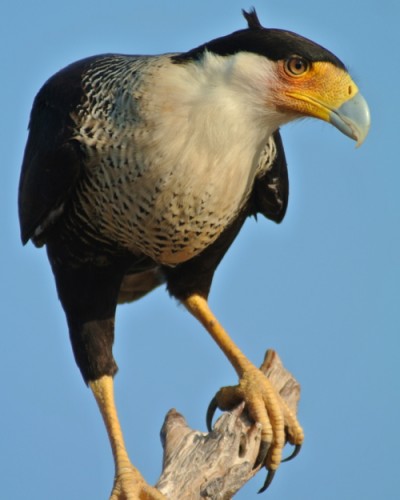 While in the Rio Grande Valley, my friend Marci asked if there were any birds I needed. I don't really have any lifers to get there but I said, "I'd like some quality time with a caracara."
She smiled slyly and said, "I think I know a way to do that."
I've seen crested caracaras in Texas and Florida, but generally as they fly by or perch momentarily. I've had opportunity to get ok photos of them at Laguna Atascosa but not on a great, sunny day.

Marci hooked me up with a place called Martin Ranch also known as Martin Refuge on their website. I blogged a little about about this place on 10,000 Birds, it's a ranch specifically set up for photographers. They have water features to bring migrant songbirds, seed feeders and meat feeders. I know baiting is an issue for people and there's a forum to discuss at on my post at 10,000 Birds, this post is more to show all the different birds that came in during my session at a photography blind. I don't really see this meat feeding station as being too different from a seed or suet feeder, only instead of seed, mealworms and beef liver fat the birds are offered taxidermy leftovers, roadkill and chicken parts from the grocery store.

For a fee, you can visit this ranch and set yourself up in their photo blinds. There are different blinds at different angles so you can sit some place with the sun behind you throughout the day.

There are comfy lawn chairs set up inside the blind and curtains to hide your movement from the birds. Our blind easily held three people but a fourth could have been added. All would have had plenty of space to photograph birds.

I have a digiscoping set up and this place is primarily used by traditional sorts of photographers. I was able to get photos, but the birds were often too close with my set up to get full body shots with my Nikon V1 and Swarovski ATX scope and I didn't really have the option to switch lenses. But I got some great shots of the birds and a chance to see things like the somewhat gross looking crop bulge that pops out of their feathers after eating.

But getting head shots of crested caracaras was just fine and dandy with me! And at the end of the day, I'm a wildlife watcher first and photographer second, it was so fun to just have a session to watch gratuitous caracara action, listen to there gutteral calls, chase each other and just chowing down--it was amazeballs!

My iPhone 4s has a wider field of view with the scope than my camera, so I was able to get some full body shots with that. I love this bird, it looks like it has a "little captain in him." Another fun thing that we got to see were some of the facial skin changes. When a crested caracara is not stressed, it has colorful facial skin, note the above reddish faced adult.

Check out this younger bird with the grayer face--that means it feels threatened and the skin color can change in only a few seconds. Another bird was about to take this bird's hunk of meat.

There were at least 3 different caracaras that flew in missing their entire foot or several toes. I wonder if someone on a nearby ranch has some leg hold traps to get mammals and get these carrion eating by mistake. Again, I admire bird resilience. I'm sure this ranch's feeding station helps the flying wounded. What was interesting to watch was one of the one-footed bird's ability to sneak in to the flock of caracaras and steal a hunk of meat right from under a two-footed bird. I suppose it's that sort of aggressiveness that helps a bird that just lost its foot to keep going.

I think this is my favorite shot of the day. This is one of the one-footed caracaras chowing down on some chicken and managing fairly well to grasp some meat and to eat.

Of course other species of meat eating birds came in to the feed pile. Here's a Harris's hawk. Only one came in and it seemed a bit on guard. The caracaras readily flew down as soon as the meat was out. The Harris's hawk watched the scene a long time before finally landing and tucking into some chicken.

A couple of turkey vultures flew in and landed on the perching tree. They never came down. I'm not sure if it was all the caracaras that kept them at bay or the sound of camera shutters clicking madly, but they were far to wary to come in to the meat.

Black vultures, however, jumped right into the fray and even chased off a few caracaras. Very interesting considering they are so much smaller than the turkey vultures, but every species has its own style when approaching a food source.

OK, this bird didn't come into the meet, but to the water and the seed feeder. When I first got into the photography blind and all the birds came in at once, I went into nature sensory overload and my brain went a little nuts. I didn't know what to focus on first, the running monolog in my head was, "Caracaras, adults, juveniles, ACK, pyrrhuloxia, caracars, no turkey vulture, ack, black vulture, ack, caracaras, in perfect light, ah cool caracara sound, oh no pyrrhuloxia is back, must digiscope for big year, ack, vultures, ack ack ack, Harris's hawk, ack, caracara, ack."
Though I would replace all the "acks" with other four letter words one mutters when excited.
As if all of that weren't exciting enough, Marci's husband Terry was next to me and got super excited. I'm not sure actual words were coming out of his mouth as opposed to sounds humans make when incredibly stoked. I've done this and I've heard many a birder do it. I looked in the direction Terry's eyes were focused on...which was right in front of the blind and saw:

A really LONG rattle snake--that thing was HUGE. We tried to alert the photographers in the blind next to us and then all the cameras went bonkers. This snake was almost as long as me, so I'm guessing it was about four and a half feet long and clearly had been feeding well. The caracaras noted it but didn't seemed too perturbed by it. I think the snake sensed our excitement and turned around to go up the bank.

It was far too close for me to digiscope but I did manage to get a shot of its rattly tail. Wow, last August in Arizona was my first ever rattlesnake and now like a nemesis bird that I've finally seen, I'm seeing another right away. That's 2 rattlesnakes in less than a year...it did make me a little nervous later on when I had to duck out of the blind to find an obliging bush to pee in...I searched a little more thoroughly before I began
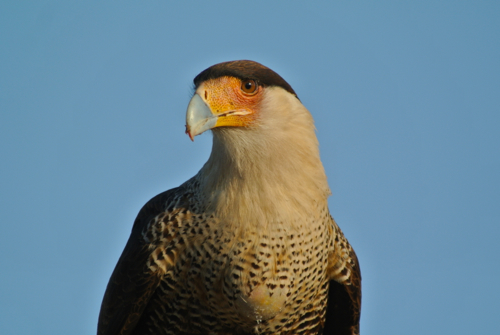 It's not cheap to use a photography blind, but you are getting something that you don't get in the wild: the chance to sit fairly comfortably with a reasonable guarantee to see a certain species in good light and perched in ways for you to get dramatic and interesting photos. It's also an opportunity to watch birds that are comfortable engage in behaviors you wouldn't see when you surprise them in the field. I had a blast and I would do it again. If getting photos of birds is your thing, I would highly recommend checking out Martin Refuge.
Here's a video I made of some of the action--you can even hear a little caracara calling:
http://www.youtube.com/watch?v=U2bOZMaa8vM&feature=youtu.be
Wondering on Whimbrels
Last week I was in Los Angeles, California and while there I had some whimbrels hanging out with me on the beach (incidentally, that is now bird 138 for my Digiscoping Big Year challenge to help build a Visitor Center for Sax Zim Bog).
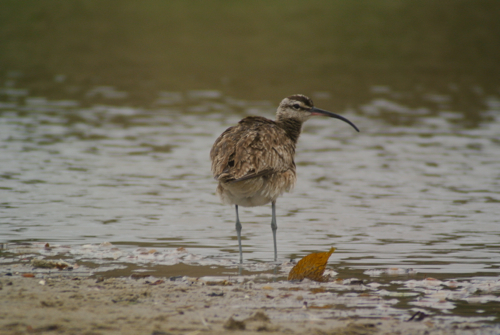
These are always cool birds to see--gotta love that beak. But whimbrels have an incredible migration so it's fun to not only enjoy these crazy looking birds but also imagine where this bird has been and what it may have seen.
The Center for Conservation Biology has done some amazing tracking work on these birds--we really didn't know all that much about their migratory route and thanks to transmittors, we know these birds are tough. We've learned that a whimbrel flew into Hurricane Irene and survived...only to be gunned down by lax shooting laws in the Caribbean.
Now that we have an idea of how they get from their breeding ground to their wintering grounds in South America, we need to learn what route they take to get back. Looks like it's going to be a loop, that they don't go the same way that they came.
According to the website the birds were, "originally captured and marked on the breeding grounds along the Mackenzie River in far western Canada in June of 2012, the birds took a bold fall migration route flying 2,800 miles (4,500 kilometers) to the east coast of Canada in mid-July to stage for 2 weeks before embarking on a marathon 4,300-mile (6,900-kilometer) flight out over the open ocean to the northern coast of South America. All three birds have spent just over 7 months in the extensive tidal system of the Gulf of Maranhao before initiating their migration north."
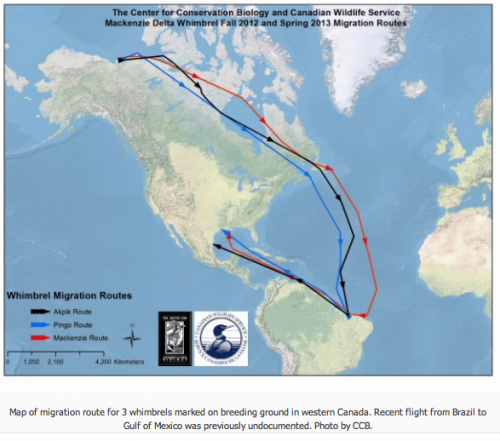
The whimbrels left their wintering grounds near Sao Luis, Brazil between April 9 - 13, 2013 and flew nonstop for 95 to 100 hours averaging 40 mph before reaching the Gulf of Mexico. They flew that. Non stop. Wow, maybe all the hassles I deal with in airports are not so bad. Where will these particular birds go? Straight up the continent? Or to the west coast where I saw the whimbrel in the above photo?
So if you ever see a whimbrel, enjoy the crazy madcap design, but also keeping in mind what that bird can fly through...and how many countries it can visit.
Digiscoped Images
Fresh Tweets
Would you like to hire me as a speaker for your event?
Email sharon@birdchick.com