
Birdchick Blog
Singing Wood Thrush LOL
So the other day I posted a short video showing a hermit thrush singing from the folks over at Music of Nature. I noticed that they also have a wood thrush video on their YouTube channel too (this is another bird that is a moral imperative to listen to): [youtube]http://www.youtube.com/watch?v=jrmxlez2cAg[/youtube]
This video cracked me up. Did you notice how many times the bird sang a phrase and then flew? I was actually surprised that the videographer got the bird perched for more than one phrase--but noted how the bird was always obscured by a branch or leaves. It reminded me of when I was a kid and my parents moved to a new home and we had one of these singing in the yard. You didn't have access to all the bird id CDs and apps back then like you do today.
So one Saturday morning my mom and I spent an hour trying to track this bird down in the tops of the trees. After each song phrase it fluttered to another leafy branch, hiding in obscurity. The longer it took, the more I fantasized this would be something cool and so beautiful it HAS to hide, maybe even a painted bunting. I remember feeling like such a chump that that it was brown and fairly colorless. How could something so brown have a song so pretty?
Now I know better and it's one of my favorite songs and sometimes I get to hear it out around the beehives. But all that searching we did to see it makes me appreciate all the work the videographer went through to give us such a wonderful glimpse to a secretive singer.
Warblers Eating Honey
I'm in a quandary with my beehives and my love of birds.

On my way out to the Horicon Marsh Bird Festival, I stopped at Mr. Neil's for a quick check of our new beehives and some birding. The warblers have arrived and the cool weather has forced those who arrive early in migration to search for alternate sources of food. Yellow-rumped warblers like these would prefer insects. Far too cool and far too few available, so the enterprising early migrants explored the bird feeders.

Despite the fact that Baltimore orioles are in the area and singing, none came to the feeders. Yellow-rumps gladly took advantage of the grape jelly.

The warblers even jockeyed for position at the suet feeder among the four species of woodpecker that normally feed here.

Pine warblers are also hitting the feeders. Whereas the yellow-rumps go for the suet and jelly, the pine goes for sunflower hearts. It will also go for the suet, but seems content to eat the seeds.

While I was working around the garage, I noticed Neil's groundskeeper Hans had put out some old bee frames. We do this so the bees from active hives will fly in and clean out the old honey. These frames were from the hives that died over the winter. The bees found it. While I was working around the garage, I noticed warbles hanging out in the area. At first, I thought the warblers were after the live bees and even said allowed, "I know you're desperate for insects, but you're far too small for eating bees."

Then, right about dusk when the honeybees were all tucked in their hives for the day, I noticed the warblers on the frames, pecking at them. The light was dim but thanks to the auto timer on my Nikon D40 I was able to digiscope a Nashville warbler and a yellow-rumped warbler on the frames.

Based on the holes in the frame it looked like the warblers were going for dead bees. Some of the frames had capped larvae that never hatched, so I figured the warblers were after the protein of old squishy non-hatched larvae. We had more frames of dead larvae and honey in the garage so I set more out. I figured the warblers could clean out the larvae and the bees could clean out the honey and help get a head start on their hives for the season.

The next morning when I went out for some birding, I checked the frames, they were covered in warblers. Above are two yellow-rumped warblers and one Nashville warbler. These were a small cross-section of about two dozen warblers waiting in line to feed off of my old beehive frames. There were at least four species in the flock, the above two and pine warblers and orange-crowned. I didn't get photos of the other two species, but got plenty of shots of the feeding frenzy.

Here are four warblers on one frame. As I took pictures and watched them feed, it became clear that old bee larvae was not the only sustenance they were after. They were very certainly eating honey. I had a moment of panic...should birds be eating honey? Honeybees are a fairly new species to North America, they came over with the early settlers. Warblers did not evolve with honeybees. Could they safely process honey and still migrate?

As I watched them I noticed that they tugged and chipped at wax foundation too. Is that safe? I've seen honeybees that have built comb out in the open on a bare branch, I remember seeing some abandon ones in Arizona and Texas...perhaps warblers have had exposure to this.

The air was so cold and their food scarce, I didn't want to take this source of food away if they were still trying to load up for their journey north. I couldn't find anything about it on the Internet other than not using honey as a means to make nectar. I wanted to plant myself in front of the frames all day long see how many species of warbler would come in but I had to go.

I also noted that as the sun got higher in the sky and our honeybees became more active, the bees didn't tolerate the warblers in close proximity and chased them off. A few warblers still came in for the bounty but not four on a frame like at dawn.

I'm not sure if this is a good thing but if the warblers figured honey out, no doubt other birds will and I don't know if they should. We already had one casualty of a tufted titmouse getting covered in honey while it explored some of our dead beehives. I'm going to have to seek out an avian nutritionist to find out if this is a safe thing to offer birds. If it is, this may be a new way to enjoy birds and bees and a new product to offer at bird stores.
Honey Covered Titmouse
This is a problem that only I could have.
Non Birding Bill and I had one of those exciting married people dates: did a little dinner, sorted some tax receipts, pretty much got down last night. While we were enjoying some sushi, my phone went off and I noticed the number was from Mr. Neil's housekeeper, Merry. She rarely calls unless there's a bird emergency, so I picked up. Her daughter Alicia walks Mr. Neil's dogs in the evening and when she arrived, she found a honey covered bird unable to fly on the ground. Merry sent this photo:
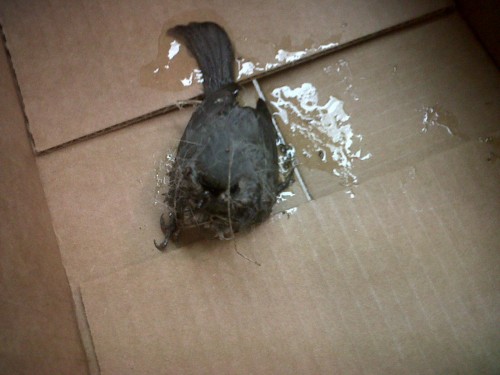
Oh no! A honey covered tufted titmouse! How the heck did that happen? I felt so guilty, it was as if the 2 loves of my life, birding and beekeeping found out about each other and got into a fight. I advised Merry to do what wildlife rehabbers do with oiled birds, use luke warm water and a little bit of Dawn Detergent and gently was off the feathers. I also asked her to check if it was banded (it was not).
So, she took to gently cleansing the feathers of the sticky bird, even carefully using a cotton swab to get the feathers around the face clean. Laura Erickson has had experiencing cleaning a red-breasted nuthatch that got caught in some grape jelly and she warned that it might take a few washings to get the bird totally honey-free.
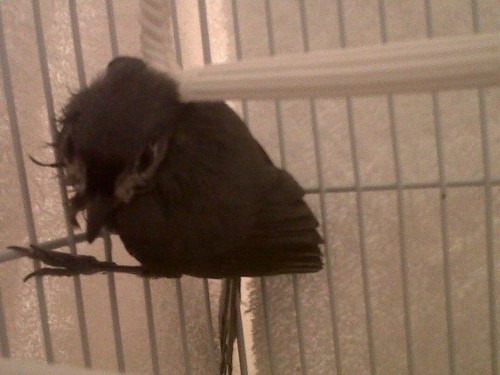
I told Merry the bird would need a warm, dark and dry place to settle, dry out and preen its feathers. I mentioned that titmice like suet, peanuts and sunflowers too, so she put some peanut suet in the cage, covered it and let the bird be til morning. I tried to puzzle how this would happen.
None of our hives survived the winter and it's been a group effort of the groundskeeper, Hans gathering the hives and all of us taking a turn at extracting the remaining honey before too many deer mice move into the empty hives and eat what the bees did not. Some of the hives have been left outside the house to await extraction. What would make a tufted titmouse explore the hives? They are not honey eaters. I wondered if our 50 degree weather brought out some early spring insects and they were attracted to the honey, which in turn attracted the titmouse?
I also recalled last fall setting out frames that were covered in wax moth larvae for the chickadees and titmice to eat. Did this bird recognize the frames as a source of larvae? It could have hopped into the open box inspecting the frames, only to come out covered in honey and unable to fly?
Thank goodness we didn't have any active hives. With that warm weather, the bees would have been out and would have gone to the titmouse to clean off the honey. The titmouse would have struggled, causing them to sting...ew, don't even want to think about that.
When Hans found out, he went back to the house last night and moved and covered the open brood boxes so no other birds would make the same mistake as the titmouse.
I got a text this morning that the titmouse was dry and feisty so it was immediately released back to the yard, hopefully a bit wiser. Thank goodness Alicia found the bird, had it been left out, it probably would've succumbed to the chilly air. It's sticky feathers wouldn't have been able to maintain a proper temperature in the cold night air. No doubt a raccoon would have found it and ate too.
Who knew beekeeping would be hazardous to birds? Now Merry has another talent to add to her resume: honey extraction from titmouse feathers.
Drunk bees!
Hello all, NBB here. Yesterday was a pretty shining example of why, three (?) years into this process, I'm still the junior beekeeping assistant, the Barney Fife of the apiary world.
To get everyone up to speed: the bees needed to be fed, Sharon has to work, Neil is out of town, Hans is out of town, and Lorraine is sick as a dog. Which left me. Now, the last time I was sent off alone to check on the bees it was a comedy of errors, if by "comedy" you mean "it's funny because it happened to someone else."
This mission, however, was a simple one: feed the bees. I didn't have to switch boxes, combine any hives, or search for the queen. Just feed the bees by mixing sugar and water in a pail, then add the pail to the hive. A job so simple, an idiot could do it.
Which is why they sent me.
It was a cold day, about 44°, which meant the hives would be less active, they tend to stay inside and cluster for warmth. I got there in plenty of time, figuring to take about an hour to make the sugar water solution. Small problem:

The sugar, having been left in the garage all summer, was not so much as “easy pour” as more of a “solid brick.” After chipping away at the bags, I was able to produce several manageable chunks and also a large mess. So after about an hour I had five pails full of sugar water.
Too bad we have six beehives. Sigh... what can I say? Math is hard! Back to the house to make another pail, then back down to the hives.
Amazing, the bees were still alive by the time I got to them.
[youtube]http://www.youtube.com/watch?v=TsJIUgrF0ws[/youtube]
We didn’t get as much honey as we were expecting this year. I wonder if the wetness of the season had something to do with this, or the fact that we had eight hives competing for pollen rather than two.
Regardless, the remaining hives seemed full. And thirsty...

[youtube]http://www.youtube.com/watch?v=cAv3TBxv7-Y[/youtube]
For reasons that escape me now, I had to reopen one of the hives after I put the pail on. I noticed one of the bees had gotten splashed with the sugar water, making her the most popular girl at the dance.

Her wings were sparkling.
We’re heading towards the end of bee season. Soon we’ll be taking the hives down to two or three brood boxes (filled with honey, which the bees will eat over the winter). We’ll wrap the hives in insulation, put the entrance reducers on (to keep out mice and other pests that would make a honey-filled box a winter home), and that’ll be that. We’ll sneak down in the winter and press our ears to the side to make sure they’re alive, dreaming whatever winter dreams bees have.
Mysterious Robber Bees
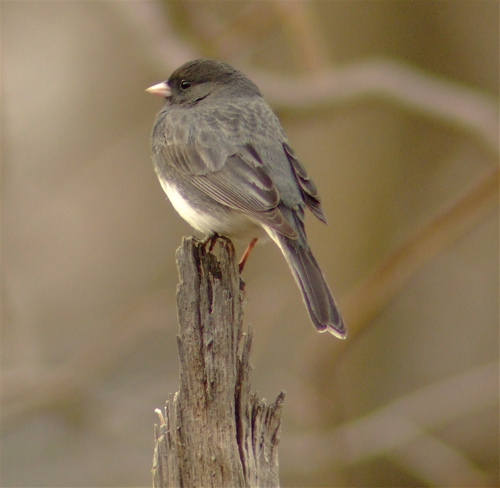 We still have juncos moving through, many were starting to sing some of their territory songs over the weekend. Some even chased each other through the brush piles as the flocks start their northward migration.
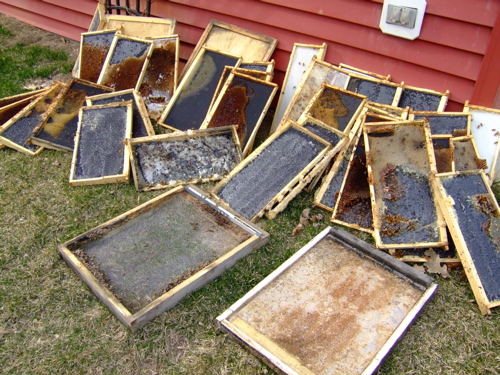
Lorraine has been gleaning honey from the remainders of the Kelli and Kitty hives. As she put the wrecked frames outside, we got some robber bees coming in to them!
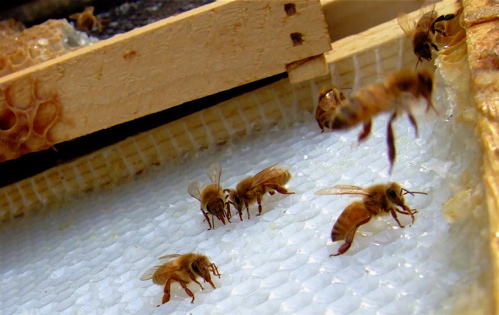
Little honeybees came in to claim what honey we had not. We currently have no active hives in our beeyard...where are these girls coming from? Is it possible that these are bees from our first summer that swarmed off of the Kitty hive? Or is a neighbor also keeping bees? Honeybees will fly 2.5 - 5 miles away from the hive in search of food, so it is conceivable that these are from a neighboring hive. But it's more fun to think them being the Kitty bees. Oh, how I wish I had a little robotic, remote-controlled, helicopter bee cam!
I Needed A Bee Moment...I needed lots of them
 Okay, the next time a hive goes queenless, I think I'm gonna leave it that way and let it go. It's just too much stress to requeen. Maybe I need some sleep to process what happened today, but the beekeeping today was not so much fun. We noticed on Sunday that there was no new eggs and larvae in the Olga hive and that was a sign that the queen had died or was failing. After consulting some beekeepers, I bought a new queen Monday morning and decided to try and requeen the colony. The queen comes in a cage with a candy door (and a few attendants). The idea is to put the cage in the colony, the new bees generally don't care for a new queen and want to attack her--the cage protects the new queen. The workers start to chew on the candy door to get to the queen and kill her. As they are chewing, the queen releases her pheromones and the workers start to think that this new queen isn't so bad after all. In about three to five days, they chew their way through the candy and in all that time, her pheromone has worked its way the colony and everyone has worked out their differences and loves the queen and hopefully, they show her around and she gets to some egg laying.
 For this brilliant plan to truly come together, the old queen must be dead, or she will fight the new queen and possibly kill her and you are left with your old failing queen and soon to be dead hive. So, Fabulous Lorraine and I had to go through the whole colony, frame by frame to see if we could find the old failing Olga queen...and kill her. We were not thrilled with this task and were hoping against hope that we would not find her and not have to kill her. The colony did not sound happy as we started going through each frame, they seemed confused and their buzzing was a little off, I felt certain the queen was totally gone.
 We made it all the way down to the bottom an I checked the contents of the varroa mite trap and was surprised at the amount of discarded bee pollen baskets--all colors. It never occurred to me that they baskets could be dropped and forgotten. There were mites mixed in there too--ew. The bottom box had a very small amount of unhatched brood and the Olga bees vehemently defended the hive at this point. Usually we get bonked on our hoods a couple of times in warning, this time, it was a steady pelting of bonks. Because we were out so long, our smoker stopped smoking (which is used to try and keep the bees calm and less focused on stinging us) and we periodically had to step away and relight it, all the while dodging angry and queenless bees.
 Poor Cabal learned that hard way that he's not fatally allergic to bee stings. Since Mr. Neil wasn't around, Cabal's been lonely and clinging close to his pack. He came over to us while we were at the Olga hive and got stung by one angry bee (when bees sting, they release a pheromone that tells the other workers something bad is here and needs to be stung) and more soon surrounded him. Cabal did what comes natural to a dog--he started whipping his head around to eat the bees coming to attack him--which is the equivalent to humans flailing which just makes bees want to sting you all the more. I gave Lorraine the smoker and she dashed over and covered him with smoke to mask the angry stinging bee pheromone and make sure he didn't have any bees still attacking him. We think he got at least two stings, one on a back leg and one on a neck, but was otherwise okay.
For some reason, when Lorraine walked back to me at the hives, Cabal decided to follow. We're not sure if he was needing reassurance after being stung or if he was trying to warn us about the danger. As soon as he came over, the bees started attacking him again and he tried to eat them. We had to put him in the truck to protect him.
 Have you ever been doing some spring cleaning and you suddenly look around after three hours of work and notice that everything is messier than when you started? That's kind of the way I felt when the above photo was taken. As the bees kept attacking and trying to sting us, Lorraine announced, "I need a moment to de-bee." She sensibly walked away to get away from the buzzing and wipe some bees off. About that time, I felt a tickle on my neck--holy crap, did a bee work its way into my suit? I decided to take a bee moment like Lorraine and confirm bees were not in my suit. Fortunately, it was just my hair brushing my neck. Whew!
After that we went back to work. Lorraine suddenly shouted, "Oh no! Is it on the inside or outside?!" I looked up and noticed that the hood of her beesuit was half unzipped and there were angry Olga bees on the screen in front of her face and a sort of collar of bees working their way to the open zipper. She scampered off and I followed, helpfully shouting, "I'll smoke you! I'll smoke you!"
We go the bees off of her, zipped her up tight and went back to finish our grueling beekeeping task.
 We noticed that most of the brood was almost hatched out in the Olga hive and no new brood behind it. Since the other hives were going like gangbusters, I decided we should take a a frame of brood from one of the other hives. The MimiKo hive appeared to have the most brood and so I took a frame from them. We ended up feeling terrible about it. Because MimiKo and Bickman are new hives, they are fairly friendly right now, we can work in them pretty easily. When I took the frame out, I had to take off all the MimiKo workers, the easiest way seemed to be using a bee brush. Boy, bees don't like the bee brush very much. The sweet, docile MimiKo bees suddenly became incredibly angry--even the ones who didn't get caught in the bee brush bristles.
We went through the whole Olga hive with the frame of brood. After going through each and every frame in the hive, we did not find a life queen. We did find one small, very black, shriveled up bee which I wondered was the dead queen--Olga I was very dark.
 We put in the new queen cage and the workers looked in and went straight for the candy. We slowly put the hive back together, our backs sore from lifting the heavy boxes and being bent over searching each frame for the nonexistent queen. Lorraine pointed out that if we had found the failing queen alive it would have been easier to kill her after being pelted by angry bees all afternoon.
We tried to wipe off all the bees on or suits, gathered our equipment, and loaded up the truck to drive back to the house. A couple of tenacious bees were still following us and we thought it best to keep the full bee suits on in case a bee was still in the vehicle. As I sat down, I felt a tickling on the middle of my chest. I told myself that it was just my hair and to not worry about it. Then it suddenly occurred to me that I no longer have long hair and that could not be the source of the tickling on my chest...something was crawling there. I was still sealed in my bee suit and assumed it was a tick and I pressed it a bit. The tickling got a little faster.
 Lorraine had already started the vehicle and was driving through the field (chock full of dandelions) back towards the road. I shouted, "I NEED A BEE MOMENT! I NEED A BEE MOMENT!" and leaped out of the slow moving truck. Lorraine slammed on the brakes and was in hot pursuit. Trying desperately to have an out of body experience I said, "There's something crawling on my chest." We carefully unzipped my hood and took it off. Lorraine slowly unzipped the front of my bee suit--there, crawling from my chest to the inside of the suit was a bee.
Now, I always thought that when it came to the fight or flight response that I was more of a fight kinda girl. My goodness, was I wrong. I totally took flight. Without a word, I took off running, although, it was hard to run since Lorraine had hold of the arms of the suit and my legs were still in the bottom of the suit. I pushed through the suit and the rest of the zipper ripped open and I tried desperately to keep running while Lorraine pulled on the suit from behind. "I'm trying to save you!" Lorraine shouted. I said nothing but continued to try my awkward run. We got the bee suit off of my legs, along with my shoes. Lorraine, still thinking the bee was in my shirt, helpfully tried to take it off. Overcome with anxiety and and humor of the situation, we just started laughing maniacally.
It's points like this where I'm really grateful that our beekeeping operation is in a remote area and the chances that anyone actually witnessed this strange little tug of war and personal bee removal striptease are incredibly slim.
We took a moment to breathe and then realized that we were still surrounded by bees foraging on the dandelions surrounding us--and I was out of the bee suit and not wearing shoes. We eventually made it back to the house, spent and emotionally drained. Up until this point, the beekeeping had been a fun discovery of cool natural history. Today, it was just hard, messy work.
When we got back to the house, I said, "You know, someone is going to have to check the cage in about three days to make sure the queen is released."
"I like how you said 'someone' like you're not going to be here to do it," she said. We decided it would be best to get some sleep and find our love of beekeeping again before deciding who would check to see if the queen were released.
I am about to collapse from exhaustion myself as I type this. When I came home, I did crawl under a blanket for about five minutes and was a tad weepy. Non Birding Bill came into the bedroom and asked what was the matter and I started recounting the day: we squished bees, we lost the old queen, will the new queen make it, and worst of all, I broke the MimiKo Hive's trust when I took their frame of brood away and used the bee brush on some of them.
NBB started laughing. "You realize that you are upset about breaking the trust of some insects?" NBB asked.
Well, when it's put that way, it does sound kind of silly and I had to chuckle at my self pity.
You can read Lorraine's version here.
Oriole In The Bee Equipment
Ug, I'm getting a backlog of blogging and I'm leaving for another festival tomorrow...prepare for a blogging explosion next week. I was supposed to go out and get to dividing Olga into a second beehive, but was WAY too distracted by birds. There were six, count 'em six, indigo buntings on Mr. Neil's feeders--among all the rose-breasted grosbeaks. Not to mention yellow-rumped warblers jockeying for position on the suet feeder. I was trying desperately to concentrate and focus on bees, not digiscoping birds. I went to the garage to the bee equipment shelves.
 I heard a rustling and then looked up. There on the top shelf was a male Baltimore oriole. How can I focus on bees when the birds are forcing me to watch them? I opened up the garage doors figuring that he would fly out. Instead, he ran behind the equipment and hid.
 Yo, dude, that's not the best hiding spot. The oriole eventually came out from hiding, but instead of flying out the wide open doors, kept flying into closed windows. I took one of the nets from one of our bee hats and tossed it on the not so bright oriole and grabbed it.
 Boy, that bander's grip does come in handy. I gave him a look over and he was fiesty--that was good, he didn't hit the windows too hard. He had bent the tip of his beak a tiny bit, but was otherwise okay. He started whistling in my hand--man, could you feel the power of that song--that's a lotta whistle coming from a tiny bird.
 I gave him to Lorraine to release and he was off. He preened a bit, roused, and then flew down to the grape jelly. A side door was open on the garage, so he must have flown in that way, probably going after what few insects are out and about.
Rolling Bees In Powdered Sugar
Or
How To Make Your Bees Really Angry, Yet Really Popular In The Hive!
Hey, I found a way to soothe a bee sting. Make an apple pie from apples the bees pollinated. That puts you in a forgiving mood.
 So, periodically, I have to check the bees for varroa mites. They have actually been a problem for the last 15 years or so and could be part of the problem with Colony Collapse Disorder. They can seriously weaken your colony. And if you're wondering why I don't talk about CCD much in the blog, here's why: every few years, the media likes to find some disease and use it to scare the pants off of us, "this could wipe out the human race" ie SARS, West Nile, Bird Flu, and now CCD. I want to wait and see before I run around like Chicken Little. Anyway, in some recent photos, I thought I was seeing mites on a bee or two. Case in point, check out the bee just emerging from the cell in the above photo. See the brownish spot on top of the head coming out? I'm fairly certain that is a varroa mite.
 So, I have two ways for testing for mites. One is getting 250 bees, soaking them in alcohol (killing them), and sifting the dead mites from the dead bees. The other is to fill a jar with 250 bees, put screen over the lid, drop in a tablespoon of powdered sugar, roll the bees around in it (not killing them), and letting them sit for a minute. Apparently, the powdered sugar causes the mites to fall off. After a few minutes, I shake the jar and sugar and mites fall through the screen and I return the sugar coated bees to the hive, mite free...although a tad angry. I decided to go with the powdered sugar method, I'd rather have angry bees than dead bees.
 I took out some frames to gather the bees. You're probably wondering how you know when you have 250 bees in a jar? Apparently, one fluid ounce roughly equals 100 bees, so we poured in two and a half ounces of liquid in a jar, marked it with tape. Then we took a bee brush and used that to brush bees into the jar. Once we had them n the jar, we slammed on the lid with the screen, and bonked it to make the bees fall to a pile. Fortunately, we estimated well, and the pile reached the 250 mark. For the record: bees REALLY do not like this at all. I'm pretty sure if someone could translate the buzzing coming from the jar, they would have recorded much profanity and threats of bodily harm.
 It's at this point where you pour in the powdered sugar and roll the pile of bees around to get completely coated. Boy, if I thought they were unhappy before, that's nothing compared to this.
 You let them sit in there to give the varroa mites a chance to fall off. Isn't this just the coolest photo? It's like you're looking into a tunnel of ghost bees. It's like what you might find in the closet of the movie Poltergeist. It's even freakier when you see this image moving around each other.
 After a few minutes we shook the sugar out onto a white plate and we found about three or four varroa mites in each hive. So, we have an infestation, not a bad one and I am choosing not to treat it this fall, but next spring we might take some action, I want read up to see what the latest is. In some areas, the mites are developing a resistance to antibiotics, but there are some other options to look into. So, after the mites are counted, we have to release the sugared bees back to the hive, here's a video, it reminds me of when the ghosts joined the battle in the Lord of the Rings series:
Isn't that freaky. The other workers swarmed around the sugared bees to lick of the sugar. Here's a photo:
 The bees get cleaned off fairly quickly. Here's an up close shot:
 Now, you may be wondering if powdered sugar causes the mites to slide off, why not dump a bunch all over the hive from time to time? Some bee experts say that powdered sugar gives the bees too much starch and can cause problems. Although, I hear there are some beekeepers who do it with good results. Again, I have all winter to research our options before I make a decision.
 Something else interesting we noticed in the Kitty hive, a few of the bees had a yellow mark on them. We did not see this on any of the Olga bees, just Kitty. NBB and I found about four bees with the yellow mark. It almost looks like someone took a tiny paint brush and slapped it down the thorax a la Pepe Le Pew cartoons.
 I watched one of the marked bees for sometime, and I'm guessing that it's just some sort of pollen dust pattern. Maybe from going inside a hibiscus? I don't know, any experienced beekeepers have any input?
And I'll end with one more bee video that NBB shot of some workers trying to clean off a bee. It's a really sweet video, the sugared bee almost falls over and the others rush in to lick off the sugar. Maybe they are trying to help or maybe they are taking advantage of the food, but either way, it's cool:
Hello Bee Sting, Goodbye Dignity
 It was inevitable. Working with bees I had to be stung sooner or later. I've been kind of dreading it, but I thought it was more the anticipation of the sting as opposed to the sting itself. I learned many lessons today, one being that the anticipation of the sting is not worse that the sting itself. The sting HURTS.
One week, I'm hand feeding my bees. The next week, they're stinging me. Women!
It was inevitable. Working with bees I had to be stung sooner or later. I've been kind of dreading it, but I thought it was more the anticipation of the sting as opposed to the sting itself. I learned many lessons today, one being that the anticipation of the sting is not worse that the sting itself. The sting HURTS.
One week, I'm hand feeding my bees. The next week, they're stinging me. Women!
So, we have this madcap plan to rid Mr. Neil's woods of invasive exotic plants like buckthorn and garlic mustard and replace it with (mostly) native or at least bird and bee friendly plants. This is a long term project, but the buckthorn must be taken away--more on this later. Today we began the plan by trying to get some bulbs in the ground that will pop up in early spring to aid the bees with pollen and nectar gathering. We got some daffodil, hyacinth, and crocus bulbs on sale and started putting them around the gardens. I had the brilliant idea of planting the bulbs near some of the hives. This wasn't too crazy of an idea, earlier this week I planted some bee friendly trees (red osier dogwood, lilac, and pussy willow). The cool weather has slowed them down a bit, and as along as I kept a good ten feet from the hives, they were okay with our digging.
 I had been out the hives earlier today--that's where most of these photos came from. I was feeding Kitty and just checking on Olga. For some reason, the bees were really interested in crawling all over my suit. I thought I must have spilled some home made nectar on my bee suit, but in hindsight, I wondering if they had it in for me from the get go? Especially that one on the far left in the above photo. This little pack of Olga bees looks like they are plotting against. But that one on the end, she has it in for me, she wants to do the stingin'.
I went out with Cabal and began planting my bulbs. It was later in the afternoon and the foraging bees were heading back to the hive. I noticed that I was working under the bee super highway, the spot where bees from both hives descend in the area and then split to go to their respective hives. I figured that if I kept bent over and low to the ground, all should go well and it did.
 Then my cell phone rang, it was my sister Terri. I told her that I was standing between the hives, she was honored. I told her that I was sans bee suit and she was really impressed. I continued planting bulbs while on the phone. We caught up and then I noticed Lorraine approaching the bee area. I hung up from my sister and Lorraine paused before coming closer. "Wow, there are a lot of bees." She noted.
I looked over to the Olga hive. In the time I was on the phone with my sister, hundreds of bees had descended on the entrance of the Olga hive. In the instant that I thought I should maybe leave, I felt a prick on my head, just behind my ear, but well into my hair. I realized that I was being stung. It didn't hurt that much in the first instant and I wondered if I really had been stung or if it was a mosquito. Then I heard angry buzzing. Then I felt tremendous pain.
 "I've been stung!" I shouted. Lorraine and Cabal looked as though they were about to bolt. "Ow! It's still in my hair! Ow!"
It was still in my hair and I wondered if I was far enough from the hive to avoid attracting the other bees attention? Would they smell the attack pheromone from her sting and come join the party? I couldn't see where I was stung, but I tried to get the bee out, by flicking fingers near the epicenter of the pain. They dying bee buzzed harder and that sent me into a panic and flight mode and I ran towards Lorraine. I'm not sure if when I reached her I tripped and fell or if some twisted response of stop, drop and roll came into play, but I was on the ground thrashing, yelling all the while, "It's still in my hair! I can hear it!"
Lorraine who is at best on uncertain terms with bees to begin with, tried to look at my hair, but my trashing on the ground was making it difficult. I think I had a fear that the bee would get loose from her stinger and get in my ear. I plugged my ear with my finger and rolled over to the other side, giving Lorraine a view of the stung side of my head. Lorraine started stomping on my ponytail. "It's still there!"
 It was at this point that Cabal sensed something was amiss and wanted to help. He sensed our panic as I was writhing and squealing on the ground and Lorraine was jumping up and down desperately trying to get a bee out of my hair without actually having to touch it. Cabal wanted to help too, but what could a mere dog do? He barked and whimpered and then began digging at my clothes.
 It was at this point I realized the ridiculousness of the situation and just started laughing. Lorraine pulled out the binder holding my ponytail and frantically kept searching for the bee. I could hear more buzzing from my unplugged ear. Every time she would find it, the bee would slip deeper into my hair. It didn't help that the bee was the same color as my hair. Finally, she got it out and then said, "Ah, it's flying at me!"
"That's not the same bee," I warned, "They die after they sting you! That's a different bee!"
 She ran. Cabal ran. I ran. We made it to the four runner, but the bees were still chasing us. We took off down the field. We made it a safe distance away, I looked down to my feet and realized I had kicked off my shoes and was barefoot.
"We have to get back to the four runner." Lorraine said nervously, noting how close it was parked to the hives.
"I have to go back to get my shoes and all the planting tools I left behind." I noted.
 We got the stuff and headed back to the house. Lorraine asked how my head was. For a moment it would have a warm, almost pleasant sensation, then would come searing pain and then it would go back to a warm sensation again. When we got to the house, Lorraine had to go through my hair to find the sting. She asked where it hurt and the area was getting wider. It didn't help that I have really thick hair to sift through. After some searching, she located the stinger and pulled it out, the waves of throbbing pain ended and I could feel the side of my head and ear swelling slightly. We were both nauseous and had some mint tea to soothe ourselves.
I hope no one in a nearby farm house was watching us from afar.
Ah, dignity, it's sometimes overrated.
Son Of A Beeswax!
Non Birding Bill and I headed out to check the status of the Kitty hive. Last time, we had placed a new queen in a cage inside the queenless hive. The cage opening was covered with hard candy. The workers were supposed to chew their way inside and by the time they got to her, the whole hive would be under the spell of the new queen's pheromone.
 When we took out the frame with the queen cage, several bees were gathered around the queen, a good sign. They didn't appear to be attacking the cage, but VERY interested as to what was inside. I decided to remove the cage from the wax to see if the queen was still inside.
 You can see on the side of the box is a piece of tape with a hole chewed through it. Behind the tape is the cage's opening. The opening is jammed with hard candy. The hole in the tape and the tunnel in the candy tells us that the workers have been trying to get the queen out--and have almost made it all the way through.
 If you look at the workers on the side of the cage, you can see their proboscis is out to feed the queen nectar through the screen--they look like they are ready to serve under her rule. We did one more test. I had NBB smoke the cage to remove all the workers and we waited to see how long it would take for the workers to come to her again. Not long! They came to the cage before I had a chance to turn on my camera. Watch them come to the queen:
I think it's safe to say that they are assimilated to her. We put her in on Tuesday and here it is, Saturday afternoon and they are all over her cage, and have almost chewed their way through the hard candy. I decided to go ahead and open up the queen cage like we did when we first installed the bees in April. I'm an old pro at that now. I gave NBB the camera and had him make a video of this momentous occasion:
Did you catch what happened there? In case you missed it, that big bee flying away above my hand in the last few seconds of the video is our queen, flying away. HOLY CRAP! That wasn't supposed to happen! As soon as the camera was off, she flew to the right, I almost had her in my hand. She landed on one of the brood boxes. I went to get her and then she flew behind NBB and I lost track of her. It was not unlike the moment in A Christmas Story when Ralphie lost all the screws when he and his dad were changing the tire and he said in slow motion, "Oooooooooooh Fffffffuuuuuuuuuuuuuuuuuuuudge."
Only, I didn't say "fudge." Imagine the worst profanity you can think of and that's pretty much what I said at that moment. What else could possibly go wrong with the Kitty hive? I briefly thought back to just a scant two months ago when Olga was the problem child.
Then, I immediately switched gears to problem solving mode, and thought back to the beekeeping class I took. The instructors warned us that this could happen when we would be hiving our new packages and releasing the queen. They said the thing to do is just stand where you are when the queen left and wait for fifteen minutes. The queen who just flew off is full of eggs and ready to lay and therefore, kinda heavy. She can't fly far and as she leaves she will realize that this isn't really what she wants, she's not going to find what she's looking for on this flight and back track. She'll look for familiar objects from where she she started--what could be more noticeable than two giants dressed all in white?
We stood and waited. I noticed when she flew that she was obviously larger than the workers and flew like a drone--slow and heavy. I went behind NBB to see if I could find her clinging to any nearby bushes, but didn't see her. NBB and I still waited. A large bee flew by my head, I watched it land at the entrance--drat, it was only a drone. The noon time sun combined with my tension of wondering if the queen would come back started to form sweat along my forehead and back. I kept remembering what the instructors told us, that the queen would come back, even if we didn't see her. After fifteen minutes, go ahead and close up the hive, she was probably in there. Although, those instructions were for installing a package in April when there were no leaves on the trees, no flowers, and much cooler weather. This was a warm, sunny day, with clover all around, and trees chock full of leaves--perfect for a queen to hide. Would the same strategy work?
Another large bee bounced off my hood, I watched it fly low to the ground, and then to the entrance. Another #$%& drone.
I started to form another strategy in head. The queen dealer wasn't far, maybe I could pick up another queen and start all over? Boy, that would be embarrassing to explain that I lost another queen. Although, I prudently hadn't killed the queen cell with an egg that we found last week, maybe I could just go with that plan? Suddenly, a large bee came from behind NBB, it was heavy and slow, and very tan. It landed right on the frame where the queen cage had been. Could it be? Was it really? YES! Yes, yes, yes, yes, yes yes! The queen came back! Of course, we videoed her triumphant return:
I'm sure we only waited for less than five minutes, but I have to say that it felt like we were waiting for an hour! In case you are having trouble viewing her in the video, I did get photos:
 She's right in the middle of the photo, surrounded by attendants. Note how her abdomen extends well past her wings. She's also much lighter in color than the original Queen Kitty. We have noticed that our workers in both hives have been changing colors. This hive started with lighter bees and now has darker bees, I'm sure it has to do with what types of drones the queen was mated with. The queen dealer told me that he had mated this queen with a variety of males, including a couple of carniolan drones which should bring me some colorful workers. Since carniolans are black, I wonder if the original Queen Kitty was carniolan?

Anyway, help us, Queen Kitty II, you're our only hope. The workers will show her around, she'll get rid of any queen cells in progress, and commence to layin' some eggs. Man, oh man, what nail biter that hive visit was.
 In other news, the Olga hive continues to be a model of good bee behavior. We got in our new Ross Rounds comb honey super and are going to try that since we are having so many problems with the original comb honey kit. I'm happy to report that not only did the Ross Rounds kit come with instructions (unlike the other kit) but it was already assembled. Since I didn't want to waste time, we didn't paint it, but added it right to the Olga hive. You can tell the Ross super from the rest because it's not painted. Here's hoping we get some good old honey out of that.
Digiscoped Images
Fresh Tweets
Would you like to hire me as a speaker for your event?
Email sharon@birdchick.com