Birdchick Blog
Adventures In Female Urination
This post maybe TMI for some people. Take note of the title and if that is not your favorite subject or something you don't like imagine other people doing, I would recommend you stop reading and maybe check out this cool post by my buddy Amber about some gannet rescue she did while on vacation in Florida. When I travel, I'm periodically asked by friends to take along a stuffed animal or a Flat Stanley for photos. I almost always decline. Number one--suitcase space is an issue and number two--I always lose something when I travel, whether it be accidental or confiscated by airport staff. Stuff just goes missing. If I lost a friend's treasured critter that's been photographed all over the planet, I'd feel terrible.

So, I got a request from an online rabbit name Audrey from All About You asking if I could take a stunt Audrey with me overseas. She has a blog and it would be a reciprocal blogging thing. I thought, "Okay, they have stunt rabbits, this isn't a treasured animal, I can do this."
So, Audrey came with me and we had a lovely time in Frankfurt. Above she is hanging out with a rather large snail outside our Frankfurt hotel.

We shared a beer in a Frankfurt bar (although, I had to chuckle at her choice of fruity beer--grapefruit beer? Really?).

And then this is the last known photo of Audrey. After getting her photo next to a Frankfurt sign warning that you are being watched, she nestled into my checked luggage for our flight to Kazakhstan...and hasn't been seen since.
ARRRGH! I feel terrible!
And she wasn't the only thing missing from my checked luggage. I had also recently won a female urinary device known as GoGirl at an outdoor convention. I was anxious to try this out. But like Audrey, it was missing from my checked luggage. I don't know why, don't want to know why.

And there were several times I missed my GoGirl. For example, above is one of our restroom stops. Our birding guide in Kazakhstan was more of an ornithologist than tour leader, so his bathroom breaks were stops like this with girls on one side boys on the other. I can go outdoors, but with short legs, there are some challenges, and I have a shy bladder. This was not ideal for me...I like a bush, a shrub for the illusion of privacy. Also, I like something to lean on or prop up against.

If we did have restrooms, they were like this. Let's take a closer look.

I really missed my GoGirl here.

I was excited at this birding spot--if you look in the distance towards the center left, there's an old wall--a perfect spot for female privacy. I went around the wall, away from the birding group, I got in a good leaning position and started to go. All was running smoothly until a slight movement in my peripheral vision caught my attention. I looked and focused on the critter that was the same color as the wall and about to crawl on my exposed area...and that was the moment I got my lifer scorpion. Didn't know they had those in Kazakhstan.
I lept up, there was spray, and a little tumbling. After a moment's recovery, I got my camera out for a photo.

Apparently, my chosen leaning location was a little nook that the scorpion liked to crawl into. All I got was a photo of its tail. It was only about four inches long, but still freaked out this Midwestern girl. I also have a new appreciation for the quick dry material on REI's convertible pants.

On our final day in Kazakhstan we hit a storm and it got very rainy. I asked our guide if we could stop some place for a toilet. He looked around and said, "This place is good," and pointed to the surrounding shrubbery.
I said, "I really need someplace dry and maybe we could go to a gas station, I'll buy the vehicle some gas. A cafe? I'll buy some food, any place but I just want it dry."
He looked skeptical but said he would find me some place dry. Our vehicle stopped and I didn't see any buildings, the terrain was as remote as the above photo. He pointed to a blue railing along the road and said, "See that blue pipe? That is bridge, you go under road, it be dry there."
And it was dry and I appreciated it.
So, Audrey and GoGirl, where ever you two are, I hope you are being put to good use.
Birding Korgalzhyn State Nature Reserve
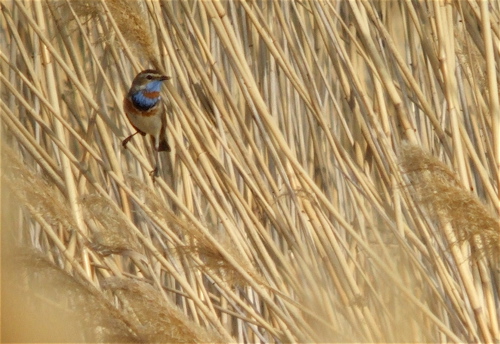
Below is one of my favorite shots from Kazakhstan. It makes me wish I could paint. I would love to spend an entire day lost in creating this shot of a brown bird, with a stunning sky blue and rust patch on his throat, surrounded by golden reeds:
It's a bluethroat, these are actually possible to see in Alaska during the breeding season, then they head to Asia for the winter. However, it is a common bird in Europe and Asia. I love it, in my neck of the woods I have a common yellowthroat in the reeds, over there, it's a bluethroat. Although, it's not a warbler, it's actually in the family turdidae...same as American robin.
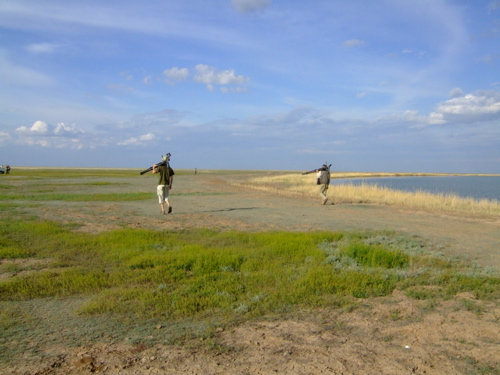
We birded our way through Korgalzhyn State Nature Reserve on our way to our evening accommodations. I hope you're not tired of the long range shots of Kazakhstan. Our information about the country said that there are fewer than six people per square mile...when you are out of the major cities, you could feel it. What a treat to be out in the middle of nowhere and at times not hear the sound of human or machinery.
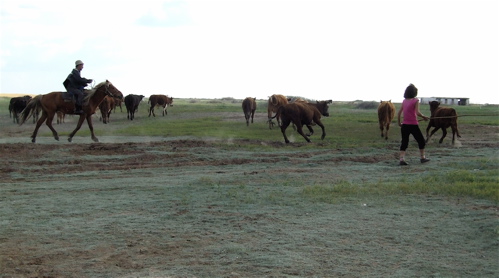
When we did encounter locals while we were birding, it was almost always Kazak cowboys--sometimes it was a joint effort of husband and wife and at other times, a lone cowboy on a horse with his trusty canine companion beside him.
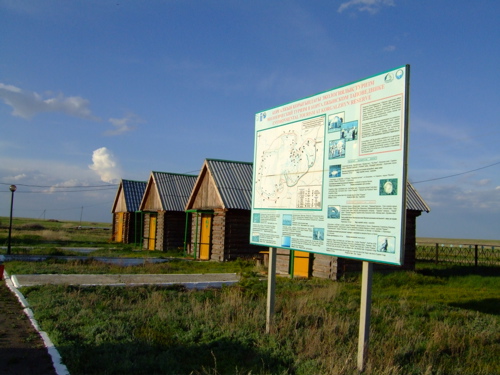
One of the items that was noticeable in my itinerary for Kazakhstan was the note that we would be going to Korgalzhyn State Nature Reserve and "small huts provide simple accommodation. We recommend a sleeping bag for this overnight stay." The photo included with the brochure showed the small huts surrounded by snow. I was fortunate that our visit was late enough in the spring that they snow had melted.
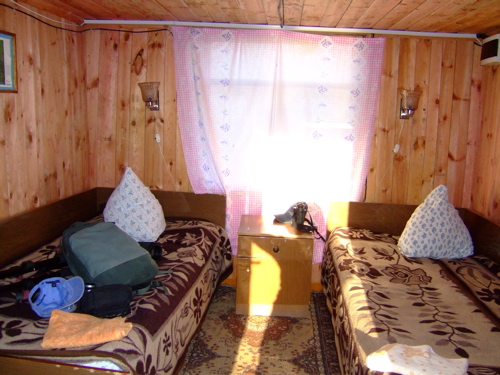
The huts were indeed simple accommodations that included two beds, a night stand, and a tv (it barely got one channel and was intended for searching out severe weather reports)--the shower was outdoors and the toilet was an outhouse (more on using the adventures of going outdoors later).
Before I left, I wondered how I could pack my sleeping bag--it's huge and easily takes up half a large suitcase. Fortunately, Mr. Neil (being a well experienced traveller) loaned me a tiny yet oh so warm silk sleeping bag. I was grateful for the toasty sleeping bag, the sleeping quarters were sparse and meant for researchers working the nature reserve and the extra warmth was much appreciated as the temps felt like they got down into the 40 degree Fahrenheit range.
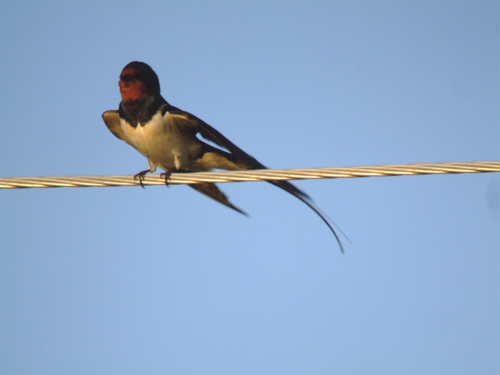
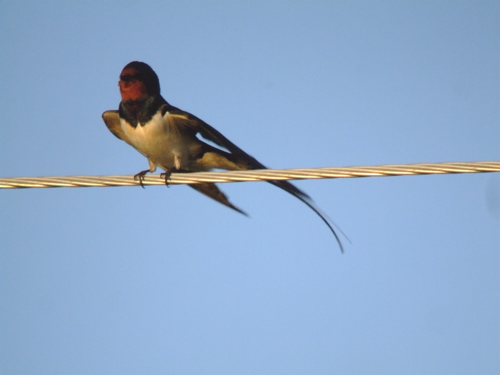
Check it out, one of the most common birds in the world--the barn swallow! I think even though this is the same species as the one I see in North American, it seemed to have a longer tail--must be a regional difference. We had already done a full day's birding on our way to the research station with the huts. The plan was to spend the night, try out some new Swarovski equipment in the morning and then head off to see the sociable lapwing. It was a delight around the research station for anyone remotely into photography--we arrived last in the afternoon and the light was perfect. We were cut loose from the formal part of the tour and given time to explore the area while our evening meal was prepared for us. An excited group of birders at a remote research station, surrounded by new birds in perfect light while food and beer was being gathered for us when the sun went down--how could it not be more perfect than that?
There were some bugs. None of my photos do the bugs justice. I even got a video of my buddy Clay walking up through the grass to kicking them up, but YouTube just does not have the quality to convey the quantity. Here's a link to a photo of a hatch of mayflies...this sort of conveys it. They didn't really bite, but every time we took a step in the grass, a swarm flew up and they just kind of floated and would hang near your hears, or accidentally get inhaled into your nose. Corey and I both remarked at how miserable our respective spouses would be having all these bugs all over the place.
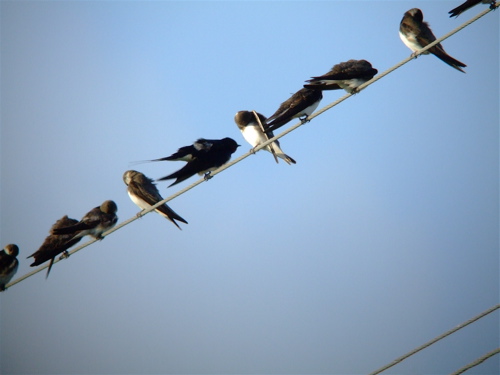
It also explained why there were so many swallows around the research station.
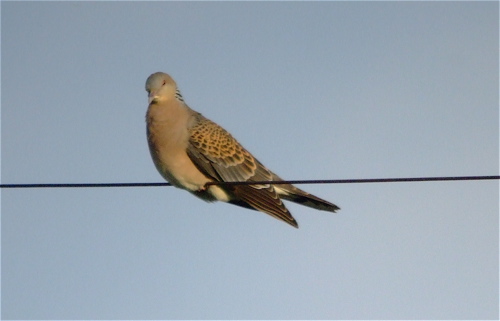
But the birding was just grand! I think the above is now one of my all time favorite does. It's called an Oriental turtle dove and the coloration reminded me of a kestrel--heck the birds have pointed wings, so when flying they look very much like a kestrel.

I was very excited to see one of these--this is a Eurasian tree sparrow. There's actually a small introduced population of these birds in St. Louis, MO. But it's more fun to see a bird in its natural habitat. Quite a few hung around the research station, very similar in habit to the house sparrow.
As I was walking along, I heard a very familiar sound...it took a moment to register...what was that sound...I know I should know it...then it hit me:
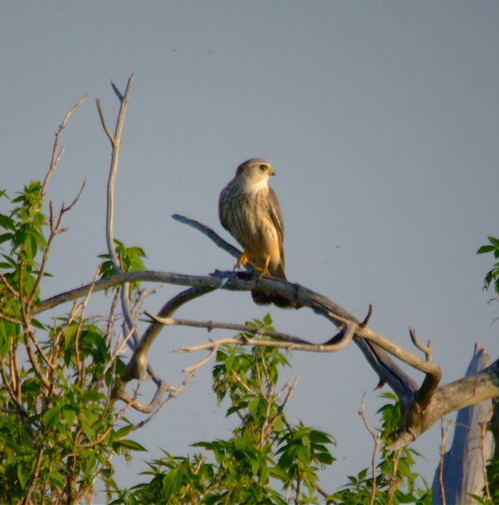
It was a merlin--just like the one's we see in Minnesota. Merlins can have different color variations, some are dark and some are light. In the US, usually the prairie merlins are lighter in color. Well, here we were in the short-grass prairie area of the Steppes and this was hands down one of the lightest merlins I had ever seen in my life. Merlins are a falcon like a kestrel or a peregrine. One of the things that all falcons of the world have in common is a malar stripe. That stripe that goes vertically down under each eye. Click on the photo links to some falcons: peregrine, kestrel, hobby, lanner--note that they all have that stripe? Merlins have a lighter malar stripe in general, but this bird was so pale, he looked like he had no stripe at all.

Speaking of familiar birds, we also saw several magpies. Here we call them black-billed magpies, there they are just magpies--both have the same latin name: Pica pica. Yes, I choose you.

Quite a few of the birds were out and about eating the insects we were kicking up. Above is a tree pipit that would fly off the wire and go for them.
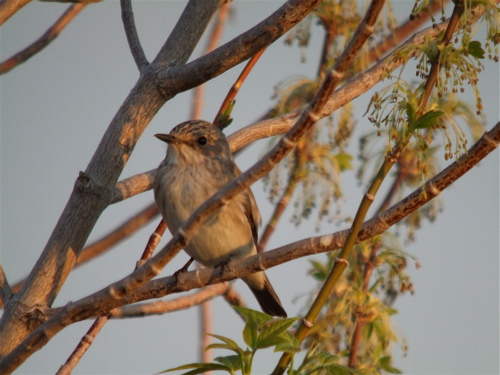
Here is a spotted flycatcher that was also going after the insects. This bird was actually perched near a bird banding station. Some nets were out, but they were closed and tied up--easy for the birds to see and difficult or them to become trapped. The flimsy insects did get caught in them and the flycatcher took full advantage of the situation, flying down get the bugs trapped in the nets. This bird was not the brightest bulb on the tree...the next morning, one of the researchers unfurled the nets and withing moments...
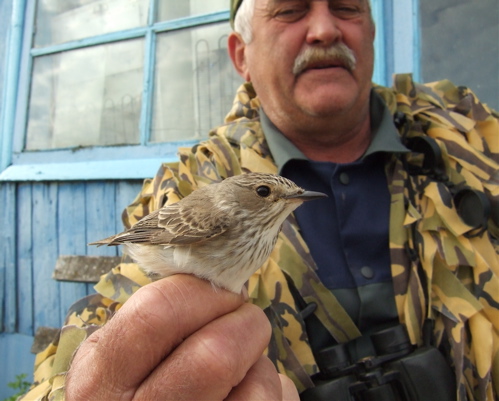
The spotted flycatcher was caught in the nets and banded (or ringed as they call it over there).
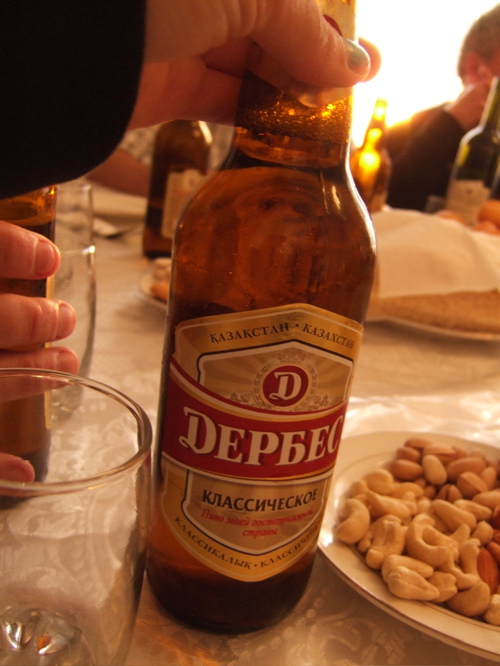
As the light became too dim to photograph, all of us made our way back to the station for nourishment. I avoided tap water on this trip (and for those curious, I did not get any shots before I left, my tetnus was updated, and I opted to not get any of the Hepatitus or Typhiod vaccines). I stuck with bottled water, Fanta, beer, vodka, wine, and aquavit.
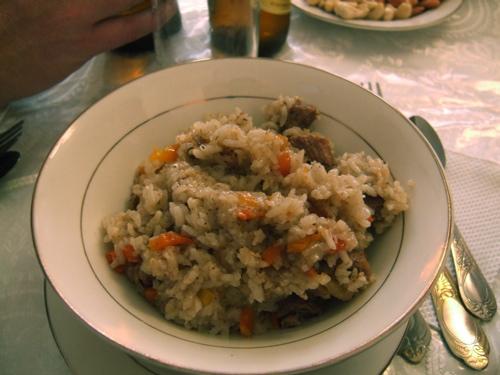
Meals were interesting, you would get something like the rice and meat dish seen above and you would think, "OK, we're near China, this is going to have an Asian flavor to it." It did not, it was quite bland and refused to make any kind of flavor statement. It was good filling food, but not a taste sensation. I would say that the one constant with all our meals was tomatoes and cucumbers. Those were served with breakfast, lunch, and dinner. Often in the form of a salad with a light dill vinagerette or as in the case of our packed lunches--just raw. Bread was also a constant--we either had very dry crusty bread or a fried dough ball...kind of like a donut without the sugar.
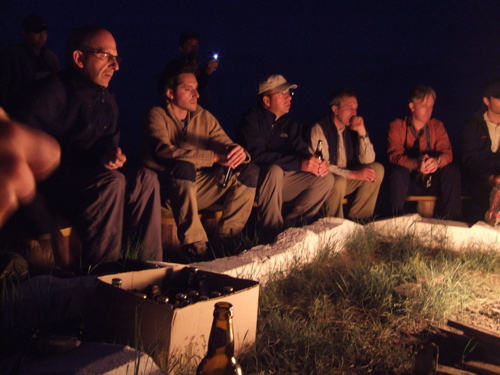
After dinner we sat around a bonfire with our box beer. The fire was no small feet--trees are few and far between on the Steppes, so it was made with wood from old crates or collapsing building near the station.
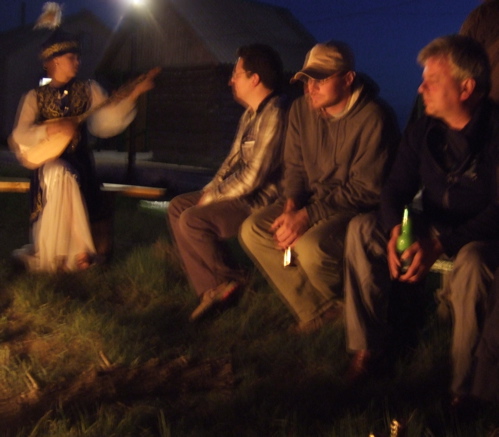
We were treated to the music styling of a young woman not only dressed in traditional costume, but also played a small guitar of Kazak folk tunes. It started with her and later her father played a few tunes on the instrument. The small guitar looking instrument only had two strings, but both players got incredible harmonies out of it. I caught a little on my camera--and do listen, it's incredible for how simple and instrument it looks:
A lovely way to end a day of amazing birding and it was exciting to know that more adventures awaited us.
Odd Birding Moments In Kazakhstan
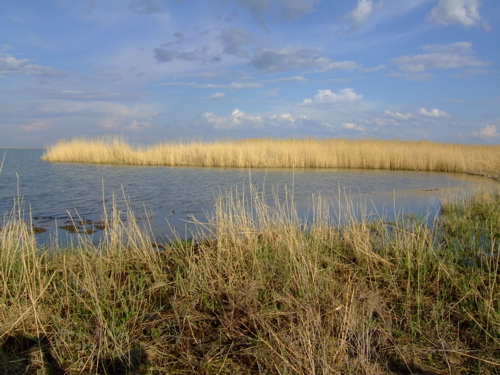
Most of the time I was in Kazakhstan, I just kind of looked around with an overwhelming sense of gratitude and wondering, "How the heck did I get here?"
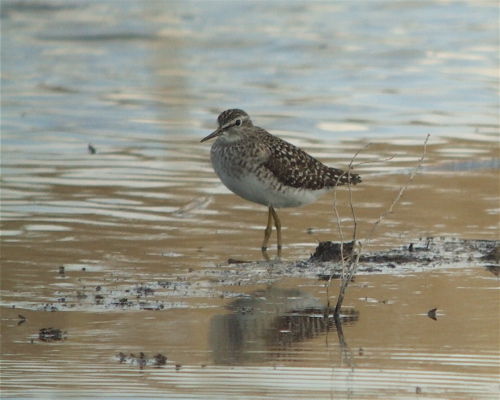
I also had some strange birding moments. Take the above wood sandpiper (it looks very similar to the yellowlegs we see in the US). This should have been a target species for me in it's native habitat. However, I had already seen one--almost a year to the day I took this photo on the Steppes. This time last year, Clay Taylor and I were on a digiscoping team at the World Series of Birding. Right before we arrived, a wood sandpiper had been reported in Delaware, so we both headed over to see it. And now, here Clay and I were watching it in it's natural environment. I looked at Clay and said, "Can you believe this, we saw this species last year."
"Yeah," he said, "3000 miles away."
Who would have thought that a year later we'd be in Kazakhstan watching it in it's native environment. Life is strange that way.
There were other birds too, like the European birders were always quick to point out the common cranes--a beautiful species...that I also saw last year in Nebraska--how weird, I should have been way more excited about that bird. Not that it wasn't cool to see, but just strange that there would be birds I had already seen as rarities in North America.
There were some odd challenges on this trip. As one of only three Americans in the group, I was totally in the minority and much different target birds than the many European birders. To them, lapwings, wagtails, and ruffs were common birds. To me, they were lifers. There are some birds I'm content to get a brief look and trudge on for more unique species, but there are some iconic birds like northern lapwing that I really wanted a good look at. I didn't get the look I was hoping for of a lapwing, but I'm sure I'll be in England at some point.
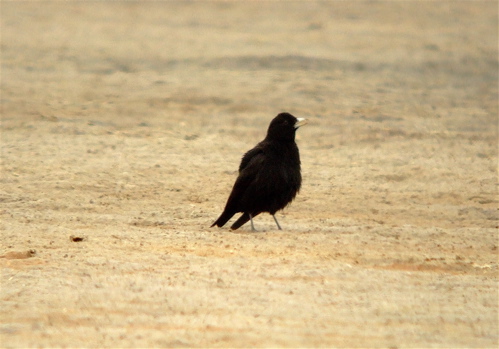
The European birders were very excited about black larks...and they were hard birds to get close to. Many wanted to get it's photo, but being a bird of open space, they were wary and it's hard to sneak up on a bird without any cover for you yourself to hide in. But it seemed as though we stopped for just about every black lark we passed.
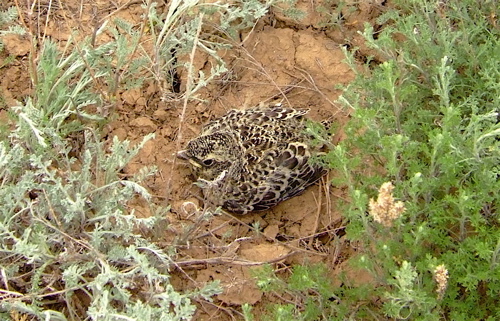
The closest we got to a lark was this young one about ready to fledge. It used its cryptic plumage to blend in with the surrounding vegetation rather than fly away from potential predators on uncertain wings.

Meanwhile, a couple of the Brits thought I was nuts for wanting the bus to stop to stop for ruffs. These are a charismatic species of shorebird that sometimes make it to the US--it's rare bird worthy in my state, but it's a bird I have not managed to see. To have a chance to see one--let alone a whole flock was just too much. I asked the bus to stop for a photo. One of the Brit's said, "Oh, that's not much of a look, let's keep going."
"Oy," I said, "we've stopped for a bunch of black larks, we can stop or this girl's lifer ruff."
He was right, it wasn't the best look at a ruff--they're barely poking above the grass, but this was as good as it was going to get for me on this trip.
All part of the fun of negotiating birds on a trip. I could understand their logic. This would be like me leading a trip in North Dakota to go see a Baird's sparrow and someone was freaked out and wanted to stop because they just saw their lifer Baltimore oriole fly over the bus. My logic would be, "Orioles are feeder birds, we can get it later, let's go for the harder to see Baird's sparrow."
However, that person may not have another shot while they are in the country--all part of the fun and challenge of birding!
I Learned Why It's Called A Rookery!
Hey, if you're looking for a good reference of collective bird names, check this out. I don't know about you, but I'm feeling about as giddy as a a conventicle of magpies. I've had more than one person ask me why heron colonies are called "rookeries" and I've never gotten around to looking up the answer. Well, I had the chance to find out first hand why they are called that.
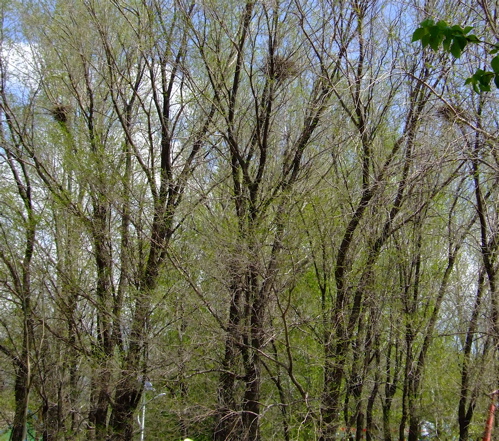
We found a few spots in Kazakhstan where several large nests were built in the trees--not unlike heron nests.
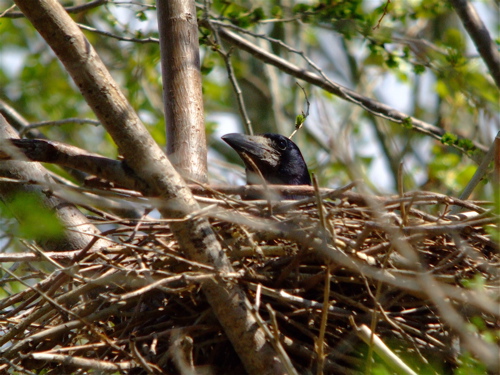
Only these were not built by herons, but were built by rooks. They look like crows with a sort of reverse goatee thing going on. The area around their bill is featherless and shows pale gray skin. As we were looking at a rook in the field guide, my buddy Clay read, "Rooks nest in colonies called 'rookeries."
We both looked at each other and said, "Duh!"
I was excited at this realization--ah rooks--nesting together in a rookery--like a heron rookery. I was surprised that I didn't figure this out sooner. I have been vaguely aware of rooks, but since they are like crows and crows in my neck of the woods are not colony nesters, I never put two and two together.
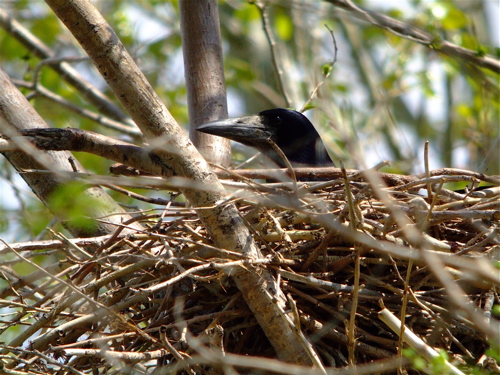
Rooks are a common bird in Kazakhstan and in Europe. One of our fellow participants by the name of Mike Weedon thought it odd that I came all the way to Kazakhstan to get a photo of what would be a common garden bird for him--but one person's common bird is another's lifer.
Here's a video that isn't all that exciting, except that you can hear other rooks calling the background. I chuckled because I realized that when I was a kid and watched the movie, The Last Unicorn, rook calls were used in the background.
[youtube]http://www.youtube.com/watch?v=mMx3D63ZMxQ[/youtube]
The Steppe Family
So in some ways it was like being around one large blended family when birding the Kazakh Steppes: What gull is that? Steppe gull. What eagle is that? Steppe eagle? Oh, cute! What mammal is that? Steppe marmot.
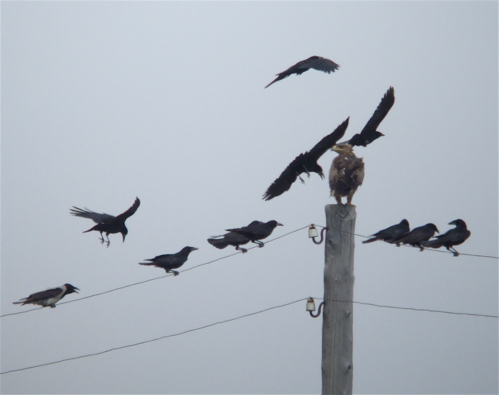
Above is a Steppe eagle being mobbed by a hooded crows, rooks, and carrion crows (apparently the crows did not get the memo that they should be Steppe crows).
Now, if you're wondering why is this area called The Steppes--is it one large stair case? No, it's basically short-grass prairie and I think the word steppe comes from a Russian word...which I don't have the keyboard to spell. Although, I just went to Babel Fish and typed in "Steppe" and it gave me this: Степь.

Quite a bit of the birding was like birding in North and South Dakota. But unlike North Dakota where we're only seeing less than 1% of the prairie that was once there, in Kazakhstan...it goes on and on and on. Our tour info read that there are less then 6 people per square mile in Kazakhstan. When you got out of the cities, you could feel how that number was true.
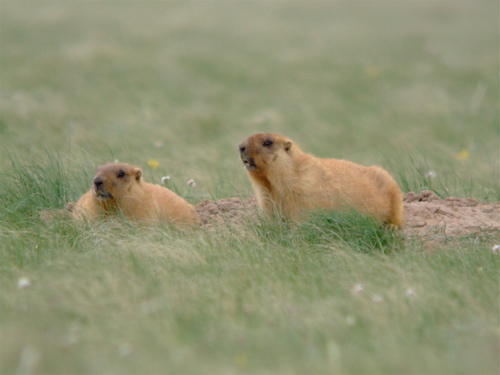
Above is a pair of Steppe marmots...kind of like groundhogs where I live. Although, with their coloring, they kind of looked like over sized prairie dogs.
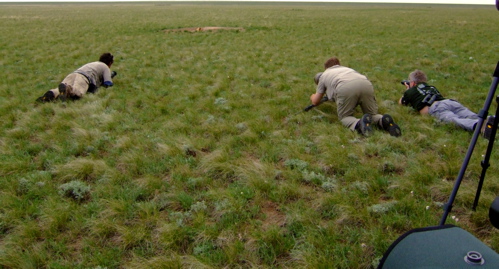
Most in our group where digiscoping our adventures--using point and shoot cameras or SLRs attached to our spotting scopes to get photos. A few in our group would use their own cameras. It was fun to watch them sneak up closer and closer to the marmots. I actually have video of their movements...but I'm pretty sure I'd destroy some European relations if I posted it. As the photographers crouched closer and closer...
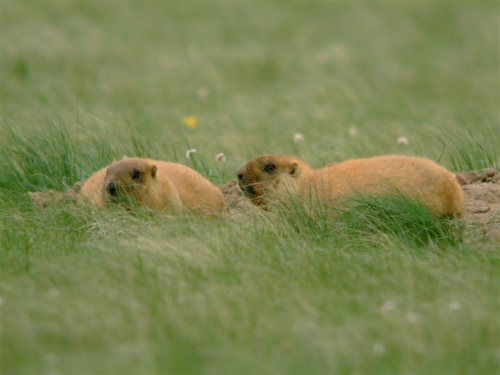
...the marmots crouched lower and lower in response. One finally went down in the burrow. The remaining marmot did not appear to buy our efforts at hiding:
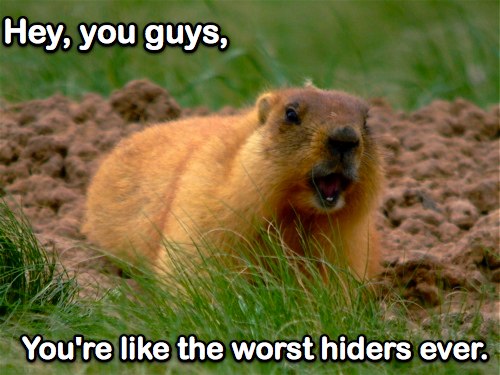
It stood guard and barked at us. Here is a video and you can hear the high pitched barking (and lots of wind).
[youtube]http://www.youtube.com/watch?v=BUp0szhgJvg[/youtube]
We all got our shots and then left the barking marmots in peace.
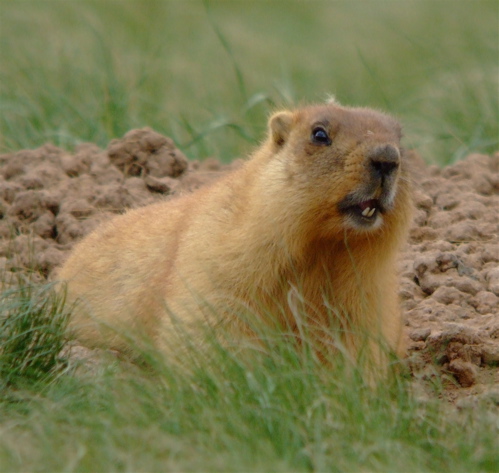
I'm sure that marmot is feeling very macho and said to its partner, "Did you see that? That group of twenty humans stopped near our burrow, about a half dozen of them closed in and my mighty bark forced them to flee. I am Macho Marmot, Terror of the Steppes!"
Just don't try that strategy with a Steppe eagle, dude.
Landing In Kazakhstan
We departed Frankfurt, Germany for Kazakhstan. Our flight left in early afternoon and between the long flight and time change, it was well past 11pm when we arrived in Astana, Kazakhstan.
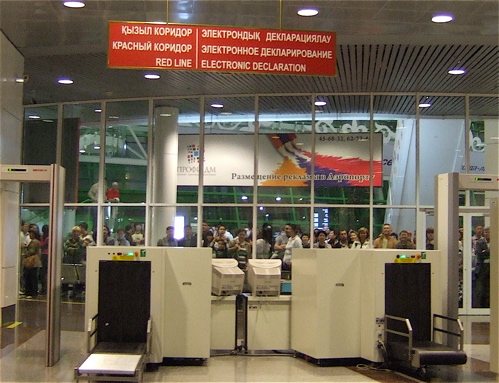
As we de-boarded the plane, a woman in a corner wearing a lab coat and mask aimed some kind scanner at us to see if anyone was carrying a significant fever (presumably over swine flu fears). We got our bags, made through the above security screening and taxi drivers and were on our way to the hotel. The taller building had these odd lights surrounding their structures which gave the illusion that they were sparkling. We checked in and I made to my room a little after midnight. I called my husband through Skype to let him know I was alive and what my initial impressions were. I told him I had to meet the group at 6:30am and he told me to get to bed. As soon as I hung up, I heard outside my hotel room door:
"Hey, Shaz, you awake?"
It was my buddy Clay Taylor. I could hear mischief in his voice, so I said, "You betcha!"
"You gotta come out and see this!"
I stepped out and found on the hotel's spiral staircase:
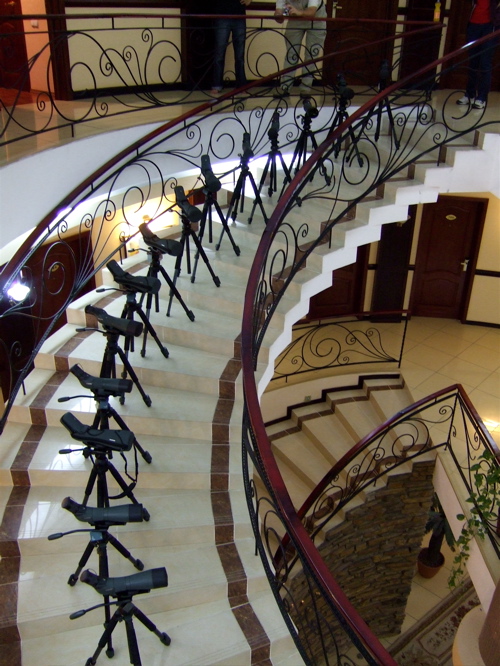
that the jet lagged and somewhat slap happy Swarovski employees had artfully displayed all of their spotting scopes onto the stairs. Pictures were being taken at all angles and all this was going on well past 1am and we had to meet at 6:30am.

When I made it back to my room to settle in for a few hours sleep, I noticed this sticker on the mini bar. I'm not sure what the hotel was trying to tell me. Perhaps that I should feel comfortable enough to dawn a Speedo in my room and have some ice cream.
I'm also not sure if I have officially said why I went to Kazakhstan in the blog. Swarovski Optik is introducing some new equipment including spotting scopes, eye pieces, and digiscoping adaptor. They invited a group from the US and Europe to not only test out this new equipment but to also witness some of the work they are funding with the sociable lapwing with BirdLife International.
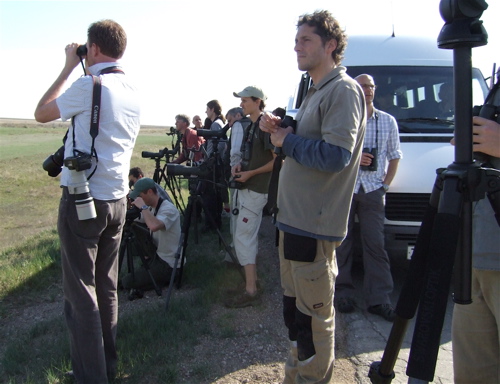
When the group introduced themselves at breakfast that first morning, I was struck that only Corey Finger of 10,000 Birds and myself were the only attending from the US. I was also the only one there remotely representing a birding publication from the US (you can find my articles in WildBird Magazine). The rest were editors of other birding publications from England, Germany, Italy, all over Europe--I'll go more indepth later, I have a new affection for birding with Eupopeans--especially the Brits. It's like birding with regular people who happen to have a strong interest in birds.
Anyway, with the group of people who were invited, I was honored to be included as an attendee and was constantly looking around asking myself, "How the heck did I end up here?"
Proving once again that the Talking Heads Letting The Days Go By is my theme song.
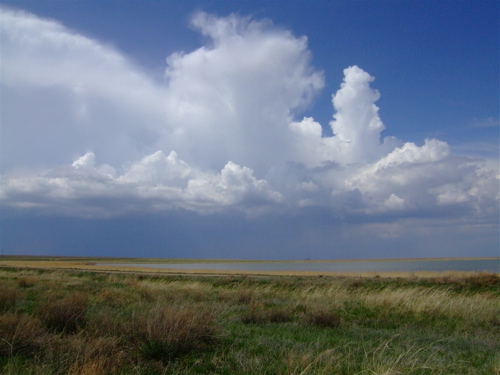
We started our birding adventure on the Steppes which was basically large tracts of short grass priaire. So much of it reminded me of the Dakotas. I had to contain myself as we passed common birds to make it to the assigned birding patch. But I couldn't help but salivate as we passed dozens of red-footed falcons nesting right off the side of the road.
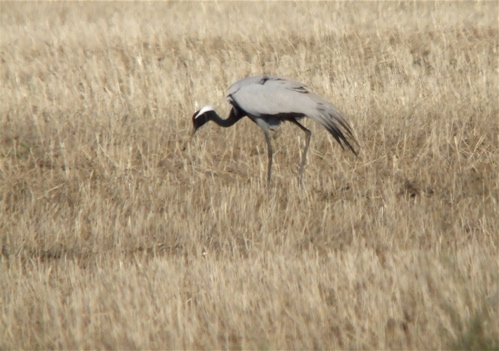
However, a pair of demoiselle cranes was enough to force our buses over before we reached our destination. They were distant, but with the scopes we could get some souvenir shots. My point and shoot camera isn't strong enough to catch every detail when the bird is at a distance. When I looked through with my naked eye, I could see this birds blazing red eye--what a cool start to our birding trip.
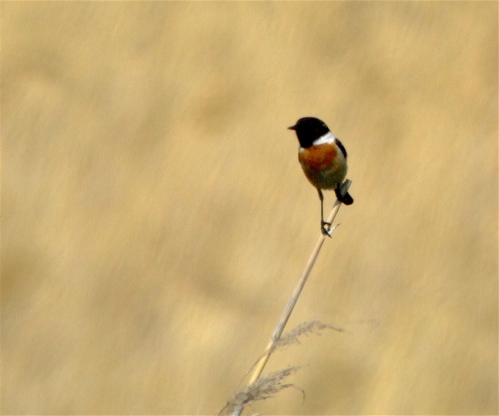
One of the common birds we saw right away was this stonechat. As the birds popped up on the prairie, I was able to get some shots and felt a great relief that I wouldn't as challenging a time taking photos as I did under the heavy tree canopy in Guatemala.
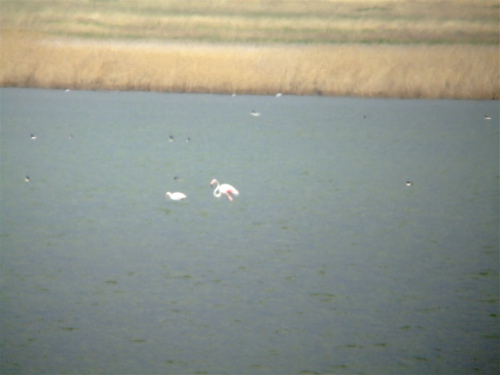
A super exciting bird that I got to see at a great distance was a wild flamingo! I always thought that I would have to go to Africa to see one of those wild and untamed, but they also breed in Kazakhstan. Not the best view in the world, but still I was able to make out that iconic shape in the distance.
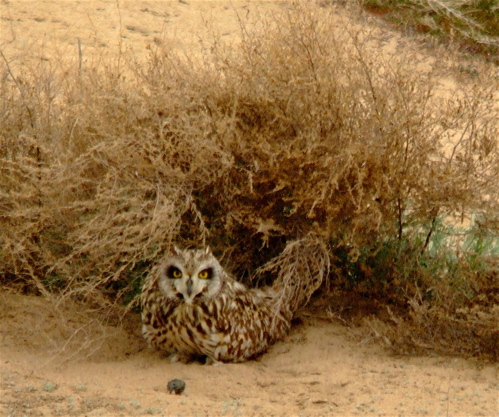
I was suprised by the overlap of species that I saw, that I could see in the US. Above is a short-eared owl--we saw a couple of them. I love this photo, the owl hidden in some brush, it would be hunting soon...note the big fat pellet on the ground in front of it (even its little ear tufts are up). This was not the only bird. At one point, I was watching some waterfowl and I heard the familiar "meep, meep, meep" of a gadwall. I thought it was a ringtone on my phone and then remembered my phone wasn't working and saw three fly overhead. It was nice and fun to see some familiar birds.
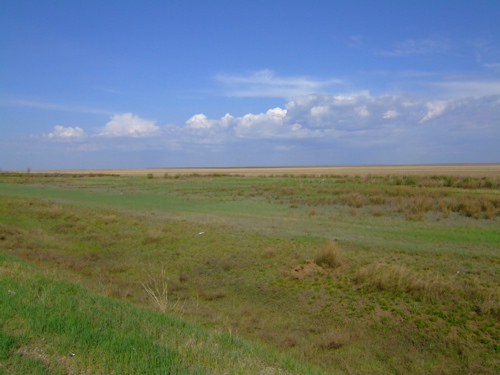
I have to step out to do some eagle banding, we will continue our Kazakhstan travels soon.
From Frankfurt With Love
I love this shot of the full moon visible from our flight to Europe.
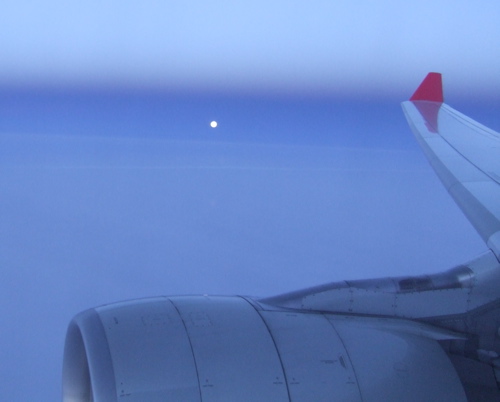
My journey to Kazakhstan started with a trip to Frankfurt. My flights worked out to go from the Twin Cities, to Detroit, to Frankfurt and then on to Kazakhstan. Originally, I was supposed to do this all in one day, but for whatever reason, it saved $1000 for me to arrive a day ahead, spend the night in Frankfurt and fly to Kazakhstan the following day--which I'm really glad happened that way. It gave me a chance to catch up with the time change...and finally do a bit of European birding. This was my first time across the Atlantic.
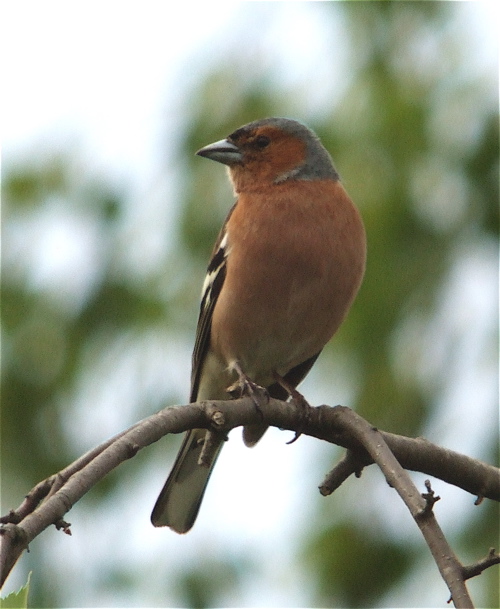
I was able to walk around the hotel and all the birds were new like the above chaffinch. I also looked forward to experiencing some of the iconic birds of Europe like the nightingale which I did not see, but only heard. This was fine with me, the song of the nightingale is written about so often, I'm not sure I would have counted it if I did not hear it (even if I saw it). Here's a sample of the nightingale song.

Some birds were just down right confusing to my little American brain. Above is a blackbird--as a matter of fact, this is the very blackbird referenced in the Beatles song, Blackbird Singing In The Dead Of Night...which this bird did do...right outside my hotel room window. However, if you look at the shape of this bird, it resembles an American robin, not something like a red-winged blackbird. Check out the bill on this bird.
Robins that I see are in the genus Turdus, their scientific name is Turdus migratorius. Well, the blackbird above has the scientific name Turdus merula--they are in the same genus as North American robins. European blackbirds are not the same as North American blackbirds, they are like our robins.
It gets more confusing!
Here is what a European robin looks like. It's not shaped like a Turdus at all (did I actually type that last sentence, yes I did). The European robin's scientific name is Erithacus rubecula, it's not in the same genus as North American robins, about all they have in common are featers, an orange breast and a love of insects for breakfast.
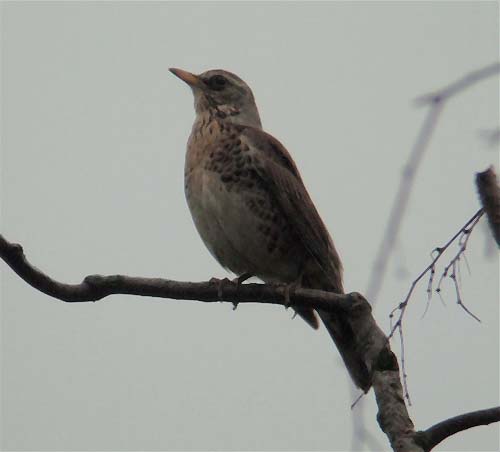
Anyway, here is another exciting (at least to me) Turdus that I got to see--a fieldfare. My only regret is that when I was finally able to get my hands on my digiscoping equipment, it was softly raining and the light was terrible. But I had a great time watching something shaped like the robin I'm used to, but colored in a different way.
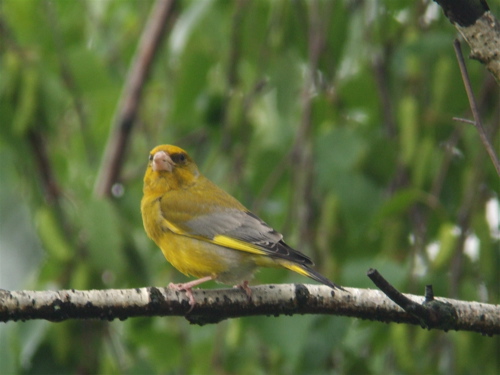
This is a green finch. After hearing the nightingale, seeing the blackbird, and then seeing this bird I thought, "All I need now is a linnet and I have a song from Sweeney Todd." I didn't get one around the Frankfurt hotel, but did later in Kazakhstan. Score!
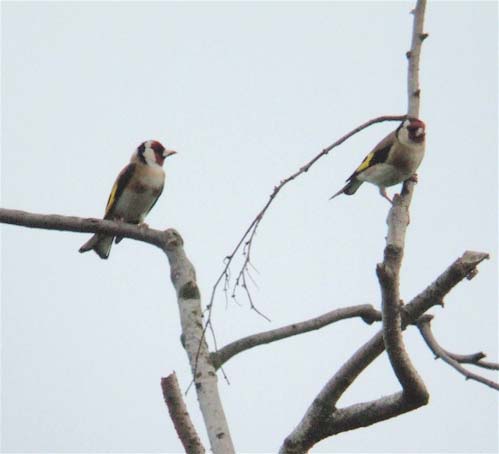





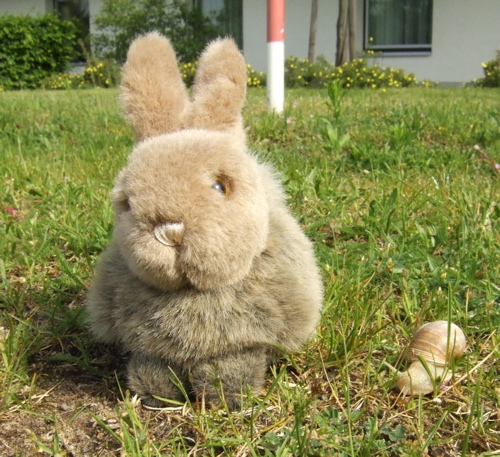
Here were some European goldfinches. This was interesting, because I periodically see these sold in pet stores in North America. It strikes me as odd that it's illegal to own North American birds as pets, but European birds are ok. Actually, according to this website, you can get some of the birds in this post (like the chaffinch and green finch) and some of the birds I saw in Kazakhstan as pets. Whoa, I just did some digging on their price list and found that one of their South American species for sale is a "yellow hood blackbird" which looks remarkably like a yellow-headed blackbird...that's not legal. And as much as I love those birds, I would not want them singing in my home on a regular basis.
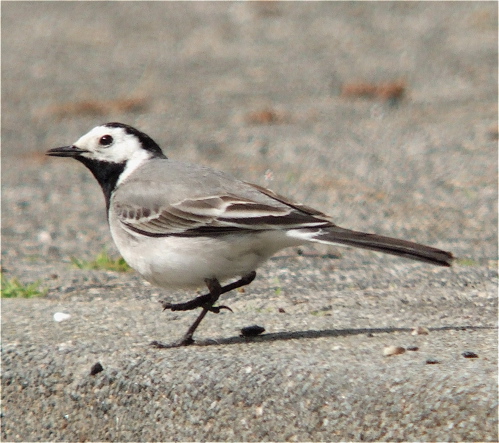
Another fun bird to see what a white wagtails. I ended up seeing several different versions of this bird throughout my travels and each one is very striking. I'm sure it's a common bird, but it's a striking one to see.
That is a sampling of the birds that jump started my Kazakhstan journey. After an afternoon of birds, I met up with some of our other travelling companions, had a meal and got a good night's sleep before board a plane for parts unknown.
Swarovski Optik Guest Blogging Contest: Finale!
 Ladies and Gentlemen, we're here to announce that the winner of the Swarovski Optik Guest Blogging Contest is...
Finca El Pilar Birding In Guatemala
Don't forget, there's still time to vote for your favorite guest blog entry!
 So, what the heck was I doing in Central America? I was part of the Fifth International Birdwatching Encounter in Guatemala. It was group that included bird guides and bloggers from Japan, Denmark, the US, and even Ecuador. One of the participants was Rick Wright of WINGS Birding Tours and I felt like I got some kind of great deal because he's a walking field guide. What a treat to have his bird knowledge along. He really is a birder's birder, we were talking popular culture and he didn't know what a Cosmo Quiz was. You want to be out in the field with a guy who has his head filled with the finer nuances of empidonax flycatchers as opposed to "What Kind Of Sexy Are You?"
 Where do I begin with my Guatemala adventure? I think with volcanoes. This was the first time I had ever been to a place so chock full of volcanoes. Let's face it, this was the first time I'd been out of the country (at least to the point where a passport was required). The whole time, I kept looking around and asking myself, "How the heck did I get here?"
Our first day of birding was at Finca El Pilar, a private shade grown coffee farm being converted into a nature reserve. We went above the coffee farm to get some of the local specialties and incredible views of the surrounding volcanoes. We birded a few days here so I'll have lots to tell you.
 Some of the volcanoes that we encountered during our visit, like Fuego are active and you can see little puffs of smoke coming off the top all day long. I digiscoped some of Fuego's smoke above. How can you not feel like you're not on an adventure if you're surrounded by active volcanoes?
 I was expecting a complete and total sensory overload when it came to the birds, but was incredibly surprised by the number of familiar faces down there, like this eastern bluebird. It had a bit of a different accent than the eastern bluebirds I hear up in Minnesota and one of the guides mentioned that it was a more local variety, down to having a duller look than the bluebirds I'm used to. Still, the first few days, their calls really tripped me up.
 When I wasn't seeing species I could see at home, I was at least seeing species similar to what I can see at home. There were all kinds of crazy looking thrushes, check out this pair of rufous-collared robins (be prepared for rufous to show up a lot in species names, whoever named the birds in Central America really liked that in their names). It's a highland thrush and looks similar to robins we see in the US.
 Another somewhat familiar bird was the black-headed siskin, here's a pair above. While the siskin irruption still rages in the US, I was still able to see some siskins at El Pilar.
 Check out this rufous-collared sparrow (there's that rufous again). It's a great looking bird, reminiscent of a white-throated sparrow. These birds were seen all over. Speaking sparrows we did see some introduced species like house sparrows and rock pigeons, but this was the first birding trip that I ever been on where I did not encounter one single starling. No starlings here...can you imagine? Ten days and not seeing a starling--crazy!
While we were doing all this birding, I at one point could have sworn I heard several bees buzzing. I looked and could not see any hives nearby. I started to wonder if elevation sickness was closing in or if my tinnitus had switched from its usual high pitched ring to buzzing. Then I noticed a small water basin and took a peak...
 There they were, a small swarm of honeybees gathering water for the hive. You sometimes can get honeybees coming to birdbaths or ponds when it's try, water is necessary for comb construction. I asked the owner of El Pilar and he said that he did not keep bees, but perhaps they were his neighbor's bees. Or they very well could have been from a wild hive. It was fun to hear that familiar buzzing.
 We found a camper while above the coffee farm and I got a giggle at the Ron Paul sticker on the back. I didn't know anyone in Guatemala would be pro Ron Paul?
And now it is time for me to head into the Park Service. More on Finca El Pilar and Guatemala later.
And don't forget to vote for your favorite guest blog entry!
Still Time To Vote
Don't forget to vote for your favorite guest blog entry that was up while I was away!
Digiscoped Images
Fresh Tweets
Would you like to hire me as a speaker for your event?
Email sharon@birdchick.com