Birdchick Blog
Birdorable Guest Blogging Contest #7: Kirk Mona
 We're just about done with the Birdorable Guest Blogging Contest. Hope you've enjoyed it as much as I have. After the final entry is posted, we'll have a poll up where you can vote for your favorite entry.
Today's entry is from Kirk Mona, and describes part of the process of identifying a bird's age when banding, something Sharon has tried to describe to me several times. Then my eyes go out of focus and I pass out. It's a strange and complicated science, but Kirk lays it out rather well. You can read more of Kirk's stuff on his blog, Twin Cities Nature Podcast.
We're just about done with the Birdorable Guest Blogging Contest. Hope you've enjoyed it as much as I have. After the final entry is posted, we'll have a poll up where you can vote for your favorite entry.
Today's entry is from Kirk Mona, and describes part of the process of identifying a bird's age when banding, something Sharon has tried to describe to me several times. Then my eyes go out of focus and I pass out. It's a strange and complicated science, but Kirk lays it out rather well. You can read more of Kirk's stuff on his blog, Twin Cities Nature Podcast.
How Old's That Thrasher?
It was a beautiful Thursday at the Lee & Rose Warner Nature Center where my co-host of the Twin Cities Naturalist Podcast, Paul and I work as naturalists. One of the fabulous things about being a naturalist is that you get to spend time outside on beautiful days. Many new migrants showed up today and the school group coming out took the Spring Birds class so that means banding! Fairly early on, the banders caught a beautiful large Brown Thrasher. What a gorgeous bird. Check out that gold eye! I usually think of thrashers as desert birds since that's usually where I see them. There are Brown Thrashers at the nature center every year but for some reason I never seem to stumble upon them. It was a thrill to see it up so close. The photo doesn't even begin to do this bird justice.
 The next photo gives you a real idea for the size of a Brown Thrasher. This particular bird had an interesting feature that can be used to age the bird. Banders need to know all kinds of tricks to figure out how old a bird is. Look carefully at the tail of the thrasher. Notice anything?
 Sometimes banders look at the condition of tail feathers, the fresher and less frayed, the newer. This tail is a little worn but that isn't the important thing to notice. There's a faint light colored band on all of the feathers about an inch or so from the tip of the tail. Can you pick it out? A variation in color on a feather is not uncommon. Sometimes there are series of bands that correspond to feathers growing at night or during the day. In the case of this thrasher though, there is only one band and it was likely caused by a change in diet while the tail feathers were growing. Most likely there was a minor deficiency in nutrients. You see this from time to time on single feathers. The key thing to note, however, is that the band appears on all of the tail feathers in the same location. For this band to appear at the same place on all of the feathers, they would have all had to form at the exact same time. Adult birds don't molt all of their tail feathers all at once or it would be very hard to fly. Unless there is some freak accident where a bird is attacked and loses all of its tail feathers, the only time all of the tail feathers grow in at once is when the bird is born. Since the band appears at the same place on all of the feathers we can tell that they all grew at the same time. Since the only time that happens is at birth, we know that these are the original tail feathers this bird grew. That tells us this is a first year bird that was born last summer.
This young male was banded and released. Hopefully he'll go on to have a long successful life. From now on, even when he gets new tail feathers, if anyone catches him again they'll know when we was born because of his band.
Birdorable Guest Blogging Contest #6: Connie Kogler
Counting down the days until Sharon gets back (two!) from the world's largest land-locked country. Haven't heard from her in the last 24 hours, but I believe this is the day she's staying in a "Soviet-style Sanatorium" (their words), so perhaps she's enjoying the facilities too much.
Today's entry comes to us from Connie Kogler of Birds O' the Morning, and involves a long hike through some love bits of Colorado.
Away Out On the Prairie
(*Of note; I could not add any info links on the Pawnee National Grasslands from the US Forest Service. Their website seems to be out of commission.)
No long and winding roads here, only long..
.. and straight. We discovered this lovely Mountain Plover while flying along a road like the one above at 55 mph. Had to stop and back up. Kind of amazing we actually spotted it. There was a second one too and both were nearly invisible.
 Horned Larks were everywhere and thankfully one stayed still long enough to get a few shots of it. Very cool little birds. Note the spiffy little horns, this dude seemed especially proud of.
 We stopped at the Crow Valley Campground, a well known hotspot for birds. And we found something cool! (Hard to do living amongst all these fantastic birders on the Front Range!) An adult female VERMILION FLYCATCHER. My first great look at this bird. I've only once before seen one, a male, and then only from a car that would not stop. We spent about 20 minutes following her around and taking pictures and even stopped back later in the afternoon on our way home to see her again. She's quite out of her range here in Colorado.. and with the storm we're having she'll wish she was back in Rick Wright's yard in AZ. A lifer for Lauren and a state bird for me.
 I believe this little guy is a 13-lined Ground Squirrel, though how it sat still long enough for anyone to count them is beyond me! So cute though.
 Heading down the trail..
 This is a bit of the face of a rock near the Pawnee Buttes. Amazing colors of lichens! I'll bet someone knows the names and types of these?
 On the way back from hiking 1.5 miles out to the west Butte the sky was amazing. I took one shot that you need a magnifying glass to verify, but it has a hawk in it! (not this one)
 Here is our first view of the Pawnee Buttes. Yes, there's two. The second one is behind the first.
 There were some crazy side canyons off of the wash we scrambled down. Not someplace to be during a flash flood!
 The second butte! See I told you..
 Lauren wondering how far we're going to have to walk back to the car.
Birdorable Guest Blogging Contest #5: Christine Kane
Just heard from Sharon and she's safe and well and about to board a plane to Almatay, Kazakhstan. She promises lots of great pictures when she gets back. But now it's time to continue the Birdorable Guest Blogging Contest with today's entry, Christine Kane of Let's Paint Nature.
In this entry from her blog, Christine lays out how to paint a White Throated Sparrow, a bird which, amazingly enough, is not entirely brown!
Let's Paint a White Throated Sparrow!
Well, I fell in love with these little suckers ever since I saw them the other day. So let’s paint them in watercolors before they’re gone…

Step 1: Start with a simple sketch in graphite. Don’t worry if every shape and line is not perfect. You aren’t obligated to stay in the lines….ever! This isn’t work, this is play.

Step 2:Here I started with a pale blue-gray wash for the belly. I added a darker blue for shadow (under his white throat patch, mid-belly, under-belly, and under his wing. Remember to keep a few highlighted spots bare, allowing the white of the paper to show through. If you do, your painting will not feel “flat” but will have a breath of life and a light feeling to it.

Step 3: While the belly was drying, I started to work on his wing. A light olive green- brown color is the foundation and a more red-brown is added on top. But remember…always keeps some white spots open! Next, I added a few stripes on his head. The color I used is a mixture of blue, green, and red. It only looks black. If you use black straight from a tube of paint, it will always look dull and flat. If you mix the colors together however, you will be surprised at how deep it looks!

Step 4:POW! Let’s add some dimension! It’s as easy as a brush stroke! In this step I added the famous yellow spot on his head. Also, a dark brown to his wing. If your edges seem too hard, while wet, take a clean brush and soften those edges with clean water.

Step 5:For the background, I wanted to represent the pine needles without going crazy on every single needle! I painted blotches of green and while wet, I took the edge of my paint brush and scraped needles into the paper. What happens next is that the green watercolor pigment seeps into the grooves making darker lines…so easy!

Step 6:I forgot one thing when painting his eye! If you do not leave a little white to represent glistening in the eye, your subject will appear dead. What can I do now that his eye is totally black already? No worries, just take an xacto blade and scrape out a little section of light! Nothing to it!

Step 7 Final:Here is the final painting. Gracing me with a visit, my white-throated friend is now forever honored in his very own watercolor painting.
I hope you enjoyed this step by step watercolor demonstration of the white throated sparrow!
Birdorable Guest Blogging Contest #4: Lili Tod McMillan
Once more into the Birdorable Guest Blogging contest! Today's entry is on a subject near and dear to the Birdchick's heart: having dead trees and brush on your property to attract birds.
The entry comes from Lili tod McMillan of the Behind the Falls Blog. Take it away, Lili!
Have you hugged a snag today?
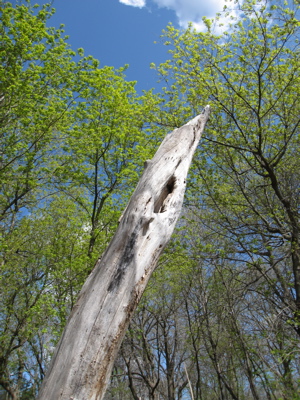
Does this image make you want to get a chainsaw or a pair of Swarovskis?
As any bird aficionado will tell you, snags such as this one, do not have to be an unattended issue in your backyard but rather a hidden magnet for all sorts of bird activity. Your neighbors might think you are being rather neglectful allowing a dead tree to stand while shedding its various parts over a long period of time but this is certainly less crazy then constructing an artificial snag.
In North America, 55 bird species are cavity nesters. Besides nesting, birds use dead trees for foraging, domain-watching, hunting and just plain hanging out without the hassles of dealing with leaves. If your dead tree or snag is strategically located, you are pretty much guaranteed a steady stream of bird visitors.
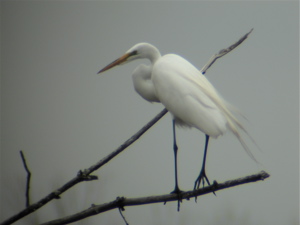
For birding humans, dead trees provide great viewing and photo opportunities.
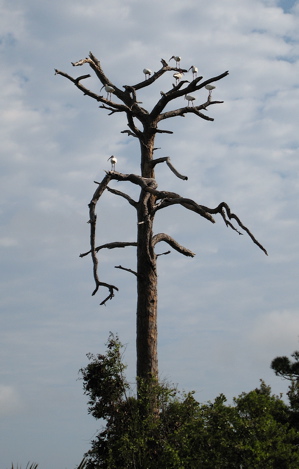
An ibis "tower" in Sebastian Florida.
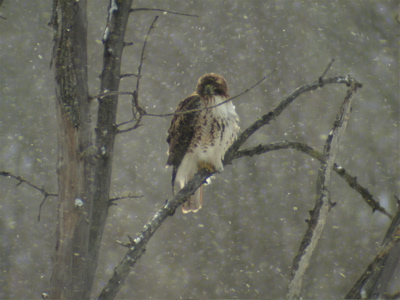
Many birds of prey, such as this red-tailed hawk, rely on the unobstructed view that a dead tree provides for finding food.
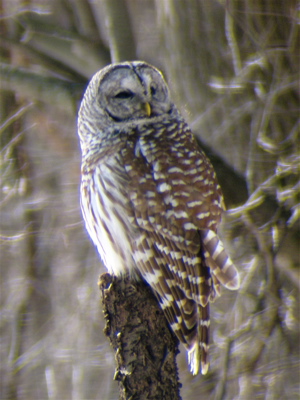
This barred owl is perched on a man-made snag of cut buckthorn. Buckthorn is an invasive small tree that is choking the understory of woodlands here in Minnesota. Creating a few of these buckthorn mini-perches is one way to make something positive out of a nuisance situation.
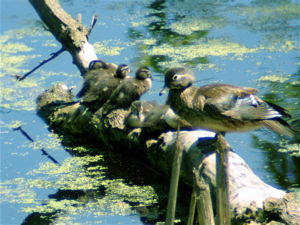
A wildlife pond is not complete without a few horizontal snags. Ducks love to rest on dead trees by the water's edge. Seeing the baby wood ducks each summer makes dragging an 100 pound snag over to the water worth all the work.
And for a non-birding use of snags, you have to give credit to Bruce Stillman who designed what I call "snaghenge".
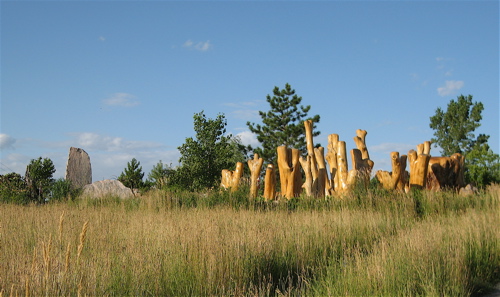
This work of art is part of the amazing Big Stone Mini Golf Course in Minnetrista, Minnesota.
Thanks for the great entry, Lili. And just because I know this is going to come up when Sharon gets home: Buckthorn is a huge problem in terms of native growth trees. Sharon recommends (and is fighting a seemingly neverending battle) against it, and her recommended solution is to try to eliminate it entirely, because it spreads like crazy.
All right, we'll be back tomorrow!
Birdorable Guest Blogging Contest #3: Craig Nash
Hello, all. NBB here again.
Sharon's off to Kazakhstan (from Frankfurt, where she could not, alas, find a frankfurter, only Viennese sausage), so it's time for our latest Birdorable guest blogging contest entry.
This one comes to us from Craig Nash of Peregrine's Bird Blog, an involves some close encounters with a very large sea bird.
Kaikoura: One of the Best Birding Experiences of my Life with Albatross Encounter
 Having left Kapiti Island we stayed in Wellington with my father's first cousin Jan for a few days before we headed to the South Island and went our seperate ways. I wanted to see Albatrosses at Kaikoura and Kea in Arthur's Pass and my father wanted to visit friends and go fishing.
I arrived in Kaikoura and stayed in the Adelphi Backpackers Lodge.I had booked to go out with Albatross Encounter about a week earlier on the internet. I got up on a beautiful morning and headed to the Encounter building. I had made sure I had taken my seasickness tablets the previous night and an hour before we were to leave. At the Encounter centre there is a really nice cafe serving excellent breakfasts and great coffee. so i had a quick coffee before our group of seven were to meet up with our guide Alastair Judkins.

Alastair drove us from the centre around a headland to where we would board the boat. Pretty much the same as Kapiti we got onto boat and it was then reversed into harbour. We made our way out to an offshore canyon which is pretty close to the shore.It is about a mile deep. It is here that two currents converge and forces nutrient rich water upwards which in turn supports a wide variety of fish and marine animals creating a wonderful feeding habitat for many different species of seabird.
The first we were to see were the Cape Pigeon or Cape Petrel.
 They have a black and white colour and were named cape pigeons because they frequent Cape Horn. They are not a pigeon but a Petrel and in NZ follow fishing boats looking for scraps.
Once we were over the canyon Alastair put a bag of frozen chum overboard and what felt like seconds birds were coming in all directions. There were Great Northern Petrels,
 Mollymawks,
 Albatrosses and as they came in Alastair was pointing them out and naming them as they came in, as I was trying to photograph them. Westland petrel, Sooty Shearwater, White Chinned Petrel,
 Buller's Shearwater,
 Hutton's Shearwater, Salvin's Mollymawk,
 Gibson's Wandering Albatross.

 The shear beauty of these very large birds cleaving the water as they bank over the waves was awe inspiring. Also the backdrop of the Kaikoura Mountains made it all the more spectacular. To me it was one of the greatest birding experiences I have ever had.
Alastair then shouted Chatham Island Mollymawk.
 This had to be the bird of the whole NZ trip for me. It is critically endangered on the IUCN red list. There are about 4500 pairs in the world and they breed on a rock called the Pyramid 800 miles to the East in the Chatham Islands. They would be a very rare visitor to New Zealand and this was only the third time in six or seven years that Alastair had seen one.It is one of the three sub species of Shy Mollymawk. It flew round the boat before coming into
 land right next to the chum.
 It really was a beautiful bird.
It then flew off not to be seen again. I then tried to take photos with my sigma 10-20mm lens with my camera body as low to the water as possible. I got a range of shots. In this one immediately below the tip of his bill is only about an inch away from the lens!!!


Then we were visited by a Black-browed Albatross of the Campbell Island Race. It is one of the most widespread albatrosses. It looks as though it is wearing eyeshadow.


The only other Mollymawk we saw was a New zealand White -capped Mollymawk. This one is immature.

Alastair then headed to show us the Spotted Shag Colony on a rock just a few hundreds from the shore when we stopped at a group of Buller's Shearwaters sitting on the water. We looked and photographed them and then he chucked the remaining chum into the water. The albatrosses and the giant petrels went into a feeding frenzy.It was a pretty noisy affair.

As a photographic experience it was second to none.It had to be one of the best mornings of my life. The next time I am in NZ I will definately go out on an earlier trip in the day to experience the early morning sunlight. I would also love to photograph the birds from an underwater perspective.
I entered this photograph, which I changed to Black and White, into the Birdforum Monthly Photo Competition (In this case the title was Monochrome Birds) and it won so I was pretty pleased with that.
Birdorable Blogging Contest #2: Dawn Frary
Hello all, NBB here. Sharon is safely in Germany just now, waiting to travel to Kazakhstan tomorrow.
Today's entry is from Dawn Frary, Volunteer Owl Feeder and Wildlife Rehabilitator, Macbride Raptor Project. You can read more of her stuff at her wildlife rehabilitation blog: For the Birds.
Best. Rehab. Ever
Tonight was perhaps the best rehab session I’ve had so far in my volunteer-career as a wildlife rehabilitator. I hadn’t rehabbed in the two weeks prior to tonight, and it felt great to get back in the flight cage and see how my feathered friends are doing. Last Monday, I didn’t go out to the raptor center because I didn’t feel well and the week before I didn’t fly either bird because they both had additional injuries that were separate from their “regular” injuries (i.e. the injuries for which they are in the flight cage in the first place). I didn’t want to agitate anything further so I let them be. It looks like letting them rest was a good idea because they both were in fine form tonight.
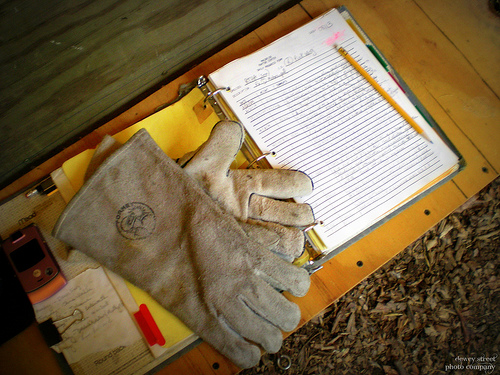 My rehab accountrements: leather falconer gloves, rehab notebook, trusty pencil.
I began with the red tailed hawk, who I fully expected to be as much of a pain in the butt as he was last time I flew him. If you will recall, I spent nearly an hour chasing him along the floor of the flight cage to no avail at all - he barely flew for me, so I put him back without completing his regimen of five perch-to-perches. Tonight was completely different. After catching him (which was the hardest part of the whole ordeal), he proceeded to give me his five perch-to-perch (P-P) flights plus an additional two P-Ps. I felt like he and I were perfectly in sync and that he understood exactly what I wanted him to do. He didn’t struggle while being held, and he didn’t put up a fight once I had caught him and was holding him. His flying mechanics have improved greatly since the last time I worked with him, and he demonstrated a vast improvement in his landings. I tried to offer him positive feedback and cheer him on while he was going through his exercises, which in my mind makes all the difference. I completed his exercises in about 30 minutes, I think, and got him back in his cage safely and soundly.
The armpit biter great horned owl was up next. Once he came down from his high perch on the wall, I caught him easily only to be bitten very hard on the left arm. It left a tiny but very painful welt. But, since I’m used to the sharp sting of his beak at this point, I got right to his wing stretches and then launched him into the air from the middle of the flight cage. His flight had improved tremendously since our last session, as well. His height, speed, glides, and landings were all those of a bird who was well on his way to being released back into the wild. After being a resident of the MRP since early winter, I’m sure he is eager to get back to the woods and tell all his friends about the mean girl who made him fly back and forth inside a big cage.
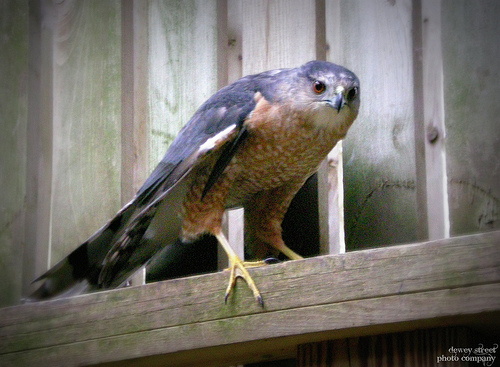
The new kid: a Cooper's hawk was brought to the flight cage this week. He is under observation only for right now.
I was so thrilled after the rehab session that I literally jumped up and down afterward. I was happy with the birds’ performances, but was also happy with myself for being what I felt was a very observant and patient rehabber. I did not allow them to intimidate me, which I do sometimes because, well, they are large wild birds who are not happy about their current living situation and the fact that people in big leather gloves come into their space, corner them, grab them by the legs, and make them do flying exercises.
Sometimes it’s also easy to forget that there is a barrier between myself and these birds, and that barrier is called WILDNESS. These birds, no matter now much I talk to them or anthropomorphosize them, are wild animals. They want nothing to do with me. When I’m holding them and looking into their eyes (from a mere six inches away) thinking about how amazing it is to be thisclose to a wild great horned owl, they are thinking, “I’d kill you right now if I could.”
It doesn’t bother me. I signed up for this so I can’t complain about the bites or the birds’ blatant animosity toward my presence in their immediate space. I am helping them, whether they know it (or like it) or not. And tonight, I felt like the three of us - me, the hawk, and the owl - were all on the same page. We danced. I led.
They’ll thank me in the end.
I made two videos from today’s session, you can view them here and here.
Thanks, Dawn. Look for another entry tomorrow!
Birdorable Guest Blogging Contest #1: Callae Frazier
NBB here. Sharon's heading off to Kazakhstan today as part of a special project for Swarovski Optik and Birdlife International, which means that it's time to begin the Birdorable Guest Blogging contest.
Our first entry is from Callae Frazier, who describes her entry as: It's an avian-related personal narrative that takes place at my childhood home in the Colorado foothills where nearly every window looks out on a bird feeder
Sky Windows
Smack! Thump.
The sound, sudden and unmistakable, resonates down the hall, through open doorways and anyone in the house familiar with it looks up, startled. Sometimes, the echo seems to move through even the walls. I’ve heard an impact resonate from the front of the ranch-style house to my back bedroom. More often I am in the kitchen, or living room, or study, all near the front of the house and closer to the most often hit windows. Windows that look out on some of the busiest bird feeders among the nearly dozen seed stations set up around the house. Clear, wide windows that birds occasionally mistake for open, wide sky.
Smack! Thump.
Dozens of species visit the area, many stay year-round. Palm-sized, chipper, ashy mountain chickadees, with their little black caps and eye stripes and chins are fairly ubiquitous. Ground-feeding juncos, all varieties, all stocky and stout, also spend most of the year pecking about the ground under feeders, in the driveway, or on the platform feeders. Bullet-shaped nuthatches, white-breasted, red-breasted, and their tiny compact cousins the pygmy’s, “yank, yank, yank” their arrival at the feeder. House finches, goldfinches, pine siskens sing their melodious, waterfall-garbled song from high atop trees before swooping down and joining the others. Orangy-red male and yellow female crossbills pass through occasionally, their high-pitched, “kip-kip-kip” calls foreshadowing their arrival. They sit upright on the hanging feeders, and I must check, and double-check their oddly formed bills every time, marveling at how the upper mandible literally crosses over the lower one. Winter flocks of hand-sized, yellow-bellied, thick-billed evening grosbeaks provide a bright spot of color against a snow and dark pine backdrop. Still larger birds visit as well. Mohawked, Stellar’s jays bully juncos from the driveway, and chickadees from the platform feeders with their large bodies, and raucous calls. We know summer has arrived when the quiet mourning doves arrive in the drive, delicately pecking seeds. The surrounding diverse sliver of habitat in a life zone typically reserved for lodgepole pine entices the birds. And the birds entice me.
My mom tells the story of how, even when I was a little girl I loved to sit in the elevated, recessed, bench next to the entryway and watch birds for hours out the bay window. We call the space our “window box” on account of its boxy, rectangular shape. The window looks out on a wide, multi-level wrap around deck and I look out at birds on the platform feeder attached to the deck railing. When young, I asked for the names of birds all the time. Mom knew them all, and by the time I started first grade I knew my colors, letters and numbers along with the names for chickadee, nuthatch, jay and junco. I knew that chickadees’ nasaly call sounded like their name, “chick-a-dee-dee-dee.” My parents adopted the chickadee’s clear two-note, descending minor-third whistle, “fee-bee”, as a way to find each other in a busy space, or to get each other’s attention. Of all the multitudes of books in the house, The Golden Guide to Birds was one I could always find on the full shelves. Before I could write, I made up stories, sitting there in the window. Mom listened, and committed my words to paper. Sealed in envelopes, my words flew thousands of miles away to my Grandparents in a silver-winged bird.
Thwap!
A flutter of anticipation begins when the sound reverberates down the hall. Approaching the window box, I search out the only sign of trauma - a bit of feathers stuck to the glass. Pressing my face to the smooth, cool surface of the window sometimes allows me to see the tiny, feathered thing on the deck below. The dogs, curious, will hop up the bench with me. Their warm breath fogs up my view. I’ve learned to leave them inside when I investigate. They sometimes mouth stunned birds and inadvertently finish off the job. I hold them at the front door with my knees, and slip out between jostling bodies and lolling tongues. There, on the brown deck, I most often find a grey chickadee or dark-headed junco lying spread-legged, wings outstretched. Larger grosbeaks and deep blue, black-crowned jays are other common casualties of our windows.
Surprisingly, for the number of windows in the house (over 40), and the number of birds who have found our land an invaluable food source over the years (hundreds), remarkably few have perished. After smacking into the windows they fall to the ground more often only stunned. I gently scoop up the lightweight bundles, cupping their small warmth in my hand. They breathe so fast. Little chests heaving up and down. Heavily lidded eyes, glazed with shock, do not acknowledge me. Their heartbeat pounds furiously into my palm. It is as though they go into a kind of coma, their brain and neurons checking and rechecking the stunned body. I like to believe my hands provide them shelter and warmth. A miniature recovery room. A little patience, careful watching, and suddenly the “on” switch clicks. Small glassy eyes brighten, drooping wings straighten, an alert head rises, cocks, looks about. I hardly exhale then, waiting to see how long they will stay.
The stunned birds never fly far. Sometimes they make it to the wide, flat bird feeder attached to the railing. Maybe they rest there a while. Often they dip into the plethora of seeds at their feet. Within moments they fight off other feeders come to the feast. I stand mere feet away, and trace the invisible impression of wing strokes crossing delicately across my palm. Sometimes I can find small pinprick depressions where their claws pressed down.
Thwack!
I know right away if the window-smacked birds are dead. There is something unmistakable about a dead thing. The way the neck bends loosely, the closed eyes, sometimes a drop of blood at the base of the delicate, grey beak. The stillness.
When I was very young my parents helped me bury birds knocked off by windows. We dug a shallow grave out in small area west of the garden. A place that today holds bones of several well-loved pets. I probably covered the little mound with a rock. Felt perhaps a little sad. But I also found the streamlined shape, soft feathers, and the delicate lightness of the little body fascinating. A dead bird gave me a chance to see the normally fluttery critters up close.
Later, feeling silly for making bird graves, I walked some distance into the woods, and tossed them into a bush. Something would find and eat them. Maybe a crow or fox. Hopefully not our indoor/outdoor cat who had a habit of bringing dead things into the house, leaving them as surprising gifts on beds, or by doors. I might also take the dead birds and deposit them deep in the compost pile where they would slowly decompose, adding their nutrients to the existing combination of vegetable parts, egg shells, coffee grounds, plant trimmings, and hay. Yes, I know you aren’t supposed to include meat in your compost, but when I was young I hardly considered the small flesh of birds an inappropriate addition to the compost.
In late August, when I made my regular round of plucking fresh snacks in the low, golden light of the autumn garden, I wouldn’t remember the birds I buried in the compost a year or two before. But they’d be there.
There, in the squat carrots I’d wrest from the soil, barely wiping the soil free on my jeans before chomping down the crisp earthy sweetness. Or there, in the round burst of sugar peas on my tongue as I popped them into my mouth one, by one. Pop, pop, pop. Their presence would be found in the meaty muscle of turnips and potatoes dug out of the soil with my bare hands. The invisible bits of birds who once mistook a clear wide window for clear open sky.
Contest & Another Birds and Beers
Don't forget that there's still time to enter the Birdorable Guest Blogging Contest. Get those blog entries in soon. Hey! We're having our May Birds and Beers at Coon Rapids Dam this Thursday, May 7, 2009. The bonus, Mark Newstrom is going to set up his nets to see if we get any birds. Sure it will be evening, but it's migration, so anything is possible. For the start, my buddy Michelle Anderson (and the hottest naturalist in the Twin Cities) will give us a list of coming programs and then we can talk, bird and have a beverage--alcohol is allowed in this park if you would like to bring your own. We'll start at 6pm.
Birds and Beers is usually an informal gathering at a pub for birders of all abilities to get together, have a beverage, and talk some birds. However, we had so much fun at the tailgating birds and beers, we thought we would do some more outdoors to add in a little informal birding.
Birdorable Guest Blogging Contest
 I'm going to be heading to Kazakhstan in a couple of weeks and similar to when I was in Guatemala, I'm not sure of what my Internet access situation will be. Since the last guest blogging contest was such a success (I got way more entries than I anticipated) I thought I would do it again. And like last time, one of my favorite vednors is sponsoring the contest.
I bring you the Birdorable Guest Blogging Contest–you could be a writer for my blog! If you already have a blog and would like to get a larger readership, this is an opportunity to show off your content to my readers. If you’re not sure you can do a blog but have an adventure to share, I have a great audience willing to read it.
I'm going to be heading to Kazakhstan in a couple of weeks and similar to when I was in Guatemala, I'm not sure of what my Internet access situation will be. Since the last guest blogging contest was such a success (I got way more entries than I anticipated) I thought I would do it again. And like last time, one of my favorite vednors is sponsoring the contest.
I bring you the Birdorable Guest Blogging Contest–you could be a writer for my blog! If you already have a blog and would like to get a larger readership, this is an opportunity to show off your content to my readers. If you’re not sure you can do a blog but have an adventure to share, I have a great audience willing to read it.
You can submit a blog entry for my blog. Non Birding Bill and I will read through them and select 10 entries that we feel fit the theme of my blog and well, just ones that we find interesting. We will post one blog entry a day while I’m gone (it will be ten days starting on May 8, 2009). If your blog entry is one of the ten published, you win (from one of my favorite bird designers, Birdorable):
 One of my favorites: the Tough Titmice Magnet. After the ten entries are up, readers can vote for their favorite finalist, and the blog entry with the most votes wins:

a Birdorable Spotting Scope shirt! The shirt shows a red-cockaded woodpecker perched on the scope, but they said the winner can choose the bird species. So, if you would prefer something like a Cooper's hawk, cardinal, or shag, they've got you covered.
Do check out Birdorable's line of product--they've got some cool stuff (excellent ideas for Mother's Day or birthdays).
Rules:
1. ANYONE CAN ENTER: If you already have a blog you can enter. If you have never blogged at all, you can still enter. If you do already have a blog and your entry gets selected, I will link back to your site with your entry.
2. BLOG ENTRY MUST FIT THEME OF THIS BLOG: I’m not going to say that you have to write about wild birds for the contest, but do keep in mind what the themes for my blog are - mostly wild bird related (watching, feeding, rehabbing, banding) with some pet rabbits, other wildlife, and honey bees. NBB and I will choose blog entries that are not only great, but fit in the overall theme of this blog. Our decision is final.
3. Content must be emailed to birdchick at gmail dot com by May 7th at 5 p.m. CST. It can include text, photos (web appropriate size) and links to videos. We may not proof read so if you your entry has typos, chances are good it’ll go up that way. Make it look good before we get it. You, obviously, agree to let us post your material in the blog by sending it to us.
4. The email entry with your blog submission MUST include your full name and mailing address. These will not be published in the blog entry, but we need them for the prizes. Also, be sure to include how you would like to be credited in the blog entry. Do you prefer that we put up your actual name or your user name and a link to your website.
5. Content must be original–your own content that you wrote. If you have a blog and you want to recycle and old blog entry from your own blog, that is your choice. If it is discovered that you use someone else’s content without credit or pass off someone else’s photos as your own, not only will you be disqualified, but it will be blogged. One entry per person.
6. If you submitted an entry for the last contest and it didn't get selected, you are welcome to submit the same entry. If you entered the previous contest and you were a finalist, you ARE eligible to submit a new entry. There are no guarantees.
7. Shameless pandering for people to vote for your entry will be deleted if it gets selected, so just don't start.
Finca El Pilar Birding In Guatemala
Don't forget, there's still time to vote for your favorite guest blog entry!
 So, what the heck was I doing in Central America? I was part of the Fifth International Birdwatching Encounter in Guatemala. It was group that included bird guides and bloggers from Japan, Denmark, the US, and even Ecuador. One of the participants was Rick Wright of WINGS Birding Tours and I felt like I got some kind of great deal because he's a walking field guide. What a treat to have his bird knowledge along. He really is a birder's birder, we were talking popular culture and he didn't know what a Cosmo Quiz was. You want to be out in the field with a guy who has his head filled with the finer nuances of empidonax flycatchers as opposed to "What Kind Of Sexy Are You?"
 Where do I begin with my Guatemala adventure? I think with volcanoes. This was the first time I had ever been to a place so chock full of volcanoes. Let's face it, this was the first time I'd been out of the country (at least to the point where a passport was required). The whole time, I kept looking around and asking myself, "How the heck did I get here?"
Our first day of birding was at Finca El Pilar, a private shade grown coffee farm being converted into a nature reserve. We went above the coffee farm to get some of the local specialties and incredible views of the surrounding volcanoes. We birded a few days here so I'll have lots to tell you.
 Some of the volcanoes that we encountered during our visit, like Fuego are active and you can see little puffs of smoke coming off the top all day long. I digiscoped some of Fuego's smoke above. How can you not feel like you're not on an adventure if you're surrounded by active volcanoes?
 I was expecting a complete and total sensory overload when it came to the birds, but was incredibly surprised by the number of familiar faces down there, like this eastern bluebird. It had a bit of a different accent than the eastern bluebirds I hear up in Minnesota and one of the guides mentioned that it was a more local variety, down to having a duller look than the bluebirds I'm used to. Still, the first few days, their calls really tripped me up.
 When I wasn't seeing species I could see at home, I was at least seeing species similar to what I can see at home. There were all kinds of crazy looking thrushes, check out this pair of rufous-collared robins (be prepared for rufous to show up a lot in species names, whoever named the birds in Central America really liked that in their names). It's a highland thrush and looks similar to robins we see in the US.
 Another somewhat familiar bird was the black-headed siskin, here's a pair above. While the siskin irruption still rages in the US, I was still able to see some siskins at El Pilar.
 Check out this rufous-collared sparrow (there's that rufous again). It's a great looking bird, reminiscent of a white-throated sparrow. These birds were seen all over. Speaking sparrows we did see some introduced species like house sparrows and rock pigeons, but this was the first birding trip that I ever been on where I did not encounter one single starling. No starlings here...can you imagine? Ten days and not seeing a starling--crazy!
While we were doing all this birding, I at one point could have sworn I heard several bees buzzing. I looked and could not see any hives nearby. I started to wonder if elevation sickness was closing in or if my tinnitus had switched from its usual high pitched ring to buzzing. Then I noticed a small water basin and took a peak...
 There they were, a small swarm of honeybees gathering water for the hive. You sometimes can get honeybees coming to birdbaths or ponds when it's try, water is necessary for comb construction. I asked the owner of El Pilar and he said that he did not keep bees, but perhaps they were his neighbor's bees. Or they very well could have been from a wild hive. It was fun to hear that familiar buzzing.
 We found a camper while above the coffee farm and I got a giggle at the Ron Paul sticker on the back. I didn't know anyone in Guatemala would be pro Ron Paul?
And now it is time for me to head into the Park Service. More on Finca El Pilar and Guatemala later.
And don't forget to vote for your favorite guest blog entry!
Digiscoped Images
Fresh Tweets
Would you like to hire me as a speaker for your event?
Email sharon@birdchick.com